

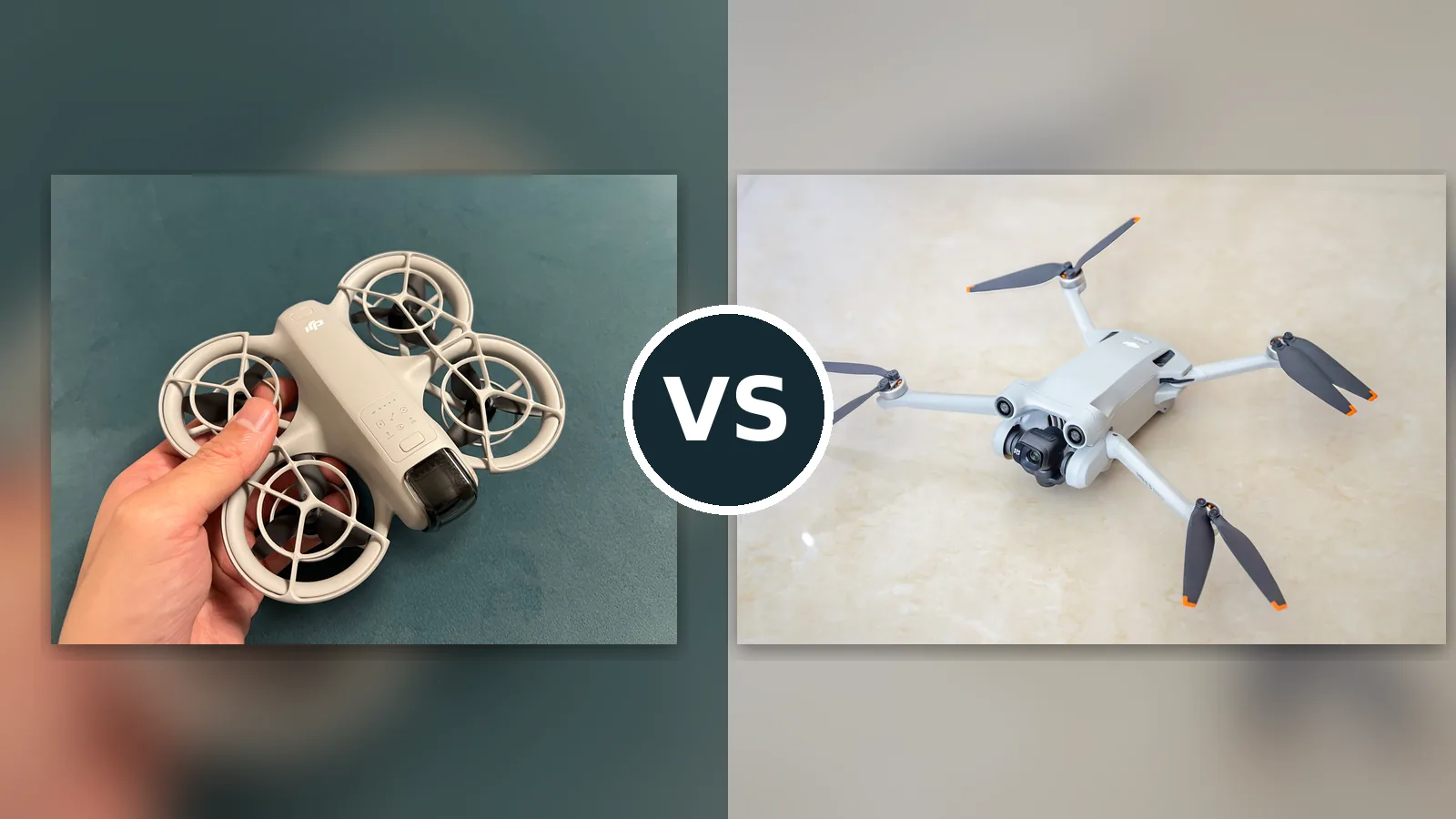
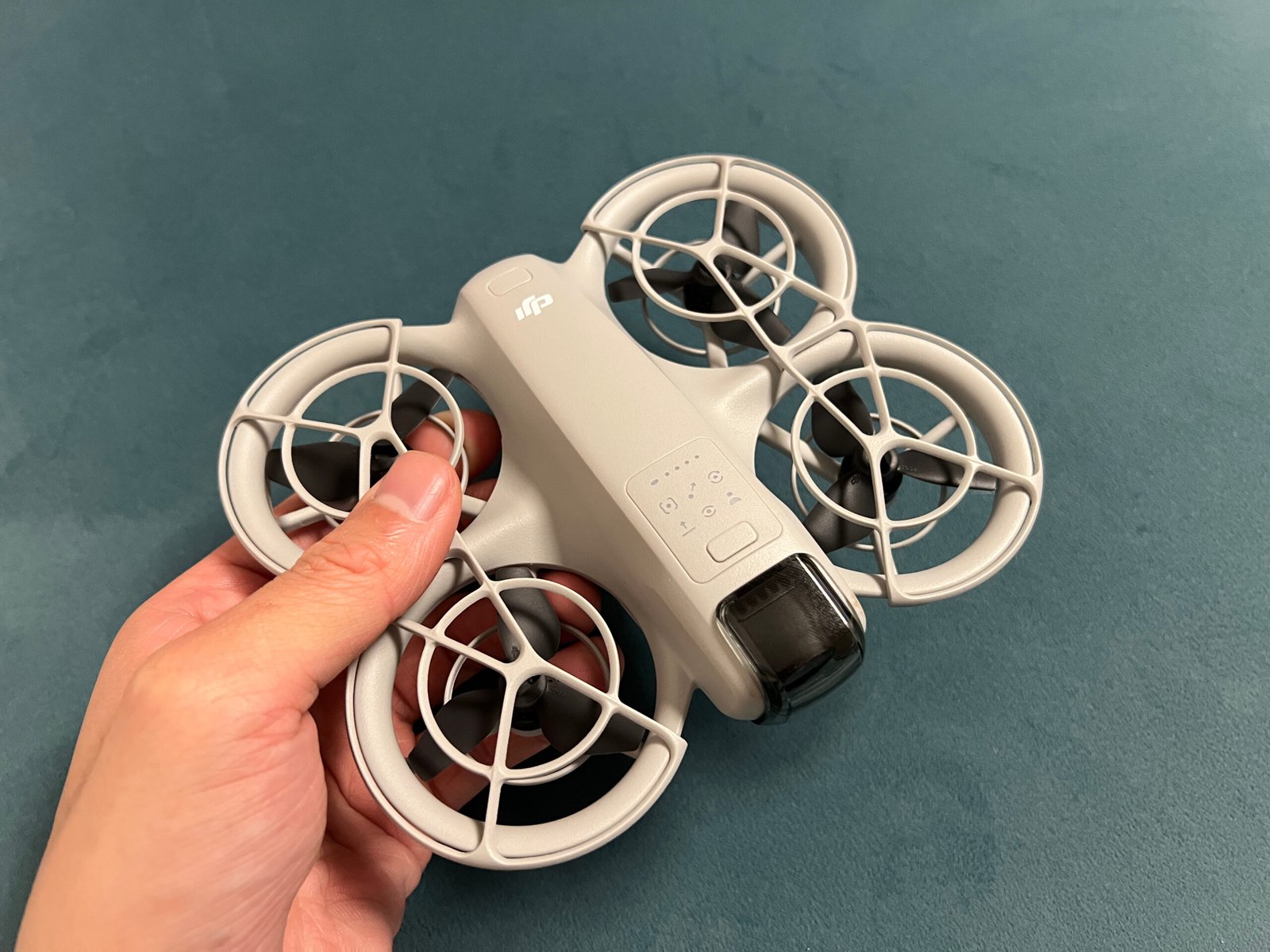
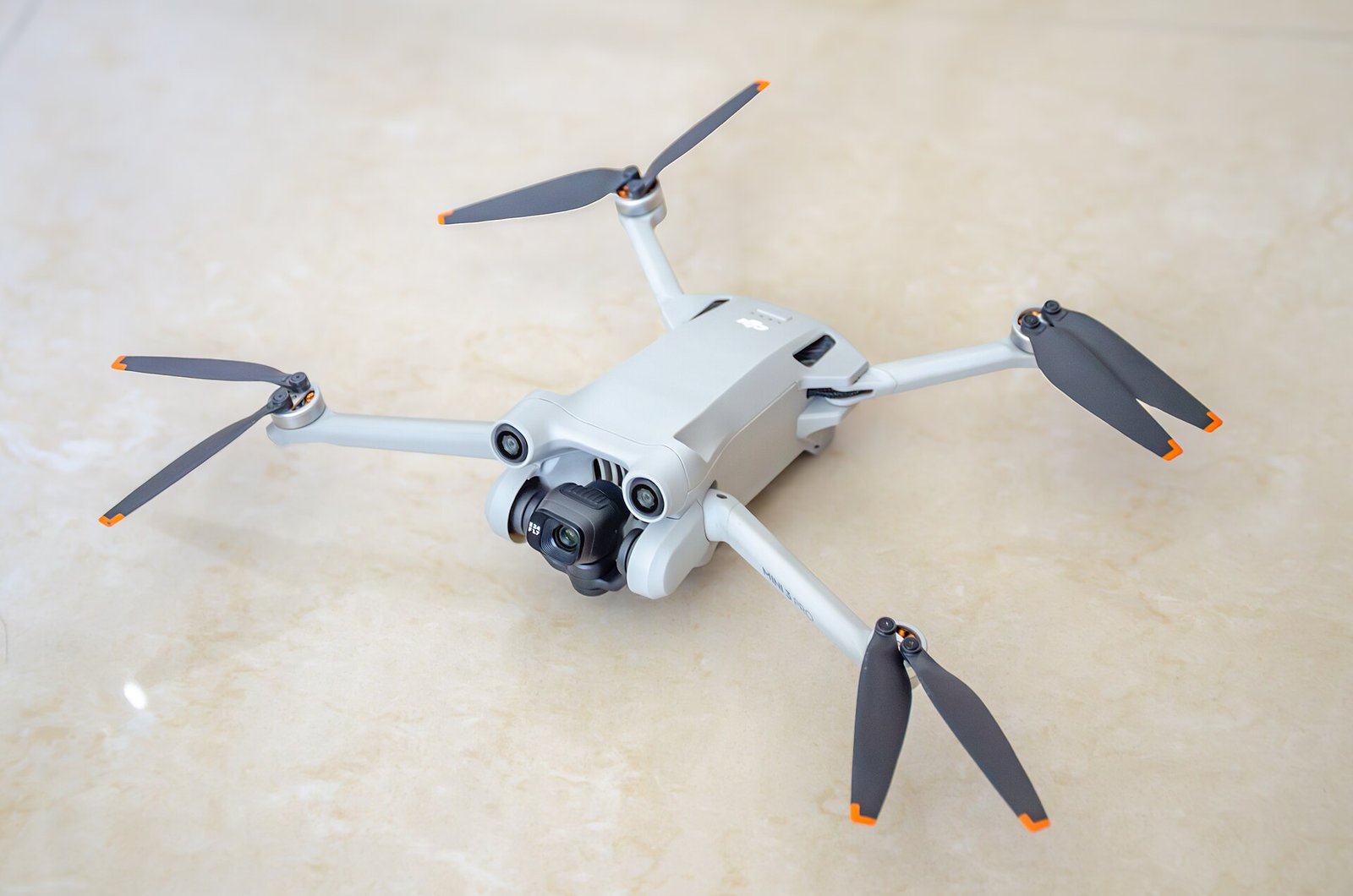
The dji neo vs dji mini 3 pro question looks simple at first glance because both drones sit under 249 grams and both carry a DJI badge. Spend five minutes with the details and the similarity falls apart. The DJI Neo is a 135 gram palm drone with integrated propeller guards that can lift off from your hand, follow you with AI subject tracking, and land again without you ever touching a controller. The DJI Mini 3 Pro is a foldable camera drone built for serious content work, with a larger 1/1.3 inch sensor, 4K/60 video, tri-directional obstacle sensing, and up to 34 minutes of flight on its standard battery. One removes almost every step between you and a quick selfie clip. The other gives a solo creator a proper camera, proper sensing, and proper range in a travel friendly package. This comparison works through the cameras, the controls, the safety systems, and the everyday compromises, so you can choose based on the job you actually need done, not just the weight class you happen to be shopping in.
Affiliate disclosure: As an Amazon Associate I earn from qualifying purchases. This page contains affiliate links. If you buy through them, we may earn a commission.
Neo for effortless moments. Mini 3 Pro for serious footage.
DJI Neo is the pick if you want the fastest route to a clip of yourself: palm takeoff and landing, flight with no controller at all, integrated guards, AI tracking, and QuickShots in a 135 gram body you can carry without thinking about it. DJI Mini 3 Pro is the pick if image quality and control matter most: a 48MP camera with a larger sensor, 4K/60 and HDR video, a 3-axis gimbal, obstacle sensing in three directions, and far longer flight time and range. Camera ceiling: Mini 3 Pro by a wide margin. Ease of use: Neo, and it is not close. Choose the drone that matches your intent, because these two solve different problems.
DJI Neo
For palm launched clips, solo social video, and flying with no controller at all
- Palm takeoff and landing with voice or app control, so a controller is optional rather than required
- Integrated propeller guards, AI subject tracking, and QuickShots for quick, repeatable solo shots
- Single-axis gimbal, no obstacle sensing, and 22 GB of fixed internal storage with no card slot
Check current availability and bundle options on Amazon
DJI Mini 3 Pro
For creators who want a larger sensor, real sensing, and long range under 249 grams
- 4K/60 and HDR video, 10-bit D-Cinelike color, DNG stills, and true vertical shooting
- 3-axis gimbal, tri-directional obstacle sensing with APAS 4.0, and FocusTrack with ActiveTrack 4.0
- Needs a controller and a more deliberate setup, with microSD storage and no internal storage
Check current availability and bundle options on Amazon
DJI Neo vs DJI Mini 3 Pro: Two Ways to Stay Under 249 Grams
Both drones duck under the 249 gram line that matters in many regions, but they earn that number in opposite ways. The Neo stays light by being tiny and simple. The Mini 3 Pro stays light by being carefully engineered for serious work.
Start with the Neo day. You are on a walk, a ride, or a family outing. The drone sits in a pocket. You hold it in your palm, it takes off, it follows you or runs a QuickShot, and it comes back to your hand. There is no unfolding, no pairing ritual, and no controller to carry if you do not want one, because voice and app control handle the basics and a controller only enters the picture when you want more range and speed. The integrated guards make close, casual flying feel less precious, especially around people and indoors where a bare propeller drone feels nervous. The footage you get is honest 4K/30 video from a 1/2 inch sensor, stabilized electronically because the gimbal moves on a single axis. For a clip that will be watched on a phone, posted the same afternoon, and judged on the moment rather than the file, that is often enough, and the fact that you captured it at all is the whole point.
Now picture the Mini 3 Pro day. You planned the shoot. The drone unfolds, the controller comes out, and you fly out with O3 transmission rated to 12 km under FCC rules, checking a composition on a proper 3-axis stabilized view. The larger sensor gathers more light, the 48MP stills give you real photographs as well as video, and the camera records 4K/60 for smooth motion, 4K/30 HDR for tricky contrast, and Full HD at 120fps when you want slow motion. Obstacle sensing watches forward, backward, and down, and APAS 4.0 helps the drone route around trouble rather than simply stopping. You stay up for a rated 34 minutes on the standard battery, or 47 minutes with the Plus battery, which changes how relaxed a session feels. This is a creator tool that happens to be small, not a toy that happens to shoot video.
If you are also weighing the standard Mini 3 against the Neo, our DJI Neo vs DJI Mini 3 comparison breaks down that closer, non Pro matchup in detail. The short version of the pattern is the same here: the Neo wins every contest about speed of use, and the Mini line wins every contest about the camera and the flying system behind it. Your job as a buyer is to be honest about which brief sounds like your weekends and your work.
Choose DJI Neo if…
- Effortlessness is the priority: you want palm takeoff, palm landing, and usable clips with no controller in your bag.
- You mostly film yourself at close range for social platforms and value guards, tracking, and QuickShots over file quality.
- You want the lightest option here at 135 grams, with 22 GB of internal storage and nothing extra to buy to start.
- You can accept 4K/30 only, a single-axis gimbal, no obstacle sensing, and an 18 minute rated flight time.
Choose DJI Mini 3 Pro if…
- Image quality is the priority: you want the larger 1/1.3 inch sensor, 48MP stills, DNG files, and 10-bit color.
- You shoot planned content, travel footage, or client facing work that needs 4K/60, HDR, slow motion, and true vertical capture.
- You value sensing, a 3-axis gimbal, O3 range, and 34 to 47 minutes of rated flight time for relaxed sessions.
- You can accept a more deliberate setup with a controller, folding arms, and microSD cards to manage.
The Spec Sheet, Line by Line
Read the rows in groups. The camera rows and the sensing rows belong to the Mini 3 Pro. The weight, guards, and control rows belong to the Neo. Flight time and range sit somewhere in between, and the table shows exactly where.
| Feature | DJI Neo | DJI Mini 3 Pro |
|---|---|---|
| Best suited to | Palm launched selfie video, close range tracking, and casual solo clips with minimal setup | Planned creator work, travel footage, and serious stills and video under 249 grams |
| Takeoff weight | 135 g | Under 249 g with the standard battery |
| Dimensions and design | 130 x 157 x 48.5 mm; fixed body with integrated propeller guards | Foldable design for travel; folded dimensions not listed in the verified set for this comparison |
| Sensor and lens | 1/2 inch CMOS, 12MP; 14mm, f/2.8 lens | 1/1.3 inch CMOS, 48MP; 24mm, f/1.7 lens |
| Video modes | 4K/30 video | 4K/60 video, 4K/30 HDR, and Full HD 120fps slow motion |
| Color and stills formats | Standard recording from a 12MP camera; no 10-bit profile listed in the verified set | 10-bit D-Cinelike color; JPEG plus DNG stills |
| Vertical capture | No true vertical mode listed in the verified set; framed for standard video | True vertical shooting for social formats without cropping the sensor view |
| Gimbal and stabilization | Single-axis gimbal with RockSteady electronic stabilization | 3-axis gimbal for mechanical stabilization on all axes |
| Obstacle sensing | Downward positioning only; no obstacle sensing | Tri-directional obstacle sensing covering front, back, and down, with APAS 4.0 |
| Subject tracking | AI subject tracking and QuickShots | FocusTrack suite including ActiveTrack 4.0 |
| Rated flight time | 18 minutes maximum | 34 minutes with the standard battery; 47 minutes with the Plus battery |
| Measured flight time | Not tested by us | Not tested by us |
| Max speed | 16 m/s in Sport mode with a controller | 16 m/s maximum |
| Transmission and range | O4 transmission up to 10 km with a controller; about 50 m range over Wi-Fi phone control | O3 transmission, 12 km under FCC rules |
| Storage | 22 GB internal storage; no memory card slot | microSD storage only; no internal storage |
| Wind resistance | Level 4, rated to 8 m/s | Level 5 |
| Control options | Palm takeoff and landing; can fly with no controller at all using voice or app control; controller optional | Conventional controller based flying as a foldable camera drone |
| Main trade-off | Maximum simplicity, but a smaller camera ceiling, no sensing, and short flight time | Maximum capability under 249 grams, but more setup, more kit, and more to learn |
Manufacturer flight times are best case lab figures, and real flights come in shorter, especially in wind or with aggressive flying. Measured flight time is listed as not tested because this is a research based comparison; see the methodology section for how the figures above were verified.
Five Differences That Decide the DJI Neo vs DJI Mini 3 Pro Choice
Specs tell you what each drone can do. These five differences tell you what each drone feels like to own, week after week, and which compromises will actually reach you.
1. Camera quality: a selfie camera vs a creator camera
Edge: Mini 3 ProThe sensor gap drives everything else in this section. The Mini 3 Pro uses a 1/1.3 inch CMOS sensor with 48MP stills and a bright 24mm f/1.7 lens. The Neo uses a 1/2 inch CMOS sensor with 12MP stills and a 14mm f/2.8 lens. In plain terms, the Mini 3 Pro collects more light through a faster lens onto a larger surface, and it shows in cleaner shadows, more forgiving highlights, and footage that holds up when you crop, grade, or play it on a television rather than a phone. Its video menu proves the point: 4K/60 for smooth action, 4K/30 HDR for high contrast scenes, and Full HD 120fps for slow motion. Add 10-bit D-Cinelike color for grading headroom and JPEG plus DNG stills for anyone who edits photographs properly, and you have a genuine imaging tool.
The Neo camera is simpler by design. It records 4K/30 video, and its single-axis gimbal works with RockSteady electronic stabilization to keep that video watchable. For its intended job, following you at close range in decent light and producing a tidy clip for social sharing, it does the work without drama. What it cannot do is pretend to be the Mini 3 Pro when the light drops, when you want slow motion, when you want a flat profile to grade, or when a still photograph matters as much as the video. The wider 14mm view also frames scenes differently, pulling in more of the surroundings at close range, which suits selfie style shooting and flatters the Neo approach. Judge this row by your screen and your standards: phone first creators can live happily with the Neo file, while anyone building a portfolio, a channel, or paid work will feel the Mini 3 Pro gap on the first edit.
2. How you fly: no controller vs proper control
Edge: Neo for ease, Mini 3 Pro for controlThe Neo rewrites the start of a flight. Palm takeoff and landing are not gimmicks here, they are the core interface, backed by voice control and app control so the drone can fly with no controller at all. You choose a mode, let AI subject tracking or a QuickShot do the framing, and stay in the scene yourself instead of staring at sticks. That matters for solo creators more than any spec admits, because the hardest shot for a lone operator is always the one where you are both pilot and subject. The Neo removes that conflict. Its limits appear when you want reach: over Wi-Fi phone control the range is about 50 m, and you only unlock O4 transmission up to 10 km and the full 16 m/s Sport speed when you add a controller.
The Mini 3 Pro asks for a conventional setup and rewards it. You fly it as a camera, positioning it deliberately, working a scene from several angles, and leaning on FocusTrack and ActiveTrack 4.0 when you want assisted framing rather than total automation. It is a different pleasure: less magic, more authorship. Beginners should not fear it, because the sensing and the stable 3-axis view make it forgiving to learn on, but nobody should buy it expecting it to live in a coat pocket and launch from a hand in seconds. One drone is an appliance. The other is an instrument. Both descriptions are compliments when they match the buyer.
3. Sensing and confidence: guards vs electronic awareness
Edge: Mini 3 ProThese drones protect themselves in opposite ways. The Neo relies on physical protection and low mass. Integrated propeller guards ring the props, the body weighs just 135 grams, and downward positioning is its only positioning help, because DJI lists no obstacle sensing for it at all. Fly it into a branch, a wall, or a piece of furniture and nothing electronic will save it. The guards and the light weight soften many of those meetings, which is why the design suits close, slow, casual flying, but a new owner should hear the limit clearly: awareness is entirely your job, even when the tracking is doing the framing.
The Mini 3 Pro relies on seeing. Tri-directional obstacle sensing covers front, back, and down, and APAS 4.0 uses that information to help the drone navigate around obstacles rather than simply hovering and waiting. No sensing system makes a drone crash proof, and thin branches, wires, and poor light still demand a careful pilot. Still, for flying in treed parks, near buildings, or in any place where a moment of inattention has consequences, the Mini 3 Pro carries a real safety net and the Neo carries none. Its Level 5 wind resistance also beats the Neo at Level 4 and 8 m/s, so the bigger drone stays composed on days when the little one should sensibly stay in your pocket.
4. Flight time, speed, and range: staying power vs staying close
Edge: Mini 3 ProOn paper the top speeds tie at 16 m/s, with the Neo reaching that figure in Sport mode with a controller. Almost every other endurance number separates them. The Neo is rated for 18 minutes per flight. The Mini 3 Pro is rated for 34 minutes with the standard battery and 47 minutes with the Plus battery. That is not a small gap you can shrug off with a spare battery, although spares help both drones. It changes the shape of a session: the Mini 3 Pro pilot can scout a location, try compositions, wait for light, and still come home with margin, while the Neo pilot works in short, purposeful bursts, which suits its quick clip mission and frustrates anyone trying to explore.
Range widens the same way. With a controller, the Neo O4 system reaches up to 10 km, a strong figure that many owners will rarely use because phone control limits them to about 50 m in the configuration they actually carry. The Mini 3 Pro O3 system is rated to 12 km under FCC rules, and it arrives in the configuration you fly every time, controller in hand. Storage cuts the other way in an interesting fashion: the Neo includes 22 GB internally, so it is ready the moment you open the box, but with no card slot that ceiling is fixed. The Mini 3 Pro includes no internal storage and depends on microSD, which sounds like a chore until a long trip makes swappable cards feel like freedom.
5. Portability and the complete kit: pocket vs planned
Edge: NeoThe Neo measures 130 x 157 x 48.5 mm and weighs 135 grams, guards included, ready to fly as it sits. There is nothing to unfold and, in its simplest form, nothing else to pack. That readiness is a feature no spec table captures well, because a drone that is already with you gets used on ordinary days, and ordinary days are where most personal footage lives. A walk becomes a clip. A ride becomes a tracked sequence. A family afternoon gets one aerial moment without turning into a production. The Mini 3 Pro folds, which keeps it genuinely travel friendly for a camera drone of its capability, but its kit still means a controller, batteries, and cards, and its flights start as a decision rather than an impulse.
Think about total ownership honestly. Neo owners should plan for spare batteries sooner than they expect, because 18 minute flights vanish quickly, and they should build a routine for moving footage off the fixed 22 GB of storage. Mini 3 Pro owners should plan for microSD cards from day one, because there is no internal fallback, and they should think about which battery story they want, since the standard battery keeps the drone under 249 grams while the Plus battery extends flight to a rated 47 minutes. Neither kit is difficult. One is simply lighter in every sense, and for many buyers that lightness, more than any camera row, will decide how often the drone leaves the house.
What You Gain, What You Give Up
DJI Neo
Reasons to choose it
- Flies with no controller at all, using palm takeoff and landing plus voice or app control
- Integrated propeller guards and a 135 gram body built for close, casual, low stress flying
- AI subject tracking and QuickShots that frame solo shots automatically
- 22 GB of internal storage included, with O4 range up to 10 km when you add a controller
Reasons to reconsider
- 4K/30 video only, a single-axis gimbal, and a smaller 1/2 inch sensor limit the file quality
- No obstacle sensing at all, 18 minute rated flights, and Level 4 wind resistance
- Fixed storage with no card slot, and only about 50 m of range on Wi-Fi phone control
DJI Mini 3 Pro
Reasons to choose it
- Larger 1/1.3 inch 48MP sensor, f/1.7 lens, 4K/60 and HDR video, and 10-bit D-Cinelike color
- 3-axis gimbal, tri-directional sensing with APAS 4.0, and FocusTrack with ActiveTrack 4.0
- 34 minutes rated on the standard battery, 47 minutes with the Plus battery, and O3 range to 12 km FCC
- True vertical shooting, DNG stills, and slow motion at Full HD 120fps
Reasons to reconsider
- Requires a controller based setup, so spontaneous palm launched clips are not its game
- No internal storage, so microSD cards are a day one necessity rather than an option
- More to learn and more kit to carry than the Neo, despite the foldable design
Batteries, Cards, and Controllers: Check the Bundle Twice
These drones punish assumptions in opposite directions. The Neo can look complete when its range is still limited by how you control it, and the Mini 3 Pro can look ready when it still needs a card before its first flight.
- Control setup, Neo: The drone alone flies by palm, voice, and app, but Wi-Fi phone control reaches only about 50 m. If you want O4 range up to 10 km and full Sport speed, confirm a compatible controller is in your plan.
- Batteries, both drones: Rated times are 18 minutes for the Neo and 34 minutes for the Mini 3 Pro on its standard battery, with 47 minutes for the Plus battery. Real flights are shorter, so budget for at least one spare for regular use.
- Weight and the Plus battery: The Mini 3 Pro figure of under 249 grams applies with the standard battery. Check your local rules before assuming the same status with the Plus battery fitted.
- Storage: The Neo carries 22 GB internally and has no card slot, so plan regular offloads. The Mini 3 Pro has no internal storage at all, so have a suitable microSD card ready before the first session.
- Guards and sensing: The Neo guards are integrated and always fitted, which suits close flying. The Mini 3 Pro sensing covers front, back, and down, which helps outdoors, but neither system removes the need to watch your surroundings.
- Listing checks: Verify the exact model name, included controller and batteries, storage items, and return terms in the listing you choose, and confirm any accessory you are counting on is actually in the box.
Effortlessness or capability. Be honest about your brief.
Choose the DJI Neo if your best footage comes from moments you did not plan to film. Its palm launch, controller free control, guards, tracking, and QuickShots turn a 135 gram drone into a camera that is simply there, ready in seconds, and its 4K/30 file is well matched to phone viewing and social sharing. Choose the DJI Mini 3 Pro if your footage is the point of the outing. Its larger sensor, 48MP stills, 4K/60 and HDR video, 10-bit color, true vertical shooting, sensing, and long flight times make it a serious creator tool that still stays under 249 grams with the standard battery. Buy the Neo hoping for a pro camera and you will outgrow it fast. Buy the Mini 3 Pro hoping for pocketable spontaneity and it will sit in its bag. Match the drone to the habit, and both choices are easy to defend.
Still deciding?
Can the DJI Neo really fly without a controller?
Yes. Palm takeoff and landing, voice control, and app control let the Neo fly with no controller at all, and its AI subject tracking and QuickShots handle framing for solo shots. The trade is reach and speed: Wi-Fi phone control is limited to about 50 m, while adding a controller unlocks O4 transmission up to 10 km and the full 16 m/s Sport mode speed.
Which drone shoots better video, the Neo or the Mini 3 Pro?
The Mini 3 Pro, clearly. Its 1/1.3 inch sensor is larger than the Neo 1/2 inch sensor, its lens is faster at f/1.7, and it records 4K/60, 4K/30 HDR, and Full HD 120fps slow motion with 10-bit D-Cinelike color. The Neo records 4K/30, which looks good in bright light for social sharing but gives you far less to work with in contrast, low light, and editing.
Does the DJI Neo have obstacle avoidance?
No. The Neo has downward positioning only and no obstacle sensing, so it cannot detect or avoid objects in front of it, behind it, or to the sides. Its integrated propeller guards and light 135 gram build soften contact, and that suits its close range role, but the pilot remains the only safety system. The Mini 3 Pro, by contrast, senses front, back, and down and adds APAS 4.0 assistance.
How much longer does the Mini 3 Pro fly than the Neo?
Nearly twice as long on rated figures. The Neo is rated for 18 minutes maximum. The Mini 3 Pro is rated for 34 minutes with the standard battery and 47 minutes with the Plus battery. Real flights for both drones land short of those numbers, especially in wind, but the gap is large enough to change how a session feels and how many spare batteries each owner needs.
Which drone is better for vertical social video?
It depends on the kind of vertical video. The Mini 3 Pro offers true vertical shooting, which uses the sensor properly for tall formats and pairs that with the stronger camera overall. The Neo counters with sheer convenience: it can be in the air from your palm in seconds, tracking you automatically, which is why many casual vertical clips will come from the Neo even though its camera is simpler.
How were these drones compared?
This is a research based comparison built from DJI published specifications and user manuals for both drones, cross checked for consistency across the two product lines. We did not fly either drone for this article, so flight times are DJI rated figures and measured flight time is listed as not tested. See the methodology section for the full source list.
How this comparison was prepared
This comparison is research based. We did not fly either drone for this article, and nothing here should be read as hands on testing. Every specification in the table was taken from DJI published documentation for the DJI Neo and DJI Mini 3 Pro, including official specification listings and user manuals, and each figure was checked against the matching figure for the other drone so that rated values are compared like for like. Where a capability was not present in the verified specification set, the table says so rather than filling the gap with an estimate. Flight times quoted are manufacturer rated maximums under ideal conditions; real flights are shorter. Sources are listed by name only below, in line with this site editorial policy.
Sources
- DJI Neo official specifications
- DJI Mini 3 Pro official specifications
- DJI Neo user manual
- DJI Mini 3 Pro user manual
Last verified: October 20, 2026. Specifications, bundles, and availability may vary by region and version.


