

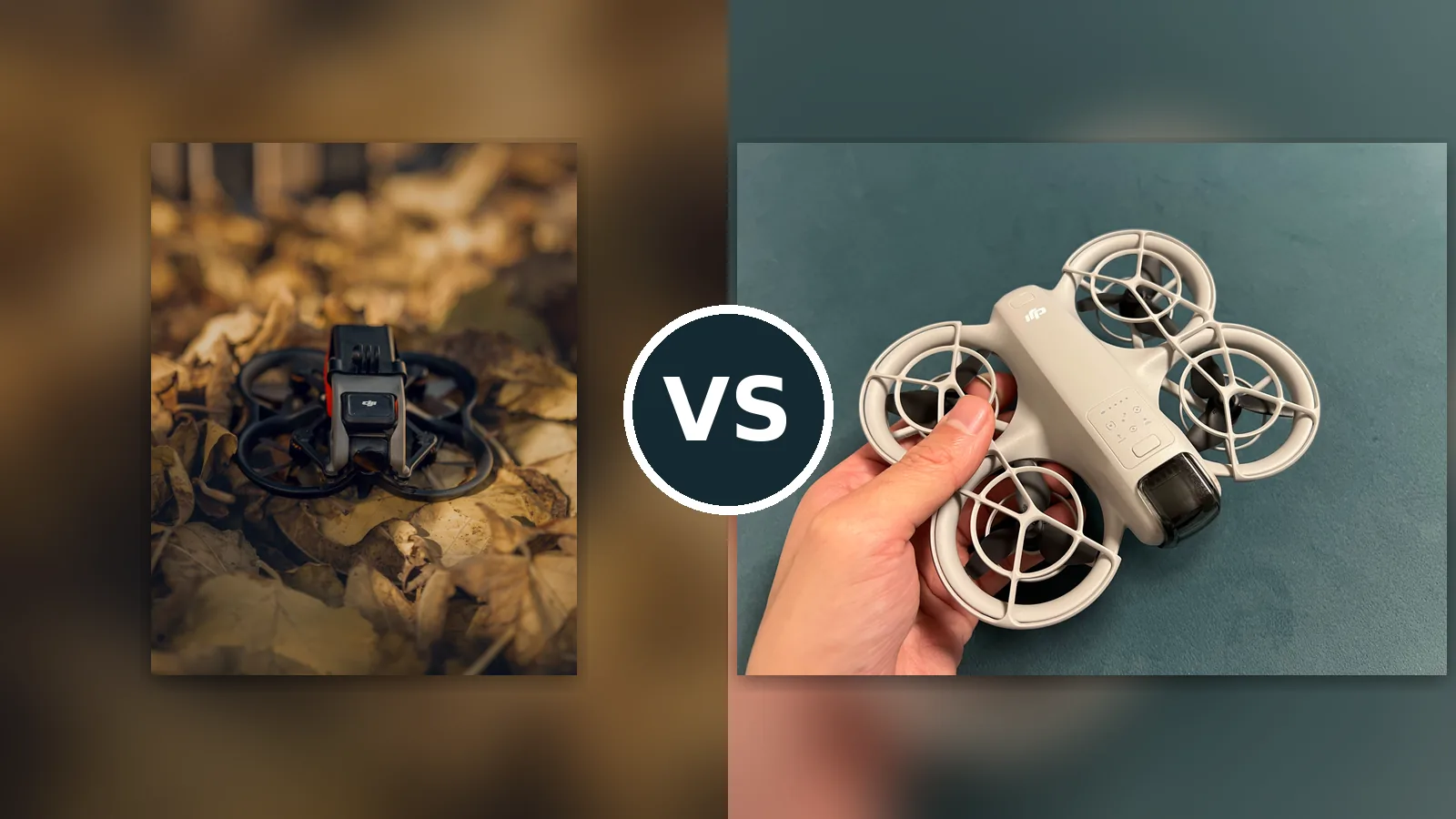
The dji neo vs dji avata question sounds like a simple spec comparison, but these two drones barely belong to the same hobby. Both wear propeller guards. Both fly indoors without drama. Both cost far less than DJI’s camera flagships. And that is about where the similarity ends. The Neo is DJI’s lightest, simplest drone ever: a 135-gram palm-sized vlogger that takes off from your hand, follows you down a trail, and lands back in your palm. The Avata is the original 2022 FPV cinewhoop: a 410-gram speed machine that straps you into goggles and hits 27 meters per second. One was built so you never have to think about flying. The other was built so flying is the whole point.
Affiliate disclosure: As an Amazon Associate I earn from qualifying purchases. This page contains affiliate links. If you buy through them, we may earn a commission.
Neo for most. Avata for the thrill.
DJI Neo wins this comparison for most buyers: it costs far less, flies itself for selfies and follow shots, takes off from your palm, and asks nothing of you. DJI Avata wins for anyone who wants genuine FPV flying: it is dramatically faster, its 48MP camera outclasses the Neo, and the goggles experience is in a different league. Camera: Avata. Ease of use: Neo. Portability: Neo. Speed: Avata. Value: Neo.

DJI Avata
For pilots who want genuine FPV flight, real speed, and a capable 4K camera
- 27 m/s top speed in Manual mode with goggles-and-motion-controller FPV flying
- 1/1.7-inch 48MP sensor shoots 4K/60fps with D-Cinelike color for grading
- A 2022 model that needs goggles to fly FPV and has no subject tracking
Check current price and available bundles on Amazon

DJI Neo
For creators who want the simplest flying camera DJI has ever made
- Palm takeoff and landing, AI subject tracking, and six QuickShots with no controller at all
- Full-coverage propeller guards plus voice control and phone-app flying
- Small 1/2-inch sensor and a 4K/30 ceiling that limit its video ambitions
Check current price and available bundles on Amazon
Orange: DJI Avata · Blue: DJI Neo
Which drone fits your flying?
Start with your main use case. The best choice should solve your needs, without charging you for features you will rarely use.
Most people shopping the dji neo vs dji avata comparison are actually choosing between two different relationships with flying. The Neo is a point-and-shoot camera that happens to fly. You hold it on your palm, press one button, pick a mode like Dronie or Circle, and it films you, follows you, and returns. There is no controller to learn and no stick skills to build. If your dream footage is a follow shot of you cycling, a quick aerial selfie at a family barbecue, or a hands-free vlog clip on a hike, the Neo is purpose-built for exactly that.
The Avata is a flying experience that happens to carry a good camera. You put on the goggles, grab the motion controller, and you are suddenly sitting in the cockpit of something fast. It dives and skims at speeds the Neo cannot touch, and its built-in propeller guards mean brushing a doorway or a tree branch is a shrug rather than a crash. The footage looks different too: low, fast, and close, with a 155-degree ultra-wide field of view that makes ordinary places feel like a race track. It is the drone you buy when the flying itself is the fun, and the footage is the souvenir.
The honest question is how much flying you actually want to do. The Neo asks almost nothing of you, which is its entire appeal. The Avata asks for goggles, a new control scheme, and a willingness to learn FPV basics. If you just want cool clips of yourself with zero fuss, the Avata’s speed will sit unused while the Neo would have been filming on day one.
DJI Avata up close: the 2022 cinewhoop that started it all
The original DJI Avata arrived in August 2022 as DJI’s second FPV drone and its first true cinewhoop: a small, ducted quadcopter designed to fly where bigger camera drones cannot. At about 410 grams with integrated aerodynamic propeller guards, it was built for tight spaces, indoor flights, and close-proximity cinematic shots.
The camera is the Avata’s strongest argument. Its 1/1.7-inch CMOS sensor captures 48-megapixel JPEG stills and records 4K at up to 60 frames per second with DJI Goggles 2, plus 2.7K slow motion up to 120 frames per second through the FPV Goggles V2. The 12.7mm-equivalent ultra-wide lens (155 degrees, f/2.8) delivers the classic FPV look: huge, immersive, and dramatic at low altitude. Video tops out at 150 Mbps with D-Cinelike color for grading, and a single-axis tilt gimbal backed by RockSteady 2.0 and HorizonSteady keeps aggressive maneuvers smooth.
In the air, the Avata is the real deal: 8 m/s in Normal mode, 14 m/s in Sport, and 27 m/s in full Manual mode, which is genuine racing-quad territory. DJI rates flight time at about 18 minutes, and the O3+ transmission system reaches up to 10 km in FCC regions with a 50 Mbps feed. It carries 20 GB of internal storage plus a microSD slot, navigates on GPS, Galileo, and BeiDou, and resists 10.7 m/s winds. Obstacle sensing is downward visual positioning only, so the environment will not save you: this is a pilot’s drone, and it expects you to be one.
On the intelligence side, the Avata keeps things focused on FPV survival rather than automation. Turtle mode flips the drone upright after an upside-down landing so you can take off again without a walk of shame. Emergency brake and hover stop it in a fraction of a second, and return-to-home brings it back when things go sideways. What it does not have is subject tracking, waypoint missions, or any of the automated camera moves DJI’s camera drones are known for. It works with the DJI Motion Controller, the FPV Remote Controller 2, and Goggles 2 or Goggles Integra. At launch it cost $629 for the aircraft alone, or $1,388 for the Pro-View Combo.
DJI Neo up close: the 135-gram palm flyer
The DJI Neo launched in September 2024 as DJI’s lightest and most affordable 4K drone: 135 grams of palm-sized quadcopter that needs no controller at all. You hold it on your outstretched hand, press the mode button, and it lifts off, films you, and returns to your palm. It is DJI’s first drone designed from the ground up for people who have never flown anything.
The camera is honest about its limits. A 1/2-inch CMOS sensor captures 12-megapixel JPEG stills through a 14mm-equivalent f/2.8 lens with a 117.6-degree field of view. Video tops out at 4K/30fps, with 1080p up to 60fps, recorded at up to 75 Mbps. A single-axis tilt gimbal plus RockSteady and HorizonBalancing electronic stabilization keeps footage impressively smooth for something this small, as long as the light is good. There is no RAW, no flat color profile, and no microSD slot: footage lives on 22 GB of internal storage, transferred over Wi-Fi or USB-C. It also records audio through the DJI Mic 2, doubling as a vlogging camera with clean sound.
Flight performance is modest and proud of it: 6 m/s in Normal mode, 8 m/s in Sport, and 16 m/s in full Manual mode. DJI rates flight time at about 18 minutes (about 17 with the propeller guards fitted), and reviewers report roughly 14 to 16 minutes of real-world flying with active tracking. The O4 transmission reaches up to 10 km with an RC controller, while Wi-Fi phone-app control stretches about 50 meters. Maximum flight distance is 7 km, wind resistance is 8 m/s (Level 4), and sensing is downward visual positioning with infrared assist. It is not a drone for fighting weather; it is a drone for calm, fun, close-range flying.
Where the Neo shines is autonomy. Palm takeoff and landing is the headline act, and it works exactly as advertised. AI subject tracking keeps you framed while you bike, skate, or hike. Six QuickShots, Dronie, Circle, Rocket, Spotlight, Helix, and Boomerang, turn one button press into a cinematic move. Voice control through the DJI Fly app responds to “Hey Fly” for hands-free commands, and the app’s virtual joysticks give you manual control from your phone. Pair it with Goggles 3 or Goggles N3 and the RC Motion 3 and the Neo even does one-push aerobatics as a tiny FPV drone. It launched at $199 for the drone alone, with the Fly More Combo (three batteries, charging hub, RC-N3 controller) at $289.
Choose DJI Avata if…
- Real FPV flight is your main concern, not just the footage at the end.
- You mostly shoot low, fast, close-range video: fly-throughs, action follow cams, indoor tours.
- You want a 48MP camera with 4K/60fps and D-Cinelike color you can grade.
- You can accept goggles-based flying, a 2022 feature set, and no subject tracking.
Choose DJI Neo if…
- Zero learning curve is your main concern, from first launch to finished clip.
- You need selfies, follow shots, and QuickShots with no controller at all.
- You value palm takeoff, voice control, and a 135-gram drone that fits in a pocket.
- You can accept a 1/2-inch sensor, 4K/30 ceiling, and modest wind handling.
DJI Neo vs DJI Avata: The Specs That Actually Matter
Compare the exact battery, controller and bundle versions you intend to buy.
| Feature | DJI Avata | DJI Neo |
|---|---|---|
| Best suited to | FPV flying, low-altitude cinematic shots, indoor and close-proximity video | Selfies, vlogs, follow shots, and hands-free casual video |
| Takeoff weight | Approx. 410 g | Approx. 135 g |
| Dimensions | 180 by 180 by 80 mm | 130 by 157 by 48.5 mm |
| Sensor and lenses | 1/1.7-inch CMOS, 48MP, 12.7mm equivalent, f/2.8, 155-degree FOV | 1/2-inch CMOS, 12MP, 14mm equivalent, f/2.8, 117.6-degree FOV |
| Video modes | 4K up to 60fps, 2.7K up to 120fps, 1080p up to 120fps (modes vary by goggles) | 4K/30fps, 1080p up to 60fps |
| Color and codecs | Standard and D-Cinelike, H.264/H.265, up to 150 Mbps | Normal color profile, H.264/H.265, up to 75 Mbps |
| Photo resolution | 48MP JPEG, 4000 by 3000; single shot only | 12MP JPEG, 4000 by 3000; single and interval shot |
| Gimbal | Single-axis mechanical (tilt), plus RockSteady 2.0 and HorizonSteady EIS | Single-axis mechanical (tilt), plus RockSteady and HorizonBalancing EIS |
| Obstacle sensing | Downward visual positioning only; no forward or side sensing | Downward visual positioning with infrared assist; no forward or side sensing |
| Subject tracking | None; Turtle mode for self-recovery after inverted landings | AI subject tracking, six QuickShots, palm takeoff and landing |
| Rated flight time | Approx. 18 minutes | Approx. 18 minutes (approx. 17 with propeller guards) |
| Real-world flight time | Not tested by us; reviewers report roughly 14 to 16 minutes in mixed FPV flying | Not tested by us; reviewers report roughly 14 to 16 minutes with active tracking |
| Max speed | 27 m/s Manual mode; 14 m/s Sport; 8 m/s Normal | 16 m/s Manual mode; 8 m/s Sport; 6 m/s Normal |
| Video transmission | DJI O3+, up to 10 km FCC, 50 Mbps feed | DJI O4, up to 10 km FCC with RC controller; about 50 m on Wi-Fi app control |
| Max flight distance | 11.6 km | 7 km |
| Wind resistance | 10.7 m/s (Level 5) | 8 m/s (Level 4) |
| Internal storage | 20 GB built in, plus microSD slot | 22 GB built in, no microSD slot |
| Controller and bundle | Pro-View Combo: Goggles 2 and Motion Controller (launched at $1,388) | Fly More Combo: RC-N3, three batteries, charging hub (launched at $289) |
| Launch price | $629 aircraft only (August 2022) | $199 drone only (September 2024) |
| Main trade-off | Needs goggles and FPV skills; 2022 feature set with no subject tracking | Small sensor and 4K/30 ceiling; modest speed and wind handling |
Manufacturer ratings are lab figures; real-world flight time is lower. Prices shown are launch prices; check the live Amazon listing for the current price. Last verified: October 20, 2026.
Orange: DJI Avata · Blue: DJI Neo
DJI Neo vs DJI Avata: Five Differences That Matter
For each category, here is the difference, its practical impact and which buyer benefits.
1. Camera and image quality
Edge: AvataThe sensor gap here is the largest in the whole comparison. The Avata’s 1/1.7-inch 48MP sensor is roughly four times the light-gathering area of the Neo’s 1/2-inch 12MP sensor, and it shows in every frame. The Avata records 4K at up to 60 frames per second with a 155-degree ultra-wide view and offers D-Cinelike color for grading. Its footage holds up on a big screen and in mixed light. The Neo tops out at 4K/30fps at 75 Mbps with a standard color profile only, and its 12MP JPEG stills are fine for phones but not for much else.
Both stabilize with a single-axis tilt gimbal plus electronic stabilization, so framing is similar. But the Avata’s bigger sensor and 150 Mbps pipeline give it more detail, better dynamic range, and cleaner low light. The Neo counters with interval shooting and DJI Mic 2 audio, which the Avata cannot do. Still, if image quality is the measure, this category is not close.
2. Flight time, speed, and range
Edge: AvataOn paper, both drones are rated at about 18 minutes of flight time, and in the real world both land around 14 to 16 minutes of mixed flying. So endurance is a genuine tie: neither drone gives you long, unhurried shooting days, and both want at least two or three batteries for a satisfying session.
Everything else favors the Avata. Its 27 m/s Manual-mode top speed is nearly double the Neo’s 16 m/s, and its Sport and Normal modes are faster too. Its 11.6 km maximum flight distance beats the Neo’s 7 km, and its 10.7 m/s Level 5 wind resistance outclasses the Neo’s 8 m/s Level 4. The Neo’s O4 system matches the 10 km transmission range with an RC controller, but Wi-Fi phone control reaches only about 50 meters. The Avata is simply the more capable aircraft: faster, longer-legged, and steadier in wind.
3. Design and portability
Edge: NeoThe Neo is the portability story of the decade in drones: 135 grams, 130 by 157 by 48.5 mm, no folding needed because there is nothing to fold. It slips into a jacket pocket, a purse, or a bike jersey. Under 250 grams it also dodges recreational registration requirements in the US and simplifies rules in much of Europe. And crucially, it flies with no controller at all: the drone is the whole kit.
The Avata weighs about 410 grams and does not fold; its integrated propeller guards make it a fixed, chunky shape. It also travels as a system, not a pocket drone: to fly FPV you carry goggles, a motion controller or remote, batteries, and a hub. DJI’s sling bag fits it all, but this is a dedicated kit for dedicated flying sessions. One honest plus for the Avata: at 410 grams it sits solidly in wind that would push the Neo around, and its 20 GB of storage plus microSD slot is more flexible than the Neo’s 22 GB with no card slot. But for pure grab-and-go portability, the Neo is in another universe.
4. Intelligent features and autonomy
Edge: NeoThis is the Neo’s home turf and the Avata’s weakest area. The Neo is the most autonomous drone DJI has ever made: palm takeoff and landing, AI subject tracking that follows you while you move, six one-press QuickShots, voice control through the DJI Fly app, and virtual joysticks for phone flying. You can own this drone for a year and never touch a controller.
The Avata has no subject tracking, no QuickShots, and no autonomous camera moves. Its intelligence is all about FPV survival: Turtle mode flips it upright after an inverted landing, emergency brake stops it in a fraction of a second, and return-to-home brings it back when the link or battery gets thin. These are genuinely useful features, but they serve the pilot, not the camera. If you want the drone to do the flying, the Neo is the only choice.
5. Price and value
Edge: NeoThe Neo launched at $199 for the drone alone, with the Fly More Combo (three batteries, charging hub, RC-N3 controller) at $289. That makes it DJI’s cheapest 4K drone by a wide margin, and the cheapest way to get AI tracking and palm-controlled flying from any major brand. Even adding the Goggles N3 and RC Motion 3 for FPV experimentation keeps the total far below a dedicated FPV setup.
The Avata launched at $629 for the aircraft alone, or $1,388 for the Pro-View Combo. As a 2022 model it is frequently discounted, and its price per unit of camera quality and speed is actually strong. But there is no getting around the math: a complete Avata FPV kit costs several times what a complete Neo kit costs. The Avata earns its premium with a far better camera and real FPV performance; the Neo earns its crown by making drone ownership nearly an impulse buy.
DJI Neo vs DJI Avata: What You Gain and Give Up
DJI Avata
Reasons to choose it
- Genuine FPV speed: 27 m/s in Manual mode with goggles and motion control
- 1/1.7-inch 48MP sensor with 4K/60fps, 150 Mbps, and D-Cinelike color for grading
- Built-in propeller guards plus Turtle mode make close-quarters flying practical
- 11.6 km max flight distance and Level 5 wind resistance for bigger adventures
- 20 GB internal storage plus a microSD slot for flexible media
Reasons to reconsider
- A 2022 model with no subject tracking, no QuickShots, and no autonomous camera moves
- Needs goggles and a second control system: more gear, more charging, more learning
- Downward-only sensing means the environment will not save you from mistakes
- At 410 g it needs registration where the Neo flies free of paperwork
- A complete FPV kit costs several times what a Neo setup costs
DJI Neo
Reasons to choose it
- Palm takeoff and landing with AI subject tracking and six QuickShots, no controller needed
- 135 grams: pocketable, and free of recreational registration in the US
- Voice control and phone-app flying make it the easiest DJI drone ever to operate
- $199 launch price makes it DJI’s cheapest 4K drone by a wide margin
- Full-coverage prop guards and 22 GB internal storage for grab-and-go shooting
Reasons to reconsider
- 1/2-inch 12MP sensor with 4K/30 ceiling, no flat color profile, and no RAW stills
- No microSD slot: 22 GB of internal storage is all you get
- 16 m/s top speed and Level 4 wind resistance limit it to calm, close-range flying
- Wi-Fi phone control reaches only about 50 meters; real range needs an RC controller
- Not a serious FPV drone: no acrobatics, no speed thrills, no manual-mode rush
Check the bundle, not just the drone
The drone on the box is only half the purchase. Run through this checklist before you tap buy.
- Controller: The Neo flies with no controller at all, which is the point. If you want range, add the RC-N3; if you want FPV, you need Goggles N3 or Goggles 3 plus the RC Motion 3. The Avata Pro-View Combo includes Goggles 2 and the motion controller; the FPV Remote Controller 2 is the separate purchase for full manual mode.
- Batteries: One battery is never enough. Both drones are rated around 18 minutes and deliver more like 14 to 16 in real flying, so plan on two or three packs. The Neo’s Fly More Combo with three batteries and a hub is the sensible starting point.
- Accessories: The Neo has no microSD slot, so its 22 GB of internal storage is your whole media library; transfer footage regularly over Wi-Fi or USB-C. The Avata takes microSD cards up to 512 GB, and a fast U3 card is essential. ND filters help both drones in bright light.
- Listing: On Amazon, confirm the exact model name, controller, and battery count in the listing title before ordering. The original Avata shares its name with the newer Avata 2, so check the product images and the “Model Name” field carefully to make sure you are getting the 2022 drone.
- Local requirements: Check your aviation authority’s current rules before you fly. The Neo’s 135 g weight keeps recreational flying free of FAA registration in the US, while the 410 g Avata must be registered. FPV flying typically requires a visual observer in many jurisdictions.
- Price timing: The Avata is a 2022 model and sees regular discounts, so its street price is often well below launch. The Neo launched at $199 and holds its value as DJI’s cheapest 4K drone. Check the live listing before you buy; launch prices in this article are reference points.
The right choice comes down to simplicity versus speed.
If you want the easiest drone you will ever own, buy the Neo. It takes off from your hand, films you without a controller, follows you down the trail, and costs less than a nice dinner for two per battery. It wins on price, portability, autonomy, and sheer convenience. If you want the most exciting way to fly that this price bracket offers, buy the Avata. Its 48MP camera, 4K/60fps video, and 27 m/s FPV speed are in a different league, and the goggles experience is something the Neo cannot imitate. Just go in with open eyes: it is a 2022 drone that demands goggles, practice, and a bigger budget, and it is worth it only if FPV is what you actually want.
Still deciding?
Is the DJI Neo a good first drone?
It is arguably the best first drone DJI has ever made. There is no controller to learn, no app expertise required, and palm takeoff means your first flight happens 30 seconds after unboxing. The propeller guards forgive bumps, and at 135 grams it needs no recreational registration in the US. Just know its limits: calm weather, close range, and casual video.
Can the DJI Neo really fly without a controller?
Yes. Press the mode button on the drone to pick a shooting mode, hold it on your palm, and it launches, films, and returns to your hand. Voice control through the DJI Fly app and virtual joysticks on your phone give you more control when you want it, and the RC-N3, RC Motion 3, or FPV Remote Controller 3 unlock full manual flying and up to 10 km of range.
Which has the better camera, the Neo or the Avata?
The Avata, by a wide margin. Its 1/1.7-inch 48MP sensor, 4K/60fps recording, 150 Mbps bitrate, and D-Cinelike color profile outclass the Neo’s 1/2-inch 12MP sensor, 4K/30 ceiling, and 75 Mbps standard color on every measure that matters: detail, dynamic range, low light, and grading flexibility.
Is the original DJI Avata still worth buying in 2026?
For the right buyer, yes. It remains a genuine FPV cinewhoop with a strong camera, and as a 2022 model it is often discounted well below its $629 launch price. Just buy it for FPV flying, not for smart features: it has no subject tracking or QuickShots. And double-check the listing, because the newer Avata 2 shares the family name.
Do I need to register the Neo or the Avata?
It depends on where you fly. In the United States, recreational drones under 250 grams, like the 135 g Neo, do not require FAA registration, while the 410 g Avata does. Rules differ by country and change over time, and FPV flying often requires a visual observer. Check your national aviation authority’s current requirements before your first flight.
How were these drones compared?
This is a research-based comparison: we compiled specifications from DJI’s official spec pages and support documentation, launch pricing from launch-day coverage, and real-world flight times from independent reviewers. We did not fly either drone for this article, so rated figures are DJI’s lab numbers and real-world figures are attributed to the reviewers who measured them. See the methodology section below for the full source list.
How this comparison was prepared
This is a research-based comparison. We did not fly either drone for this article, and we do not imply otherwise. Every specification comes from DJI’s official documentation: the Neo support specifications page, the Avata support beginner’s guide, and DJI’s official store comparison of the Avata 1 and Avata 2. Launch pricing comes from launch-day reporting. Real-world flight times are attributed to independent reviewers who measured them. Amazon ASINs were verified by matching each ASIN against the exact product title across Amazon-indexed listing data before any affiliate link was written.
Sources and verification
- DJI Neo official specifications (dji.com support, accessed October 20, 2026): weight, dimensions, speeds, flight time, camera, gimbal, sensing, storage, and transmission figures
- DJI Avata beginner’s guide (support.dji.com, accessed October 20, 2026): 1/1.7-inch sensor, 4K/60fps video, 18-minute flight time, and O3+ transmission details
- DJI Avata 2 vs DJI Avata official comparison (DJI Store, accessed October 20, 2026): original Avata spec deltas including 20 GB storage and downward visual positioning
- DJI Avata launch coverage (DroneLife, New Atlas, August 2022): launch pricing and core specifications
- DJI Avata detailed specifications (Wex Photo Video, DroneSpec): cross-check of speeds, gimbal ranges, GNSS, and battery figures
- DJI Neo launch coverage (DIYPhotography, Amateur Photographer, September 2024): launch pricing, palm takeoff, AI tracking, and QuickShots details
- DJI Neo hands-on review (Notebookcheck): measured real-world flight time around 15 minutes
- DJI Neo review (Amateur Photographer): 17 versus 18 minute flight time with and without guards, pricing context
- DJI Neo specifications (B and H Photo, MyDearDrone): cross-check of camera, gimbal, storage, and transmission figures
- ASIN verification: Avata Pro-View Combo listing (B0B7GJZZ48, with DJI Goggles 2) and Neo Fly More Combo listing (B07FTRYVT5, RC-N3 with 3 batteries) confirmed against Amazon-indexed titles and independent affiliate-link citations
Last verified: October 20, 2026. Bundle availability, pricing, and specifications may vary by region and version. Prices in this article are launch reference prices; check the live Amazon listing for the current price.
cosas que hacer en tossa de mar
cosas que hacer en valladolid en pareja
cuales son las mejores playas de almeria
las 8 mejores playas de alicante
las mejores playas de la comunidad valenciana
las mejores playas de marbella
las mejores playas del sur de gran canaria
mejores playas de cadiz capital
mejores playas de mallorca para ir con niños
mejores playas de torremolinos


