

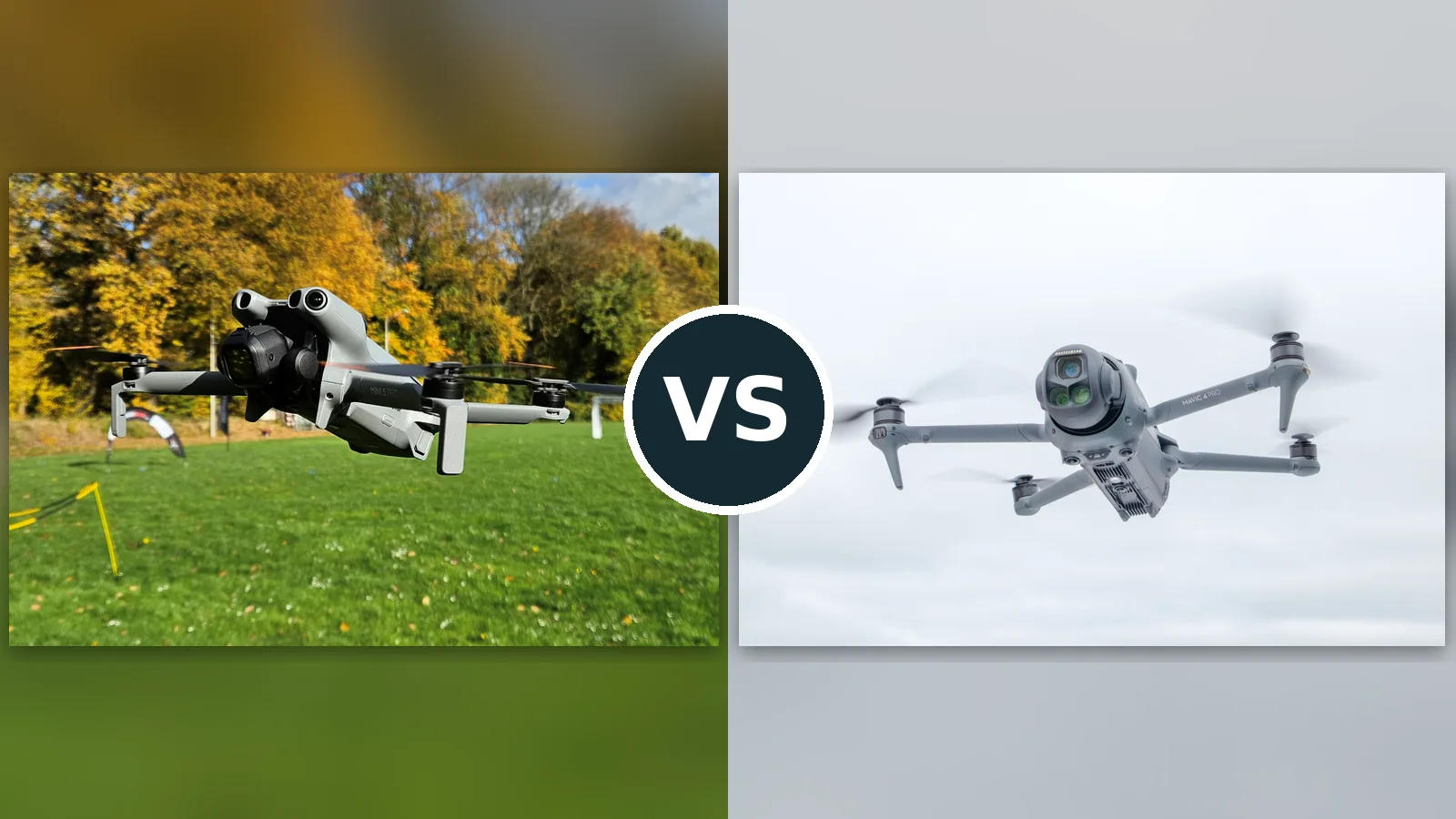
The dji mini 5 vs mavic 4 question is really a question about what kind of pilot you are. The DJI Mini 5 Pro is the drone that shrank flagship imaging into a folding body that weighs about as much as a smartphone: a 1-inch 50MP sensor, 4K/120fps slow motion, forward-facing LiDAR, and omnidirectional obstacle sensing, all in a package DJI markets at 249.9 grams. The DJI Mavic 4 Pro is the opposite bet: a 1,063-gram flagship with a triple-camera system led by a 100MP 4/3-inch Hasselblad, true 6K/60 video, a 360-degree Infinity gimbal, and a 51-minute flight time. One fits in a jacket pocket. The other needs its own camera bag. We compared the camera, flight time, portability, intelligent features, and complete kit cost so you can decide which philosophy matches the way you fly.
Affiliate disclosure: As an Amazon Associate, we earn from qualifying purchases. This page contains affiliate links. If you buy through them, we may earn a commission.
Mavic 4 Pro for image quality. Mini 5 Pro for everything else.
DJI Mavic 4 Pro wins this comparison on pure imaging: a 100MP 4/3-inch Hasselblad main camera, true 6K/60 video, three optical focal lengths (28mm, 70mm, 168mm), and 51 minutes of flight time make it the best flying camera DJI has ever built. DJI Mini 5 Pro wins on portability and value: a 1-inch 50MP sensor in a folding drone that weighs roughly 253 grams as flown, 4K/120fps slow motion, LiDAR-assisted nightscape sensing, and a launch price under $800. Camera: Mavic 4 Pro. Flight time: Mavic 4 Pro. Portability: Mini 5 Pro. Value: Mini 5 Pro. If the absolute best aerial image is the job, buy the Mavic 4 Pro. If you want near-flagship footage from a drone you will actually carry everywhere, the Mini 5 Pro is the smarter buy.

DJI Mini 5 Pro
For travelers and creators who want pro-level footage from a near-250g folding drone
- World-first 1-inch sensor in a Mini body, with 4K/120fps and true vertical shooting
- Forward LiDAR plus omnidirectional sensing that works down to 1 lux
- Measured 252 to 253 g on real scales, so FAA registration applies despite the sub-250g marketing
Check current price and available bundles on Amazon

DJI Mavic 4 Pro
For serious creators who need three pro cameras, 6K video, and maximum airtime
- Triple-camera system: 28mm Hasselblad plus 70mm and 168mm telephotos, all 4K/60 HDR
- Infinity gimbal with 360-degree yaw and 70-degree upward tilt
- Never officially released in the US; Amazon listings are third-party imports with no DJI US warranty
Check current price and available bundles on Amazon
Which drone fits your flying?
Start with your main use case. The best choice should solve your needs, without charging you for features you will rarely use.
Here is the twist that makes the dji mini 5 vs mavic 4 comparison more interesting than the price gap suggests: the Mini 5 Pro’s 1-inch main sensor is physically larger than two of the Mavic 4 Pro’s three cameras (the 1/1.3-inch medium tele and the 1/1.5-inch long tele). Only the 4/3-inch Hasselblad outclasses the Mini’s sensor. So at the wide end, where most drone footage lives, you are comparing a very good 1-inch camera against an excellent 4/3 camera, not a toy against a pro tool. The Mavic pulls away with its extra optical focal lengths, true 6K capture, and 16 stops of dynamic range, but the Mini 5 Pro is bringing the same knife, just a slightly smaller one.
The real split is philosophical. The Mini 5 Pro answers the question: how much camera fits in something that folds to 157 by 95 by 68 mm and weighs about as much as a deck of cards? The answer: 50MP RAW stills, 4K/120fps slow motion, 10-bit D-Log M, a 225-degree rotating gimbal for true vertical video, and forward-facing LiDAR for near-darkness safety. It is the drone for the traveler who used to leave the big drone home because it meant a second bag. The Mini goes in the jacket pocket and comes out at every viewpoint.
The Mavic 4 Pro answers a different question: what is the absolute best image a folding drone can produce? The answer is the triple-camera block on the spherical Infinity gimbal: 100MP Hasselblad stills with an adjustable f/2.0 to f/11 aperture, 6K/60fps HDR video, and 168mm telephoto compression no Mini can produce. The 360-degree yaw and 70-degree upward tilt unlock angles no previous Mavic could attempt. It is the drone for the creator whose footage pays the bills. It weighs 1,063 grams, needs FAA registration everywhere, and travels in a dedicated case. It earns that inconvenience with every frame.
One more thing before the details: the US buying reality. The Mini 5 Pro launched worldwide on September 17, 2025, and the Mavic 4 Pro on May 13, 2025, but DJI paused the US rollout of both amid import difficulties and tariffs, and a DJI spokesperson has confirmed neither is officially imported stateside. On Amazon.com, both appear only through third-party sellers: no DJI Care Refresh in the US, region-locked warranties DJI may refuse to honor, and prices that float with gray-market supply. Both carry forward-facing LiDAR, which sits inside the FCC’s ongoing proceeding on foreign LiDAR-equipped drones. They are legal to own and fly today, but buy with open eyes: read the seller line, check the return policy, and budget as if you have no manufacturer safety net.
DJI Mini 5 Pro · DJI Mavic 4 Pro
Choose DJI Mini 5 Pro if…
- Portability is your main concern, and you want a drone that actually leaves the house with you.
- You mostly shoot travel, landscape, and social content where a 1-inch sensor is already overkill.
- You value 4K/120fps slow motion, true vertical video, and LiDAR-assisted night flying in a tiny package.
- You can accept single-camera framing, roughly 36 minutes of rated flight time, and third-party-only US availability.
Choose DJI Mavic 4 Pro if…
- Image quality is your main concern, and you want the best camera DJI puts on a folding drone.
- You need three optical focal lengths, 6K/60 video, and 100MP stills for client or print work.
- You value 51-minute flights, 30 km O4+ range, and a gimbal that can look straight up.
- You can accept a 1,063 g airframe, a dedicated camera bag, and gray-market US availability with no DJI warranty.
DJI Mini 5 vs Mavic 4: The Specs That Actually Matter
Compare the exact battery, controller and bundle versions you intend to buy.
| Feature | DJI Mini 5 Pro | DJI Mavic 4 Pro |
|---|---|---|
| Best suited to | Travel photography and videography, social content, landscapes, real estate | Professional aerial cinematography, commercial work, high-end landscapes |
| Takeoff weight | 249.9 g plus or minus 4 g (spec); independent scales show 252 to 253 g as flown | Approx. 1063 g |
| Dimensions (folded) | 157 x 95 x 68 mm | 257.6 x 124.8 x 103.4 mm (without propellers) |
| Sensor and lenses | 1-inch CMOS, 50MP, 24mm equivalent, f/1.8, 84-degree FOV | Triple camera: 4/3-inch 100MP Hasselblad 28mm f/2.0 to f/11; 1/1.3-inch 48MP 70mm f/2.8; 1/1.5-inch 50MP 168mm f/2.8 |
| Photo resolution | Up to 50MP (8192 x 6144), JPEG and DNG RAW | Up to 100MP (12288 x 8192) on Hasselblad, JPEG and DNG RAW on all three cameras |
| Video modes | 4K up to 60/120fps HDR, FHD up to 240fps | 6K up to 60fps HDR (main), 4K up to 120fps (main and medium tele), 4K up to 100fps (tele), 4K vertical up to 60fps |
| Color and codecs | 10-bit D-Log M and HLG, H.264/H.265, up to 130 Mbps | 10-bit D-Log, D-Log M and HLG, H.264/H.265, up to 180 Mbps; dual native ISO fusion |
| Dynamic range | Up to 14 stops (manufacturer claim) | 16 stops (main), 14 stops (medium tele), 13 stops (tele) |
| Gimbal | 3-axis mechanical, 225-degree roll rotation, true vertical shooting | Infinity gimbal, 3-axis, 360-degree yaw rotation, 70-degree upward tilt |
| Vertical capture | Native: gimbal rotates 90 degrees for true vertical 4K video | Native: 4K vertical at up to 60fps via Infinity gimbal |
| Obstacle sensing | Omnidirectional vision plus forward-facing LiDAR, nightscape sensing to 1 lux | Omnidirectional vision plus forward-facing LiDAR, nightscape sensing to 0.1 lux |
| Subject tracking | ActiveTrack 360 degrees, MasterShots, QuickShots, Waypoint Flight | ActiveTrack with improved vehicle tracking, Waypoint Flight, Cruise Control |
| Rated flight time | 36 minutes standard; 52 minutes with Plus battery (pushes past 250 g) | 51 minutes; 45 minutes hovering |
| Real-world flight time | Not tested by us; reviewers report roughly 25 to 30 minutes on the standard battery | Not tested by us; flagship-class endurance with a 95.3 Wh battery under the 100 Wh airline limit |
| Max speed | 18 m/s in Sport mode (19 m/s with Plus battery) | 25 m/s in Sport mode (about 90 km/h) |
| Video transmission | DJI O4+, up to 20 km FCC, 1080p/60fps live view | DJI O4+, up to 30 km FCC, 1080p/60fps live view, 10-bit HDR feed |
| Wind resistance | 12 m/s | 12 m/s |
| Internal storage | 42 GB plus microSD slot | 64 GB standard (512 GB Creator Combo) plus microSD up to 2 TB |
| Controller and bundle | DJI RC-N3 (launched at $759) or DJI RC 2 with built-in screen (launched at $959) | DJI RC 2 included; RC Pro 2 with 7-inch Mini-LED display optional |
| US availability | Never officially sold by DJI in the US; Amazon listings are third-party sellers only; no DJI Care in the US | Never officially released in the US; Amazon.com listings are gray-market imports; no DJI US warranty |
| Main trade-off | Single camera, shorter flight time, and the sub-250g promise does not survive a real scale in the US | Four times the weight, three times the price, and zero official US support |
Manufacturer ratings are lab figures; real-world flight time is lower. Prices shown are launch reference prices; check the live Amazon listing for the current price. Last verified: October 20, 2026.
DJI Mini 5 Pro · DJI Mavic 4 Pro
DJI Mini 5 vs Mavic 4: Five Differences That Matter
For each category, here is the difference, its practical impact and which buyer benefits.
1. Camera quality and creative flexibility
Edge: Mavic 4 ProThe Mavic 4 Pro’s headline is the 100MP 4/3-inch Hasselblad with an adjustable f/2.0 to f/11 aperture, shooting true 6K/60fps HDR video with 16 stops of dynamic range. That sensor is roughly twice the area of the Mini 5 Pro’s 1-inch chip, and the difference shows in fine detail, highlight rolloff, and low-light cleanliness. Then there are the two telephotos: a 48MP 70mm and a 50MP 168mm, each recording 4K/60fps HDR. The 168mm lens compresses distant ridgelines and cityscapes the way a ground-based long lens does, a look the Mini physically cannot produce with its single 24mm lens and digital zoom.
But the Mini 5 Pro’s camera is genuinely excellent. Its 1-inch 50MP sensor shoots 4K/120fps slow motion, records 10-bit D-Log M and HLG at up to 130 Mbps, and captures 50MP RAW stills that hold up to serious editing. Its f/1.8 aperture is faster than the Mavic’s f/2.0 wide open, which helps at dusk. For social content, YouTube, and large prints, most viewers will never see the difference. For pixel-peeping, grading, and commercial delivery, the Mavic 4 Pro is in a different league.
2. Flight time, range, and time in the air
Edge: Mavic 4 ProDJI rates the Mavic 4 Pro at 51 minutes of flight time and 45 minutes hovering, fed by a 6,654 mAh, 95.3 Wh battery that sits just under the 100 Wh airline carry-on limit. Its 41 km maximum flight distance and 30 km O4+ range (FCC) are the longest DJI has shipped on a folding drone. In practice, one battery covers a full golden-hour session with reserve.
The Mini 5 Pro is rated at 36 minutes on the standard 2,788 mAh battery, with reviewers reporting roughly 25 to 30 minutes of real mixed flying. The Plus battery stretches the rating to 52 minutes, beating the Mavic on paper, but it pushes the drone well past 250 grams and is not sold in Europe. The honest math: you will fly the Mavic on one battery where the Mini needs two.
3. Design, portability, and the 250-gram question
Edge: Mini 5 ProFolded, the Mini 5 Pro measures 157 by 95 by 68 mm, roughly the footprint of a large smartphone, and DJI prints 249.9 grams on the spec sheet with a plus or minus 4 gram tolerance. The honest part: independent scales consistently weigh production units at 252 to 253 grams, a variance DJI attributes to late propeller and speaker changes. The FAA allows no tolerance at the 250-gram line, so in the US the Mini 5 Pro legally requires FAA registration and Remote ID broadcast, just like the Mavic. Europe kept its C0 classification, but the sub-250g promise does not survive an American scale.
Even so, the portability gap is enormous. The Mini 5 Pro plus the RC-N3 controller disappears into a jacket pocket or a camera bag’s side pouch; total kit weight stays under half a kilogram. The Mavic 4 Pro folds to 257.6 by 124.8 by 103.4 mm and weighs 1,063 grams before you add the RC 2, spare batteries, and the case it deserves. It travels like professional gear because it is professional gear. If your drone lives in a dedicated bag by the front door, the Mavic’s size is a non-issue. If your drone needs to earn its place in luggage that is already full, only the Mini makes the cut.
4. Intelligent features and flight confidence
Edge: Mavic 4 ProBoth drones carry omnidirectional obstacle sensing backed by forward-facing LiDAR, which is remarkable: two years ago LiDAR was unheard of on consumer drones, and now the pocket drone has it. The Mini 5 Pro’s nightscape system works down to 1 lux, genuinely useful for dusk and dawn flights. The Mavic 4 Pro pushes that to 0.1 lux, near-darkness performance aimed at the night cinematographers DJI is courting with this flagship. Both offer ActiveTrack subject tracking, waypoint missions, and automated quick-shot modes.
The Mavic separates itself with the Infinity gimbal: the spherical 360-degree yaw design lets the camera pan a full circle and tilt 70 degrees upward, enabling dramatic reveals that start looking straight up at a skyscraper. The Mini counters with 225 degrees of roll rotation and true vertical shooting, which the Mavic matches with 4K/60fps vertical capture of its own. The Infinity gimbal gives the Mavic shots the Mini cannot physically attempt.
5. Value of the complete kit
Edge: Mini 5 ProCompare what you pay to start flying. The Mini 5 Pro launched at $759 with the RC-N3 controller and one standard battery, or $959 with the RC 2 and its built-in screen. Third-party Amazon sellers have since listed it under $700, and even the Fly More Combo with three batteries, a charging hub, ND filters, and a bag costs less than half of the Mavic 4 Pro. That is a complete, ready-to-fly 1-inch camera drone with LiDAR for the price of a mid-range phone.
The Mavic 4 Pro’s gray-market Amazon listings have hovered around $2,199 for the standard kit with the RC 2, and the 512GB Creator Combo pushes well past $3,000. There is no official US price because there was no official US launch. Every dollar buys capability the Mini cannot match, but the value math only works if you use it. A Mini 5 Pro Fly More Combo plus spares still costs less than the Mavic body alone. For everyone except working professionals, the Mini is the better financial decision by a mile.
DJI Mini 5 vs Mavic 4: What You Gain and Give Up
DJI Mini 5 Pro
Reasons to choose it
- World-first 1-inch 50MP sensor in a Mini body, with 4K/120fps slow motion and 10-bit D-Log M that embarrasses every other drone its size
- Folds to smartphone size and weighs about 253 g as flown, so it actually travels with you instead of staying home
- Forward-facing LiDAR plus omnidirectional sensing that works down to 1 lux, a safety net unheard of in this class
- True vertical shooting via 225-degree gimbal rotation, plus 42 GB of internal storage as a backup for forgotten memory cards
- Launch price under $800, with third-party listings seen under $700, makes it the value pick by a wide margin
Reasons to reconsider
- Measured 252 to 253 g on real scales, so the sub-250g marketing does not exempt you from FAA registration in the US
- Single 24mm camera only: no optical telephoto reach, no 6K, and 16-stop dynamic range is reserved for the Mavic
- Roughly 25 to 30 minutes of real flight time per battery means carrying two or three packs for a serious outing
- Never officially sold in the US: third-party Amazon sellers only, no DJI Care Refresh, region-locked warranty
- The Plus battery’s 52-minute rating comes at the cost of blowing past 250 g and is not sold in Europe
DJI Mavic 4 Pro
Reasons to choose it
- 100MP 4/3-inch Hasselblad with adjustable aperture and true 6K/60fps HDR, the best image on any folding DJI drone
- Triple-camera system (28mm, 70mm, 168mm) gives three optical perspectives without landing to swap lenses
- 51 minutes of rated flight time and 30 km O4+ range cover entire shoots on a single battery
- Infinity gimbal with 360-degree yaw and 70-degree upward tilt unlocks angles no previous Mavic could attempt
- 0.1-lux nightscape sensing plus forward LiDAR makes it DJI’s most confidence-inspiring night flyer
Reasons to reconsider
- At 1,063 g it needs FAA registration everywhere and travels in a dedicated case, not a pocket
- Gray-market US availability only: no official launch, no DJI US warranty, prices float with importer supply
- Around $2,199 for the standard kit and well past $3,000 for the Creator Combo is serious money
- Its medium tele and tele sensors (1/1.3-inch and 1/1.5-inch) are smaller than the Mini 5 Pro’s 1-inch main sensor
- Both drones carry LiDAR, which sits inside the FCC’s ongoing proceeding on foreign LiDAR-equipped drones
Check the bundle, not just the drone
The drone on the box is only half the purchase. Run through this checklist before you tap buy.
- Controller: The Mini 5 Pro comes with the RC-N3 (bring your own phone, $759 kit) or the RC 2 with a built-in 5.5-inch screen ($959 kit); the RC 2 is worth it in bright sunlight. The Mavic 4 Pro ships with the RC 2, and the RC Pro 2 with its 7-inch Mini-LED display is the Creator Combo step-up.
- Batteries: One battery is never enough. The Mini 5 Pro Fly More Combo’s three batteries turn a flight into a session, and the hub fills all three in about 115 minutes. Skip the Plus battery unless you accept the weight consequences. The Mavic 4 Pro’s 95.3 Wh battery sits under the 100 Wh airline limit, so spares fly in carry-on luggage.
- Accessories: A fast microSD card (U3/V30) is essential for 6K and high-bitrate 4K on both drones. ND filters matter: the Mavic’s adjustable aperture helps, but the Mini’s fixed f/1.8 needs NDs in bright light for cinematic shutter speeds. The Mini’s 42 GB of internal storage is a backup, not a replacement for a card.
- Listing: On Amazon, both drones come from third-party sellers, not DJI. Read the seller line before checkout, confirm the model name, controller, and battery count in the listing title, and check return terms and seller history. Prices swing with gray-market supply: the Mini 5 Pro has been seen under $700, the Mavic 4 Pro around $2,199.
- Local requirements: In the US, both drones require FAA registration: the Mavic 4 Pro at 1,063 g, and the Mini 5 Pro because production units weigh 252 to 253 g with no tolerance at the 250-gram line. Registration costs $5 for three years at FAADroneZone, and Remote ID broadcast applies. Check your aviation authority’s current rules before your first flight.
- Warranty reality: DJI warranties are tied to the purchase region, and DJI has confirmed neither drone is officially imported to the US. If a US-bought unit needs service, DJI may refuse it. Third-party sellers set their own return policies, so treat the seller’s reputation as part of the product.
The right choice comes down to the camera bag question.
If you already carry a camera bag and your footage has to survive client scrutiny, grading sessions, or large prints, buy the DJI Mavic 4 Pro. Its 100MP Hasselblad, true 6K/60, triple optical focal lengths, and 51-minute flights are the best DJI has ever put on a folding drone, and nothing else in this comparison touches them. If you want footage that looks flagship-grade on every screen you own, from a drone that folds into a jacket pocket and costs less than a third of the flagship, buy the DJI Mini 5 Pro. Just register it with the FAA, buy from a reputable third-party seller, and go in knowing the sub-250g promise and the US warranty are both thinner than the marketing suggests. Either way, you are buying one of the two best camera drones DJI built in 2025. The only wrong choice is the one that stays home.
Still deciding?
Is the Mavic 4 Pro worth roughly three times the price of the Mini 5 Pro?
Only if you use what the extra money buys. The Mavic’s 4/3-inch Hasselblad, 6K/60 video, two telephotos, and 51-minute flights are genuinely a class above, and for commercial work they pay for themselves. For travel, social content, and YouTube, the Mini 5 Pro’s 1-inch sensor delivers footage most viewers cannot tell apart from the flagship, at a third of the price.
Which drone is better for travel?
The Mini 5 Pro, and it is not close. It folds to 157 by 95 by 68 mm, weighs about 253 g as flown, and its whole kit fits in a jacket pocket. The Mavic 4 Pro weighs 1,063 g and needs a dedicated case. One caveat: the Mini’s measured weight means FAA registration is required in the US, so its travel edge is about bag space, not paperwork.
Do I need to register the Mini 5 Pro or the Mavic 4 Pro with the FAA?
Yes to both, if you fly in the United States. The Mavic 4 Pro at 1,063 g obviously requires it. The Mini 5 Pro requires it too, because independent scales consistently weigh production units at 252 to 253 g, and the FAA allows no tolerance at the 250-gram threshold. Registration costs $5 for three years and Remote ID broadcast applies to both.
Can I buy either drone directly from DJI in the US?
No. DJI never officially launched either drone in the United States, and a DJI spokesperson has confirmed neither is officially imported. On Amazon.com both appear only through third-party sellers: no DJI Care Refresh in the US, region-locked warranties DJI may not honor, and prices that move with gray-market supply. Read the seller line carefully before you buy.
Which has the better camera for stills? For video?
For stills, the Mavic 4 Pro: 100MP from the 4/3-inch Hasselblad versus 50MP from the Mini’s 1-inch sensor, with an adjustable aperture for exposure control. For video it depends on the job: the Mavic wins on resolution and dynamic range with 6K/60 and 16 stops, while the Mini 5 Pro wins on slow motion with 4K/120fps from its main camera. Both shoot 10-bit D-Log profiles and true vertical video.
How were these drones compared?
This is a research-based comparison: we compiled specifications from DJI’s official spec pages and launch announcements, then cross-checked them against independent reviews and owner measurements from DroneXL, Loiter Point, UAV Coach, and DroneDJ. We did not fly either drone, so rated figures are DJI’s lab numbers and real-world figures belong to the reviewers who measured them.
How this comparison was prepared
This is a research-based comparison. We did not fly either drone for this article, and we do not imply otherwise. Every specification in the table above comes from DJI’s official documentation, primarily the DJI Mini 5 Pro specifications page and the DJI Mavic 4 Pro specifications page, with launch details cross-checked against DJI’s official launch announcements from September 2025 and May 2025. Where this article mentions real-world weights and flight times, those figures are attributed to the people who measured them: independent scales consistently put Mini 5 Pro production units at 252 to 253 grams, and reviewers report roughly 25 to 30 minutes of real flying on the standard battery. Amazon ASINs were verified by matching each ASIN against the exact product title through Amazon-indexed listing data and independent price trackers before any affiliate link was written. US availability claims rest on reporting from UAV Coach and DroneDJ plus DJI’s own public statements confirming neither drone is officially launched or imported in the United States.
Sources and verification
- DJI Mini 5 Pro official specifications (dji.com, accessed October 20, 2026): aircraft, camera, gimbal, sensing, transmission, and battery figures
- DJI Mavic 4 Pro official specifications (dji.com, accessed October 20, 2026): weight, dimensions, triple-camera system, flight time, and sensing figures
- DJI Mini 5 Pro launch announcement (DJI newsroom via PR Newswire, September 17, 2025): 1-inch sensor world-first claim, launch pricing, bundle contents
- DJI Mavic 4 Pro launch coverage (May 2025): triple-camera details, Infinity gimbal, 51-minute flight time
- DroneXL Mini 5 Pro weight reporting: 252 to 253 gram production measurements, FAA no-tolerance position, EASA C0 confirmation
- Loiter Point DJI Mini 5 Pro review: rated versus real-world battery figures and owner weight data
- UAV Coach availability reporting: third-party-only US listings, DJI’s no-US-launch stance, region-locked warranty notes
- DroneDJ US market reporting: DJI spokesperson confirmation that neither drone is officially launched or imported in the US
- B and H Photo Mavic 4 Pro product page: launch pricing context and triple-camera specifications
- ASIN verification: Mini 5 Pro listing (B0F6XJ7W9M, RC-N3 base edition) and Mavic 4 Pro listing (B0DS2HDF1M, DJI RC 2 edition) confirmed against Amazon-indexed title, model, and brand data
Last verified: October 20, 2026. Bundle availability, pricing, and specifications may vary by region and version. Prices in this article are launch reference prices; check the live Amazon listing for the current price.


