

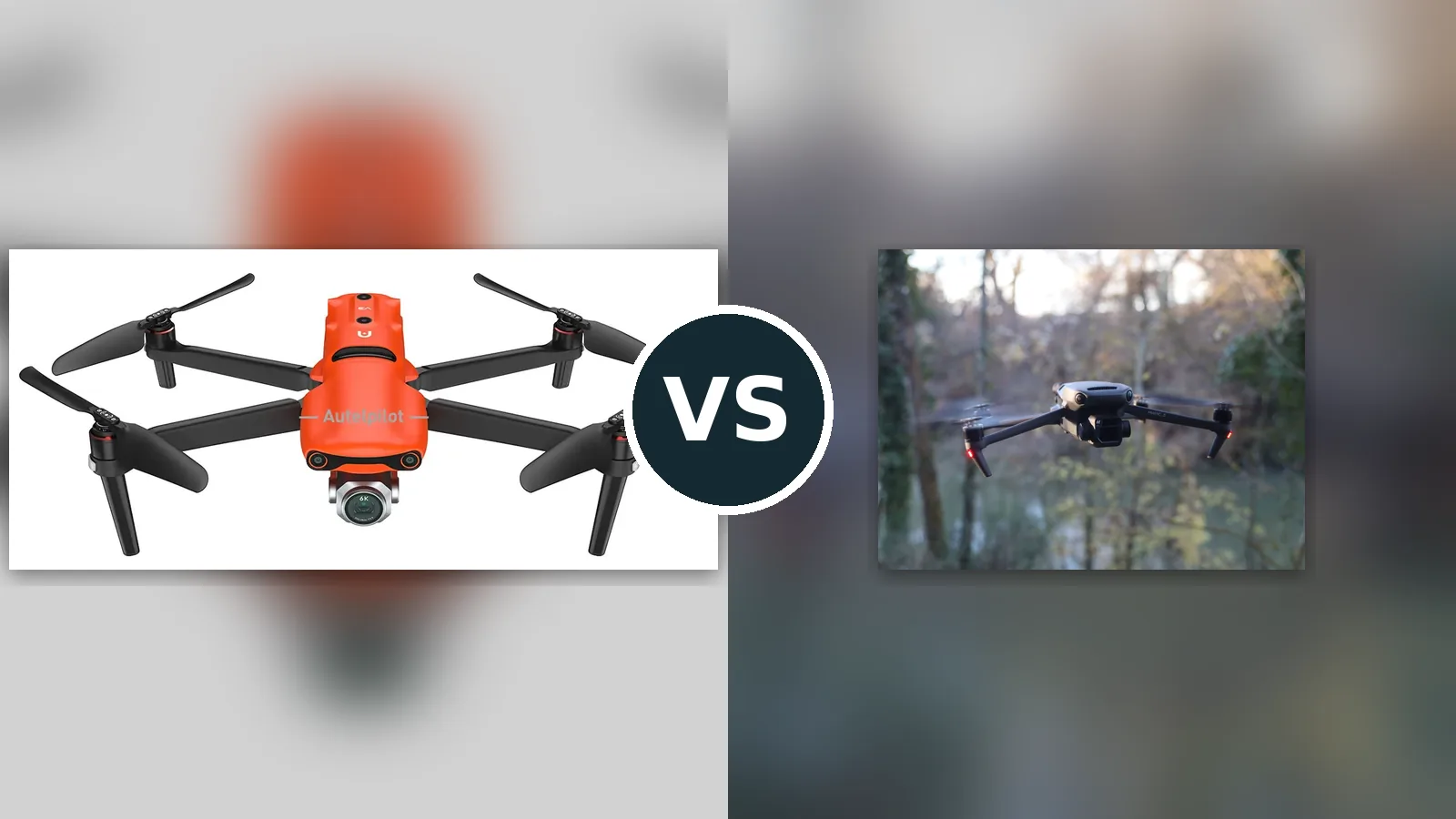
The autel evo ii pro vs mavic 3 comparison is the heavyweight title fight of this series: two professional folding drones with big sensors, long endurance, and omnidirectional sensing, built by the industry’s dominant maker and its most credible challenger. The Autel EVO II Pro answers DJI with a 1-inch sensor that shoots 6K video, an adjustable aperture, a 40-minute battery, and no geofencing locks in its flight software. The DJI Mavic 3 counters with a Four Thirds Hasselblad camera, a second telephoto camera, 46-minute endurance, and the deepest accessory and app ecosystem in the business. If you are spending professional money, this is the comparison that decides where it goes.
As an Amazon Associate, we earn from qualifying purchases.
Mavic 3 for most pros. EVO II Pro for the DJI-independent.
DJI Mavic 3 wins for most professionals: a larger Four Thirds sensor, a genuine 162mm telephoto camera, 46-minute flights, and DJI’s mature app, tracking, and support ecosystem. Autel EVO II Pro wins for pilots who want 6K from a 1-inch sensor, 12-bit DNG stills, a controller ecosystem outside DJI’s, and flight software without DJI’s geofencing system. Camera versatility: Mavic 3. Single-camera resolution: EVO II Pro. Endurance: Mavic 3. Independence from DJI: EVO II Pro, by design.

Autel EVO II Pro
For professionals who want 6K, 12-bit stills, and an alternative to the DJI ecosystem
- 1-inch sensor records 6K video and 12-bit DNG stills with an f/2.8 to f/11 aperture
- Omnidirectional binocular sensing and up to 15 km SkyLink 2.0 transmission
- Heavier than the Mavic 3 and supported by a smaller app and accessory ecosystem
Check availability and bundle options on Amazon

DJI Mavic 3
For professionals who want the best folding camera system DJI has built
- Four Thirds Hasselblad main camera plus a real telephoto second camera
- 46-minute endurance, O3+ transmission to 15 km, APAS 5.0 and ActiveTrack 5.0
- DJI’s geofencing and account systems are part of the ownership package
Check availability and bundle options on Amazon
Two professional tools, two ecosystems
At this level the spec sheets converge: big sensors, long batteries, full sensing. What separates these drones is the camera architecture and the company standing behind the software.
Choose the Mavic 3 if your work rewards flexibility. Its Four Thirds main camera delivers the best image quality in a folding drone of its generation, and the 162mm equivalent telephoto opens shots, inspections, wildlife, compressed landscapes, that a single wide camera cannot attempt. Add 46-minute endurance, the polished DJI Fly app, ActiveTrack 5.0, and an enormous knowledge base of parts, tutorials, and service options, and it is the default professional choice for a reason.
Choose the EVO II Pro if your work rewards independence and single-camera punch. Its 1-inch sensor shoots 6K video, higher resolution than the Mavic 3’s main camera output for stills extraction and cropping, and its 12-bit DNG stills carry exceptional editing depth. Autel’s flight software does not apply DJI-style geofencing authorization zones, which some professional operators strongly prefer, while remaining the pilot’s legal responsibility either way. Rugged bundles with the bright Smart Controller SE suit field and inspection work.
Both aircraft exceed 250 grams by a wide margin, both require registration and professional diligence, and both will produce client-grade work. The sections below separate camera, endurance, sensing, and ecosystem so the decision rests on your jobs, not brand gravity.
Buy the EVO II Pro if you:
- Want 6K and 12-bit stills: maximum single-camera resolution and editing depth
- Prefer flight software without DJI’s geofencing authorization system
- Value the Smart Controller SE’s bright built-in screen in field kits
- Work in inspection, mapping-adjacent, and public-safety style roles
Buy the DJI Mavic 3 if you:
- Need two cameras: Four Thirds wide plus a 162mm telephoto
- Want the longest endurance and the most mature app and tracking
- Rely on DJI’s service network, parts supply, and tutorial ecosystem
- Shoot cinematic work where the Hasselblad color science earns its keep
Autel EVO II Pro: the 6K challenger
Autel built the EVO II Pro to out-spec DJI’s professional line on the camera page, and wrapped it in an airframe meant for working pilots. The current V3 generation refines the formula with SkyLink 2.0 and the Moonlight Algorithm 2.0 for low light.
A 1-inch camera that shoots above its class
The Sony 1-inch CMOS sensor captures 20MP stills up to 5472 by 3648 and video up to 5472 by 3076 at 30fps, marketed as 6K, with 4K/60 and 1080p/120 beneath it at up to 120 Mbps in H.264 and H.265. The lens offers a 29mm equivalent view with an adjustable f/2.8 to f/11 aperture. Stills record as 12-bit DNG, a genuine professional differentiator that preserves enormous color depth for stills work, and the V3’s Moonlight Algorithm 2.0 pushes usable video ISO far into low light.
A 3-axis mechanical gimbal with a wide controllable range keeps footage steady, and digital zoom reaches 16x with up to 3x lossless in video. For photographers who think in single frames and maximum resolution, the EVO II Pro’s camera is the argument.
A working aircraft, sized accordingly
The V3 weighs 1,191 grams, folding to 230 by 130 by 108 millimeters, with a 397 mm wheelbase. Its 7100 mAh battery delivers a rated 40 minutes of flight, about 35 hovering, and SkyLink 2.0 transmission is rated to 15 km with tri-band frequency hopping. Maximum speed is 20 m/s in Ludicrous mode and cruise wind resistance is 12 m/s. Twelve vision sensors provide omnidirectional binocular sensing, and Dynamic Track follows subjects intelligently.
GNSS covers GPS, Galileo, BeiDou, and GLONASS. Internal storage is 8 GB with microSD support to 256 GB.
Autel’s software environment centers on the Autel Explorer app, and the company has steadily aimed the EVO II line at working crews: commercial, inspection, and public-safety operators are core Autel customers, and the platform’s accessories, from the Smart Controller line to enterprise-style bundles, reflect that. The standard controller in earlier kits even carried its own small built-in display, a philosophy the Smart Controller SE continues at 6.4 inches: the screen you fly with should not be a borrowed phone.
GNSS covers GPS, Galileo, BeiDou, and GLONASS. Internal storage is 8 GB with microSD support to 256 GB. Bundles pair the aircraft with controllers including the Smart Controller SE, a 6.4-inch OLED unit, which field crews appreciate in bright conditions. The honest costs: the EVO II Pro is the heavier aircraft here, Autel’s app ecosystem and third-party support are smaller than DJI’s, and its community knowledge base is thinner when something goes wrong at a job site.
DJI Mavic 3: the folding flagship formula
The Mavic 3 defined the modern professional folding drone: a Four Thirds camera, a telephoto second eye, endurance past 45 minutes, and DJI’s full software stack.
Two cameras, led by a Four Thirds Hasselblad
The main camera uses a Four Thirds CMOS sensor, the largest in any folding consumer drone of its generation, with 20MP stills behind a 24mm equivalent lens with an adjustable f/2.8 to f/11 aperture and Hasselblad color science. Video reaches 5.1K/50 and DCI 4K/120, with 10-bit D-Log and HLG profiles for grading. The second camera pairs a 1/2-inch 12MP sensor with a 162mm equivalent telephoto, enabling compressed, distant, and inspection-style shots without moving the aircraft into the subject’s space.
The Four Thirds sensor’s advantage is light: cleaner high-ISO footage, richer dynamic range, and stills that behave like a real camera’s. For cinematic and commercial work, this is the image pipeline to beat in a folding body.
Endurance and awareness in depth
At 895 grams, the Mavic 3 is meaningfully lighter than the EVO II Pro while flying longer: a rated 46 minutes, about 40 hovering, from its 5000 mAh, 77 Wh battery. O3+ transmission reaches 15 km FCC, top speed is 21 m/s, and wind resistance is 12 m/s. Omnidirectional sensing feeds APAS 5.0 obstacle routing and ActiveTrack 5.0 subject tracking, and Advanced Return to Home plans efficient, obstacle-aware paths back.
GNSS spans GPS, Galileo, and BeiDou, internal storage is 8 GB with microSD expansion, and the DJI Fly ecosystem brings waypoint flights, MasterShots, and Hyperlapse.
The Mavic 3’s software depth shows in the details working pilots lean on: waypoint missions that can be saved and reflown for repeatable progress documentation, cruise control that holds a steady forward speed for long tracking passes, and an omnidirectional sensing display that shows obstacle distances in the app as you fly. None of these headline a spec sheet, and all of them save time on a job.
GNSS spans GPS, Galileo, and BeiDou, internal storage is 8 GB with microSD expansion, and the DJI Fly ecosystem brings waypoint flights, MasterShots, and Hyperlapse. The trade-offs are DJI’s own systems: geofencing authorization in controlled areas, account-bound aircraft, and a telephoto camera whose small sensor is a daylight tool. None of that stops the Mavic 3 being the most complete professional folder of its era.
Specifications: challenger against flagship
Manufacturer ratings for the current EVO II Pro V3 and the standard Mavic 3. Both are professional aircraft; the differences are in camera architecture, weight, and ecosystem.
| Specification | Autel EVO II Pro | DJI Mavic 3 |
|---|---|---|
| Takeoff weight | 1,191 g (V3) | 895 g |
| Dimensions | Folded 230 × 130 × 108 mm; unfolded 457 × 558 × 108 mm | Folded 212 × 96 × 85 mm |
| Main camera sensor | 1-inch CMOS, 20MP | Four Thirds CMOS, 20MP Hasselblad |
| Main lens | 29mm equivalent, f/2.8 to f/11 | 24mm equivalent, f/2.8 to f/11 |
| Second camera | None; up to 16x digital zoom | Telephoto: 1/2-inch CMOS, 12MP, 162mm equivalent |
| Max video | 5472 × 3076 (6K class) at 30fps; 4K/60; 1080p/120 | 5.1K/50; DCI 4K/120; 1080p up to 200fps |
| Color and codecs | 10-bit A-Log, HDR; up to 120 Mbps; H.264/H.265 | 10-bit D-Log and HLG; H.264/H.265 |
| Photo formats | JPEG and 12-bit DNG RAW, up to 5472 × 3648 | JPEG and DNG RAW, 20MP |
| Gimbal | 3-axis mechanical | 3-axis mechanical |
| Obstacle sensing | Omnidirectional binocular vision, 12 sensors | Omnidirectional vision with APAS 5.0 |
| Tracking and modes | Dynamic Track 2.1, hyperlapse, orbit modes | ActiveTrack 5.0, MasterShots, Waypoint Flight, Hyperlapse |
| Rated flight time | 40 minutes (35 hovering) | 46 minutes (40 hovering) |
| Transmission | SkyLink 2.0, up to 15 km, tri-band | DJI O3+, up to 15 km FCC |
| Max speed | 20 m/s (Ludicrous mode) | 21 m/s |
| Wind resistance | 12 m/s in cruise | 12 m/s |
| GNSS | GPS, Galileo, BeiDou, GLONASS | GPS, Galileo, BeiDou |
| Internal storage | 8 GB plus microSD up to 256 GB | 8 GB plus microSD |
| Battery | 7100 mAh, 82 Wh | 5000 mAh, 77 Wh |
| Controllers | Standard controller; Smart Controller SE bundles with 6.4-inch OLED screen | RC-N1, DJI RC, and DJI RC Pro options |
EVO II Pro figures reflect the V3 generation as currently sold; earlier V1 and V2 aircraft differ in transmission range and controller. Mavic 3 figures are for the standard model, not the Cine variant.
Five differences that decide professional purchases
Both drones will produce work you can bill for. The professional question is which one’s strengths line up with your jobs, and which ecosystem you want to live in.
1. One big camera against two good ones
Depends on the jobThe EVO II Pro concentrates everything into one 1-inch camera: 6K video, 20MP stills, 12-bit DNG. For stills-led work and maximum-resolution video from a single viewpoint, that concentration pays. The Mavic 3 spreads its budget across a Four Thirds main camera and a 162mm telephoto, trading a little single-camera resolution for a second framing that changes what one flight can capture.
In practice, the telephoto gets used constantly: inspections from standoff distance, wildlife, compressed landscapes, detail shots during the same pass as the wide establishing shot. But for a photographer whose deliverable is the frame itself, the EVO’s 6K and 12-bit stills are the sharper tool. This round is a genuine split decision, resolved by your shot list.
There is a workflow consequence hiding in that choice. A Mavic 3 pilot plans one flight path and harvests two framings from it, which makes scouting faster and battery planning simpler on a busy location. An EVO II Pro pilot plans the shot itself more carefully, because the single camera rewards deliberate positioning, then walks away with files that tolerate aggressive cropping in post. Neither approach is wrong, but they favor different temperaments: the opportunist and the perfectionist.
2. Image quality at the margins
DJI Mavic 3The Mavic 3’s Four Thirds sensor is physically larger than the EVO’s 1-inch chip, and size governs the hard cases: high ISO, deep shadow recovery, dynamic range across a bright sky and dark ground. Hasselblad’s color tuning adds a natural, filmic starting point that colorists consistently praise.
Autel answers with processing: the V3’s Moonlight Algorithm 2.0 is a serious low-light video system, and 10-bit A-Log grades well. In good light the two are peers. At dawn, dusk, and indoors-adjacent work, the Mavic 3’s sensor physics win more frames.
In good light the contest tightens further for stills. The EVO’s 5472 by 3648 frames give commercial photographers large, detailed files, and its 12-bit depth means skies and skin tones survive strong edits without banding. The Mavic 3 counters with cleaner files as light falls, so an events or dusk specialist gets more keepers from the DJI. Choose by the light you actually work in, not the light you wish for.
3. Endurance and airframe
DJI Mavic 3The Mavic 3 flies a rated 46 minutes, weighs 895 grams, and folds smaller. The EVO II Pro flies 40 minutes at 1,191 grams. Those six minutes and 300 grams compound across a working day: fewer battery swaps, lighter cases, longer reaches on location with the DJI.
The EVO’s extra mass is not wasted; it is a stable, planted aircraft in wind, and its larger battery and motors suit methodical inspection flying. But as an all-day instrument, the Mavic 3’s endurance-to-weight ratio is simply better engineering.
Carry math matters more than spec sheets admit. Two aircraft, four batteries, controllers, and cases: the Mavic 3 kit crosses a location on foot without complaint, while the heavier Autel kit pushes crews toward vehicle-based work. Neither is wrong, but the difference decides which jobs each drone gets sent to.
4. Software philosophy: gates against responsibility
Autel EVO II ProDJI’s ecosystem includes geofencing: authorization zones that require unlocking through DJI before flight in controlled areas. Many pilots accept it; some professional operators find the friction and the dependency unacceptable on time-sensitive jobs. Autel does not impose an equivalent authorization system in its flight app, placing airspace compliance entirely on the pilot, where the law puts it anyway.
Be clear-eyed: no software setting changes your legal obligations, and both aircraft must be flown within the rules. But as a workflow philosophy, this is a real and deliberate difference, and for a slice of professional buyers it decides the purchase on its own.
Consider the rescheduled inspection or the breaking-news scene: the pilot who cannot fly until an unlock request clears carries a risk that has nothing to do with airmanship. That is the scenario Autel’s buyers cite most, and it is why entire fleets standardize on the platform that launches when the crew is ready. DJI’s defenders counter that unlocks are routine and fast for documented operators, and for planned work in known locations that is largely true.
5. Ecosystem, support, and resale
DJI Mavic 3DJI’s scale shows everywhere around the Mavic 3: batteries and parts on every continent, a deep bench of controllers, third-party accessories, tutorials for every feature, service centers, and strong resale demand. When a job depends on the drone, that infrastructure is insurance.
Autel’s ecosystem is competent and growing, with rugged bundles and controllers like the Smart Controller SE that many field users prefer, but it is smaller in every dimension. Buying the EVO II Pro is partly a bet on Autel’s trajectory, and owners should make it knowingly.
Pros and cons, plainly
Autel EVO II Pro
What it does best
- 6K video and 20MP stills from a 1-inch sensor
- 12-bit DNG stills with exceptional editing depth
- Adjustable f/2.8 to f/11 aperture
- No DJI-style geofencing authorization in the flight app
- Smart Controller SE bundles with a bright 6.4-inch OLED screen
Where it gives ground
- 1,191 grams: the heaviest aircraft in this comparison
- Single camera: no optical telephoto option
- Smaller app, accessory, and service ecosystem
- 40-minute endurance trails the Mavic 3
- Thinner community knowledge base for troubleshooting
DJI Mavic 3
What it does best
- Four Thirds Hasselblad main camera with superb color
- 162mm telephoto second camera for distant subjects
- 46-minute endurance at 895 grams
- APAS 5.0, ActiveTrack 5.0, and a mature DJI Fly workflow
- Deep parts, service, and accessory ecosystem
Where it gives ground
- Geofencing authorization is part of DJI ownership
- Telephoto camera’s 1/2-inch sensor is a daylight tool
- No Apple ProRes on the standard model
- Premium pricing across batteries and accessories
- Aircraft is bound to a DJI account ecosystem
Bundle checklist: professional kit decisions
At this level the aircraft is the beginning of the spend, not the end. These decisions determine whether the kit works on day one of a job.
- Version check on the EVO II Pro: the line spans V1, V2, and V3 generations with different radios and controllers. Confirm exactly which version and controller a listing includes before comparing bundles.
- Batteries are production capacity: plan a minimum of three flight batteries for paid work on either platform, and price them into the comparison; per-battery costs differ meaningfully.
- Controller choice matters: screen-equipped controllers like Autel’s Smart Controller SE and DJI’s RC Pro remove phone friction and brightness problems on site. Decide before you buy, since bundle economics favor choosing once.
- Storage workflow: 6K and 5.1K footage eats fast cards and faster drives. Budget high-endurance microSD cards and a real offload routine for either drone.
- Compliance is your job on both: registration, Remote ID, and airspace authorization apply to these weights everywhere; software differences do not change the law.
- ND filters and cases: both cameras have adjustable apertures, and both still benefit from ND sets for video; a fitted hard case protects a professional kit that travels for money.
Buy the ecosystem your work lives in.
For most professionals, the DJI Mavic 3 is the safer and more versatile instrument: two cameras, the best folding-drone image quality of its generation, the longest endurance, and an ecosystem that supports paid work at scale. The Autel EVO II Pro is the deliberate alternative: a 6K, 12-bit-stills single camera with an adjustable aperture, flown outside DJI’s authorization systems, in rugged bundles built for field crews. If your shot lists run wide and detailed, buy the Autel. If they run wide and far, buy the Mavic 3. Professionals will make money with either; the difference is which compromises match your jobs.
Your own working pattern settles it faster than any spec table. If your weeks are client shoots with shot lists, deliverables, and deadlines, the Mavic 3’s endurance, telephoto, and support network protect your schedule. If your work is field documentation where the drone must launch on your authority and the stills must survive heavy editing, the EVO II Pro’s camera concentration and software stance fit better. Solo creators crossing over into paid work usually grow into the Mavic 3’s versatility first, while established crews with defined roles often extract more from the Autel.
Questions buyers ask about this pairing
Which drone has the better camera, EVO II Pro or Mavic 3?
For versatility and low light, the Mavic 3: its Four Thirds sensor is larger, and the 162mm telephoto adds shots the Autel cannot take. For single-camera resolution, the EVO II Pro’s 6K video and 12-bit DNG stills are exceptional. Most filmmakers pick the Mavic 3; stills-led and inspection buyers often pick the Autel.
Does the Autel EVO II Pro really have no geofencing?
Autel’s flight software does not impose DJI-style authorization zones that require unlocking before flight. That does not change the law: airspace rules, registration, and authorization requirements from aviation authorities apply fully to both drones, and compliance is always the pilot’s responsibility.
Which flies longer?
The Mavic 3, rated at 46 minutes against the EVO II Pro’s 40 minutes, and the DJI does it while weighing about 300 grams less. In real conditions both land several minutes early, but the ranking holds: the Mavic 3 is the endurance leader of this pair.
Is the EVO II Pro V3 different from earlier versions?
Yes. The V3 generation brought SkyLink 2.0 transmission rated to 15 km, the Moonlight Algorithm 2.0 for low-light video, and bundles built around the Smart Controller SE. Earlier V1 and V2 aircraft use different radios and controllers, so verify the version in any listing.
Which is better for inspection work?
Both are used professionally. The Mavic 3’s telephoto allows standoff inspection without approaching structures, and its ecosystem speeds up reporting workflows. The EVO II Pro’s 6K resolution and 12-bit stills serve detailed documentation, and its rugged bundles suit field crews. The deciding factor is usually the software ecosystem your team already runs. Travel between sites matters too: the Mavic 3’s lighter, smaller kit makes multi-stop days easier, while the Autel’s heavier build feels at home on vehicle-based routes where the case lives in the truck.
Do both drones need registration and Remote ID?
Yes in the US: at 1,191 grams and 895 grams respectively, both are far above the 250-gram recreational threshold, so registration is required and Remote ID rules apply. Commercial operators need the appropriate certification for their work regardless of brand.
How this comparison was prepared
This is a research-based comparison; we did not fly either drone for this article. EVO II Pro specifications come from Autel’s official product documentation and the Autel store specification table for the V3 generation, cross-checked against B&H Photo and Adorama listings. Mavic 3 specifications come from DJI’s official Mavic 3 specifications page and user manual. Comments on geofencing reflect the manufacturers’ published software policies. Amazon listings for both drones were verified against the exact product titles before the links in this article were written.
Sources and verification
- Autel EVO II Pro V3 official product page and specification table (Autel store): camera, flight time, sensing, and transmission figures
- Autel EVO II Pro documentation (Autel Robotics)
- B&H Photo and Adorama EVO II Pro listings: specification cross-check
- DJI Mavic 3 official specifications (dji.com): dual camera, flight time, sensing, and transmission figures
- DJI Mavic 3 user manual (DJI)
- Amazon listing verification: Autel EVO II Pro and DJI Mavic 3 product titles matched to the linked listings
Last verified: October 20, 2026. Specifications, bundle contents, and availability may vary by region and over time.


