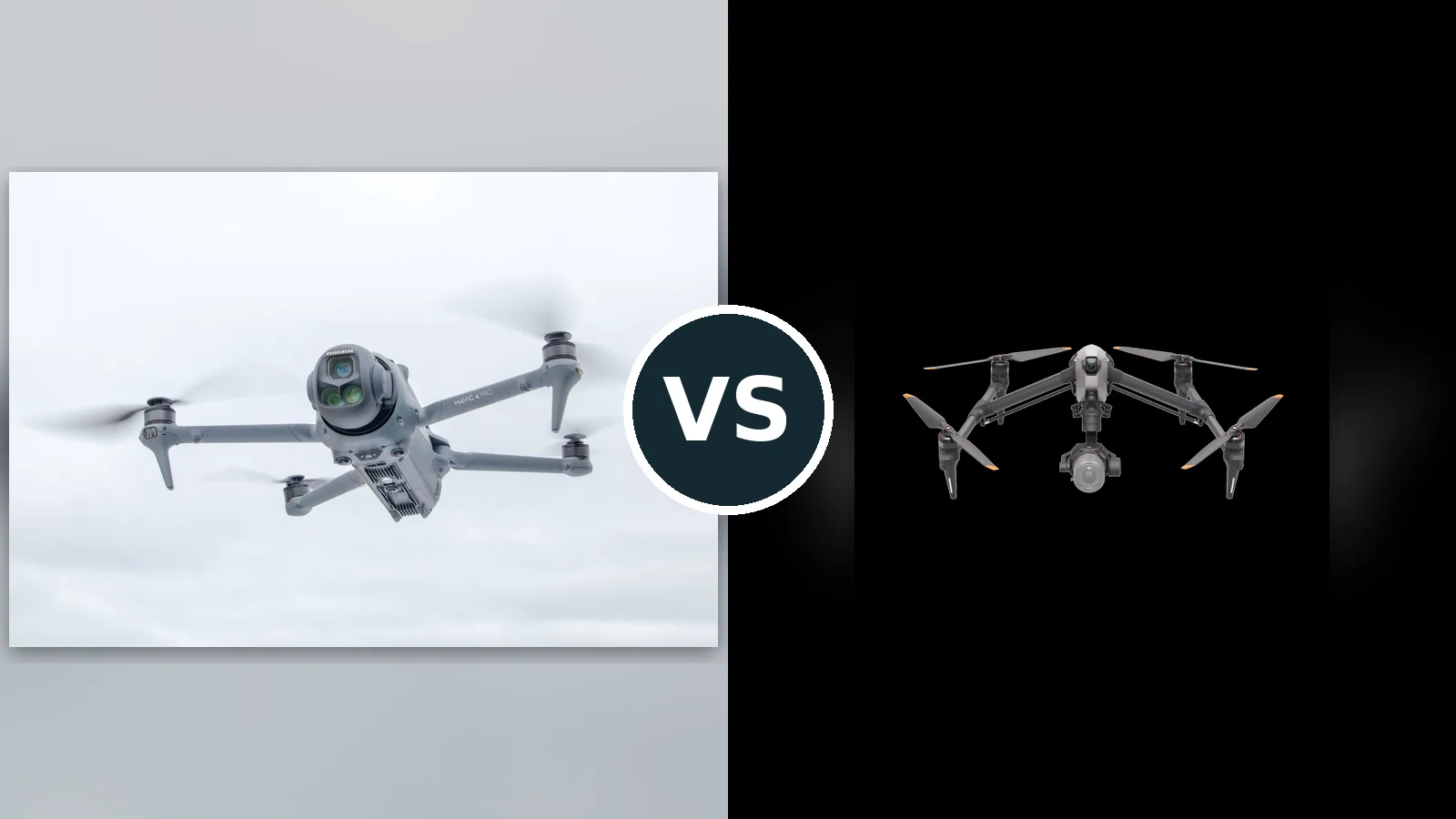
The mavic 4 pro vs inspire 3 question is really two questions: how much camera do you need, and how much are you willing to carry? The Mavic 4 Pro is DJI’s most advanced consumer drone, a folding triple-camera flagship with a 100MP Hasselblad sensor launched in May 2025. The Inspire 3 is a different animal: a full-frame 8K cinema platform with the Zenmuse X9-8K Air camera, built for film sets and budgets starting at $16,499. We compared camera, flight performance, portability, intelligent features, and kit cost so you can see what seven times the money buys.
Affiliate disclosure: As an Amazon Associate I earn from qualifying purchases. This page contains affiliate links. If you buy through them, we may earn a commission.
Mavic 4 Pro for almost everyone. Inspire 3 for film sets.
DJI Mavic 4 Pro wins the mavic 4 pro vs inspire 3 debate for the vast majority of buyers. Its 100MP Hasselblad triple camera shoots 6K/60fps HDR, it flies 51 minutes, it folds into a backpack, and it costs roughly one seventh of the Inspire 3. DJI Inspire 3 wins when the job demands a true cinema camera: full-frame 8K RAW, interchangeable lenses, and the repeatable precision of RTK positioning. Stills: Mavic. Cinema RAW: Inspire. Flight time and portability: Mavic, and it is not close. Professional video pipeline: Inspire, and it is not close either.
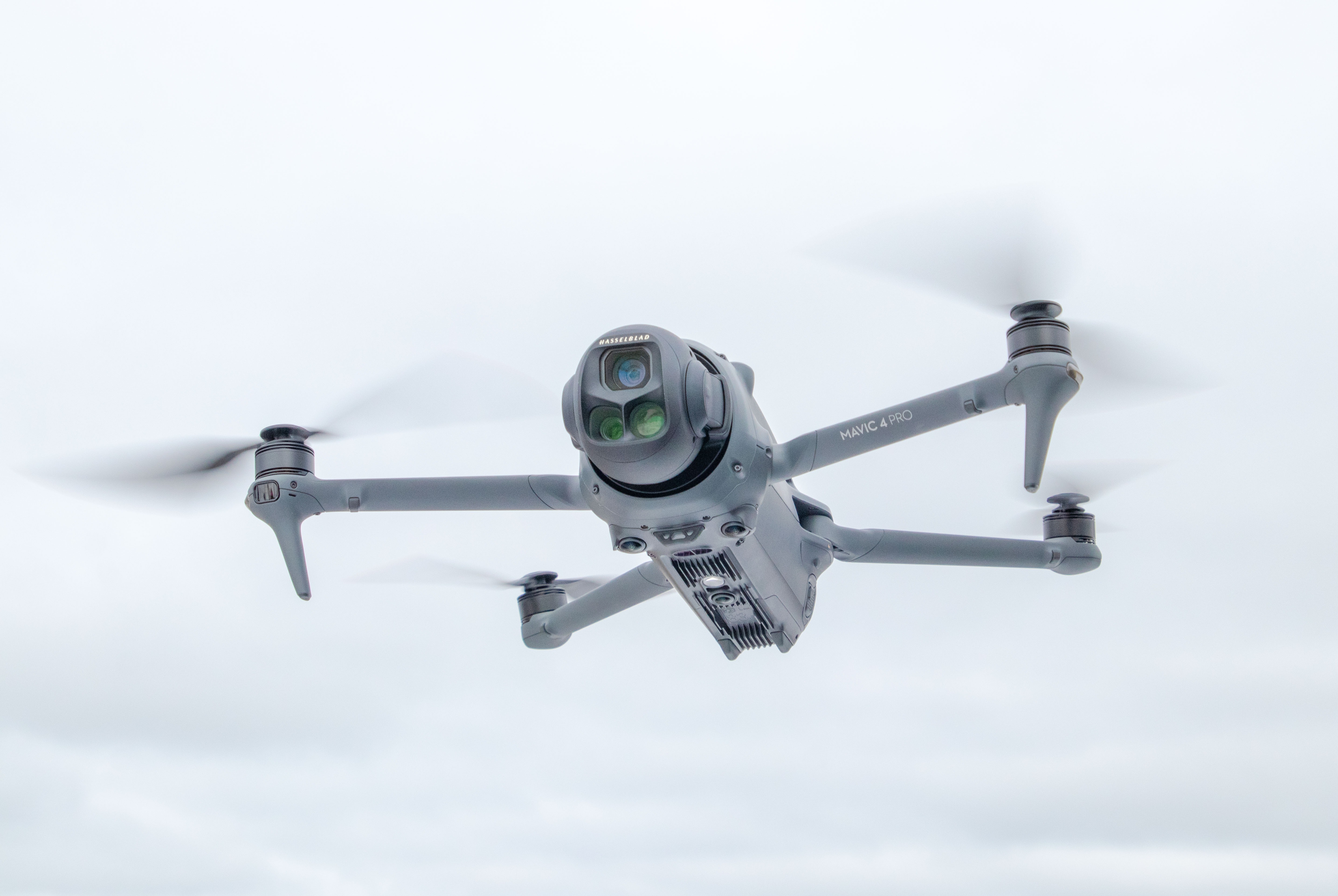
DJI Mavic 4 Pro
For creators who want the best camera drone that still fits in a backpack
- Triple camera system: 28mm, 70mm, and 168mm equivalents, all shooting 4K/60 HDR or better
- 360-degree Infinity Gimbal with 70-degree upward tilt for shots no other folding drone can get
- Never officially released in the US, so American buyers rely on gray-market import listings
Check current price and available bundles on Amazon
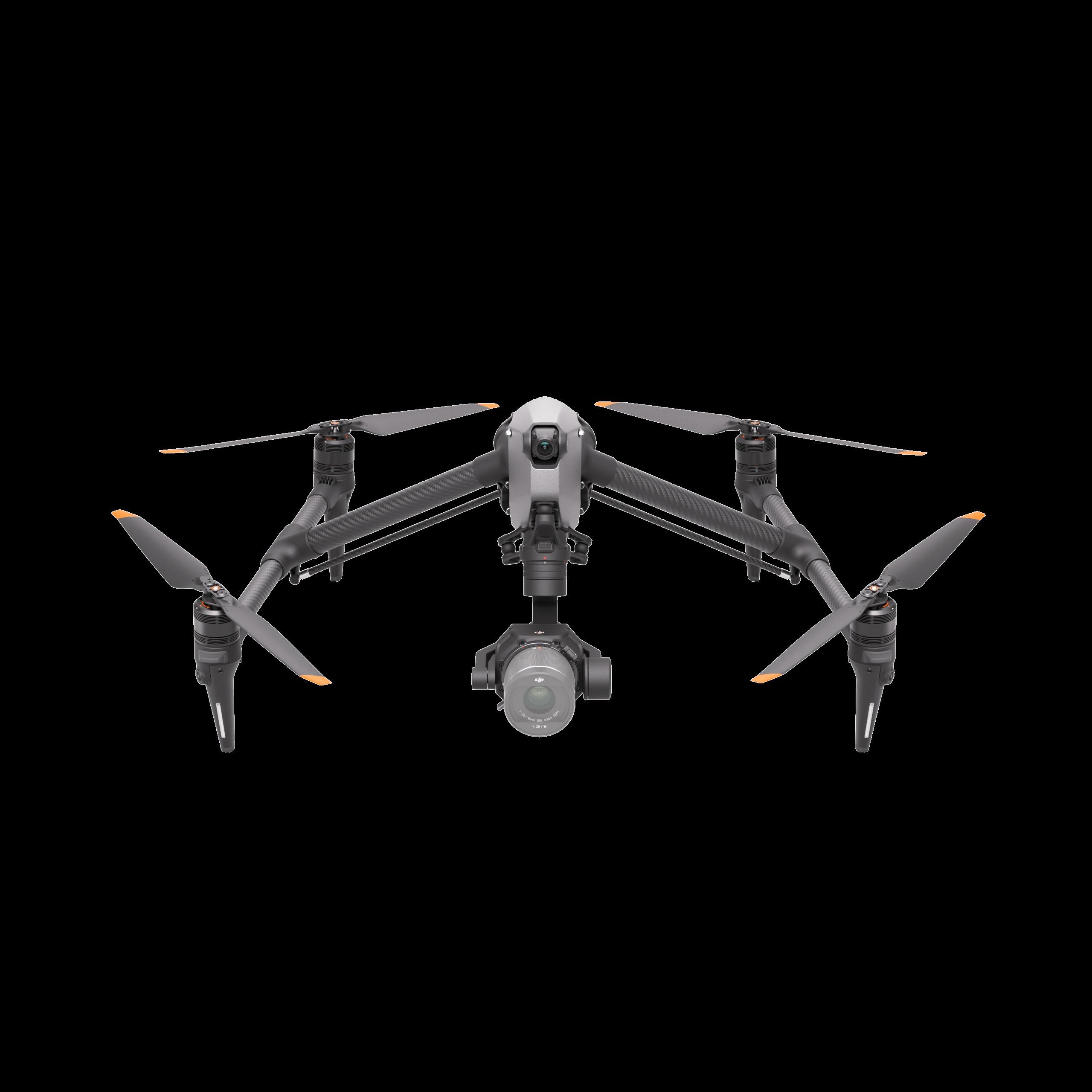
DJI Inspire 3
For productions that need a full-frame 8K camera on a repeatable flight platform
- Zenmuse X9-8K Air: 8K/75fps Apple ProRes RAW, 8K/25fps CinemaDNG, interchangeable DL lenses
- Centimeter-level RTK positioning and Waypoint Pro for shots you can repeat exactly, take after take
- The full combo costs $16,499, and this is a two-person, trolley-case production tool, not a travel drone
Check current price and available bundles on Amazon
DJI Mavic 4 Pro (left) · DJI Inspire 3 (right)
Which drone fits your flying?
Start with your main use case. The best choice should solve your needs, without charging you for features you will rarely use.
Anyone shopping the mavic 4 pro vs inspire 3 comparison is really asking whether their aerial work has outgrown the consumer world. The Mavic 4 Pro is the ceiling of what a folding camera drone can do. Its 100MP Hasselblad main camera captures 6K/60fps HDR video with 10-bit D-Log color, the 70mm medium tele and 168mm tele cameras give you three genuinely usable focal lengths without landing, and the 360-degree Infinity Gimbal rotates fully for vertical shots and dramatic moves. With 51 minutes of rated flight time, it stays in the air longer than anything else in its class.
The Inspire 3 belongs to a different profession. It is not a better Mavic; it is a flying cinema camera built for film sets, commercials, and broadcast work. The Zenmuse X9-8K Air is a full-frame sensor shooting 8K/75fps Apple ProRes RAW and 8K/25fps CinemaDNG, with interchangeable DL-mount lenses, dual native ISO, and more than 14 stops of dynamic range. It records to a 1TB DJI PROSSD, slots into professional color pipelines, and became the first drone approved for Netflix 4K Originals production. None of that matters to a weekend creator. All of it matters when the drone is an A-camera on a production.
There is also a cost reality that frames everything else. The Inspire 3 combo costs $16,499 and arrives in a trolley case with six batteries, a charging hub, the RC Plus controller, and the camera. A gray-market Mavic 4 Pro on Amazon typically lists around $2,100 to $2,200 for the base kit. That means the Inspire 3 costs roughly seven times as much while flying barely half as long per battery, weighing nearly four times as much, and needing a two-person crew. If you cannot name the specific production job that requires the Inspire 3, the Mavic 4 Pro is the right answer.
Choose DJI Mavic 4 Pro if…
- Maximum image quality per dollar is your main concern, from 100MP stills to 6K HDR video to three telephoto focal lengths.
- You mostly shoot solo: real estate, weddings, travel films, YouTube, and commercial work that fits in one backpack.
- You prefer a folding drone with 51-minute flights, 30 km O4+ transmission, and omnidirectional sensing with LiDAR.
- You can accept that US buyers face gray-market import listings, since DJI never officially released it in America.
Choose DJI Inspire 3 if…
- A professional cinema pipeline is your main concern: full-frame 8K RAW, interchangeable lenses, and Netflix-approved footage.
- You need repeatable precision: centimeter-level RTK positioning, Waypoint Pro, and dual-operator control for complex shots.
- You value the DJI PRO ecosystem: PROSSD media, Master Wheels, follow focus, and timecode sync with ground cameras.
- You can accept a $16,499 trolley-case production system with 28-minute flights that needs a crew, not a daypack.
Mavic 4 Pro vs Inspire 3: The Specs That Actually Matter
Compare the exact battery, controller and bundle versions you intend to buy.
| Feature | DJI Mavic 4 Pro | DJI Inspire 3 |
|---|---|---|
| Best suited to | Solo creators, real estate, travel films, high-end prosumer work | Film sets, commercials, broadcast, Netflix-approved productions |
| Takeoff weight | Approx. 1,063 g | Approx. 3,995 g (with camera, two batteries, lens, PROSSD, propellers) |
| Dimensions | Folds to 257.6 x 124.8 x 106.6 mm | Travel mode 709.8 x 500.5 x 176 mm; trolley case required |
| Sensor and lenses | 4/3 CMOS Hasselblad 100MP (28mm, f/2.0-11); 1/1.3-inch 48MP (70mm, f/2.8); 1/1.5-inch 50MP (168mm, f/2.8) | 35mm full-frame CMOS, 44.7MP stills; interchangeable DL mount (18/24/35/50mm f/2.8, 75mm f/1.8) |
| Video modes | 6K/60fps HDR (main), 4K/120fps (main and medium tele), 4K/100fps (tele), native 4K vertical | 8K/75fps Apple ProRes RAW, 8K/25fps CinemaDNG, full-frame 4K/120fps ProRes RAW in S&Q mode |
| Color and codecs | 10-bit D-Log, D-Log M, HLG; H.264/H.265, up to 180 Mbps; JPEG and DNG RAW stills | D-Log, DJI Cinema Color System; CinemaDNG and Apple ProRes RAW (license key sold separately), ProRes 422 HQ, H.264 |
| Dynamic range | DJI claims up to 16 stops (Hasselblad main camera) | 14+ stops; dual native ISO (EI 800/4000 at 30fps and below) |
| Gimbal | 3-axis Infinity Gimbal: 360-degree rotation, 70-degree upward tilt | 3-axis: 360-degree pan, 80-degree Tilt Boost with landing gear lowered |
| Obstacle sensing | Omnidirectional binocular vision plus forward-facing LiDAR; 0.1-lux night sensing | Omnidirectional with nine vision sensors plus ToF infrared; customizable sensing |
| Subject tracking | ActiveTrack 360, MasterShots, Waypoint Flight, Cruise Control, Hyperlapse | Spotlight Pro AI tracking, Waypoint Pro with repeatable routes, 3D Dolly |
| Positioning | GPS + Galileo + BeiDou | GPS + Galileo + BeiDou plus centimeter-level RTK (1 cm horizontal) |
| Rated flight time | 51 minutes max; 45 minutes hovering | 28 minutes max (landing gear lowered); 25 minutes hovering |
| Real-world flight time | Not tested by us; reviewers report roughly 43 minutes in 15 to 20 mph wind | Not tested by us; independent tests report roughly 22 to 24 minutes of normal flying with 4K recording |
| Max speed | 25 m/s Sport mode | 94 km/h (58.4 mph) Sport mode |
| Video transmission | DJI O4+, up to 30 km FCC, 10-bit HDR live feed | DJI O3 Pro, up to 15 km FCC, up to 4K/30fps live feed, dual-operator control |
| Wind resistance | 12 m/s | 12 m/s takeoff and landing; 14 m/s in flight |
| Storage | 64 GB internal (42 GB usable); 512 GB on Creator Combo; microSD supported | DJI PROSSD 1TB; no microSD slot on the aircraft |
| Controller and bundle | DJI RC 2 or RC Pro 2 (7-inch Mini-LED, 2000 nits); Creator Combo adds batteries, hub, 512 GB storage | RC Plus (7-inch, 1200 nits, 3.3-hour built-in battery); combo includes 6 TB51 batteries, hub, PROSSD 1TB, trolley case |
| Launch price | Around $2,699 in official markets; gray-market US listings around $2,100 to $2,200 | $16,499 combo; Amazon dealer listing seen at $15,999 |
| Main trade-off | Not a cinema camera: smaller sensor, no interchangeable lenses, no RAW video | Not a travel drone: 4 kg, 28-minute flights, trolley case, crew operation, and a cinema price |
Manufacturer ratings are lab figures; real-world flight time is lower. Prices shown are launch or recent market references; check the live Amazon listing for the current price. Last verified: October 20, 2026.
DJI Mavic 4 Pro (left) · DJI Inspire 3 (right)
Mavic 4 Pro vs Inspire 3: Five Differences That Matter
For each category, here is the difference, its practical impact and which buyer benefits.
1. Camera quality and creative flexibility
Edge: SplitThis is the heart of the mavic 4 pro vs inspire 3 debate, and it refuses to produce a single winner. The Mavic 4 Pro has the finest stills camera ever put on a folding consumer drone: a 100MP 4/3 Hasselblad sensor with an f/2.0 to f/11 aperture, shooting 6K/60fps HDR video with 10-bit D-Log color. The 70mm medium tele (48MP) and 168mm tele (50MP) both shoot 4K HDR, so you can punch in from hundreds of meters away without landing. For photography, the Mavic 4 Pro wins outright: 100MP DNG RAW files, five-frame RAW stacking, and dual native ISO fusion give stills shooters enormous latitude.
The Inspire 3 answers with a camera from a different industry. The Zenmuse X9-8K Air is a full-frame sensor recording 8K/75fps Apple ProRes RAW and 8K/25fps CinemaDNG, with interchangeable DL-mount lenses and more than 14 stops of dynamic range. Full-frame 4K/120fps ProRes RAW in S&Q mode and the DJI Cinema Color System let the footage cut against ground-based cinema cameras in a color suite. The Mavic 4 Pro cannot record RAW video at all, and no consumer codec survives the grading that ProRes RAW shrugs off. The split is honest: stills and versatility go to the Mavic 4 Pro, while motion-picture image quality goes to the Inspire 3 by a distance no firmware update can close.
2. Portability and travel
Edge: Mavic 4 ProThis is the most lopsided category in the comparison. The Mavic 4 Pro folds to roughly 258 by 125 by 107 mm and weighs about 1,063 g. It slides into a camera backpack next to a mirrorless body, and one person can carry the drone, controller, three batteries, and a charging hub as hand luggage. Setup takes about a minute: unfold the arms, power on, and the RC Pro 2’s 7-inch 2000-nit display is readable in direct sun.
The Inspire 3 travels as freight. The aircraft alone weighs nearly 4 kg, and the combo ships in a wheeled trolley case with the RC Plus controller, six 470 g batteries, a 1.68 kg charging hub, the PROSSD, lenses, and propellers. Travel-mode dimensions run about 710 by 500 by 176 mm before the case. The 98.8 Wh batteries sit just under the 100 Wh airline carry-on limit, but six of them means planning battery logistics like a production manager. The transformable landing-gear design is brilliant for unobstructed camera moves, but it adds bulk no folding mechanism can hide.
3. Flight time, range, and endurance
Edge: Mavic 4 ProDJI rates the Mavic 4 Pro at 51 minutes of flight time and 45 minutes of hovering on a 95 Wh battery, with a maximum flight distance of 41 km. Real-world reports are kind to it: reviewers flying in 15 to 20 mph wind still report around 43 minutes, roughly 85 percent of the rated figure. That covers a full real estate shoot or multiple locations on one battery. The O4+ transmission reaches 30 km under FCC rules with a 10-bit HDR live feed, so the drone runs out of battery long before it runs out of signal, and a 240W charger refills three batteries in about 90 minutes.
The Inspire 3 is rated at 28 minutes with the landing gear lowered and 26 minutes with it raised, hovering for about 25 minutes, and independent testing lands around 22 to 24 minutes of normal flying with 4K recording, dropping toward 19 to 21 minutes in aggressive 8K ProRes RAW work. The dual-battery system supports hot swapping, which is genuinely useful on set, but two 98.8 Wh batteries buy less than half the airtime of one Mavic 4 Pro battery, and O3 Pro transmission tops out at 15 km. For a cinema drone this is acceptable, because film sets fly short, planned takes. For everyone else, the Mavic 4 Pro simply stays up far longer.
4. Intelligent features and professional workflow
Edge: Inspire 3Both drones are smart, but about different jobs. The Mavic 4 Pro is the smarter solo operator: ActiveTrack 360 keeps a subject framed even in the dark or behind obstacles, MasterShots automates a full cinematic sequence, Waypoint Flight and Cruise Control handle repeatable moves, and omnidirectional sensing with forward LiDAR gives 0.1-lux night vision for confident after-dark flying. These features exist to replace a crew.
The Inspire 3 is the smarter production tool. Waypoint Pro locks altitude, speed, gimbal angle, and camera settings for identical takes, and 3D Dolly mimics crane, cable cam, and dolly moves. Centimeter-level RTK positioning delivers 1 cm horizontal accuracy, making the flight path a measurable instrument. Spotlight Pro uses AI tracking while the pilot flies, and dual-operator mode lets a camera operator run the gimbal on a second RC Plus. Then the media pipeline: 1TB PROSSD storage, timecode sync with ground cameras, and compatibility with Master Wheels and follow focus. If your workflow includes a DIT, a colorist, and a shot list, the Inspire 3 is the only drone here that speaks that language.
5. Price and total value
Edge: Mavic 4 ProCompare what you actually pay to start working. In markets where DJI sells it officially, the Mavic 4 Pro launched around $2,699 with the DJI RC 2 controller, and the 512GB Creator Combo with the RC Pro 2 runs higher. For US buyers there is a wrinkle: DJI never officially released the Mavic 4 Pro in America, so Amazon listings are gray-market imports, typically around $2,100 to $2,200 for the base kit. That is still an extraordinary amount of drone for the money. Understand the trade: gray-market imports can mean limited warranty support, so check the seller’s return terms before you buy.
The Inspire 3 combo costs $16,499 and includes the aircraft, the Zenmuse X9-8K Air camera, the RC Plus controller, six batteries, the charging hub, a 1TB PROSSD, propellers, the lens box, and the trolley case. An Amazon dealer listing was spotted at $15,999, but most buyers purchase through DJI Enterprise dealers who provide the support a production depends on. There are also costs the sticker price hides: the CinemaDNG and Apple ProRes RAW license is a separate $979 purchase, DL lenses run $1,199 to $1,299 each, and a spare battery is $349. None of this is a ripoff; it is cinema-equipment economics, where a single ground-camera lens can cost more than the entire Mavic 4 Pro. But the real Inspire 3 investment sits comfortably above $16,499, while a complete Mavic 4 Pro kit stays well under $4,000.
Mavic 4 Pro vs Inspire 3: What You Gain and Give Up
DJI Mavic 4 Pro
Reasons to choose it
- 100MP Hasselblad main camera with 6K/60fps HDR, plus 70mm and 168mm tele cameras that are genuinely useful
- 51-minute rated flight time with real-world reports near 43 minutes, the longest in its class by a wide margin
- Folds into a backpack at 1,063 g, with 30 km O4+ transmission and omnidirectional sensing plus LiDAR
- 360-degree Infinity Gimbal with 70-degree upward tilt for shots no folding drone could get before
- Roughly one seventh the price of the Inspire 3 combo, with a far lower total cost of ownership
Reasons to reconsider
- No RAW video recording and no interchangeable lenses, so it can never join a professional cinema pipeline
- Never officially released in the US; American buyers depend on gray-market imports with uncertain warranty support
- At 1,063 g it needs registration in most countries and cannot fly in the sub-250g regulatory category
- The 4/3 sensor, excellent as it is, cannot match full-frame depth of field or low-light performance
- No RTK positioning, no dual-operator mode, and no timecode sync for multi-camera productions
DJI Inspire 3
Reasons to choose it
- Full-frame Zenmuse X9-8K Air: 8K/75fps ProRes RAW, 8K/25fps CinemaDNG, interchangeable DL lenses, 14+ stops of dynamic range
- First drone ever approved for Netflix 4K Originals production, with a color pipeline built for professional post
- Centimeter-level RTK positioning, Waypoint Pro repeatable routes, and 3D Dolly for exact, repeatable cinema moves
- Dual-operator control, 1TB PROSSD media, timecode sync, and full DJI PRO ecosystem compatibility
- 360-degree pan and 80-degree Tilt Boost for upward shots no folding drone can attempt
Reasons to reconsider
- $16,499 combo price, plus a $979 RAW license, $1,199-plus lenses, and $349 batteries
- 28 minutes of rated flight time that shrinks fast in real 8K recording, with a 4 kg airframe to transport
- Trolley-case logistics, six batteries to manage, and realistically a two-person crew to operate it well
- Sold through dealers and the DJI Enterprise channel; not a walk-in consumer purchase
- Vastly overpowered for photos, YouTube, and travel work, where the Mavic 4 Pro is better and cheaper
Check the bundle, not just the drone
The drone on the box is only half the purchase. Run through this checklist before you tap buy.
- US availability (Mavic 4 Pro): DJI never officially released the Mavic 4 Pro in the United States, and DJI was added to the FCC Covered List in late 2025, so American buyers rely on third-party import listings. Confirm the exact model, controller, and region firmware in the listing, and read the seller’s warranty and return terms carefully before ordering.
- Controller: The Mavic 4 Pro ships with the DJI RC 2 or the RC Pro 2 with its 7-inch 2000-nit Mini-LED display; the RC Pro 2 is worth it in bright sun. The Inspire 3 comes with the RC Plus, with a 7-inch 1200-nit screen and about 3.3 hours of built-in battery, extendable to 6 hours with an external WB37 battery.
- Batteries: The Mavic 4 Pro’s 95 Wh battery delivers the headline 51 minutes, so two or three cover a full day. The Inspire 3 combo includes six 98.8 Wh TB51 batteries and a 476W charging hub that fast-charges pairs to 90 percent in 35 minutes; the hot-swap design keeps the aircraft powered during changes.
- Media and storage: The Mavic 4 Pro has 64 GB internal storage (about 42 GB usable) plus microSD support, or 512 GB on the Creator Combo. The Inspire 3 records to a 1TB DJI PROSSD at $799 a pop, with no microSD slot, so budget for at least one spare.
- RAW license (Inspire 3): The headline CinemaDNG and Apple ProRes RAW recording modes require a separate $979 license key. Without it you are limited to ProRes 422 HQ and H.264, so factor this into the real cost before you compare prices.
- Listing: On Amazon, confirm the exact model name, controller, and battery count in the listing title, and check that the seller is reputable with clear return terms. For the Inspire 3, consider an authorized DJI Enterprise dealer instead, since they provide the support a production depends on.
- Local requirements: Both drones are well over 250 g, so registration is required in the US and most other countries, and commercial work typically needs the appropriate certification. The Inspire 3’s size and weight also make insurance and airspace authorizations a standard part of every job.
The right choice comes down to the job, not the specs.
If you are a creator, photographer, or solo commercial operator, buy the Mavic 4 Pro. It is the most capable camera drone you can fold into a backpack: a 100MP Hasselblad triple camera, 51-minute flights, a 360-degree gimbal, and a price that leaves room for everything else. If you run a production company or shoot for broadcast or streaming, buy the Inspire 3. Nothing else here offers full-frame 8K RAW, interchangeable lenses, RTK precision, and a Netflix-approved pipeline. It costs roughly seven times as much because it does a different job, and for that job there is no substitute near its price.
Still deciding?
Is the Inspire 3 worth seven times the price of the Mavic 4 Pro?
Only if you are selling cinema-grade footage. The Inspire 3 earns its price on film sets, where full-frame 8K RAW, interchangeable lenses, RTK precision, and a Netflix-approved pipeline are billable capabilities no consumer drone offers. For photography, YouTube, real estate, and travel work, the extra money buys nothing you can see in the final deliverable, and the Mavic 4 Pro is the better tool at one seventh of the cost.
Can I buy the Mavic 4 Pro in the US?
Not officially. DJI never released the Mavic 4 Pro in the United States, and DJI’s addition to the FCC Covered List in late 2025 closed the door on official imports. American buyers can find it on Amazon through third-party import sellers, typically around $2,100 to $2,200 for the base kit. Check the exact model and controller in the listing, and read the seller’s warranty and return terms, since gray-market imports do not carry standard DJI US warranty support.
Which drone takes better photos?
The Mavic 4 Pro, comfortably. Its 100MP 4/3 Hasselblad sensor with DNG RAW, an f/2.0 to f/11 adjustable aperture, and three focal lengths make it a genuine aerial photography camera. The Inspire 3 shoots 44.7MP stills that are excellent, but its camera was designed for motion pictures, not stills, and it carries a 4 kg production system to do it.
Which drone is better for video production?
It depends on the production. For solo and small-crew video work, the Mavic 4 Pro’s 6K/60fps HDR, 4K/120fps slow motion, and 10-bit D-Log color are superb and far easier to shoot with. For professional film and broadcast, the Inspire 3’s full-frame 8K ProRes RAW and CinemaDNG, interchangeable lenses, and 14+ stops of dynamic range are in a different league, and it is the only drone here a colorist would accept as an A-camera.
Do I need the $979 RAW license for the Inspire 3?
If you bought the Inspire 3 for its RAW capabilities, yes. The CinemaDNG and Apple ProRes RAW recording modes require a separate license key sold by DJI. Without it, the camera records ProRes 422 HQ and H.264, which are fine for many jobs but not the headline cinema formats. Factor the license into your budget before you compare the Inspire 3’s price against anything else.
How were these drones compared?
This is a research-based comparison: we compiled specifications from DJI’s official spec pages for both aircraft, then cross-checked them against independent coverage from outlets like DroneXL, Y.M.Cinema, TechNode, New Atlas, and Globe Drones. We did not fly either drone for this article, so rated figures are DJI’s lab numbers and real-world figures are attributed to the reviewers who measured them. Amazon ASINs were verified by matching each ASIN against the exact product title across Amazon-indexed listing data and third-party price trackers before any affiliate link was written. See the methodology section below for the full source list.
How this comparison was prepared
This is a research-based comparison. We did not fly either drone for this article, and we do not imply otherwise. Every specification in the table above comes from DJI’s official documentation, with launch pricing, bundle contents, and availability cross-checked against DJI’s official store pages and launch coverage. Where this article mentions real-world flight times, those figures are attributed to independent reviewers who measured them. Amazon ASINs were verified by matching each ASIN against the exact product title across Amazon-indexed listing data and third-party price trackers before any affiliate link was written. The Inspire 3 listing found on Amazon is a third-party dealer listing, which is normal for an enterprise product that DJI primarily sells through dealers.
Sources and verification
- DJI Mavic 4 Pro official specifications (dji.com, accessed October 20, 2026): aircraft, camera, gimbal, sensing, transmission, and battery figures
- DJI Inspire 3 official specifications (dji.com, accessed October 20, 2026): aircraft, gimbal camera, sensing, transmission, battery, and controller figures
- DJI Inspire 3 official store page (store.dji.com, accessed October 20, 2026): combo contents, pricing, and product image
- DJI Mavic 4 Pro launch coverage (DroneXL, The Tech Outlook, Mezha, May 2025): launch date, pricing, and feature descriptions
- DroneXL Mavic 4 Pro coverage: long-term review verdict, US gray-market status, third-party listings
- DJI Rumors Mavic 4 Pro spec roundup (updated June 2026): official-market pricing, gray-market US pricing, FCC Covered List status
- TechNode Inspire 3 launch report (April 2023): launch price, combo contents, shipping timeline
- Globe Drones Inspire 3 review: measured real-world flight times and charging details
- Y.M.Cinema Inspire 3 Netflix approval coverage (April 2025): Netflix approval, Amazon dealer listing at $15,999
- New Atlas and Popular Photography Inspire 3 launch coverage: combo contents, pricing, accessory prices
- ASIN verification: Mavic 4 Pro (B0DS2HDF1M, DJI RC 2 edition) via pricehistory.app Amazon store record; Inspire 3 (B0GXX5J2YX) via Y.M.Cinema Amazon link data labeling it DJI Inspire 3 at $15,999
Last verified: October 20, 2026. Bundle availability, pricing, and specifications may vary by region and version. Prices in this article are launch or recent market reference prices; check the live Amazon listing for the current price.