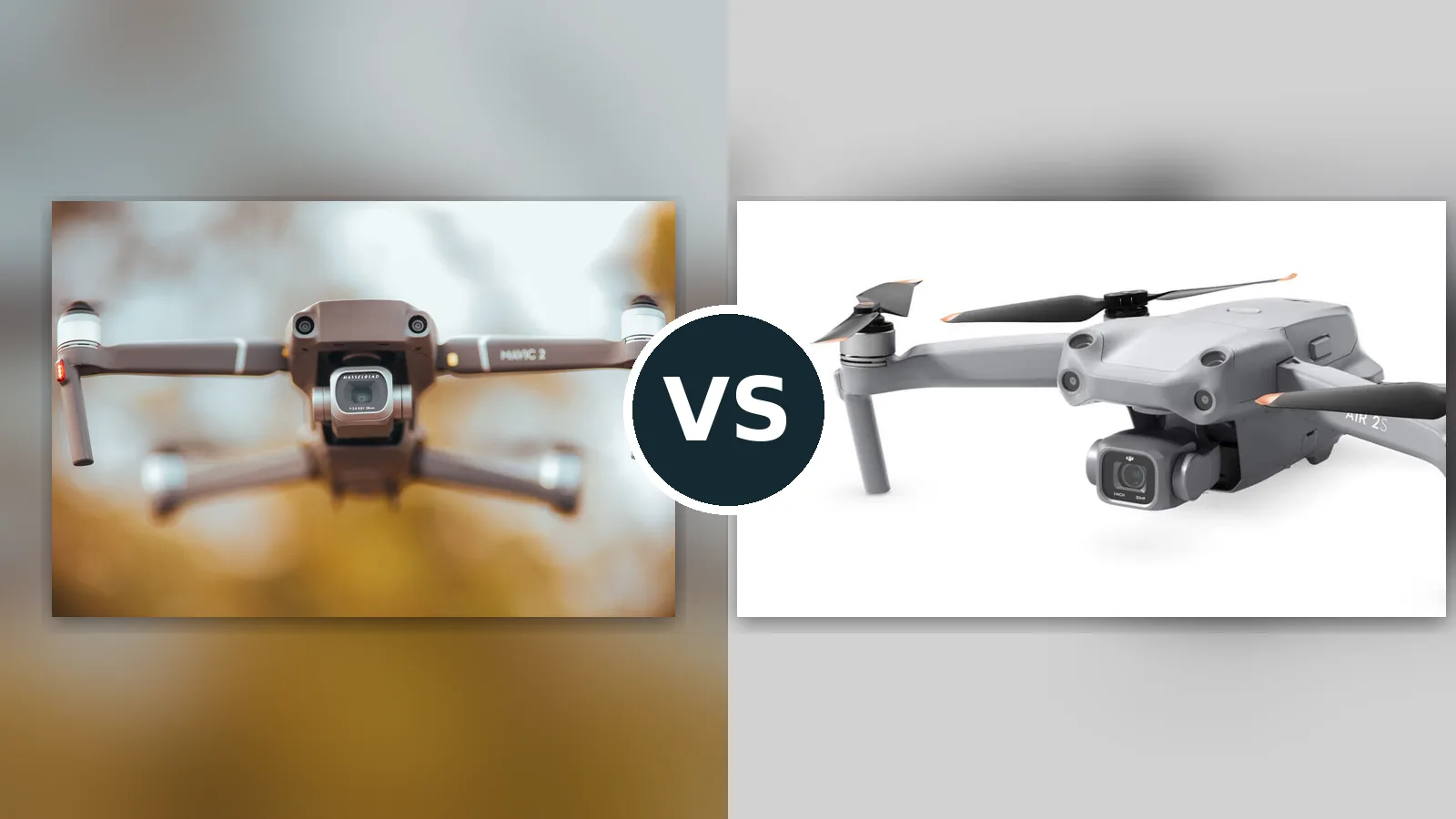
The mavic 2 pro vs air 2s question is really about what you prize most in a flying camera: pedigree or modernity. The Mavic 2 Pro is DJI’s 2018 flagship, the drone that put a Hasselblad camera in the sky, and it still carries the one feature almost no modern drone has: an adjustable aperture. The Air 2S is DJI’s 2021 answer, lighter and sharper in the video department, with 5.4K recording and a transmission link that reaches twice as far. Both pack a 1-inch 20MP sensor, both fly for a rated 31 minutes, and both have earned loyal followings for good reasons. One of them you can still buy new with a warranty. The other you hunt down on the used market, where it sells for a fraction of its launch price. We compared the camera, portability, flight features and complete kit cost so you can decide which one deserves your money.
Affiliate disclosure: As an Amazon Associate I earn from qualifying purchases. This page contains affiliate links. If you buy through them, we may earn a commission.
Air 2S for most. Mavic 2 Pro for the photographer.
DJI Air 2S wins this comparison for most buyers: it shoots sharper video at higher resolution, weighs a third less, flies farther on a more modern transmission link, and you can still buy it new with a warranty. DJI Mavic 2 Pro wins for stills photographers who value its Hasselblad color science and its adjustable aperture, a genuine photographic tool you can now pick up on the used market for a fraction of its $1,449 launch price. Photos: Mavic 2 Pro. Video: Air 2S. Portability: Air 2S. Sensing: Mavic 2 Pro. Value: depends on whether you trust the used market.
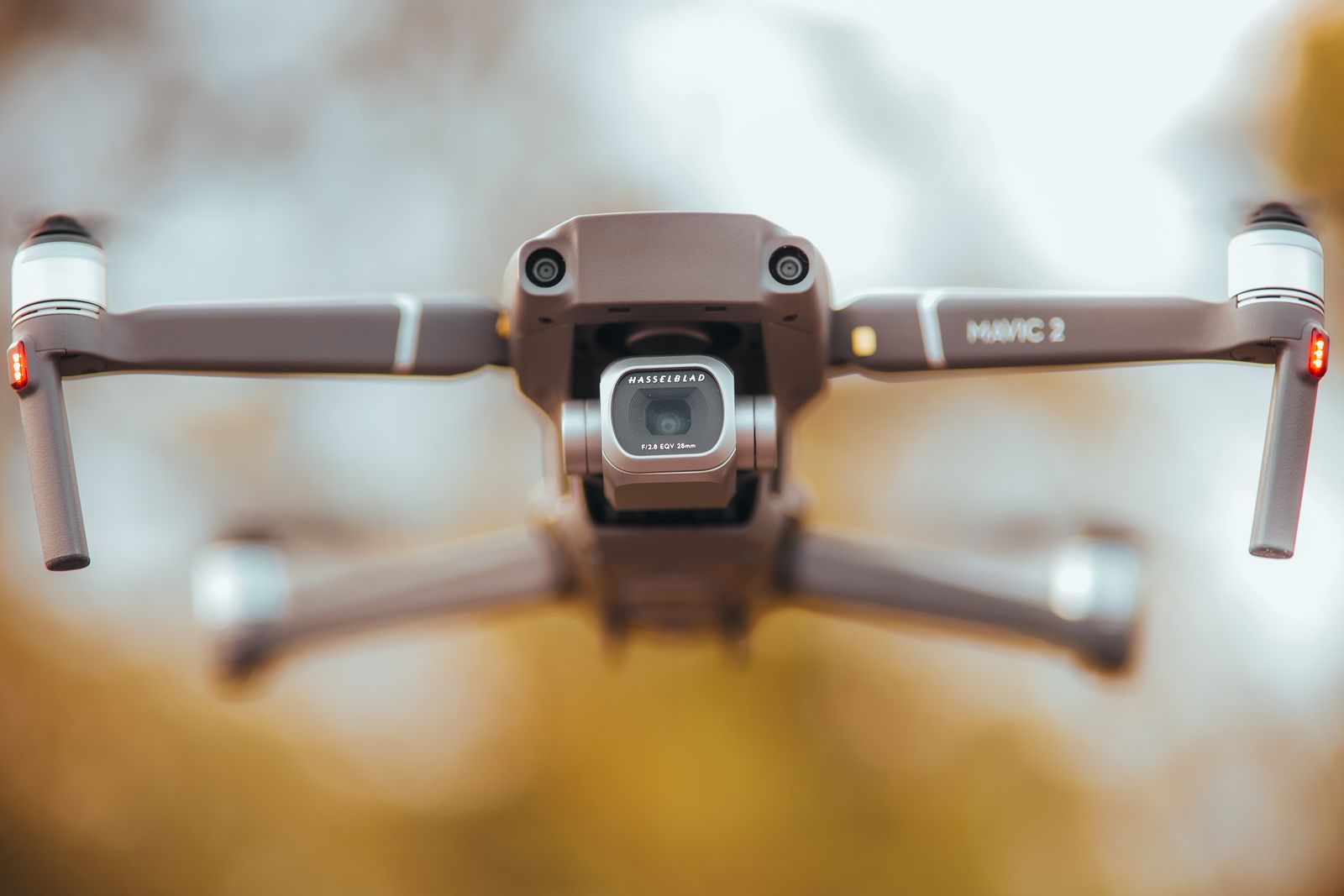
DJI Mavic 2 Pro
For photographers who want Hasselblad color and an adjustable aperture at used-market prices
- Hasselblad L1D-20c camera with HNCS color and a rare f/2.8 to f/11 adjustable aperture
- Omnidirectional obstacle sensing, a first for DJI when it launched, still protects every direction
- Discontinued: buy used or renewed only, with no warranty and aging batteries to check
Check current price and available bundles on Amazon
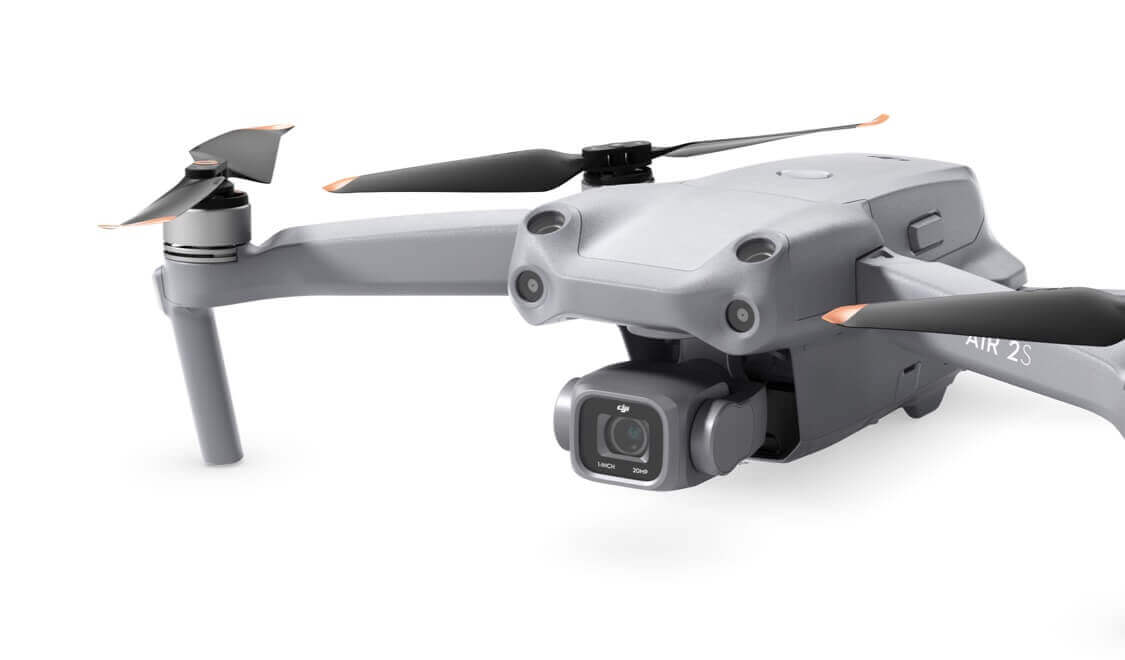
DJI Air 2S
For creators who want 5.4K video, a lighter airframe, and a drone you can still buy new
- 5.4K/30fps and 4K/60fps video at 150 Mbps with 10-bit Dlog-M for serious grading
- O3 transmission reaches 12 km with a rock-solid 1080p live feed
- Fixed f/2.8 aperture means carrying ND filters, and sensing covers four directions, not all
Check current price and available bundles on Amazon
Which drone fits your flying?
Start with your main use case. The best choice should solve your needs, without charging you for features you will rarely use.
Three years separate these drones, and you can feel every one of them in the design. The Mavic 2 Pro launched in August 2018 as the most capable consumer drone DJI had ever built, and the headline was the camera: a genuine Hasselblad partnership with the Swedish maker’s Natural Colour Solution baked into every file. When reviewers flew it against everything else on the market, the verdict was consistent: nothing this portable shot stills this well. DJI priced it at $1,449, and working photographers bought it in droves as a legitimate business tool.
The Air 2S arrived in April 2021 with a different brief. DJI took the compact Mavic Air 2 airframe and stuffed a 1-inch sensor into it, creating a drone that was smaller and lighter than the Mavic 2 Pro but recorded higher-resolution video. At $999 it undercut the old flagship by a third while adding MasterShots, a one-tap cinematic mode, and the O3 transmission system. It was the first sign that DJI’s mid-range line had caught up to, and in video terms passed, the old pro line.
That history matters because it frames the real trade in front of you. The Mavic 2 Pro is discontinued, which means every unit on the market is used, renewed, or old new-stock. Prices have fallen hard: renewed and open-box listings on Amazon and specialist retailers typically sit between $400 and $800, less than half the launch price. For that money you get the Hasselblad color science, the adjustable aperture, and omnidirectional sensing. What you do not get is a warranty, fresh batteries, or modern video resolution. This is the drone for the photographer who knows exactly why they want it and is comfortable buying smart on the secondhand market.
The Air 2S is the safer, simpler purchase. It is newer, lighter at 595 grams, still widely available new and renewed with proper returns, and its 5.4K video and 12 km transmission link are objectively more capable than anything the Mavic 2 Pro offers. If you shoot more video than stills, want intelligent modes that do the cinematic work for you, and would rather not gamble on a seven-year-old battery, the Air 2S is the obvious pick. The honest caveat is the camera’s fixed f/2.8 aperture, which takes exposure control out of your hands in a way the Mavic 2 Pro never did.
Choose DJI Mavic 2 Pro if…
- Still photography is your main concern, and you know what Hasselblad color and an adjustable aperture are worth to you.
- You shoot in changing light and want real aperture control instead of stacking ND filters on a fixed lens.
- You value omnidirectional obstacle sensing that watches every side of the aircraft.
- You are comfortable buying used or renewed, checking battery health, and skipping the warranty.
Choose DJI Air 2S if…
- Video quality and resolution is your main concern, from 5.4K detail to 4K/60fps smoothness.
- You want a lighter, smaller kit at 595 grams that is easier to travel with and set up.
- You value intelligent modes like MasterShots and ActiveTrack 4.0 that automate cinematic shots.
- You want to buy new or renewed with a return window and current firmware support.
DJI Mavic 2 Pro
View on Amazon ↗DJI Air 2S
View on Amazon ↗Mavic 2 Pro vs Air 2S: The Specs That Actually Matter
Compare the exact battery, controller and bundle versions you intend to buy.
| Feature | DJI Mavic 2 Pro | DJI Air 2S |
|---|---|---|
| Best suited to | Aerial photography, landscapes, real estate, professional stills work | Aerial video, travel content, social media, 5.4K creators |
| Takeoff weight | 907 g (with battery and propellers) | 595 g (with battery and propellers) |
| Dimensions | Folded: 214 x 91 x 84 mm; unfolded: 322 x 242 x 84 mm | Folded: 180 x 97 x 77 mm; unfolded: 183 x 253 x 77 mm |
| Camera sensor | 1-inch CMOS, 20MP (5472 x 3648), Hasselblad L1D-20c | 1-inch CMOS, 20MP (5472 x 3648) |
| Lens | 28mm equivalent, 77-degree FOV, f/2.8 to f/11 adjustable aperture | 22mm equivalent, 88-degree FOV, f/2.8 fixed aperture |
| Video specs | 4K/30fps, 2.7K/60fps, FHD/120fps at 100 Mbps | 5.4K/30fps, 4K/60fps, 2.7K/60fps, FHD/120fps at 150 Mbps |
| Photo resolution | 20MP JPEG and DNG (RAW) | 20MP JPEG and DNG (RAW) |
| Color and codecs | 10-bit Dlog-M, 10-bit HLG HDR, H.264/H.265 | 10-bit Dlog-M, 10-bit HLG, H.264/H.265 |
| ISO range | Video 100-6400; photo 100-3200 auto, 100-12800 manual | Video 100-6400; photo 100-6400 |
| Intelligent features | Hyperlapse, QuickShots, ActiveTrack 2.0, Spotlight 2.0, POI 2.0, Waypoint 2.0, APAS, panoramas | MasterShots, FocusTrack (Spotlight 2.0, ActiveTrack 4.0, POI 3.0), Hyperlapse, QuickShots, SmartPhoto, APAS 4.0, AirSense ADS-B |
| Obstacle sensing | Omnidirectional: forward, backward, upward, downward, plus left/right in tracking and tripod modes | Four directions: forward, backward, upward, downward |
| Rated flight time | Up to 31 minutes (29 minutes hovering) | Up to 31 minutes (30 minutes hovering) |
| Max speed | 72 km/h (44.7 mph) in Sport mode | 68.4 km/h (42.5 mph) in Sport mode |
| Max range | 8 km (FCC) on OcuSync 2.0, 1080p live view | 12 km (FCC) on O3, 1080p/30fps live view |
| Wind resistance | 29.5 to 38.5 km/h (Level 5) | 8.5 to 10.5 m/s, about 30.6 to 37.8 km/h (Level 5) |
| GNSS | GPS plus GLONASS | GPS plus GLONASS |
| Controller options | Standard RC (phone required); compatible with DJI Smart Controller; DJI GO 4 app | DJI RC-N1 (phone required); compatible with DJI RC, DJI RC Pro, Smart Controller; DJI Fly app |
| Launch price and availability | $1,449 at launch (2018); discontinued, used and renewed market only | $999 at launch (2021); Fly More Combo $1,299; still widely available new and renewed |
| Main trade-off | Older video resolution, heavier airframe, no warranty on used units | Fixed aperture limits exposure control; sensing misses the sides |
Manufacturer ratings are lab figures; real-world flight time is lower. Prices shown are launch prices; check the live Amazon listing for the current price. Last verified: October 20, 2026.
DJI Mavic 2 Pro
View on Amazon ↗DJI Air 2S
View on Amazon ↗Mavic 2 Pro vs Air 2S: Five Differences That Matter
For each category, here is the difference, its practical impact and which buyer benefits.
1. Camera: Hasselblad color and aperture against 5.4K resolution
Edge: TieBoth drones use a 1-inch 20MP sensor, but the cameras around those sensors tell two different stories. The Mavic 2 Pro’s Hasselblad L1D-20c pairs its sensor with the Hasselblad Natural Colour Solution, a color science tuned by one of the most respected camera makers in the world, and with a mechanical aperture that stops down from f/2.8 to f/11. That aperture is the headline feature. On a bright day you can close it down to keep your shutter speed cinematic without reaching for ND filters; at dusk you open it up to f/2.8 and let the light in. Almost no drone at any price offers this, and photographers who have used it tend to describe it as the feature they miss most when they move to a fixed-aperture drone.
The Air 2S answers with resolution and bitrate. Its 5.4K/30fps video captures noticeably more detail than the Mavic 2 Pro’s 4K/30fps ceiling, its 4K/60fps gives you smooth motion the older drone cannot match, and it records at 150 Mbps against the Mavic 2 Pro’s 100 Mbps, which means less compression smearing in complex scenes like trees and water. Both drones offer 10-bit Dlog-M and 10-bit HLG for grading, so neither is a slouch in post. But the Air 2S is stuck at f/2.8 forever, which means bright daylight shooting demands ND filters and careful exposure, and its color, while good, lacks the distinctive Hasselblad rendering that made the Mavic 2 Pro famous.
2. Design and portability: 907 g flagship against 595 g traveler
Edge: Air 2SThe Mavic 2 Pro is a big drone by modern standards. At 907 grams with a folded footprint of 214 by 91 by 84 mm, it fills a camera bag compartment rather than a jacket pocket, and its 59 Wh battery is the reason: that pack weighs 297 grams on its own, nearly half the Air 2S’s entire airframe. In the air the weight is an asset. The Mavic 2 Pro shrugs off gusts that push lighter drones around, and its low-drag body design plus low-noise propellers made it famously quiet for its size when it launched.
The Air 2S is the travel drone of the two. At 595 grams it is a third lighter, folds to 180 by 97 by 77 mm, and the whole kit with the RC-N1 controller and two batteries fits in a small shoulder bag. Setup is genuinely quick: unfold, power on, and the DJI Fly app connects in seconds. The lighter build does mean it gets pushed around more in strong wind, though both drones are rated Level 5, and the Air 2S’s 3500 mAh battery at 198 grams keeps the flying weight down at the cost of raw power.
3. Flight confidence: omnidirectional sensing against smarter tracking
Edge: Mavic 2 ProWhen the Mavic 2 Pro launched, its omnidirectional obstacle sensing was a genuine first: ten vision sensors watching forward, backward, upward, downward, and, in tracking, tripod, and QuickShot modes, left and right. For a pilot flying a $1,449 camera in tight spaces, that coverage was the safety net that justified the price. It still is. No other drone in this comparison watches every direction, and in complex environments like forests or construction sites, side sensing is the difference between a close call and a crash.
The Air 2S senses four directions: forward, backward, upward, and downward, with no side coverage at all. What it has instead is smarter software. APAS 4.0 routes around obstacles more decisively than the Mavic 2 Pro’s original APAS, ActiveTrack 4.0 holds onto subjects better than ActiveTrack 2.0, and MasterShots is the standout party trick: tap your subject and the drone plans and flies ten different cinematic maneuvers on its own, then cuts a short edited video. Add AirSense ADS-B, which warns you about nearby manned aircraft, and the Air 2S is arguably the safer drone in open sky, even if it is the blinder drone in tight quarters.
4. Battery life, range, and transmission: equal endurance, newer link
Edge: Air 2SOn paper this is a dead heat: DJI rates both drones at 31 minutes of flight time, with the Mavic 2 Pro hovering 29 minutes and the Air 2S 30. In practice, independent testing and years of owner reports put real-world mixed flying for both in the low to mid twenties, depending on wind, temperature, and how aggressively you fly. The Mavic 2 Pro’s bigger 3850 mAh pack feeds a heavier, hungrier airframe; the Air 2S’s smaller 3500 mAh pack feeds a lighter one. The result is the rare spec-sheet tie that holds up in the real world.
Range is where the generations show. The Air 2S’s O3 transmission system reaches 12 km in FCC regions with a 1080p/30fps live feed at up to 16 Mbps, while the Mavic 2 Pro’s OcuSync 2.0 reaches 8 km with a 1080p feed. In most countries you will never legally fly anywhere near either limit, but the practical difference is link robustness: the Air 2S’s four-antenna design and newer protocol hold a cleaner feed in interference-heavy urban environments, and owners consistently report fewer breakup moments at medium range. The Mavic 2 Pro’s link is still perfectly usable, it is just a generation behind.
5. Price and value: new with warranty against used bargain
Edge: Air 2SNew against used is never a fair fight on price, and it is not one here either. The Air 2S launched at $999 with the RC-N1 controller and $1,299 for the Fly More Combo, and it remains widely available new and renewed from Amazon and major retailers, often discounted below launch pricing. You get a return window, a warranty, fresh batteries, and firmware that DJI still supports. For most buyers that peace of mind is worth real money.
The Mavic 2 Pro launched at $1,449 in 2018, and the used market has been kind to patient buyers: renewed and open-box listings typically land between $400 and $800, which buys you a Hasselblad camera and omnidirectional sensing for less than a new mid-range drone. But the discounts come with asterisks. There is no warranty, batteries are the weak point of any used drone purchase since LiPo cells degrade with age and cycles, and DJI has moved on: the Mavic 2 Pro flies on the older DJI GO 4 app, not DJI Fly, and firmware updates are history. Buy from a reputable renewed seller, check battery cycle counts if the listing shows them, and budget for a replacement battery if the included one is tired.
Mavic 2 Pro vs Air 2S: What You Gain and Give Up
DJI Mavic 2 Pro
Reasons to choose it
- Hasselblad L1D-20c camera with HNCS color science produces stills with a distinctive, professional rendering
- Adjustable f/2.8 to f/11 aperture gives real exposure control that almost no modern drone offers
- Omnidirectional obstacle sensing protects every side of the aircraft, including the sides in tracking modes
- 10-bit Dlog-M and 10-bit HLG video plus DNG RAW stills give serious grading and editing latitude
- Used and renewed prices between $400 and $800 make it a pro-grade camera for mid-range money
Reasons to reconsider
- Discontinued with no warranty, and aging batteries are the biggest risk in any used purchase
- Video tops out at 4K/30fps, which lags three generations behind current mid-range drones
- At 907 g it is heavy and bulky by modern standards, and misses every sub-250 g regulatory break
- Runs on the older DJI GO 4 app with no meaningful firmware updates coming
- OcuSync 2.0 and 8 km range are solid but a generation behind the Air 2S’s link
DJI Air 2S
Reasons to choose it
- 5.4K/30fps and 4K/60fps video at 150 Mbps deliver the sharpest footage in this comparison
- At 595 g it is lighter and more compact, making it the better travel and hiking companion
- O3 transmission with 12 km range holds a cleaner feed in interference-heavy areas
- MasterShots, ActiveTrack 4.0, and APAS 4.0 automate cinematic shots a beginner could not fly manually
- Still available new and renewed with warranty, returns, and current firmware support
Reasons to reconsider
- Fixed f/2.8 aperture removes exposure control and forces ND filter use in bright light
- Obstacle sensing covers four directions only, with no side coverage at all
- Color science is good but lacks the distinctive Hasselblad rendering of the Mavic 2 Pro
- Lighter airframe gets pushed around more in strong wind despite the Level 5 rating
- FocusTrack and APAS 4.0 are disabled in the top video modes, including 5.4K and 4K/60
Check the bundle, not just the drone
The drone on the box is only half the purchase. Run through this checklist before you tap buy.
- Controller and app: The Mavic 2 Pro ships with the standard RC that needs your phone, and it flies on the DJI GO 4 app, not DJI Fly. Check that GO 4 still runs well on your current phone before buying used. The Air 2S ships with the RC-N1 and runs on DJI Fly; it is also compatible with the DJI RC, DJI RC Pro, and Smart Controller if you want a built-in screen.
- Batteries: This is the make-or-break item on a used Mavic 2 Pro. LiPo batteries degrade with age and charge cycles, and a 2018-era pack that has sat unused for years can be a paperweight. Ask the seller for cycle counts, look for swelling, and budget for a fresh battery if anything looks off. For the Air 2S, plan on at least two batteries either way; the Fly More Combo’s three batteries, charging hub, ND filters, and shoulder bag remain the best value.
- Accessories: A fast microSD card (U3/V30 rated) is essential for both drones, since the Mavic 2 Pro supports cards up to 128 GB and the Air 2S up to 256 GB. ND filters are near-mandatory for the Air 2S because of its fixed f/2.8 aperture; for the Mavic 2 Pro they are optional thanks to the adjustable aperture. Both drones have 8 GB of internal storage as a backup.
- Listing: On Amazon, confirm the exact model name in the listing title before ordering: you want the Mavic 2 Pro, not the Mavic 2 Zoom, and the Air 2S, not the older Mavic Air 2. For used and renewed units, read the condition notes carefully and buy from sellers with clear return policies. The ASINs linked on this page point to the standard editions of each drone.
- Local requirements: Check your aviation authority’s current rules before you fly. At 907 g the Mavic 2 Pro requires registration in most countries, including FAA registration in the US. At 595 g the Air 2S also requires registration in the US, since both sit above the 250 g threshold. Airspace restrictions apply to both regardless of weight.
- Price timing: The Air 2S sees regular discounts around sales events, so if the price looks high today, check back in a week. For the Mavic 2 Pro, used prices fluctuate with supply; be patient and compare several renewed listings rather than grabbing the first one. The launch prices quoted in this article are reference points, not what you should necessarily pay.
The right choice comes down to the camera you will actually use.
If you shoot more video than stills, travel light, and want a drone you can buy with a warranty and current firmware, buy the Air 2S. Its 5.4K video, 12 km O3 link, and intelligent modes make it the better drone for most people in 2026, and it asks nothing of you beyond the purchase price. If you are a stills photographer who knows what an adjustable aperture is worth, the used Mavic 2 Pro is one of the great bargains in drones: Hasselblad color, f/2.8 to f/11 control, and omnidirectional sensing for less than half its launch price. Just buy it with your eyes open: check the batteries, accept the older app, and remember that 4K/30 is all the video you get.
Still deciding?
Is the Air 2S worth buying over a used Mavic 2 Pro?
For most buyers, yes. The Air 2S gives you sharper video, a lighter airframe, a more robust transmission link, and a new product with a warranty and return window. The used Mavic 2 Pro only makes sense if you specifically want its Hasselblad color science and adjustable aperture for stills photography, and you are comfortable vetting batteries and buying without a warranty. If those two features do not matter to you, the Air 2S is the better drone and the safer purchase.
Which drone has the better camera for photography?
The Mavic 2 Pro. Both drones share a 1-inch 20MP sensor and shoot DNG RAW, but the Mavic 2 Pro adds Hasselblad’s Natural Colour Solution and a mechanical aperture from f/2.8 to f/11, which gives you genuine exposure control in changing light. The Air 2S is stuck at f/2.8, so bright scenes force you onto ND filters. For pure stills work, the older flagship remains the more capable photographic tool.
Which drone is better for video?
The Air 2S, comfortably. It records 5.4K at 30fps and 4K at 60fps with a 150 Mbps bitrate, against the Mavic 2 Pro’s 4K/30fps at 100 Mbps. That means more detail, smoother motion, and cleaner compression in demanding scenes. Both offer 10-bit Dlog-M and HLG for grading, but the Air 2S gives you more pixels and more frames to work with. Note that the Air 2S disables FocusTrack and APAS 4.0 in its top video modes, so plan tracking shots in 4K/30 or below.
Which is better for beginners?
The Air 2S. It is lighter, runs on the current DJI Fly app, offers MasterShots one-tap cinematics and ActiveTrack 4.0 subject following, and you can buy it new with support if anything goes wrong. The Mavic 2 Pro is not hard to fly, its omnidirectional sensing is excellent, but buying used means inheriting someone else’s batteries and maintenance history, which is a poor first-drone experience. Start with the Air 2S; graduate to a used Mavic 2 Pro later if photography hooks you.
Can I still buy the Mavic 2 Pro new?
No. DJI discontinued the Mavic 2 Pro, so every unit on the market is used, renewed, or old new-stock. Renewed listings on Amazon and specialist camera retailers are the safest route, since they typically include inspection and a limited return window. Avoid private sellers unless you can verify battery health and test-fly the drone. And budget for the possibility of replacing the battery: LiPo packs from the 2018 to 2020 era are the likeliest point of failure on any used Mavic 2 Pro.
How were these drones compared?
This is a research-based comparison. We compiled specifications from DJI’s official Mavic 2 and Air 2S spec pages and launch announcements, then cross-checked them against independent coverage from outlets like PetaPixel, DroneDJ, The Drone Girl, and retailer spec sheets from B and H Photo and Adorama. We did not fly either drone for this article, so rated figures are DJI’s lab numbers. Launch prices are historical reference points; the used-market pricing reflects listings observed during research. See the methodology section below for the full source list.
How this comparison was prepared
This is a research-based comparison. We did not fly either drone for this article, and we do not imply otherwise. Every specification in the table above comes from DJI’s official documentation, primarily the DJI Mavic 2 specifications page on dji.com support and the DJI Air 2S specifications, with launch pricing and bundle contents cross-checked against DJI’s official launch announcements from August 2018 and April 2021. Used-market pricing reflects renewed and open-box listings observed on Amazon and specialist retailers during research, and it moves with supply, so treat it as a range rather than a quote. Amazon ASINs were verified by matching the ASIN against the exact product title across Amazon-indexed listing data, affiliate-link citations on independent drone sites, and manuals.plus ASIN-keyed documentation before any affiliate link was written. No tagged affiliate URL was ever opened or clicked during research.
Sources and verification
- DJI Mavic 2 official specifications (dji.com support, accessed October 20, 2026): aircraft, camera, gimbal, sensing, transmission, and battery figures
- DJI Air 2S official specifications (dji.com, accessed October 20, 2026): weight, dimensions, camera, flight time, sensing, and transmission figures
- DJI Mavic 2 Pro and Mavic 2 Zoom launch coverage (August 2018): launch pricing of $1,449, OcuSync 2.0, Hyperlapse, and feature descriptions
- DJI Air 2S launch coverage (April 2021): launch pricing of $999, MasterShots, O3 transmission, and feature descriptions
- B and H Photo DJI Mavic 2 Pro product page: detailed spec sheet including wind resistance, GNSS, and dimensions
- B and H Photo DJI Air 2S product pages: detailed spec sheet including battery, sensing ranges, and controller compatibility
- Adorama DJI Mavic 2 Pro and Air 2S product pages: feature descriptions, availability status, and bundle details
- The Drone Girl Air 2S launch coverage: 1-inch sensor context and Mavic 2 Pro comparison notes
- ASIN verification: Mavic 2 Pro listing (B07GSVXHCC, standard edition with Hasselblad camera) confirmed against manuals.plus ASIN-keyed user manual documentation; Air 2S listing (B08Z3DYBMC, standard edition) confirmed against four independent affiliate-link citations and Amazon-indexed title data. Direct Amazon page opens were blocked by Amazon’s bot protection (HTTP 403); no tagged (?tag=) URL was ever opened or clicked.
Last verified: October 20, 2026. Bundle availability, pricing, and specifications may vary by region and version. Prices in this article are launch reference prices and observed used-market ranges; check the live Amazon listing for the current price.