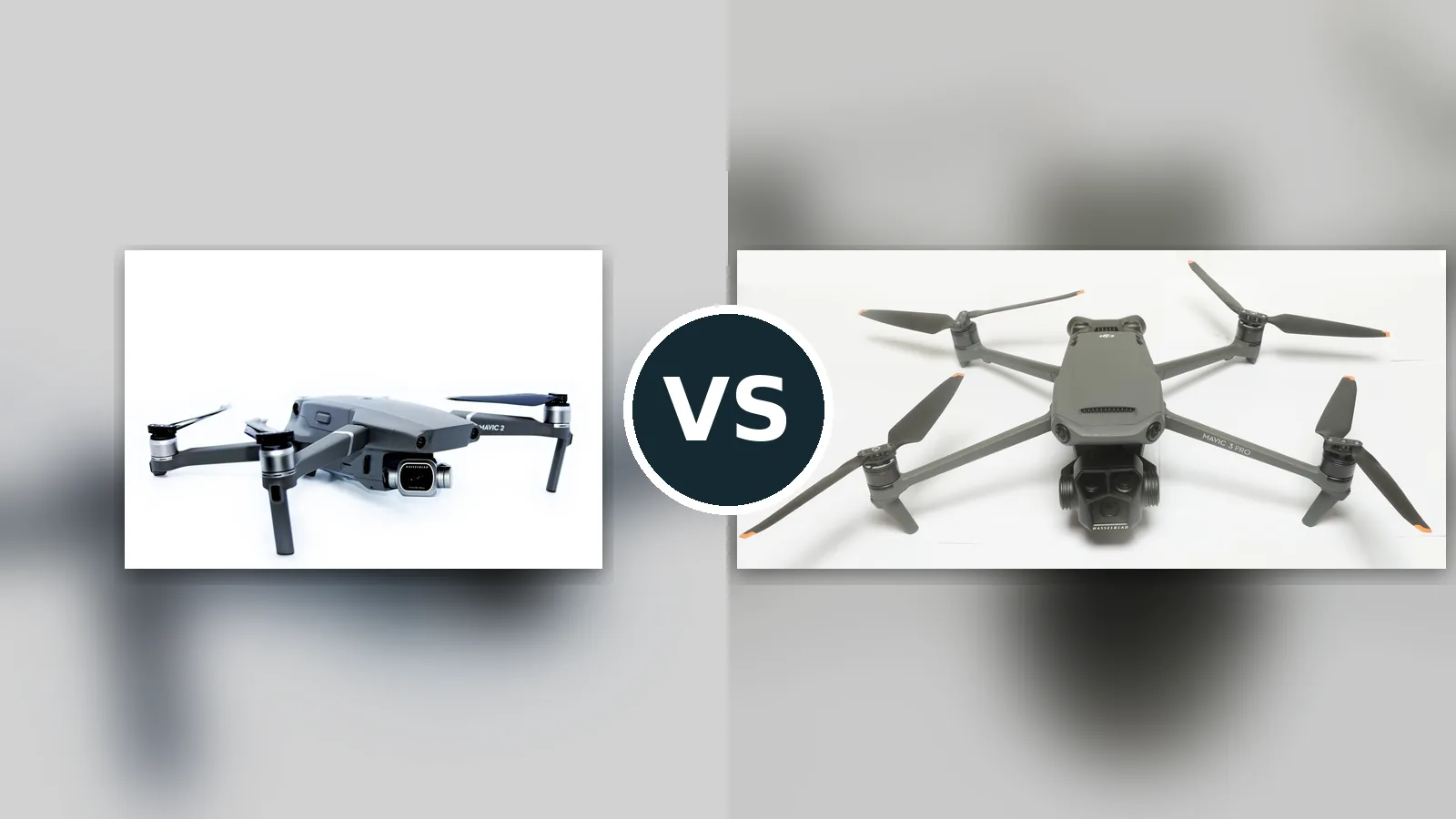
The mavic 2 pro vs mavic 3 pro question is really a question about time. The Mavic 2 Pro launched in August 2018 and became the aerial photographer’s workhorse: a 1-inch Hasselblad camera, 31-minute flights, and omnidirectional sensing for $1,499. DJI discontinued it years ago, so today you can only find it renewed, refurbished, or used. The Mavic 3 Pro arrived in April 2023 with a triple-camera system, a 4/3-inch Hasselblad main sensor, 43-minute flight time, and a $2,199 launch price. We compared the cameras, flight performance, sensing, and real-world buying math, including the honest risks of buying a 2018 drone in 2026, so you can decide whether the flagship upgrade earns your money.
Affiliate disclosure: As an Amazon Associate I earn from qualifying purchases. This page contains affiliate links. If you buy through them, we may earn a commission.
Mavic 3 Pro for most. Mavic 2 Pro as a used bargain.
DJI Mavic 3 Pro wins this comparison for most buyers: its triple-camera system outshoots the 2 Pro in every mode, it flies 12 minutes longer, its O3+ link reaches nearly twice as far, and its tracking and sensing are a full generation ahead. DJI Mavic 2 Pro wins on price if you buy used: a well-kept example with healthy batteries can deliver 80 percent of the stills quality for a third of the money. The catch is age. Batteries from 2018 are a real risk, so the 2 Pro only makes sense from a reputable seller with verified battery health. Camera: Mavic 3 Pro. Flight time: Mavic 3 Pro. Portability: Mavic 2 Pro, narrowly. Value: depends on what you pay.
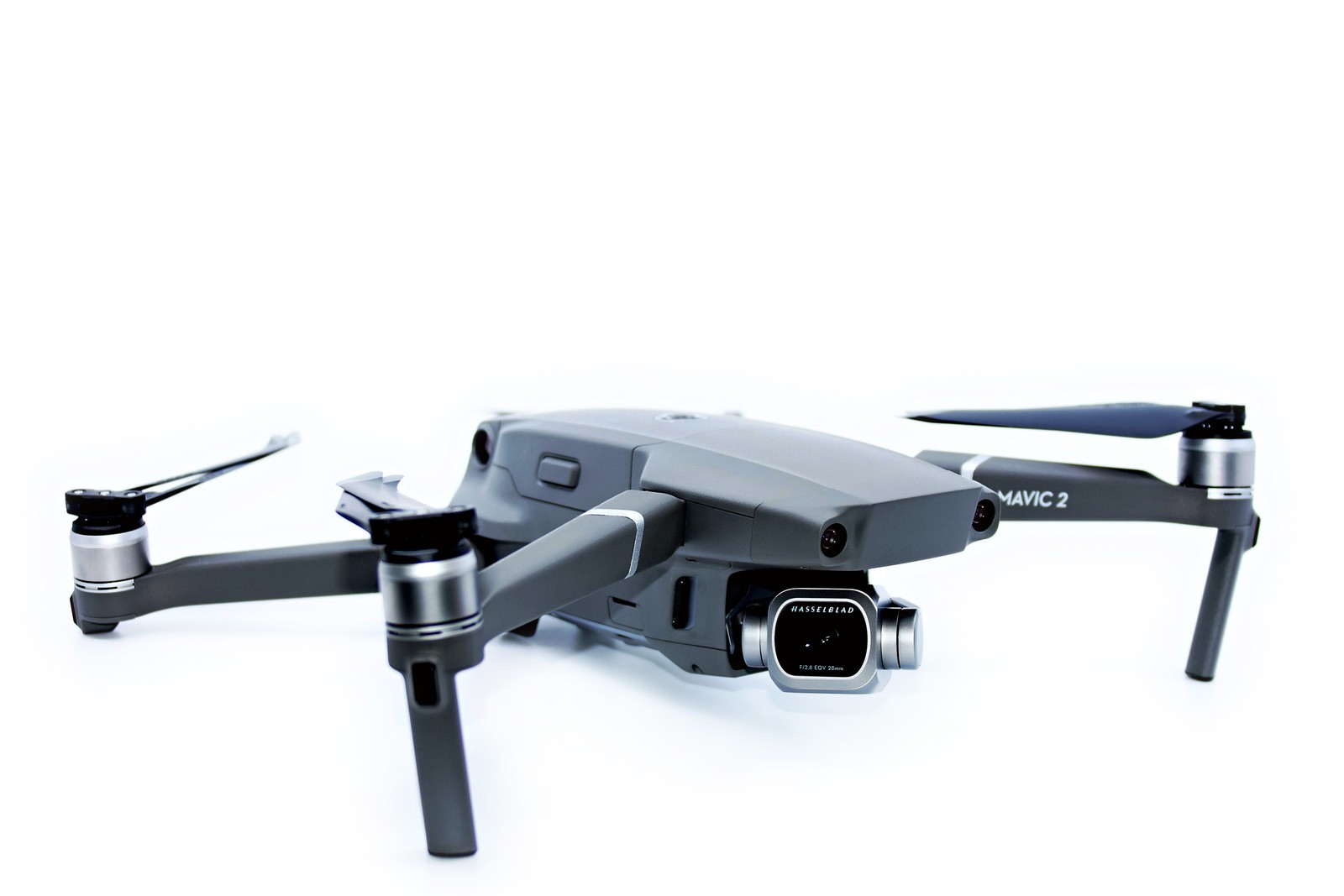
DJI Mavic 2 Pro
For budget-minded photographers willing to buy a discontinued classic carefully
- The 1-inch Hasselblad sensor still takes excellent 20MP stills, and used prices are a fraction of the launch $1,499
- Omnidirectional sensing, 3-axis gimbal, and 10-bit Dlog-M were flagship features that hold up well
- Discontinued since 2020: listings are renewed or used, and aging batteries are the biggest risk
Amazon listings for this discontinued model are typically renewed or third-party: check the seller and condition carefully
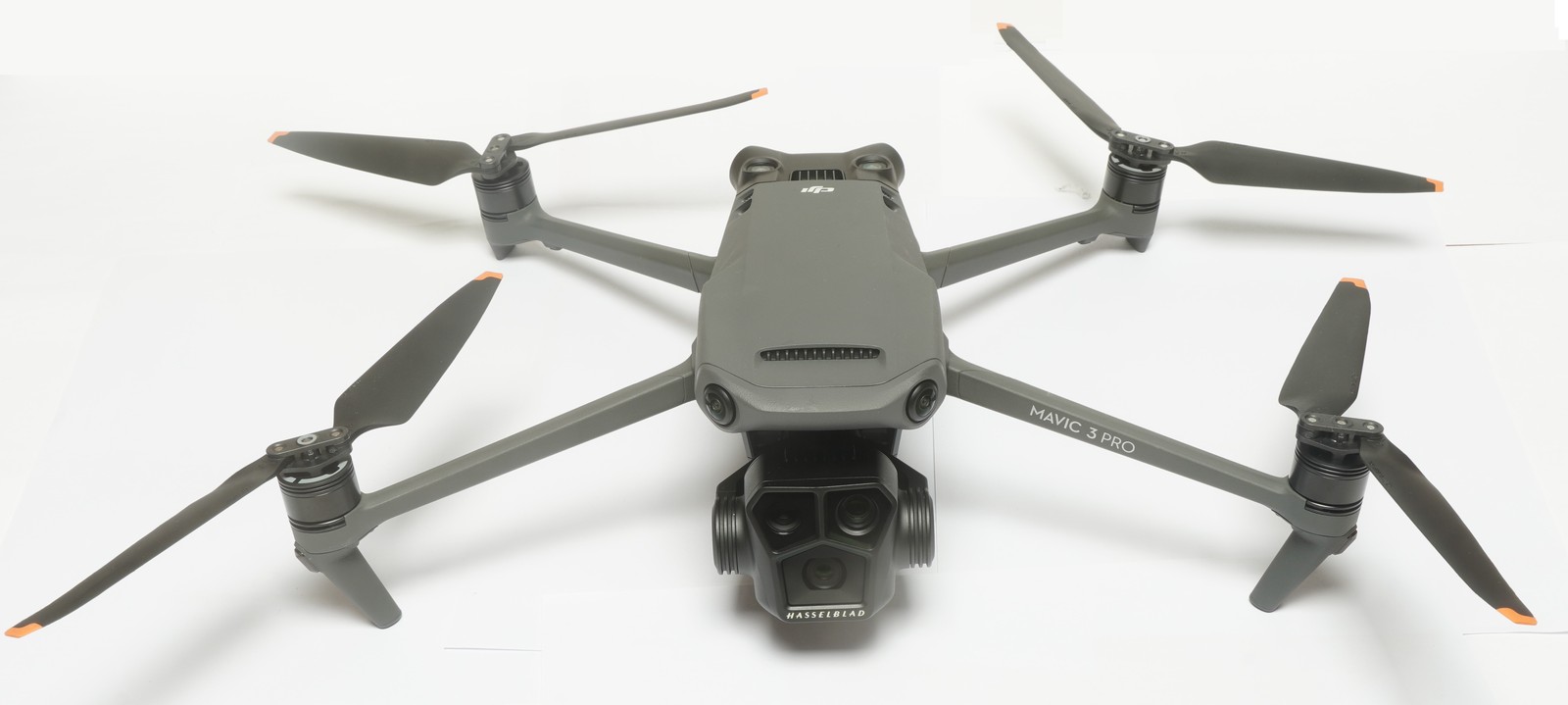
DJI Mavic 3 Pro
For creators who want DJI’s triple-camera flagship with pro-level flexibility
- Three cameras in one gimbal: 24mm Hasselblad wide, 70mm medium tele, and 166mm telephoto
- 5.1K/50fps video, 10-bit D-Log and HLG, plus 43 minutes of rated flight time
- Flagship pricing: launched at $2,199, and the Fly More Combo costs considerably more
Check current price and available bundles on Amazon
Which drone fits your flying?
Start with your main use case. The best choice should solve your needs, without charging you for features you will rarely use.
Most people land on the mavic 2 pro vs mavic 3 pro comparison from one of two directions. Some already own a Mavic 2 Pro, or have spotted a tempting used one, and wonder whether the Mavic 3 Pro is worth the jump. Others are shopping for a serious camera drone and keep seeing the older model recommended as a budget alternative. Both groups need the same honest answer, and it starts with what has changed in the years between these two launches.
The Mavic 2 Pro was the drone that made the 1-inch sensor mainstream. Its Hasselblad L1D-20c camera, with an adjustable f/2.8 to f/11 aperture and 10-bit Dlog-M, was the first sub-$1,500 drone camera that professionals took seriously. Reviewers called it the new benchmark for consumer aerial imaging, and for stills photography it genuinely was. But it records 4K at only 30 frames per second, its tracking is two generations old, and its OcuSync 2.0 link tops out at 8 km. Time has moved on, and the Mavic 3 Pro is where that time went: a bigger 4/3-inch sensor, two extra telephoto cameras, 5.1K video, and 43 minutes in the air.
The wrinkle is availability. DJI discontinued the Mavic 2 Pro, and new old-stock units are essentially gone. What you find on Amazon today is renewed, refurbished, or sold by third parties, and on the wider used market the drone trades hands for roughly a third of its original price. That makes the comparison less about specs and more about risk tolerance: the Mavic 3 Pro is the better drone in almost every measurable way, and the Mavic 2 Pro is the better deal only if you buy a healthy example at a used price and accept that you are flying a platform DJI no longer supports with new firmware or parts.
Choose DJI Mavic 2 Pro if…
- Stills-first photography on a budget is your main concern, and you can find a well-kept used example with healthy batteries.
- You want a proven 1-inch Hasselblad camera with an adjustable aperture for a fraction of the Mavic 3 Pro’s price.
- You are comfortable buying discontinued gear: no warranty from DJI, parts only from the used market, and firmware updates long finished.
- You can accept 4K/30fps video, older ActiveTrack 2.0, and an 8 km transmission range.
Choose DJI Mavic 3 Pro if…
- Video and versatility are your main concern, from 5.1K wide shots to compressed telephoto storytelling.
- You want three focal lengths without landing: 24mm, 70mm, and 166mm in a single flight.
- You value the longest flight time DJI has put in a folding drone: 43 minutes rated per battery.
- You can accept flagship pricing and a heavier 958 g airframe that needs registration everywhere.
Mavic 2 Pro vs Mavic 3 Pro: The Specs That Actually Matter
Compare the exact battery, controller and bundle versions you intend to buy.
| Feature | DJI Mavic 2 Pro | DJI Mavic 3 Pro |
|---|---|---|
| Best suited to | Stills photography and careful 4K video on a used-market budget | Professional aerial video, real estate, and travel cinematography |
| Takeoff weight | 907 g | 958 g (963 g for the Cine version) |
| Dimensions (folded) | 214 x 91 x 84 mm | 231.1 x 98 x 95.4 mm |
| Sensor and lenses | 1-inch CMOS, 20MP, 28mm equivalent, f/2.8 to f/11, 77-degree FOV | 4/3 CMOS 20MP 24mm f/2.8 to f/11; 1/1.3-inch 48MP 70mm f/2.8; 1/2-inch 12MP 166mm f/3.4 |
| Video modes | 4K/30fps, 2.7K/60fps, 1080p/120fps | 5.1K/50fps and 4K/120fps (wide); 4K/60fps (both tele cameras); 1080p/200fps |
| Color and codecs | 10-bit Dlog-M, 10-bit HDR (HLG), H.264/H.265, up to 100 Mbps; JPEG and DNG RAW | 10-bit D-Log, D-Log M and HLG, H.264/H.265, up to 200 Mbps; JPEG and DNG RAW; Apple ProRes on Cine |
| Vertical capture | Cropped in post; no native vertical mode | Cropped in post; no native vertical mode |
| Gimbal | 3-axis mechanical (tilt, roll, pan) | 3-axis mechanical (tilt, roll, pan) |
| Obstacle sensing | Omnidirectional with APAS | Omnidirectional with APAS 5.0 |
| Subject tracking | ActiveTrack 2.0, Point of Interest 2.0, Waypoint 2.0, Hyperlapse | ActiveTrack 5.0, Waypoint Flight, Cruise Control, Hyperlapse, Night Shots |
| Rated flight time | 31 minutes (29 minutes hovering) | 43 minutes (37 minutes hovering) |
| Real-world flight time | Not tested by us; reviewers reported roughly 25 to 27 minutes of mixed flying when new | Not tested by us; reviewers report roughly 32 to 35 minutes of real shooting per battery |
| Max speed | 72 km/h (47.7 mph) in Sport mode | 75.6 km/h (21 m/s) in Sport mode |
| Video transmission | OcuSync 2.0, up to 8 km FCC, 1080p live view | DJI O3+, up to 15 km FCC, 1080p/60fps live view |
| Wind resistance | 29 to 38 km/h (Level 5) | 12 m/s, about 43 km/h (Level 6) |
| Internal storage | 8 GB built in, plus microSD up to 128 GB | 8 GB built in (1 TB SSD on Cine), plus microSD up to 512 GB |
| Controller and bundle | Standard RC with phone mount (launched at $1,499); Smart Controller edition also sold | DJI RC (launched at $2,199), Fly More Combo, or Cine Premium Combo |
| Main trade-off | Discontinued: only renewed or used units available, with aging batteries as the main risk | Flagship price and a 958 g airframe; overkill if you only shoot stills |
Manufacturer ratings are lab figures; real-world flight time is lower. The Mavic 2 Pro is discontinued: launch prices are shown for reference, and current listings are renewed or used. Last verified: October 20, 2026.
Mavic 2 Pro vs Mavic 3 Pro: Five Differences That Matter
For each category, here is the difference, its practical impact and which buyer benefits.
1. Camera quality and creative flexibility
Edge: Mavic 3 ProThis is the biggest gap in the whole comparison, and it is wider than the sensor sizes suggest. The Mavic 2 Pro’s 1-inch Hasselblad sensor was a landmark in 2018: 20MP stills with RAW, an adjustable f/2.8 to f/11 aperture, and 10-bit Dlog-M video that graded beautifully for its era. For photography, it remains genuinely good. A 20MP DNG from the L1D-20c, shot at low ISO with the aperture stopped down, still holds up against anything under $1,000 today. If your output is prints and web galleries, the old flagship embarrasses very little.
The Mavic 3 Pro simply plays a different sport. Its main camera uses a 4/3-inch sensor, roughly twice the area of a 1-inch chip, with the same 20MP resolution and the same f/2.8 to f/11 aperture range, but it records 5.1K/50fps and 4K/120fps with 10-bit D-Log, D-Log M, and HLG, at up to 200 Mbps. Then there are the two cameras the 2 Pro cannot answer: a 70mm medium telephoto with a 48MP 1/1.3-inch sensor shooting 4K/60fps, and a 166mm telephoto for 7x reach. That trio lets you shoot a wide establishing frame, a compressed mid shot, and a tight detail, all without landing or swapping drones. For video work, it is not close: the 2 Pro’s 4K/30fps ceiling and 100 Mbps bitrate belong to another era, and its slow motion tops out at 1080p/120fps while the 3 Pro shoots 4K/120fps on the main camera.
2. Portability and travel
Edge: Mavic 2 Pro, narrowlyBoth drones fold, and neither is small by modern standards. The Mavic 2 Pro weighs 907 g and folds to 214 by 91 by 84 mm; the Mavic 3 Pro weighs 958 g and folds to 231.1 by 98 by 95.4 mm. In the hand, the 2 Pro feels a touch more compact, and its 51 g weight advantage is real, if modest. Both need a dedicated bag, both need registration in the US and most other countries since they are well over 250 g, and neither will ever pass as a travel drone in the Mini sense. Setup is the same ritual on both: unfold the arms, power on, wait for satellites, fly.
Where portability arguments get interesting is endurance per gram. The Mavic 3 Pro carries a 5,000 mAh battery to the 2 Pro’s 3,850 mAh, and that extra 153 g of battery buys 12 more rated minutes in the air. On a hiking shoot, one Mavic 3 Pro battery covers what takes a Mavic 2 Pro battery and a half to cover, which means the heavier drone can actually mean a lighter bag. The 3 Pro’s charging is faster too, with 100W hub charging available. So the 2 Pro wins the tape measure, and the 3 Pro wins the practical question of how much flying you get per trip. Call it a narrow win for the older drone on pure dimensions, with an asterisk the size of a battery.
3. Flight confidence, sensing, and tracking
Edge: Mavic 3 ProThe Mavic 2 Pro deserves credit for being early: its omnidirectional obstacle sensing and APAS were genuinely advanced in 2018, and its ActiveTrack 2.0 could follow subjects reliably in open space. But five years of development separate it from the Mavic 3 Pro’s APAS 5.0, which uses eight wide-angle vision sensors to detect obstacles in every direction and plot smoother avoidance routes, and ActiveTrack 5.0, which holds onto subjects through occlusions and direction changes that would lose the older system. The 3 Pro also adds Waypoint Flight, Cruise Control, and a proper Night Shots mode, features the 2 Pro’s firmware never received.
Transmission is the other half of confidence. The 2 Pro’s OcuSync 2.0 reaches 8 km in FCC regions with a 1080p live feed, which was excellent in 2018 and remains usable today. The 3 Pro’s O3+ link reaches 15 km with a 1080p/60fps feed that reviewers describe as noticeably more stable at range and in interference-heavy environments. Neither drone is crash-proof, and both demand the same respect for airspace rules, but the newer sensing stack and the stronger link make the 3 Pro the easier drone to trust when the shot gets complicated. One honest note for the 2 Pro: its firmware is frozen in time, so any quirks it shipped with are the quirks you keep.
4. Battery life and time in the air
Edge: Mavic 3 ProDJI rates the Mavic 2 Pro at 31 minutes and the Mavic 3 Pro at 43 minutes, and the real-world gap is just as wide. When new, reviewers measured roughly 25 to 27 minutes of mixed flying from the 2 Pro’s 3,850 mAh pack; the 3 Pro’s 5,000 mAh pack delivers roughly 32 to 35 minutes of real shooting in independent tests. That is the difference between rushing a location and working it properly, and it compounds across a day: two 3 Pro batteries give you over an hour of airtime, where the 2 Pro needs three batteries to get there.
Then there is the age problem, and it is the single most important paragraph in this article for Mavic 2 Pro shoppers. Lithium-polymer batteries degrade with time and cycles, and every Mavic 2 battery in existence is now years old. A swollen or high-cycle battery is not just short-lived, it is a safety risk, and genuine new Mavic 2 batteries are increasingly hard to find. If you buy a used 2 Pro, budget for battery health as the first thing you verify: ask for cycle counts, inspect for swelling, and assume you may need to source replacements from the used market. The Mavic 3 Pro has no such issue; its batteries are current production, widely available, and covered by DJI’s normal support.
5. Value of the complete kit
Edge: Depends on the price you payAt launch, the math was simple: $1,499 for the Mavic 2 Pro against $2,199 for the Mavic 3 Pro with the DJI RC, $2,999 for the Fly More Combo, and $4,799 for the Cine Premium Combo. In 2026, the math is a tale of two markets. The Mavic 3 Pro sells new with full warranty at or near its launch pricing, discounted during sales events. The Mavic 2 Pro sells only as renewed, refurbished, or used, typically for a few hundred dollars: a working used example with a battery or two often changes hands for less than a third of its original price.
That makes the value question personal. If you want the best image quality and the longest support life per dollar, a discounted Mavic 3 Pro, or even the cheaper Mavic 3 Classic for stills-first buyers, is the rational buy. But if your budget is firm and your output is photography, a $500 to $700 used Mavic 2 Pro with verified healthy batteries is an enormous amount of camera for the money. The trap to avoid is paying near-new prices for a renewed 2 Pro from a third-party seller: at $1,000 or more, you are in striking distance of newer DJI models with warranties, and the used flagship stops being a bargain. Always compare the renewed price against what the Mavic 3 series costs on sale before you commit.
Mavic 2 Pro vs Mavic 3 Pro: What You Gain and Give Up
DJI Mavic 2 Pro
Reasons to choose it
- A 1-inch 20MP Hasselblad camera with adjustable f/2.8 to f/11 aperture that still takes excellent stills, now available at used prices far below its $1,499 launch price
- 10-bit Dlog-M and 10-bit HDR video with H.265 at 100 Mbps: modest by 2026 standards, but a real grading workflow for a budget drone
- Omnidirectional obstacle sensing, 3-axis gimbal, and 31-minute rated flight time were flagship specs that remain perfectly usable
- Slightly lighter and more compact than the Mavic 3 Pro, with the same folding design language
- A huge used market means airframes, parts, and community knowledge are easy to find
Reasons to reconsider
- Discontinued: Amazon listings are renewed or third-party, with no DJI warranty and no new firmware coming
- Aging batteries are the biggest risk: every Mavic 2 battery is years old, and swelling or high cycle counts are common
- 4K tops out at 30fps, slow motion is limited to 1080p/120fps, and there is no telephoto camera
- ActiveTrack 2.0 and older APAS lag a full generation behind the Mavic 3 Pro’s tracking and sensing
- OcuSync 2.0 reaches 8 km against the 3 Pro’s 15 km, with a less robust link in congested areas
DJI Mavic 3 Pro
Reasons to choose it
- Triple-camera system: 4/3-inch 20MP Hasselblad wide, 48MP 70mm medium tele, and 166mm telephoto, three focal lengths in one flight
- 5.1K/50fps and 4K/120fps video with 10-bit D-Log, D-Log M, and HLG at up to 200 Mbps, plus Apple ProRes on the Cine version
- 43 minutes of rated flight time, roughly 32 to 35 minutes of real shooting per battery in independent tests
- APAS 5.0 omnidirectional sensing, ActiveTrack 5.0, Waypoint Flight, and Cruise Control: the most capable autonomy DJI has shipped in this class
- Current product with full DJI support, warranty, fresh batteries, and ongoing firmware updates
Reasons to reconsider
- Flagship pricing: $2,199 to start, $2,999 for the Fly More Combo, and $4,799 for the Cine Premium Combo at launch
- At 958 g it is heavier than the Mavic 2 Pro and needs registration in the US and most other countries
- Overkill for stills-only shooters: the main camera advantage over a used Mavic 2 Pro is real but not transformative for photography
- No native vertical video mode; vertical content still means cropping in post
- The 70mm and 166mm cameras, while excellent, cannot match the main camera’s low-light performance or frame rates
Check the bundle, not just the drone
The drone on the box is only half the purchase, and for a discontinued model the seller matters as much as the specs. Run through this checklist before you tap buy.
- Condition: For the Mavic 2 Pro, confirm exactly what you are buying: renewed, refurbished, or used, and from whom. Amazon listings for this ASIN are typically renewed or third-party. Read the condition notes and the seller’s return policy before anything else.
- Batteries: This is the make-or-break check on any Mavic 2 Pro. Ask for cycle counts, check for swelling, and confirm the batteries hold a charge. Budget for the possibility of sourcing replacements on the used market, since new Mavic 2 batteries are scarce. For the Mavic 3 Pro, batteries are current production and easy to buy.
- Controller: The Mavic 2 Pro base edition ships with the standard phone-mount controller; a Smart Controller edition also exists and costs more used. The Mavic 3 Pro Fly More Combo in our link includes the DJI RC with its built-in 5.5-inch screen, so no phone is needed.
- Accessories: A fast microSD card is essential for both (the 2 Pro supports up to 128 GB, the 3 Pro up to 512 GB). ND filters help both drones in bright light. For a used Mavic 2 Pro, extra propellers and a fresh set of ND filters are cheap insurance.
- Listing: On Amazon, confirm the exact model name, controller, and battery count in the listing title before ordering, and check that the seller is reputable with clear return terms. Similarly named combos and renewed units are easy to confuse.
- Local requirements: Both drones weigh well over 250 g, so expect registration requirements in the US and most other countries. Check your aviation authority’s current rules on registration, training, and airspace before your first flight.
- Price timing: The Mavic 3 Pro sees regular discounts around sales events; if the price looks high today, check again in a week. For the Mavic 2 Pro, compare any renewed price against used-market prices on MPB or eBay: if a renewed unit costs nearly as much as a new mid-range DJI drone, it is not the bargain it appears to be.
The right choice comes down to new flagship versus used classic.
If you want the best camera drone in this comparison with no caveats, buy the Mavic 3 Pro. It wins on image quality, video capability, flight time, range, sensing, and support, and it will keep winning for years because DJI still sells and updates it. It is the drone we would recommend to eight out of ten people reading this comparison. If your budget is tight and your work is photography, a used Mavic 2 Pro with verified healthy batteries remains one of the great value buys in drones: a 1-inch Hasselblad camera for the price of a toy. Just go in with open eyes about what discontinued means. No warranty, aging batteries, and 4K/30fps video are the price of the discount, and it is worth paying only when the price is truly a used price.
Still deciding?
Is the Mavic 2 Pro still worth buying in 2026?
As a used purchase at a used price, yes, for photographers. Its 1-inch 20MP Hasselblad camera with an adjustable aperture still takes excellent stills, and used examples sell for a fraction of the original $1,499. As a renewed unit priced near four figures, no: at that point you are close to newer DJI models with warranties. Whatever you pay, verify battery health first, since aging batteries are the biggest risk with this discontinued model.
Is the Mavic 3 Pro worth the upgrade over the Mavic 2 Pro?
For video work, absolutely. You get a larger 4/3-inch sensor, 5.1K/50fps and 4K/120fps recording, two telephoto cameras, 12 more minutes of rated flight time, and a full generation of better tracking and sensing. For stills-only photography, the upgrade is real but less dramatic: the main camera is better, but a used Mavic 2 Pro at a third of the price takes photographs most viewers could not distinguish. Upgrade for video and versatility; keep the 2 Pro if stills on a budget is the whole job.
Can you still buy a new Mavic 2 Pro?
Effectively no. DJI discontinued the Mavic 2 Pro, and new old-stock units are essentially gone from authorized retailers. Amazon listings are renewed, refurbished, or sold by third-party sellers. The wider used market, including MPB and eBay, is where most buyers find one today. Treat any listing claiming to be brand new with skepticism and check the seller carefully.
Which drone has the better camera for photography?
The Mavic 3 Pro, on paper and in practice. Its 4/3-inch Hasselblad main camera has roughly twice the sensor area of the Mavic 2 Pro’s 1-inch chip, with the same 20MP resolution and f/2.8 to f/11 aperture range, plus two telephoto cameras the 2 Pro cannot match. That said, the gap matters most in low light and for large prints; in good light at web sizes, the Mavic 2 Pro’s DNG files remain excellent, which is why it survives as a budget recommendation.
Do I need to register the Mavic 2 Pro or the Mavic 3 Pro?
Almost certainly yes. At 907 g and 958 g respectively, both drones are well over the 250 g threshold, so recreational registration is required in the United States and most other countries. Rules differ by country and change over time, so check your national aviation authority’s current requirements, including any training or remote ID rules, before your first flight.
How were these drones compared?
This is a research-based comparison: we compiled specifications from DJI’s official spec pages, launch announcements, and documentation, then cross-checked them against independent reviews from outlets like B&H Photo, DroneXL, TechRadar, and Dronios. We did not fly either drone for this article, so rated figures are DJI’s lab numbers and real-world figures are attributed to the reviewers who measured them. See the methodology section below for the full source list.
How this comparison was prepared
This is a research-based comparison. We did not fly either drone for this article, and we do not imply otherwise. Every specification in the table above comes from DJI’s official documentation, primarily the DJI Mavic 2 Pro specifications page and the DJI Mavic 3 Pro specifications page, with launch pricing and bundle contents cross-checked against DJI’s official launch announcements and reputable retailers. Where this article mentions real-world flight times, those figures are attributed to independent reviewers who measured them, not to us: reviewer consensus puts a new Mavic 2 Pro at roughly 25 to 27 minutes of mixed flying, and the Mavic 3 Pro at roughly 32 to 35 minutes of real shooting per battery. The Mavic 2 Pro’s discontinued status and current availability were verified against retailer listings, including B&H Photo’s discontinued listing and current Amazon marketplace listings. Amazon ASINs were verified by matching the ASIN against the exact product title and model number across Amazon-indexed listing data and third-party records before any affiliate link was written.
Sources and verification
- DJI Mavic 2 Pro official specifications (dji.com, accessed October 20, 2026): aircraft, camera, gimbal, sensing, transmission, and battery figures
- DJI Mavic 3 Pro official specifications (dji.com, accessed October 20, 2026): weight, dimensions, triple-camera system, flight time, and sensing figures
- DJI Mavic 2 Pro launch announcement (DJI newsroom, August 2018): launch pricing, Hasselblad camera details, and feature descriptions
- DJI Mavic 3 Pro launch announcement (DJI newsroom, April 2023): launch pricing, bundle contents, and triple-camera details
- B&H Photo DJI Mavic 2 Pro product pages: full specifications and discontinued availability status
- SkyDronesUSA DJI Mavic 2 Pro specifications: camera, gimbal, battery, and transmission detail
- Dronios DJI Mavic 3 Pro review (2026): real-world flight time and camera assessment
- Wellbots and GearFocus DJI Mavic 3 Pro specifications: video modes, weight, and bundle detail
- ASIN verification: Mavic 2 Pro listing (B07GSVXHCC, base edition, model CP.MA.00000019.01) confirmed via manuals.plus ASIN-to-model mapping and UPC record; Mavic 3 Pro Fly More Combo listing (B0CLFY2N76, DJI RC edition) confirmed via Ubuy US-import product record naming the exact bundle
Last verified: October 20, 2026. Bundle availability, pricing, and specifications may vary by region and version. Prices in this article are launch reference prices unless noted; check the live Amazon listing for the current price.