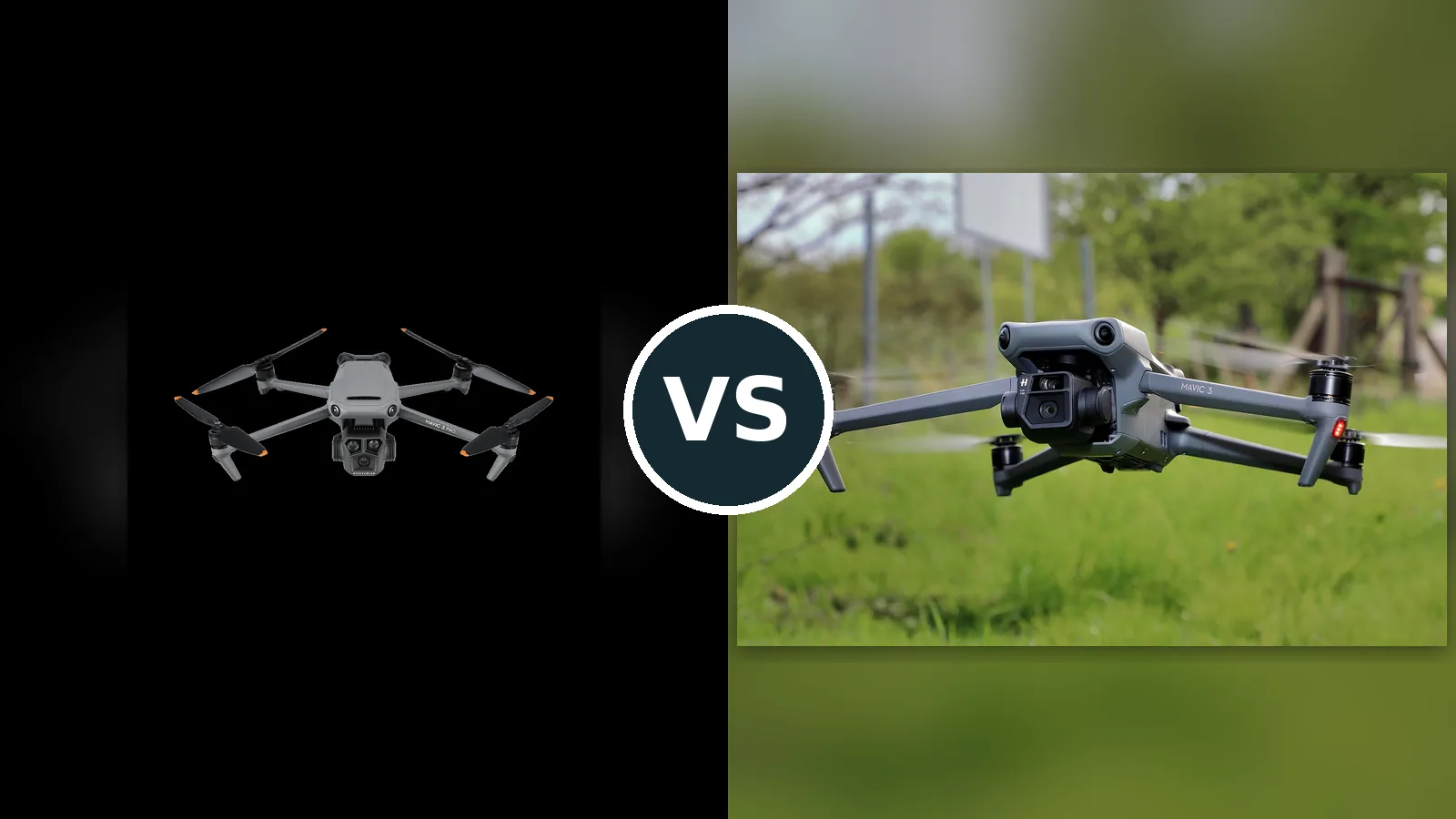
The mavic 3 pro vs cine question is really a question about what kind of creator you are. Both drones wear the Mavic 3 name and share DJI’s 4/3 Hasselblad camera, but they were built for different jobs in different years. The Mavic 3 Cine launched in November 2021 as the no-compromise video variant of the original Mavic 3, with Apple ProRes 422 HQ encoding and a 1TB SSD. The Mavic 3 Pro arrived in April 2023 with a triple-camera system that adds a 70mm medium tele and an upgraded 166mm tele to the same Hasselblad main camera, at less than half the Cine’s launch price. We compared the cameras, codecs, flight performance and kit cost so you can pick the right flagship.
As an Amazon Associate, we earn from qualifying purchases.
Mavic 3 Pro for most creators. Cine for ProRes workflows.
DJI Mavic 3 Pro wins for most buyers: three cameras instead of two, a newer platform, and a $2,199 launch price against the Cine’s $4,999. DJI Mavic 3 Cine wins for one specific buyer: the professional who needs Apple ProRes 422 HQ recorded in the drone, with a 1TB SSD to hold it. Camera versatility: Mavic 3 Pro. Codec and post workflow: Mavic 3 Cine. Flight time: Mavic 3 Cine, by three minutes. Value: Mavic 3 Pro, and it is not close.
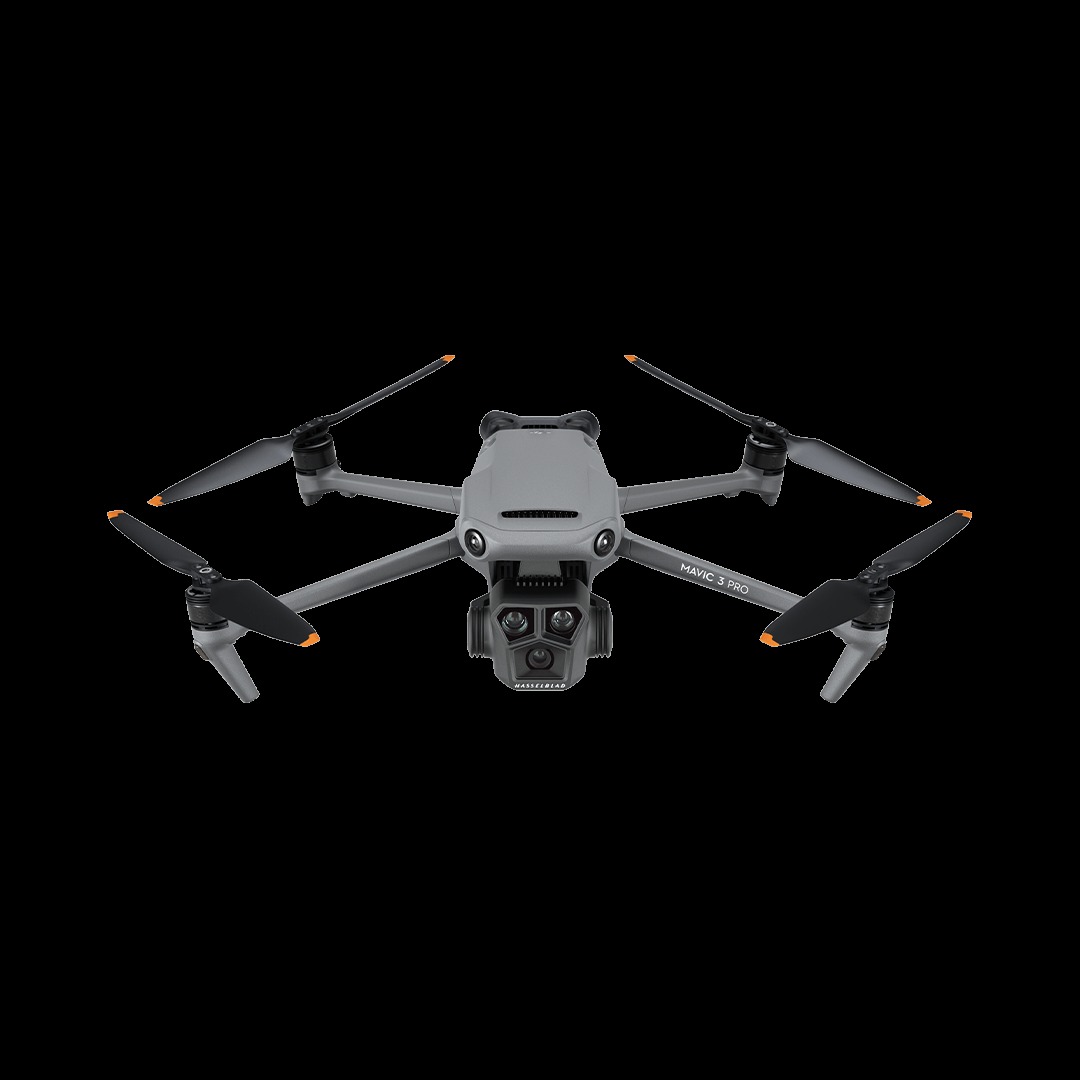
DJI Mavic 3 Pro
For creators who want three focal lengths and flagship image quality at a sane price
- Triple-camera system (24mm wide, 70mm 3x, 166mm 7x) covers wide landscapes to compressed telephoto storytelling
- 5.1K/50fps and 4K/120fps with 10-bit D-Log M on the 4/3 Hasselblad main camera
- The base model records H.264/H.265 only with 8GB internal storage; ProRes lives on the separate Pro Cine variant
Check current price and available bundles on Amazon
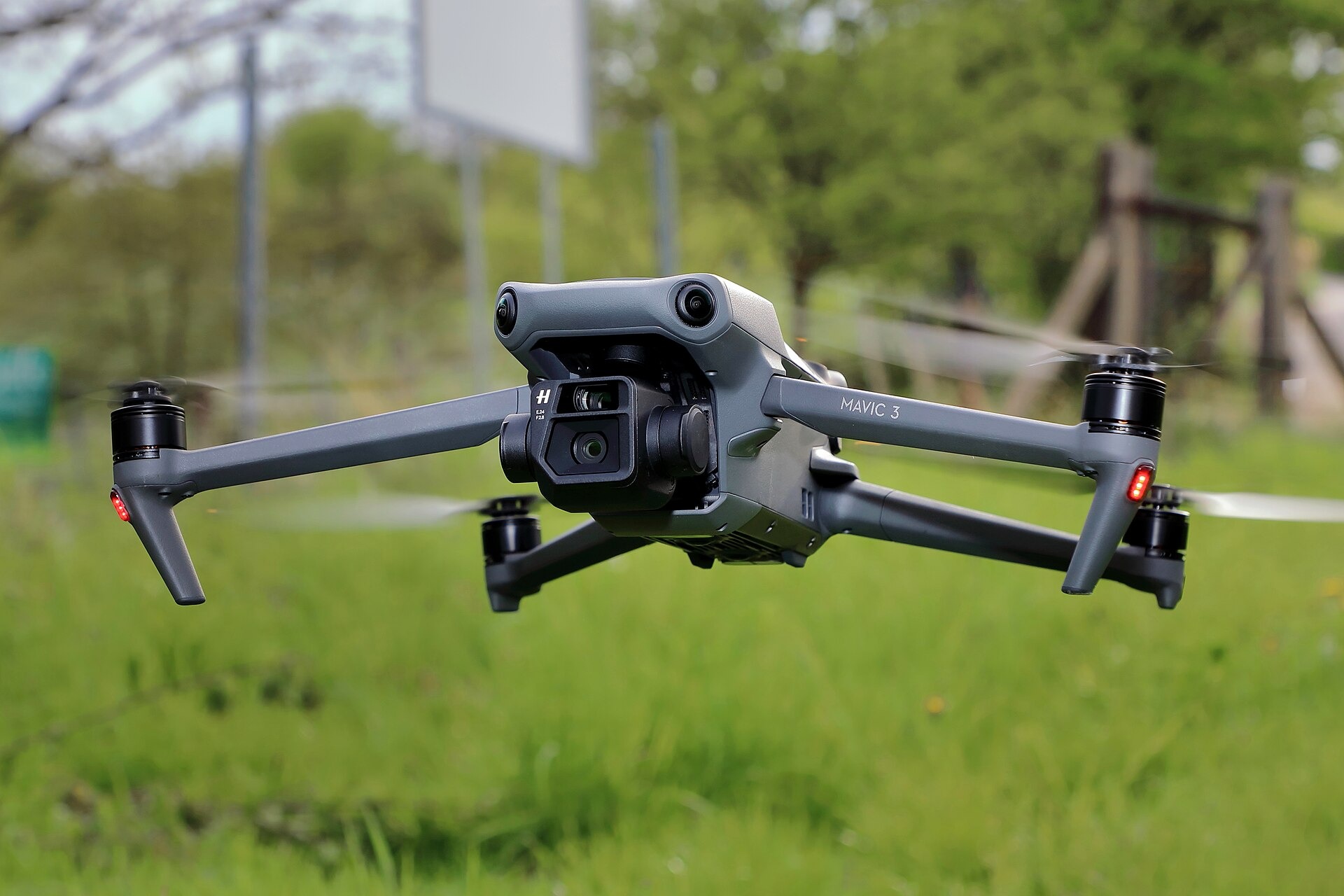
DJI Mavic 3 Cine
For production crews who need Apple ProRes 422 HQ and 1TB of onboard storage
- Apple ProRes 422 HQ at up to 3,772 Mbps: a true cinema codec in a folding drone
- 1TB internal SSD plus a 10Gbps Lightspeed cable for fast offloads on set
- Older dual-camera system and a $4,999 launch price that is hard to justify today
Check current price and available bundles on Amazon
Orange: DJI Mavic 3 Pro · Blue: DJI Mavic 3 Cine
Which flagship fits your work?
Start with the footage you deliver. These two drones answer different briefs, and the right one is the one that matches your edit, not the one with the longer spec sheet.
Most people landing on the mavic 3 pro vs cine comparison are choosing between two philosophies. The Mavic 3 Pro is the versatile storyteller: a 24mm wide for landscapes, a 70mm medium tele for compressed portraits of places, and a 166mm tele for distant details, all without moving the drone. For weddings, real estate, travel films, or YouTube, that range changes what you can shoot in a single flight.
The Mavic 3 Cine is the specialist. Its main camera is the same 4/3 Hasselblad sensor, so it cannot outshoot the Pro on framing. What it offers instead is a post-production pipeline: Apple ProRes 422 HQ at up to 3,772 Mbps on a 1TB SSD. If you deliver to broadcasters or grade aggressively, ProRes holds up where H.264 falls apart. That is the entire reason the Cine exists, and the entire reason it cost $4,999.
Timing matters too. The Cine is a retired 2021 drone; the Pro is the current 2023 flagship. Buying the Cine in 2026 only makes sense when ProRes is a line item on your invoice.
Choose DJI Mavic 3 Pro if…
- Camera versatility is your main concern, with three focal lengths for different stories.
- You shoot weddings, real estate, travel, or YouTube and want 5.1K/50fps plus 4K/120fps slow motion.
- You prefer paying $2,199 at launch pricing over $4,999 for the same main sensor.
- You can accept H.264/H.265 recording and 8GB of internal storage plus a microSD card.
Choose DJI Mavic 3 Cine if…
- Apple ProRes workflow is your main concern, for grading latitude and broadcast delivery.
- You need 1TB of internal SSD storage and fast 10Gbps offloads on set.
- You value three extra minutes of rated flight time and a slightly lighter 899 g airframe.
- You can accept a two-camera system, 2021-era tech, and a much higher price.
DJI Mavic 3 Pro Deep Dive: Three Cameras, One Drone
The April 2023 flagship that turned the Mavic 3 into a triple-camera system.
Overview: the flagship grows a third eye
DJI launched the Mavic 3 Pro on April 25, 2023 at $2,199 with the DJI RC, and the headline was simple: three cameras where the Mavic 3 had two. The airframe is familiar, a folding quadcopter at 958 g that feels dense and planted in the hand, with the same 43-minute rated flight time class as its predecessor. But the camera housing tells the new story: a large Hasselblad wide camera flanked by two telephoto modules, giving one drone the framing vocabulary that used to require landing and swapping lenses, which of course you cannot do on a drone.
DJI kept the 4/3 Hasselblad main camera that made the Mavic 3 famous, then filled the two gaps owners complained about: a mid-range telephoto for natural-looking compression, and a longer telephoto that shoots genuinely usable video. ActiveTrack 5.0, MasterShots, Waypoint Flight, and Cruise Control cover automated shooting.
Camera system: 24mm, 70mm, and 166mm
The main camera is the Hasselblad L2D-20c style 4/3 CMOS sensor shooting 20MP stills through a 24mm equivalent lens with an adjustable f/2.8 to f/11 aperture. It records 5.1K at up to 50fps, DCI 4K at up to 120fps, and Full HD at up to 200fps, with 10-bit D-Log M and HLG color and 12.8 stops of dynamic range. Stills go to 12-bit RAW with Hasselblad Natural Colour Solution, and the 100MP panorama mode stitches huge landscapes in camera.
The new medium tele camera is the one photographers asked for: a 1/1.3-inch 48MP sensor behind a 70mm equivalent f/2.8 lens, giving a natural 3x compression that flatters buildings and ridgelines. It shoots 4K/60fps with D-Log M and HLG, so its footage cuts cleanly with the main camera. The upgraded tele pairs a 1/2-inch 12MP sensor with a 166mm equivalent f/3.4 lens for 7x reach, also at 4K/60fps.
Flight performance: 43 minutes of planted confidence
The Pro is rated for 43 minutes of flight and 37 minutes of hovering, with a 28 km maximum flight distance. Real-world flying lands in the low 30s per battery in mixed conditions, which is plenty for most shoots. Top speed is 21 m/s in Sport mode, wind resistance is rated at 12 m/s, and the 958 g airframe handles gusts with the authority of a heavier drone. DJI O3+ transmission reaches 15 km under FCC rules with a 1080p/60fps live feed.
Omnidirectional obstacle sensing with APAS 5.0 watches every direction and steers around obstacles instead of just stopping, which matters when you are flying backward for a reveal or sideways for a tracking shot. AirSense ADS-B alerts you to nearby crewed aircraft, and Advanced RTH computes an efficient route home.
Mavic 3 Pro pros and cons
- Pro: Triple-camera system with 24mm, 70mm, and 166mm equivalents covers nearly every aerial framing need.
- Pro: 5.1K/50fps, 4K/120fps, and 10-bit D-Log M from the 4/3 Hasselblad main camera.
- Pro: 43-minute rated flight time with omnidirectional sensing and APAS 5.0.
- Pro: Strong value at $2,199 launch pricing against the Cine’s $4,999.
- Con: No Apple ProRes on the base model; that requires the separate, pricier Pro Cine variant.
- Con: Only 8GB of internal storage, so a fast microSD card is mandatory.
- Con: Tele cameras lag the main camera in low light and dynamic range.
DJI Mavic 3 Cine Deep Dive: Built for ProRes
The November 2021 cinema variant that put a true post-production codec in a folding drone.
Overview: what “Cine” actually means
DJI announced the Mavic 3 Cine on November 5, 2021 alongside the standard Mavic 3, priced at $4,999 as the Cine Premium Combo. The airframe is the same folding Mavic 3 design at 899 g with the same 4/3 Hasselblad main camera and 162mm telephoto. The “Cine” in the name refers to exactly two things: Apple ProRes 422 HQ encoding at up to 3,772 Mbps, and a built-in 1TB SSD to store it.
DJI bundled the Cine with the RC Pro, three batteries, two ND filter sets, and a 10Gbps Lightspeed Data Cable, a kit list that reads like a production manifest for commercial and documentary crews. ActiveTrack 5.0, MasterShots, Hyperlapse, and QuickShots cover the creative modes.
Camera system: the same Hasselblad, a better codec
The main camera is the Hasselblad L2D-20c with a 4/3 CMOS sensor, 20MP stills, a 24mm equivalent lens, and an adjustable f/2.8 to f/11 aperture. It records 5.1K at up to 50fps, DCI 4K at up to 120fps, and Full HD at up to 200fps, with 10-bit D-Log, 12.8 stops of dynamic range, and Vision Detection Autofocus that uses the vision sensors to speed up focusing. Stills go to 12-bit RAW, and the 100MP panorama mode is here too. Side by side with the Mavic 3 Pro’s main camera, the files are essentially twins: same sensor class, same lens philosophy, same color science.
The second camera is a 1/2-inch 12MP telephoto with a 162mm equivalent f/4.4 lens and 28x hybrid zoom, aimed more at scouting locations in Explore mode than at serious cinematography. This is the Cine’s honest weak spot against the Pro: one fewer camera, an older telephoto design, and no 70mm middle ground.
Where the Cine pulls ahead is the codec menu. Alongside H.264 and H.265, it records Apple ProRes 422 HQ, ProRes 422, and ProRes 422 LT. ProRes 422 HQ at up to 3,772 Mbps preserves vastly more color information than H.265, which means heavier grades, cleaner keys, and files that survive multiple export generations. For a real color pipeline, this is the difference between footage that grades and footage that breaks.
Storage and workflow: 1TB inside, 10Gbps out
ProRes files are enormous, which is why the Cine’s 1TB SSD is a requirement, not a luxury: minutes of 5.1K ProRes 422 HQ fill storage that would hold an hour of H.265. About 934.8GB is usable, and the included 10Gbps Lightspeed Data Cable moves files to a fast drive in minutes. On a real set, that is the difference between backing up at lunch and backing up instead of sleeping.
Flight performance: 46 minutes, the longest of the pair
The Cine is rated for 46 minutes of flight and 40 minutes of hovering, with a 30 km maximum distance, the best endurance figures of any Mavic in this comparison. At 899 g it is 59 g lighter than the Pro, and its folded footprint is slightly smaller. Top speed is 21 m/s, wind resistance 12 m/s, and O3+ transmission reaches 15 km with a 1080p/60fps live feed. Omnidirectional sensing, APAS 5.0, AirSense, and Advanced RTH all carry over from the Mavic 3 platform, so it flies with the same confidence as its newer sibling.
Mavic 3 Cine pros and cons
- Pro: Apple ProRes 422 HQ at up to 3,772 Mbps: the best codec ever put in a folding consumer drone.
- Pro: 1TB internal SSD plus 10Gbps Lightspeed cable for a genuinely professional offload workflow.
- Pro: 46-minute rated flight time and 899 g: the longest-flying, lightest drone in this comparison.
- Pro: Same excellent 4/3 Hasselblad main camera as the Pro, with 5.1K/50fps and 4K/120fps.
- Con: Only two cameras, and the 162mm telephoto is a scouting tool more than a cinema lens.
- Con: $4,999 launch price for 2021-era tech that DJI has since retired from its own store.
- Con: No 70mm medium tele, so reframing options are far narrower than the Pro.
Mavic 3 Pro vs Cine: The Specs That Actually Matter
Manufacturer ratings from DJI’s official spec pages, verified October 2026.
| Feature | DJI Mavic 3 Pro | DJI Mavic 3 Cine |
|---|---|---|
| Best suited to | Versatile photo and video creators who want three focal lengths | Production crews who need ProRes and 1TB onboard storage |
| Launch date and price | April 2023, from $2,199 with DJI RC | November 2021, $4,999 Cine Premium Combo |
| Takeoff weight | 958 g | 899 g |
| Dimensions folded | 231.1 x 98 x 95.4 mm | 221 x 96.3 x 90.3 mm |
| Camera system | Triple: 4/3 Hasselblad 20MP 24mm f/2.8 to f/11; 1/1.3-inch 48MP 70mm f/2.8; 1/2-inch 12MP 166mm f/3.4 | Dual: 4/3 Hasselblad 20MP 24mm f/2.8 to f/11; 1/2-inch 12MP 162mm f/4.4 |
| Video modes (main camera) | 5.1K/50fps, DCI 4K/120fps, FHD/200fps | 5.1K/50fps, DCI 4K/120fps, FHD/200fps |
| Codecs and color | H.264/H.265, 10-bit D-Log M and HLG (ProRes only on separate Pro Cine variant) | H.264/H.265 plus Apple ProRes 422 HQ, 422, 422 LT up to 3,772 Mbps; 10-bit D-Log |
| Photo resolution | 20MP main, 48MP medium tele, 12MP tele; 12-bit RAW; 100MP panorama | 20MP main, 12MP tele; 12-bit RAW; 100MP panorama |
| Internal storage | 8GB plus microSD up to 512GB | 1TB SSD (about 934.8GB usable) plus microSD |
| Rated flight time | 43 minutes (37 minutes hovering) | 46 minutes (40 minutes hovering) |
| Max flight distance | 28 km | 30 km |
| Transmission | DJI O3+, 15 km FCC, 1080p/60fps live feed | DJI O3+, 15 km FCC, 1080p/60fps live feed |
| Obstacle sensing | Omnidirectional, APAS 5.0, AirSense, Advanced RTH | Omnidirectional, APAS 5.0, AirSense, Advanced RTH |
| Max speed / wind resistance | 21 m/s Sport; 12 m/s wind resistance | 21 m/s Sport; 12 m/s wind resistance |
| GNSS | GPS, Galileo, BeiDou | GPS, Galileo, BeiDou |
| Controller options | DJI RC, DJI RC Pro; compatible with Goggles 2 and Integra | DJI RC Pro included in Premium Combo; compatible with DJI RC |
| Main trade-off | No ProRes or big internal storage on the base model | Two cameras only, older platform, much higher price |
Manufacturer ratings are lab figures; real-world flight time is lower. Prices shown are launch prices; check the live Amazon listing for the current price. Last verified: October 20, 2026.
Orange: DJI Mavic 3 Pro · Blue: DJI Mavic 3 Cine
Mavic 3 Pro vs Cine: Five Differences That Matter
For each category, here is the difference, its practical impact and which buyer benefits.
1. Camera quality and creative flexibility
Edge: Mavic 3 ProThe main cameras are a wash: both shoot 20MP stills and 5.1K/50fps through a 4/3 Hasselblad sensor with a 24mm f/2.8 to f/11 lens, 12.8 stops of dynamic range, and 10-bit log color. The comparison is decided by everything around that main camera. The Pro adds a 70mm medium telephoto with a 1/1.3-inch 48MP sensor plus an upgraded 166mm telephoto shooting real 4K/60fps video. The Cine counters with a 162mm telephoto that is a generation older, fixed at f/4.4, and best used for scouting locations rather than filming them.
In practice, the Pro owner frames three ways without moving: wide, compressed mid shot, distant detail. The Cine owner gets the wide shot and a punch-in. For photography, the Pro’s 48MP medium tele is a genuine second camera; the Cine’s tele is a 12MP afterthought.
2. Codecs and post-production workflow
Edge: Mavic 3 CineThis is the Cine’s home turf and the reason it exists. Apple ProRes 422 HQ at up to 3,772 Mbps captures roughly an order of magnitude more data than H.265, and that data survives aggressive grades and multi-generation exports that would turn H.265 into mush. The 1TB SSD means you can actually record it, and the 10Gbps Lightspeed cable moves files to your edit drive fast enough to keep a production day moving.
The base Mavic 3 Pro records H.264 and H.265 only. Its 10-bit D-Log M grades beautifully for YouTube and client work, but it is a delivery codec, not an intermediate one. A separate Mavic 3 Pro Cine variant adds ProRes and 1TB to the triple-camera platform, which shows how DJI itself resolved this debate. Between these two drones, the codec crown belongs to the Cine alone.
3. Flight time and range
Edge: Mavic 3 CineThe Cine is rated for 46 minutes of flight and 40 minutes of hovering, against the Pro’s 43 and 37. Maximum distance is 30 km versus 28 km. The gap comes from weight and tuning: the Cine’s simpler dual-camera gimbal and 899 g takeoff weight sip slightly less power than the Pro’s 958 g triple-camera assembly. Three minutes does not sound like much until you are waiting out a sunset or finishing a mapping run, and the Cine owner lands with the more relaxed battery gauge.
Both drones fly in the same endurance class, and both deserve the same discount on lab figures: expect the low 30s in real mixed flying. Transmission is identical, so neither drone outranges the other in practice. A genuine but small win for the Cine.
4. Design and portability
Edge: TieThese are the same folding Mavic design language, and the numbers show it. The Cine folds to 221 x 96.3 x 90.3 mm and weighs 899 g; the Pro folds to 231.1 x 98 x 95.4 mm and weighs 958 g. In a camera bag, the difference is the weight of a small apple and a few millimeters of plastic. Both need a proper bag rather than a jacket pocket, both set up in under a minute, and both carry the same 5000 mAh battery class.
The Pro’s triple-lens gimbal is bulkier and deserves the storage cover when packing; the Cine’s housing is a touch slimmer. Handling in the air is nearly identical. Call it a tie with a whisper of an advantage to the lighter Cine.
5. Price and value
Edge: Mavic 3 ProThe numbers are stark. The Mavic 3 Pro launched at $2,199 with the DJI RC. The Mavic 3 Cine Premium Combo launched at $4,999. That is a $2,800 gap for what is, at the sensor level, the same main camera. The Cine’s premium buys ProRes, 1TB of SSD, the RC Pro controller, extra batteries, and two ND sets, but even accounting for the richer bundle, you are paying more than double for a codec and storage.
The Pro is the current flagship, still sold and supported. The Cine is a retired 2021 product whose DJI store page now redirects to support documentation, and buying old stock carries battery and warranty risks. Unless ProRes is billable on your projects, the Pro delivers more drone per dollar by a wide margin.
Mavic 3 Pro vs Cine: What You Gain and What You Give Up
DJI Mavic 3 Pro
Reasons to choose it
- Triple-camera system with 24mm, 70mm, and 166mm equivalents for unmatched framing flexibility
- 5.1K/50fps and 4K/120fps from the 4/3 Hasselblad main camera with 10-bit D-Log M
- Newer platform with Waypoint Flight, Cruise Control, and ongoing firmware support
- Strong value at $2,199 launch pricing with the DJI RC included
Reasons to reconsider
- No Apple ProRes on the base model; only 8GB internal storage plus microSD
- Telephoto cameras trail the main camera in low light
- Heavier at 958 g with three fewer minutes of rated flight time than the Cine
DJI Mavic 3 Cine
Reasons to choose it
- Apple ProRes 422 HQ at up to 3,772 Mbps for professional color pipelines
- 1TB internal SSD plus 10Gbps Lightspeed cable for fast on-set offloads
- 46-minute rated flight time: the longest endurance in this comparison
- Premium Combo bundles the RC Pro, three batteries, and full ND sets
Reasons to reconsider
- Only two cameras, and the 162mm telephoto is dated
- $4,999 launch price for a retired 2021 platform
- No 70mm middle focal length, limiting creative options
Check the bundle, not just the drone
The drone on the box is only half the purchase. Run through this checklist before you tap buy.
- Controller: The Pro ships with the DJI RC and its built-in 5.5-inch screen; step up to the RC Pro for 1000-nit brightness. The Cine Premium Combo includes the RC Pro by default. Confirm the exact controller in the listing title.
- Batteries: One battery is never enough. The Cine Premium Combo includes three, which is ideal. For the Pro, the Fly More Combo adds two extra batteries, a 100W charging hub, ND filters, and a shoulder bag, and it is the better buy if you fly weekly.
- Storage: The Pro’s 8GB of internal storage means a fast U3/V30 microSD card up to 512GB is effectively mandatory. The Cine’s 1TB SSD covers ProRes sessions, but keep a microSD card as backup anyway.
- Listing: The Cine is retired from DJI’s own store, so Amazon and third-party listings may be new-old-stock, refurbished, or used. Verify the exact model name, shutter count if used, battery cycle count, seller reputation, and return terms. For the Pro, stick to sealed retail bundles from reputable sellers.
- The Pro Cine alternative: If you want the Pro’s three cameras AND ProRes with 1TB of storage, DJI sells exactly that as the Mavic 3 Pro Cine Premium Combo. It costs more than the base Pro, but it is the modern answer to the Cine and worth pricing before you commit to the older drone.
- Local requirements: Both drones weigh well over 250 g, so expect registration requirements in the US, UK, and EU. Check your aviation authority’s current rules on registration, Remote ID, and airspace before your first flight.
The right choice comes down to codec versus cameras.
If you want the most capable aerial camera system for the money, buy the Mavic 3 Pro. Its triple-camera array, newer platform, and $2,199 launch price make it the smarter purchase for weddings, real estate, travel, and YouTube. If your work lives in a professional color pipeline and clients expect ProRes deliverables, buy the Mavic 3 Cine: its ProRes 422 HQ encoding and 1TB SSD are purpose-built for exactly that job. Everyone else should take the Pro and never look back.
Still deciding?
Is the Mavic 3 Cine worth it over the Mavic 3 Pro?
Only for a specific professional workflow. The Cine offers ProRes 422 HQ, a 1TB SSD, and three extra minutes of flight time. The Pro counters with a third camera, a newer platform, and less than half the launch price. If ProRes is not on your invoices, buy the Pro.
What is the difference between the Mavic 3 Cine and the Mavic 3 Pro Cine?
They are different drones, and the names confuse everyone. The Mavic 3 Cine is the 2021 ProRes variant of the original two-camera Mavic 3. The Mavic 3 Pro Cine is the ProRes variant of the 2023 triple-camera Mavic 3 Pro, with a 1TB SSD and tri-camera ProRes support. If you want modern cameras plus ProRes, the Pro Cine is the current product; the older Cine is the retired one.
Can the Mavic 3 Pro shoot Apple ProRes?
The base Mavic 3 Pro cannot; it records H.264 and H.265 with 10-bit D-Log M and HLG. Apple ProRes on the triple-camera platform requires the separate Mavic 3 Pro Cine variant, which adds ProRes support and a 1TB SSD at a higher price.
Do both drones share the same main camera?
Effectively yes. Both use a 4/3 Hasselblad sensor with a 24mm equivalent f/2.8 to f/11 lens, 20MP stills, 5.1K/50fps video, 12.8 stops of dynamic range, and 10-bit log color. Wide-angle image quality is a tie; the Pro pulls ahead with its two additional telephoto cameras.
Which drone flies longer, and which is lighter?
The Mavic 3 Cine wins both: 46 minutes of rated flight time against 43, and 899 g against 958 g. Maximum range is 30 km versus 28 km. The differences are real but small, and both drones need the same real-world discount on lab figures.
How were these drones compared?
This is a research-based comparison. We compiled specifications from DJI’s official spec pages, launch announcements, and manuals, then cross-checked them against independent reviews and retailer listings. We did not fly either drone, so rated figures are DJI’s lab numbers. ASINs were verified by matching each one against the exact product title before any affiliate link was written.
How this comparison was prepared
This is a research-based comparison. We did not fly either drone for this article, and we do not imply otherwise. Every specification above comes from DJI’s official documentation, mainly the Mavic 3 Pro and Mavic 3 spec pages, with pricing and bundle contents cross-checked against DJI’s launch announcements, the DJI Store, and authorized retailers. The Mavic 3 Cine has been retired from DJI’s consumer store, so availability notes reflect third-party and marketplace listings as of October 2026.
Sources and verification
- DJI Mavic 3 Pro official specifications (dji.com, accessed October 20, 2026): aircraft, triple-camera, gimbal, sensing, transmission, and battery figures
- DJI Mavic 3 Pro FAQ (dji.com, accessed October 20, 2026): version differences, combo contents, and Cine Premium Combo details
- DJI Mavic 3 official specifications (dji.com support, accessed October 20, 2026): weight, dimensions, dual-camera, flight time, and sensing figures
- DJI Mavic 3 Cine Premium Combo product page (DJI Store, accessed October 20, 2026): ProRes codecs, 1TB SSD, and combo contents
- DJI Mavic 3 launch press release (DJI newsroom via mynewsdesk, November 2021): ProRes data rates, SSD, Lightspeed cable, and launch pricing
- DJI Mavic 3 Pro launch coverage (April 2023): triple-camera specifications, launch pricing, and combo details
- ASIN verification: Mavic 3 Pro listing (B0BYHSDY4C, DJI RC edition) and Mavic 3 Cine Premium Combo listing (B09HHB3YFW) confirmed against Amazon-indexed title and product data
Last verified: October 20, 2026. Bundle availability, pricing, and specifications may vary by region and version. Prices in this article are launch reference prices; check the live Amazon listing for the current price.