

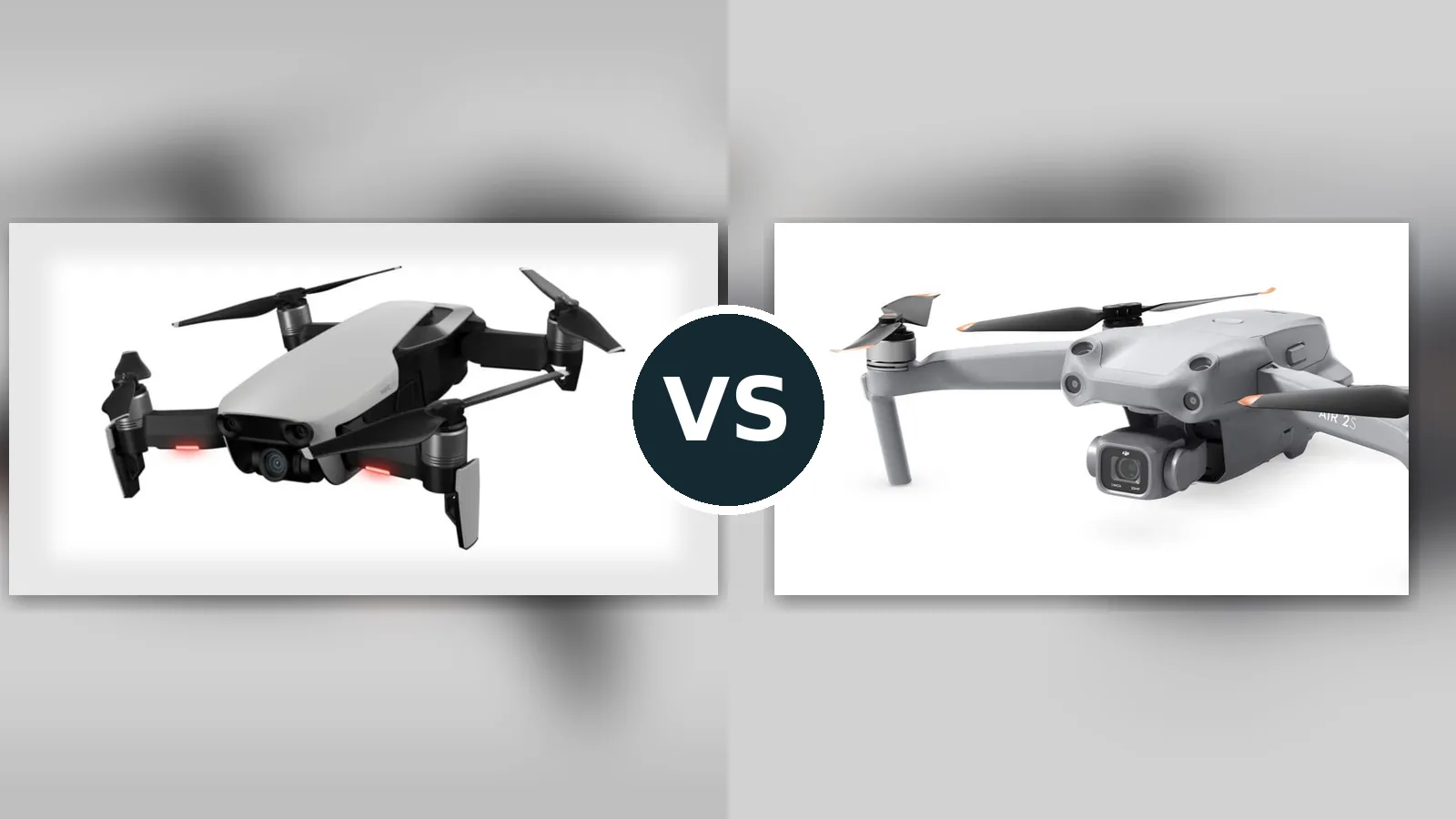
The dji mavic air vs dji air 2s comparison spans just three years of DJI history, but what years they were. The original Mavic Air of 2018 was a marvel: a 430-gram folding drone with a 4K/30 camera at 100 Mbps, 3-directional sensing, gesture control, and 8 GB of internal storage, all firsts or near-firsts at its size. The Air 2S of 2021 is its direct descendant and its rebuttal: a 1-inch sensor shooting 5.4K, four-direction sensing, 31-minute flights, and modern O3 transmission. If you own the original, inherited one, or found one cheap, this comparison tells you exactly what the upgrade buys, and what the little 2018 drone still does surprisingly well.
As an Amazon Associate, we earn from qualifying purchases.
Air 2S, clearly. Mavic Air for charm and spare change.
DJI Air 2S wins this comparison on nearly every measurable axis: a 1-inch sensor against a 1/2.3-inch, 5.4K against 4K, 31 minutes against 21, four-direction sensing against three, and O3 transmission against Wi-Fi. DJI Mavic Air keeps two honest claims: it is smaller and lighter at 430 grams, and it remains a delightful, capable little aircraft for casual flying when bought very inexpensively. Camera: Air 2S by a mile. Portability: Mavic Air. Everything else: Air 2S.

DJI Mavic Air
For casual flyers who find the 2018 original at a truly low price
- Still tiny and tough: folds to 168 by 83 by 49 mm with a proper 3-axis gimbal
- Gesture control, Asteroid and Boomerang QuickShots, and 8 GB internal storage were ahead of their time
- Wi-Fi transmission, 21-minute flights, DJI GO 4 software, and aging batteries date it today
Check availability and bundle options on Amazon
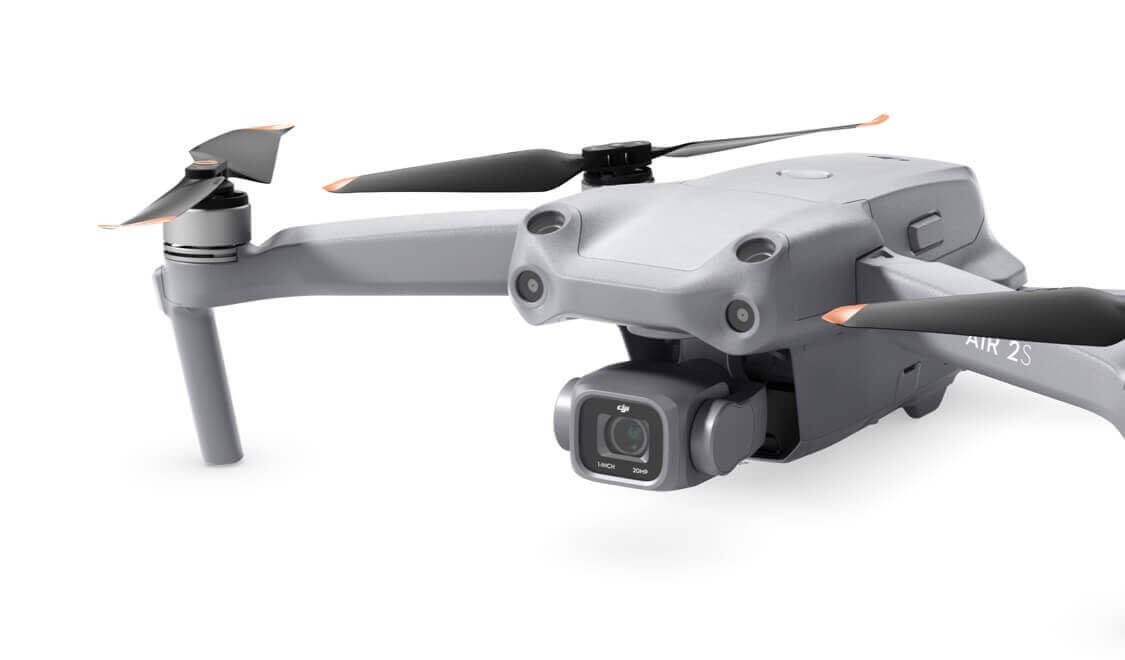
DJI Air 2S
For anyone who wants the Air concept with a professional camera
- 1-inch sensor with 5.4K video and 10-bit color outclasses the original in every light
- Four-direction sensing, MasterShots, and 12 km O3 transmission modernize the whole experience
- Bigger and heavier than the original, and priced like the serious tool it is
Check availability and bundle options on Amazon
An upgrade question, mostly
Unlike most pairings in this series, these two drones are not really rivals for the same new buyer. The Mavic Air is an ownership decision about an old drone; the Air 2S is a purchase decision about a current-class tool.
Choose the Air 2S if you are buying a drone to shoot with. Its camera is not incrementally better than the original’s; it is categorically better, with a sensor roughly four times the area, 5.4K oversampled video, 10-bit color for grading, and low-light performance the 2018 drone cannot approach. Its sensing adds the upward direction the original lacked, its transmission is a modern digital link instead of Wi-Fi, and its 31-minute endurance transforms what a single battery can cover.
Choose the Mavic Air if one lands in your hands cheaply, as a gift, a hand-me-down, or a bargain-bin find, and your ambitions are casual. It flies beautifully, its 4K/30 footage at 100 Mbps still looks good in daylight, and its tiny folded size makes it an effortless travel companion. As a trainer or a second drone, it remains genuinely lovable.
What does not make sense in 2026 is paying real money for a Mavic Air as your main camera drone.
There is a collector’s angle, briefly: the Mavic Air is old enough and distinctive enough, with its gem-cut styling and three launch colors, that clean examples are becoming memorabilia. That is a fine reason to own one and a poor reason to depend on one. Working pilots need batteries that hold rated capacity and software that opens on a modern phone, and both of those point at the newer drone.
What does not make sense in 2026 is paying real money for a Mavic Air as your main camera drone. Its batteries are old, its app is the retired DJI GO 4, its Wi-Fi link is its weakest organ, and the Air 2S exists. The breakdowns below quantify each gap so an owner can judge an upgrade, or a bargain hunter can judge a price.
Buy the DJI Mavic Air if you:
- Found one very cheap: a casual flyer and trainer at a bargain price
- Want the smallest, lightest package in this comparison at 430 grams
- Fly for fun in daylight and value gesture control and playful QuickShots
- Accept DJI GO 4 software, Wi-Fi range, and old batteries as the terms
Buy the DJI Air 2S if you:
- Shoot seriously: 1-inch sensor, 5.4K, 10-bit color, RAW stills
- Want modern O3 transmission and 31-minute endurance
- Need four-direction sensing and MasterShots automation
- Are upgrading from the original Air and want the leap to be unmistakable
DJI Mavic Air: the 2018 pocket rocket
Judged by 2018 standards the Mavic Air was astonishing, packing Mavic Pro capability into half the size. Judged today, it is a charming classic with clearly dated infrastructure.
A small camera that punched above its year
The 1/2.3-inch CMOS sensor shoots 12MP stills and 4K/30 video at a then-remarkable 100 Mbps, with 1080p/120 slow motion, behind a 24mm f/2.8 lens on a true 3-axis gimbal. It pioneered 32MP Sphere panoramas and stored 8 GB internally, a DJI first. In bright daylight its footage still holds up respectably on modern screens, with decent color from DJI’s tuning of the era.
The ceilings are equally clear. The small sensor limits dynamic range and low-light work, there is no 10-bit or flat profile pipeline to grade, and 4K stops at 30fps. Against the Air 2S’s 5.4K and 1-inch sensor, the gap is the story of three years of sensor progress compressed into one comparison.
Fast, clever, and connected by Wi-Fi
At 430 grams, folding to 168 by 83 by 49 millimeters, the Mavic Air remains one of the most portable camera drones DJI has made. It is quick, with a 68.4 km/h Sport mode top speed, and tough in wind for its size per DJI’s launch claims. FlightAutonomy 2.0 provides forward, backward, and downward sensing with APAS routing, ActiveTrack follows subjects, SmartCapture lets you launch and direct it with hand gestures, and QuickShots include the delightful Asteroid and Boomerang modes.
The constraints are endurance and link. The 2375 mAh battery is rated at 21 minutes, the shortest in this comparison,
Its party pieces deserve their footnote in history: the Mavic Air was DJI’s gesture-control showcase, launching, landing, and directing shots from an open palm, and its Asteroid QuickShot, which warps a sphere panorama into a tiny-planet reveal, remains one of the most shareable automated shots DJI has designed. The rear obstacle sensors were also a genuine first at this size, giving the little drone a backward awareness that flagship buyers previously monopolized.
The constraints are endurance and link. The 2375 mAh battery is rated at 21 minutes, the shortest in this comparison, and transmission is Enhanced Wi-Fi rated to 4 km FCC with a 720p feed, which in real neighborhoods means interference and break-up far sooner. It flies on the retired DJI GO 4 app, and every battery in circulation is years old. Lovable, yes. Current, no.
DJI Air 2S: the Air idea, perfected
The Air 2S is what the Mavic Air wanted to be when it grew up: the same compact folding concept, rebuilt around a professional camera and modern systems.
The 1-inch camera rewrites the comparison
A 1-inch CMOS sensor captures 20MP stills in JPEG and DNG RAW and video up to 5.4K/30, with 4K/60 and 1080p/120 beneath, at up to 150 Mbps in 10-bit D-Log M or HLG. The 5.4K mode oversamples down to exceptionally detailed 4K, and the big sensor’s dynamic range and low-light behavior belong to a different class than the original’s small chip. Where the Mavic Air’s footage says 2018, the Air 2S’s still passes for current professional work.
The 22mm equivalent f/2.8 lens is fixed-aperture, the one specification where the Mavic 3-class drones pull ahead, but exposure control through shutter and ND filters covers real-world needs comfortably.
Systems from a later generation
At 595 grams, folded to 180 by 97 by 77 millimeters, the Air 2S is larger than its ancestor and uses the space well. Sensing covers forward, backward, upward, and downward with APAS 4.0 routing, adding the upward direction the original lacked. FocusTrack brings ActiveTrack 4.0, Spotlight 2.0, and Point of Interest 3.0, and MasterShots automates full cinematic sequences with an assembled edit.
Endurance is rated at 31 minutes from a 3500 mAh battery, ten minutes beyond the original, and DJI O3 transmission reaches 12 km FCC, replacing Wi-Fi with a robust digital link.
The Air 2S also inherits the line’s digital zoom, up to 4x at 4K/30 and more at lower resolutions, useful for cautious framing around subjects you should not approach. Combined with Spotlight 2.0, which keeps the camera locked on a subject while you fly freely, the Air 2S offers camera choreography the original’s simpler ActiveTrack could not attempt.
Endurance is rated at 31 minutes from a 3500 mAh battery, ten minutes beyond the original, and DJI O3 transmission reaches 12 km FCC, replacing Wi-Fi with a robust digital link. Top speed matches the original’s 68.4 km/h. Registration is required at this weight in the US, and the Air 2S flies on the current DJI Fly app, keeping it inside DJI’s supported world.
Specifications: three years of progress, itemized
Manufacturer figures for both drones. Nearly every row moves in the Air 2S’s favor; the weight and size rows are the original’s remaining territory.
| Specification | DJI Mavic Air | DJI Air 2S |
|---|---|---|
| Takeoff weight | 430 g | 595 g |
| Dimensions | Folded 168 × 83 × 49 mm | Folded 180 × 97 × 77 mm |
| Camera sensor | 1/2.3-inch CMOS, 12MP | 1-inch CMOS, 20MP |
| Lens | 24mm equivalent, f/2.8 | 22mm equivalent, f/2.8 |
| Max video | 4K/30; 1080p/120 | 5.4K/30; 4K/60; 1080p/120 |
| Color and codecs | Standard profiles; up to 100 Mbps | 10-bit D-Log M and HLG; up to 150 Mbps |
| Photo formats | JPEG and DNG, 12MP; 32MP Sphere panoramas | JPEG and DNG RAW, 20MP |
| Gimbal | 3-axis mechanical | 3-axis mechanical |
| Obstacle sensing | Forward, backward, downward; FlightAutonomy 2.0 with APAS | Forward, backward, upward, downward; APAS 4.0 |
| Tracking and modes | ActiveTrack, SmartCapture gestures, QuickShots incl. Asteroid and Boomerang | FocusTrack with ActiveTrack 4.0, MasterShots, QuickShots |
| Rated flight time | 21 minutes | 31 minutes |
| Transmission | Enhanced Wi-Fi, up to 4 km FCC, 720p live view | DJI O3, up to 12 km FCC |
| Max speed | 68.4 km/h in Sport mode | 68.4 km/h in Sport mode |
| Wind resistance | Handles winds up to about 36 km/h per DJI launch material | 10.5 m/s (Level 5) |
| GNSS | GPS and GLONASS | GPS and GLONASS |
| Internal storage | 8 GB plus microSD | 8 GB plus microSD up to 256 GB |
| Battery | 2375 mAh | 3500 mAh |
| App | DJI GO 4 | DJI Fly |
| Registration (US recreational) | Required at 430 g | Required at 595 g |
Figures are the manufacturers’ published ratings from each drone’s era. The Mavic Air’s battery figures assume a healthy pack; on an eight-year-old drone, real endurance depends entirely on the individual battery’s condition.
Five differences between 2018 and 2021
This pairing is a time machine. Each breakdown below is a lesson in what three years of DJI development actually bought.
1. The sensor: four times the light
DJI Air 2SThe Air 2S’s 1-inch sensor has roughly four times the surface area of the Mavic Air’s 1/2.3-inch chip. Everything flows from that: 5.4K oversampled video, 20MP RAW stills, dynamic range that holds a sunset together, and dusk footage that stays clean while the original’s turns to noise. It is the largest single gap in this comparison and the core of the upgrade case.
The Mavic Air’s camera is not bad; in daylight its 100 Mbps 4K remains perfectly watchable. But side by side, in any light that is not perfect, the Air 2S’s footage belongs to a different product category.
For stills shooters the difference is just as wide. Both drones record DNG files, but the Air 2S’s 20MP captures from a 1-inch sensor hold far more recoverable detail in shadows and skies, so a single frame can be cropped or printed with confidence. The original’s 12MP files remain fine for social sharing, yet they punish heavy editing quickly.
2. Transmission: Wi-Fi against O3
DJI Air 2SThe Mavic Air’s Enhanced Wi-Fi was its weakest system even in 2018: a 4 km FCC rating on paper, and in real neighborhoods a feed that stutters behind houses and trees. The Air 2S’s O3 digital link, rated to 12 km FCC, is stable, long-ranged, and confidence-inspiring in exactly the places Wi-Fi gives up.
Transmission quality shapes every flight, because the live view is what you fly by. This is the difference owners feel first, before they ever compare footage on a monitor.
There is also a learning angle. New pilots learn faster when the picture on the controller stays stable, because they can trust what the drone sees and focus on smooth stick inputs. With the Mavic Air, a feed that breaks up at modest distances teaches caution early, and many owners simply learn to keep it close. The Air 2S lets a beginner build range and confidence progressively, which shortens the path from tentative first flights to deliberate camera work.
3. Endurance: ten more minutes
DJI Air 2STwenty-one rated minutes was acceptable in 2018; it feels frantic now, especially with aged batteries delivering less. The Air 2S’s 31 minutes is a 48 percent improvement that changes behavior: time to scout, wait for light, and retake a shot without the low-battery warning colonizing your attention.
The Mavic Air’s defense is that its shots were always meant to be quick. True, but even quick shooters land happier with reserve in the tank, and the Air 2S provides it.
Kit value follows the same math. A Mavic Air owner who wants a full afternoon of flying ends up hunting down several aging packs of uncertain health, while an Air 2S owner covers the same outing with fewer, healthier batteries and spends the time shooting instead of swapping. Longer flights per battery also mean fewer charge cycles consumed per project, which stretches the useful life of every pack in the bag.
4. Size: the original’s last stand
DJI Mavic AirFolded, the Mavic Air is smaller in every dimension and 165 grams lighter than the Air 2S. It disappears into a jacket pocket in a way the bigger drone cannot, and its dense, jewel-like build still feels premium. For pure travel minimalism, the 2018 drone wins its home turf.
The Air 2S spends that size on sensor, battery, and sensing, and most buyers will call it the right trade. But if your drone lives in your everyday carry and flies opportunistically, the original’s footprint is a real and lasting virtue.
Everyday carry tells the same story in miniature. The Mavic Air plus its controller rides in a small sling without negotiating for space. The Air 2S kit wants a dedicated bag slot and earns it back in capability. Decide which bag your drone honestly lives in, because a drone left at home shoots nothing at all.
5. Software and support era
DJI Air 2SThe Mavic Air runs DJI GO 4, the retired app generation: no updates, creeping phone-compatibility risk, and a parts and battery supply that thins every year. The Air 2S runs DJI Fly, inside DJI’s current support world, with MasterShots, modern tracking, and accessories still on shelves.
An old drone’s real cost is rarely the purchase; it is the ecosystem quietly expiring around it. On that measure the Air 2S is not just better, it is safer money.
Pros and cons, plainly
DJI Mavic Air
What it does best
- Smallest and lightest here: 430 g, truly pocketable fold
- 4K/30 at 100 Mbps still looks good in daylight
- 3-directional sensing and APAS were pioneering at its size
- SmartCapture gestures and Asteroid and Boomerang QuickShots are pure fun
- 8 GB internal storage, unusual generosity for 2018
Where it gives ground
- Small sensor: weak dynamic range and low-light performance
- 21-minute rated flights, less on aging batteries
- Wi-Fi transmission breaks up early in real neighborhoods
- Retired DJI GO 4 app and an expiring parts ecosystem
- No upward sensing and no 10-bit color pipeline
DJI Air 2S
What it does best
- 1-inch 20MP sensor with 5.4K video and 10-bit color
- 31-minute flights and robust O3 transmission to 12 km
- Four-direction sensing with APAS 4.0
- MasterShots and FocusTrack automation
- Current DJI Fly support and accessory availability
Where it gives ground
- 595 grams: bigger carry and registration required
- Fixed f/2.8 aperture limits exposure flexibility
- No native vertical video mode
- Priced as a serious tool, with batteries to match
- Less pocketable than the original it replaces
Bundle checklist: old drone, new drone, different checks
The right pre-purchase checks differ completely between a 2018 classic and a current model. Run the list that matches your side of this comparison.
- For a Mavic Air, battery interrogation is the purchase: ask for cycle counts, charge behavior, and any swelling; a cheap Air with tired batteries is not cheap once you source replacements.
- Confirm the Mavic Air is unbound: the drone must be released from the previous owner’s DJI account, and DJI GO 4 must run on your phone. Test both before money moves.
- For the Air 2S, choose the controller bundle once: RC-N1 style phone-based control or a screen controller is a daily-experience decision; buying right the first time is cheaper than upgrading later.
- Cards for the Air 2S’s appetite: 150 Mbps recording wants fast, high-endurance microSD; the Mavic Air’s 8 GB internal buffer forgives a forgotten card on both drones, briefly.
- Registration applies to both: at 430 grams and 595 grams, both exceed the US recreational threshold, and Remote ID rules deserve a check for the older drone especially.
- Spares strategy differs: Mavic Air propellers and batteries are legacy stock, so buy spares when you find them; Air 2S accessories remain in normal retail channels.
Honor the original by upgrading from it.
The DJI Mavic Air deserves its place in drone history: it proved a pocket drone could be a real camera drone, and it remains a joy to fly casually. But as a purchase in 2026, the DJI Air 2S defeats it on camera, endurance, transmission, sensing, and support, which is to say on everything except folded size. If you own the original and love it, the Air 2S is the upgrade that will feel like a generational leap, because it is one. If you are offered the original at a true bargain, take it as a trainer and a travel toy with open eyes about its batteries and its Wi-Fi. Everyone else: buy the Air 2S.
Think of it as two different purchases sharing one name. The Mavic Air is a hobby purchase: buy it for the pleasure of a clever little aircraft, fly it on calm days close to home, and enjoy footage that still surprises people when you tell them its age. The Air 2S is a tool purchase: buy it when the footage is the point, when clients or an audience will see the results, and when you want one compact drone to cover stills and video work without apology.
Questions buyers ask about this pairing
Is the Air 2S a big upgrade from the Mavic Air?
Yes, one of the clearest generational upgrades DJI has made. The sensor is roughly four times larger, video resolution jumps from 4K to 5.4K with 10-bit color, flight time grows from 21 to 31 minutes, sensing adds a fourth direction, and Wi-Fi transmission is replaced by O3 with three times the rated range.
Is the original Mavic Air still worth buying?
Only at a genuinely low price and for casual use. It still flies well and shoots decent daylight 4K, but its batteries are old, its app is retired, and its Wi-Fi link is fragile by modern standards. As a main camera drone at a serious price, the Air 2S is the rational buy. A first-time pilot who finds one cheap also gets an honest trainer: it teaches positioning, exposure discipline, and battery management on hardware that forgives a modest budget, and every habit learned on it transfers directly to the Air 2S later.
Do both drones need registration?
Yes. The Mavic Air weighs 430 grams and the Air 2S weighs 595 grams, both above the 250-gram threshold, so registration is required for recreational flying in the US, and Remote ID rules apply. Check the current requirements for your situation before flying.
Which drone has better range?
The Air 2S by a wide margin: its O3 system is rated to 12 km FCC against the Mavic Air’s 4 km Wi-Fi rating, and the practical gap in built-up areas is even more noticeable than the numbers suggest, since Wi-Fi links suffer more interference.
Can the Mavic Air still get parts and batteries?
Increasingly through third-party and remaining-stock channels rather than DJI’s current retail. Propellers and batteries exist, but supply thins each year, which is why bargain hunters should buy spares alongside the drone when they find them.
Which is better for travel?
For pure portability, the Mavic Air: smaller, lighter, pocketable, and quick to deploy at an unplanned viewpoint. For travel footage you will actually publish, the Air 2S: its sensor, endurance, wind manners, and link justify the slightly larger bag. Most travel creators who have tried both end up carrying the Air 2S on any trip where the footage truly matters.
How this comparison was prepared
This is a research-based comparison; we did not fly either drone for this article. Mavic Air specifications come from DJI’s original 2018 launch materials and published specifications, corroborated by contemporaneous launch coverage. Air 2S specifications come from DJI’s official Air 2S specifications page. Statements about battery aging, app support, and parts availability reflect both models’ documented product status. Amazon listings for both drones were verified against the exact product titles before the links in this article were written.
Sources and verification
- DJI Mavic Air launch announcement and specifications (DJI, January 2018): weight, camera, flight time, sensing, and storage figures
- PetaPixel DJI Mavic Air launch coverage (January 2018): feature set and wind performance claims
- DJI Mavic Air product information (Amazon listing data): model and configuration details
- DJI Air 2S official specifications (dji.com): sensor, video, sensing, flight time, and transmission figures
- Amazon listing verification: DJI Mavic Air and DJI Air 2S product titles matched to the linked listings
Last verified: October 20, 2026. Specifications, bundle contents, and availability may vary by region and over time.


