

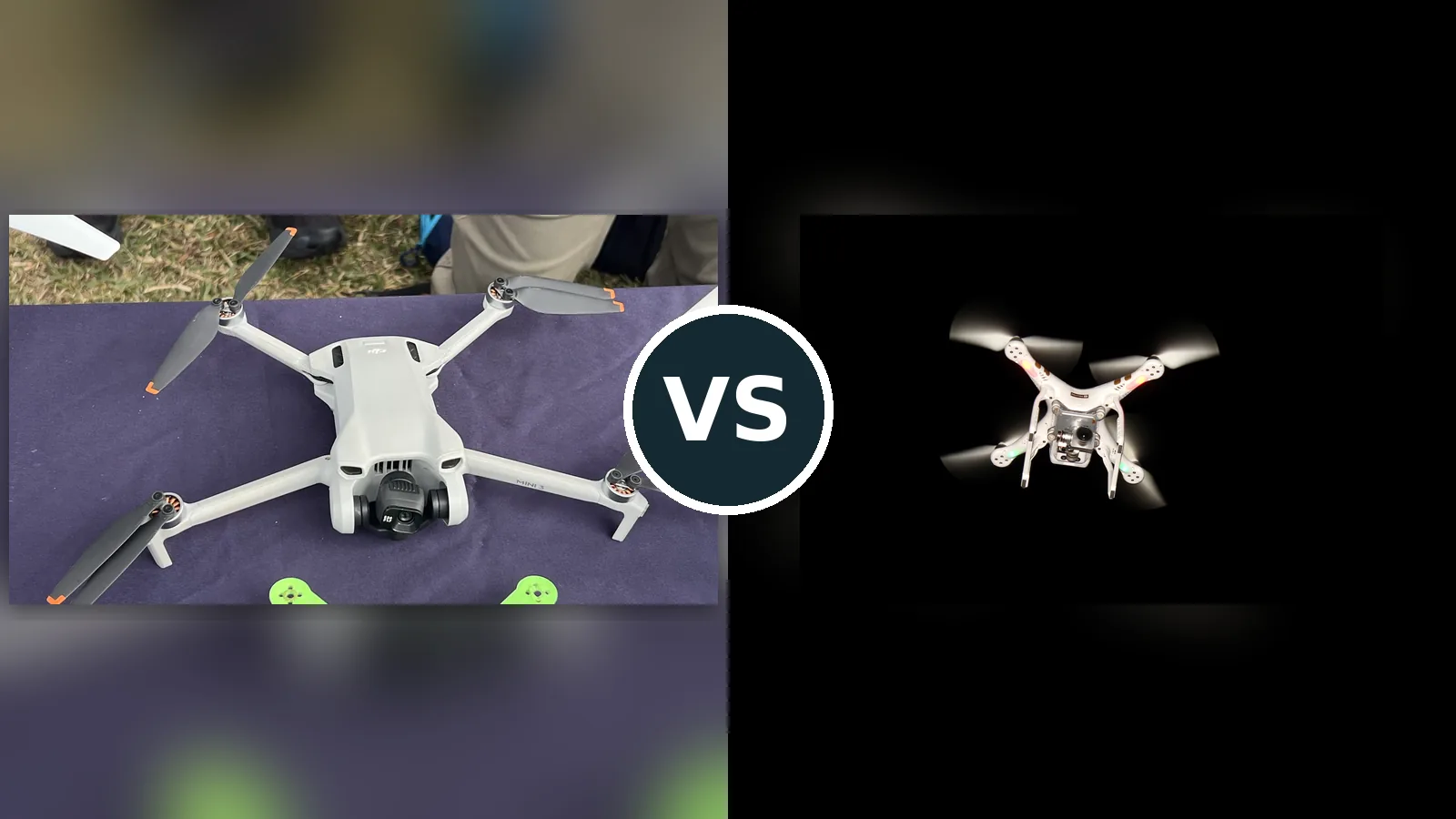
The dji mini 3 vs phantom 4 comparison looks odd on paper, and that is exactly why it is useful. One drone weighs 248 grams, folds into a jacket pocket, and was built for creators who want to launch anywhere in under a minute. The other weighs 1,380 grams, does not fold at all, and defined what a camera drone looked like for a generation. The DJI Mini 3 is the modern answer: a 1/1.3-inch sensor, true vertical shooting, and up to 38 minutes on a standard battery. The DJI Phantom 4 is the classic answer: forward obstacle sensing, ActiveTrack, proven Lightbridge transmission, and that unmistakable tall airframe that still turns heads at a flying field. If you are choosing between a cheap used Phantom and a new Mini, or wondering whether the old flagship still earns its space in a bag, this guide works through the camera, the handling, the safety systems, and the ownership reality in plain language.
Affiliate disclosure: As an Amazon Associate I earn from qualifying purchases. This page contains affiliate links. If you buy through them, we may earn a commission.
Mini 3 for almost everyone. Phantom 4 for nostalgia with a purpose.
DJI Mini 3 is the clear pick for travel, social video, and everyday flying: a bigger sensor than the Phantom, true vertical capture, longer rated flight time, and a kit that fits in a small sling. DJI Phantom 4 only makes sense if you specifically want its forward sensing, ActiveTrack and TapFly modes, its 1080p slow motion, or the experience of flying the classic itself. On image quality, portability, and ease of ownership today, the Mini 3 wins by a wide margin.

DJI Mini 3
For creators who want a sub-250 gram drone with a real 4K camera and vertical video
- Larger 1/1.3-inch sensor with 48MP stills and an f/1.7 lens for cleaner low light work
- True Vertical Shooting turns the gimbal 90 degrees for social formats without cropping
- 38 minutes rated on the standard battery, 51 minutes with the Plus battery where rules allow
Check current availability and bundle details on Amazon

DJI Phantom 4
For collectors and pilots who want forward sensing and the original flagship feel
- Forward obstacle sensing plus downward Vision Positioning, which the Mini 3 does not offer
- ActiveTrack, TapFly and Draw modes for subject following the Mini 3 cannot match
- Discontinued and sold used only, so condition and battery health decide everything
Check current availability and bundle details on Amazon
Which drone fits your flying?
Start with your main use case. The best choice should solve your needs, without charging you for features you will rarely use.
Start by being honest about how you actually fly. If your best clips come from trips, walks, family days, and quick launches when the light looks good, the Mini 3 fits that life. It lives in a bag you already carry. It asks for almost no setup. You unfold the arms, wait for satellites, and you are in the air while a Phantom owner is still fitting propellers and finding a flat patch large enough for those tall landing legs. That speed changes behaviour. You fly more often, you try the extra angle, and you keep the drone with you on days when you would have left a big case at home.
The Phantom 4 asks for a different kind of commitment. You plan around it. You carry a dedicated case, you scout a launch area, and you accept that people will notice you. In return you get a machine that feels planted in the sky, with a camera that points where you tell it and a set of intelligent modes that were flagship features in their day. Some pilots love that ritual. They enjoy the checks, the size, and the sense that the aircraft is a tool rather than a gadget. If that description sounds like you, the Phantom still has charm. If it sounds like friction, you already have your answer.
There is also a practical split that matters more than nostalgia. The Mini 3 has no obstacle sensing beyond its downward vision system. You are the collision avoidance system. The Phantom 4 has forward sensing and more automated help, including ActiveTrack. That does not make the Phantom easier in every way, because its size, age, and app support create their own work, but it does mean a nervous beginner who flies around trees and buildings may feel more support from the older drone. Weigh that against registration, transport, and battery age, and the picture gets clearer. Most buyers should buy the Mini. A smaller, well defined group should buy the Phantom on purpose, with eyes open.
Choose DJI Mini 3 if…
- Portability is your main concern, and you want a drone that travels in a jacket pocket or small sling.
- You mostly shoot travel, family, property, and social content, including vertical clips that need no cropping.
- You prefer a quiet, quick launch and a modern app, fresh batteries, and parts that are easy to replace.
- You can accept having no obstacle sensing and no ActiveTrack, and you are willing to fly with extra care around obstacles.
Choose DJI Phantom 4 if…
- The classic flagship experience matters to you, and you want forward sensing plus ActiveTrack and TapFly.
- You need 1080p at higher frame rates for slow motion, or you value the Phantom handling in a breeze.
- You are comfortable buying used, checking battery cycles, and living with a discontinued platform and an older app.
- You can accept 1,380 grams, a large case, registration requirements, and a smaller sensor with weaker low light results.
The specs that actually matter
Compare the exact battery, controller and bundle versions you intend to buy.
| Feature | DJI Mini 3 | DJI Phantom 4 |
|---|---|---|
| Best suited to | Travel, social creators and everyday pilots who want the lightest useful 4K kit | Collectors, classic-drone fans and pilots who want forward sensing and subject tracking in a large airframe |
| Takeoff weight | 248 g with standard battery, 290 g with Intelligent Flight Battery Plus | 1,380 g |
| Sensor & lenses | 1/1.3-inch CMOS, 48MP photos, 24mm equivalent, f/1.7, dual native ISO | 1/2.3-inch CMOS, 12.4MP photos, 94-degree field of view, f/2.8 |
| Video modes | 4K at 24, 25 and 30 fps with HDR, 2.7K to 60 fps, 1080p to 60 fps | 4K at 30 fps, 2.7K at 30 fps, 1080p to 120 fps for slow motion |
| Color & codecs | H.264 up to 100 Mbps, JPEG plus DNG RAW stills | H.264 up to 60 Mbps, JPEG plus DNG RAW stills |
| Vertical capture | True Vertical Shooting, gimbal rotates 90 degrees for native vertical framing | Not available, vertical work requires cropping a horizontal frame |
| Obstacle sensing | No obstacle sensing, downward vision system only | Forward obstacle sensing plus downward Vision Positioning |
| Subject tracking | No ActiveTrack, QuickShots include Dronie, Helix, Rocket, Circle and Boomerang, plus Panorama | ActiveTrack, TapFly and Draw modes, plus standard intelligent flight modes of its era |
| Rated flight time | 38 minutes with standard battery, 51 minutes with Plus battery | 28 minutes |
| Measured flight time | Not tested by us, no measured range was supplied for this comparison, so treat the rated figure as a calm-conditions maximum | Not tested by us, no measured range was supplied for this comparison, and aged used batteries will usually deliver less than the original rating |
| Rated wind resistance | 10.7 m/s, Level 5 | No separate figure supplied in the brief, larger and heavier airframe with a 20 m/s Sport top speed |
| Controller & bundle | DJI RC-N1 with a phone, or DJI RC with a built-in screen, microSD storage on the aircraft | GL300C controller with a phone or tablet, DJI GO 4 app |
| Main trade-off | No obstacle sensing and no subject tracking, so the pilot must manage every approach | Large, heavy, discontinued and used only, with a smaller sensor and older app support |
| Dimensions | Folding Mini airframe designed for pockets and small bags, exact folded size varies by how the arms are stowed | Non-folding classic airframe, needs a dedicated case and a larger launch area |
| Max speed | 16 m/s in Sport mode | 20 m/s in Sport mode, listed as 72 km/h |
| Transmission | DJI O2, up to 10 km under FCC conditions | DJI Lightbridge, up to 5 km |
| Storage | microSD card on the aircraft | microSD card on the aircraft |
Manufacturer ratings are lab figures. Real flight time is lower in wind, cold and mixed flying. Last verified: October 20, 2026.
Five differences worth paying attention to
These two drones come from different eras, and the gaps show up in daily use far more than the spec table suggests. Here is where the money and the hassle really sit.
1. Camera: a modern sensor against a famous name
Edge: Mini 3On pure sensor terms this is not close. The Mini 3 uses a 1/1.3-inch CMOS sensor that is much larger than the 1/2.3-inch sensor in the Phantom 4. That size gap matters every time the light drops, every time you push shadows in an edit, and every time you want a clean still rather than a noisy one. The Mini records 48MP photos against 12.4MP on the Phantom, opens up to f/1.7 against f/2.8, and adds dual native ISO to help keep video clean when you fly at dawn, at dusk, or under tree cover. The Phantom was impressive in its day, but its day was a different sensor generation.
Video tells the same story with one twist. The Mini 3 shoots 4K at 24, 25 and 30 fps with HDR, plus 2.7K and 1080p up to 60 fps, at up to 100 Mbps in H.264. The Phantom 4 shoots 4K at 30 fps and 2.7K at 30 fps at up to 60 Mbps. For normal speed footage the Mini gives you more detail, better dynamic range, and more room to grade. The twist is slow motion. The Phantom can record 1080p at 120 fps, which the Mini cannot match. If your work leans on smooth slow motion of action, waves, or sports, that single mode is a real point for the older drone, and you should weigh it honestly rather than dismissing it.
Stills photographers should also note the shared ground. Both drones shoot JPEG plus DNG RAW, and both use a 3-axis gimbal. You can edit flexibly with either. The difference is what the file gives you to work with. A DNG from the Mini starts with more resolution, a wider aperture, and a larger sensor, so crops hold up better and evening shots stay usable longer. A DNG from the Phantom is still a proper RAW file, which collectors and careful editors will appreciate, but it hits its limits sooner when you zoom in or lift exposure. For most readers the camera verdict is simple. Pick the Mini for image quality. Pick the Phantom only if its one video trick or its classic rendering is the reason you are buying.
2. Vertical video and social formats: one drone was built for today
Edge: Mini 3Open a social feed and count how many clips are vertical. That is the world the Mini 3 was designed for. Its True Vertical Shooting mode rotates the gimbal by 90 degrees so the sensor records a native vertical frame. You keep the full quality of the sensor, you frame correctly while you fly, and you do not throw away the sides of a horizontal image in the edit. For creators who post daily, for property work, and for anyone whose audience lives on phones, this feature alone can justify the Mini over almost any older drone.
The Phantom 4 has no answer to that. You shoot horizontal, you crop in post, and you accept the resolution loss and the awkward framing guesswork while you fly. You can still make good vertical clips with a Phantom, and pilots did it for years, but you are working around the aircraft rather than with it. The same point applies to QuickShots. The Mini offers Dronie, Helix, Rocket, Circle and Boomerang moves plus Panorama modes that are tuned for quick shareable results. They are not a substitute for ActiveTrack, which the Mini lacks, but they do make a solo creator look like a small crew.
Think about your last month of shooting, not your ideal month. If most of your finished work ended up vertical, square, or cropped for a phone, the Mini workflow will save you time on every single flight. If everything you make is horizontal, delivered on a large screen, and edited slowly, the vertical gap matters far less. Even then the Mini still wins on sensor and portability, so the Phantom needs its sensing and tracking strengths to stay in the argument. Social format support is not a gimmick in this comparison. It is a daily quality of life difference.
3. Safety, sensing and tracking: the Phantom still has cards to play
Edge: Phantom 4Here is where the older drone fights back. The Phantom 4 has forward obstacle sensing and a downward Vision Positioning system. The Mini 3 has no obstacle sensing at all, only a downward vision system to help it hold position. That means the Phantom can warn you, slow, or stop before a forward collision in suitable light and conditions, while the Mini will fly into a branch, a wall, or a cable if you tell it to. Neither system sees thin wires, glass, or low light scenes reliably, and neither makes a drone crash proof, but the gap in help is real and beginners feel it.
Tracking widens the gap. The Phantom offers ActiveTrack for following a subject, TapFly for tapping a direction on screen, and Draw for sketching a path. The Mini 3 offers none of that subject tracking. Its QuickShots fly preset patterns around a point, which is useful, but it will not lock onto a moving cyclist, boat, or runner and follow intelligently. If your reason for owning a drone is to film moving subjects while you ride, drive, or walk, the Phantom feature set is closer to what you need, even allowing for its age. If you mostly fly scenic, property, and travel shots where the camera moves and the subject stays still, tracking may never come up.
So how should you weigh sensing against everything else. Ask where you fly. Wide open fields, coasts, and rooftops give the Mini pilot plenty of margin, and careful flying closes most of the risk. Tight gardens, wooded paths, and busy sites punish the lack of sensing, and a new pilot will make mistakes while learning distances on a small screen. The honest advice is this. If you choose the Mini, budget your attention instead of relying on sensors. Fly higher than you think you need, scout the return path, and keep the drone in sight. If you choose the Phantom for its sensing, remember that its sensors are also old, its app is older, and size brings its own risks. Sensing helps. It does not settle the comparison on its own.
4. Size, setup and daily life: 248 grams changes everything
Edge: Mini 3Weight is not just a number in a table. At 248 grams with the standard battery the Mini 3 sits in the lightest regulatory class in many places, folds down small, and disappears into luggage you were already taking. At 1,380 grams the Phantom 4 needs registration in most systems, needs its own case, and needs a launch spot that fits its wide stance and tall legs. Those facts decide whether a drone comes with you at all. A drone left in a cupboard takes no photos. The Mini wins flights simply by being present.
Setup time widens the feeling. The Mini unfolds, powers on, and is ready in the time it takes to talk through a shot. The Phantom needs propellers checked, a phone or tablet mounted on the GL300C controller, the DJI GO 4 app opened, and a larger clear area confirmed. None of that is hard, and many owners enjoy the routine, but it is minutes rather than seconds and it matters when light is changing or a moment is passing. Travel work rewards speed. Family work rewards speed even more. The drone you can launch before the moment ends is the better tool, even if the slower drone has a feature you admire.
Noise and attention matter too. A Mini at a respectful distance is easy to ignore. A Phantom is louder in presence, larger in the sky, and more likely to draw questions from bystanders and site staff. That can be good if you want a visible professional presence, and it can be a problem if you want to work quietly. Think about the places you fly most. If they are public, shared, or sensitive, the small drone creates less friction before you even take off. If they are private, open, and planned, the Phantom presence is no drawback at all. Portability is the Mini strongest everyday advantage, and for many buyers it ends the debate.
5. Flight time, range and ownership in 2026
Edge: Mini 3On rated endurance the Mini leads clearly. DJI rates it at 38 minutes with the standard battery and 51 minutes with the Plus battery, against 28 minutes for the Phantom 4. Treat every rating as a best case in calm air, and expect less when you fight wind, climb, or fly fast, but the relative order holds. More rated minutes means fewer battery swaps, longer single takes, and more margin to wait for the right light. The Plus battery pushes the Mini over 250 grams, which can change its regulatory class, so check your local rules before you treat it as a free upgrade. Used Phantom batteries bring a bigger warning. Age and cycle count matter more than the label, and a tired pack can cut a flight short in ways a spec sheet never shows.
Transmission is closer in spirit than in numbers. The Mini uses DJI O2 with up to 10 km under FCC conditions. The Phantom uses Lightbridge with up to 5 km. In real flying, legal line of sight, interference, and terrain will limit you long before either headline number does, and both systems were respected for a stable link in their time. The practical difference is support. The Mini sits in the current DJI Fly world with current phones and accessories. The Phantom sits in the DJI GO 4 world, discontinued by DJI and sold on the used market only. Check that your phone or tablet runs the app well before you buy a Phantom, and check the cables, batteries, and charger in the listing with care.
Ownership cost is not just the listing you click. With the Mini you can buy fresh batteries, spare props, and current controllers such as the RC-N1 or the screened DJI RC without hunting. With the Phantom you are shopping used stock for almost everything, which can be cheap and satisfying if you like that hunt, and frustrating if you need a part before a job next week. Ask any Phantom seller for battery cycle information, clear photos of the shell and gimbal, and a recent test flight video. Ask any Mini seller the same if you buy used, but new stock removes most of that work. Time is a cost too, and the Mini charges less of it.
What you gain. What you give up.
DJI Mini 3
Reasons to choose it
- Larger sensor, sharper stills and cleaner low light video than the Phantom
- True Vertical Shooting for social work without cropping
- 38 minutes rated, 51 minutes with the Plus battery, in a 248 gram standard kit
- Current app, controllers and accessories, with O2 transmission to 10 km
Reasons to reconsider
- No obstacle sensing in any direction beyond downward vision
- No ActiveTrack, so moving subject work needs manual flying
- Plus battery pushes weight to 290 grams and can change the rules that apply
- Small size needs care in wind, even with a Level 5 rating of 10.7 m/s
DJI Phantom 4
Reasons to choose it
- Forward obstacle sensing and downward Vision Positioning
- ActiveTrack, TapFly and Draw modes that the Mini does not offer
- 1080p slow motion at 120 fps and a planted, confident feel in the air
- Iconic, well documented platform with a large base of owner knowledge
Reasons to reconsider
- Only 12.4MP from a 1/2.3-inch sensor, with weaker low light results
- 1,380 grams, non-folding, large case and registration in most places
- Discontinued and used only, so batteries and condition vary widely
- Older DJI GO 4 app and Lightbridge link, with no vertical shooting mode
Check the bundle, not just the drone
Both drones reward a careful bundle check. With the Phantom that check is the whole purchase. With the Mini it decides which controller and battery life you live with.
- Controller: For the Mini 3, confirm whether the kit uses the DJI RC-N1 with your phone or the DJI RC with its own screen. For the Phantom 4, confirm the GL300C controller is included and works, and that a suitable phone or tablet fits its mount.
- Batteries: On the Mini, note whether each pack is the standard battery or the Plus battery, because weight and rules change at 290 grams. On the Phantom, ask for cycle counts and look for swelling, cracked shells, or packs that will not hold a charge.
- Condition on used Phantoms: Ask for a recent flight video, gimbal movement through its full range, clear shell photos, and honest crash history. A cheap Phantom with a tired gimbal or battery is not cheap for long.
- App check: Install and open DJI GO 4 on the device you plan to use with a Phantom before you commit. For the Mini, confirm the DJI Fly app and your phone or DJI RC are current.
- Storage and extras: Both drones record to microSD. Confirm card speed is suitable for 4K, and check whether ND filters, spare props, a case, and a charging hub are included or need buying separately.
- Local requirements: The Mini at 248 grams sits in a lighter class in many places with the standard battery only. The Phantom at 1,380 grams needs registration and training in most systems. Check your aviation authority rules for your exact battery and operation before you fly.
The right choice comes down to era, not just specs.
Buy the DJI Mini 3 if you want the better camera, the longer flights, the vertical mode, and a drone you will actually carry. It is the modern tool and the sensible purchase for travel, family, property, and social work. Buy the DJI Phantom 4 if you know exactly why you want it: its forward sensing, its tracking modes, its slow motion, or the simple pleasure of flying a classic, and you have found a clean used example with healthy batteries. Do not buy a Phantom by accident because the name sounds more professional. In this pairing the smaller drone is the more capable camera for most people.
Still deciding?
Is the DJI Mini 3 camera really better than the Phantom 4?
Yes, on the measures that affect most footage. The Mini uses a larger 1/1.3-inch sensor, records 48MP stills against 12.4MP, has a faster f/1.7 lens, and records 4K HDR at up to 100 Mbps. The Phantom still offers 1080p at 120 fps for slow motion, which the Mini lacks, but for detail, dynamic range, and low light work the Mini file is stronger and easier to edit.
Which drone is better for beginners?
It depends on what worries you. The Mini 3 is lighter, quicker to launch, cheaper to transport, and sits in a lighter regulatory class with its standard battery, which makes starting out simpler. The Phantom 4 gives a beginner forward obstacle sensing and ActiveTrack, which can build confidence. Neither replaces learning to fly in open space, checking the return path, and keeping the drone in sight. A careful beginner will do well with either, a rushed beginner will struggle with both.
Can the Phantom 4 still be bought new?
No. The Phantom 4 was discontinued by DJI and is available on the used market only. That is why condition checks matter so much in this comparison. Photos, battery information, a test flight video, and confirmation that the aircraft is not tied to a previous owner account are worth more than a tidy listing description.
Does the Mini 3 Plus battery change its legal class?
It can. With the standard battery the Mini 3 takes off at 248 grams. With the Intelligent Flight Battery Plus it takes off at 290 grams. Many regulatory systems draw a line near 250 grams, so the heavier battery can move the drone into a class that needs registration or extra steps. Always check the current rules where you fly, with the exact battery you plan to use.
Which drone is better for vertical social video?
The Mini 3, by design. Its True Vertical Shooting mode rotates the gimbal 90 degrees so you record a native vertical frame at full sensor quality. The Phantom 4 must shoot horizontal and crop, which loses resolution and makes framing while flying harder to judge. If vertical clips are your main output, this single feature is a strong reason to choose the Mini.
How were these drones compared?
This is a research based comparison. We compiled the specifications from DJI official documentation for the Mini 3 and the Phantom 4, checked the intelligent modes, transmission systems, and controller options against DJI manuals and product pages, and cross checked discontinuation and used market points. We did not fly either drone for this article, so rated flight times are manufacturer figures and the measured flight time row in the table says so plainly. See the methodology section for the source list.
How this comparison was prepared
This is a research based comparison. We did not fly either drone for this article and we do not claim hands on results. Every specification in the table comes from DJI official documentation for the two models, with camera, gimbal, transmission, and battery figures checked against the relevant DJI specification pages and manuals. Where a fact was only available for one drone in the supplied research, the table says so rather than filling the gap with a guess.
Flight time figures are DJI rated maximums in calm lab conditions. The measured flight time row records that we did not test either aircraft and that no measured range was supplied for this pairing, because presenting a borrowed number as our own result would mislead readers. Readers buying a used Phantom 4 should expect less than the original rating if the batteries are aged or heavily cycled, and should verify health with the seller before paying.
Sources and verification
- DJI Mini 3 official specifications (dji.com)
- DJI Phantom 4 official specifications (dji.com)
- DJI Mini 3 user manual and QuickShots documentation
- DJI Phantom 4 user manual and intelligent flight modes documentation
- DJI O2 and Lightbridge transmission documentation
Last verified: October 20, 2026. Bundle availability and specifications may vary by region and version.


