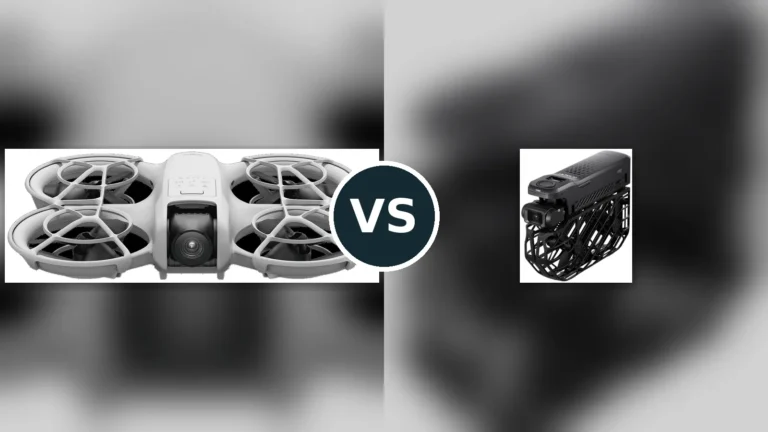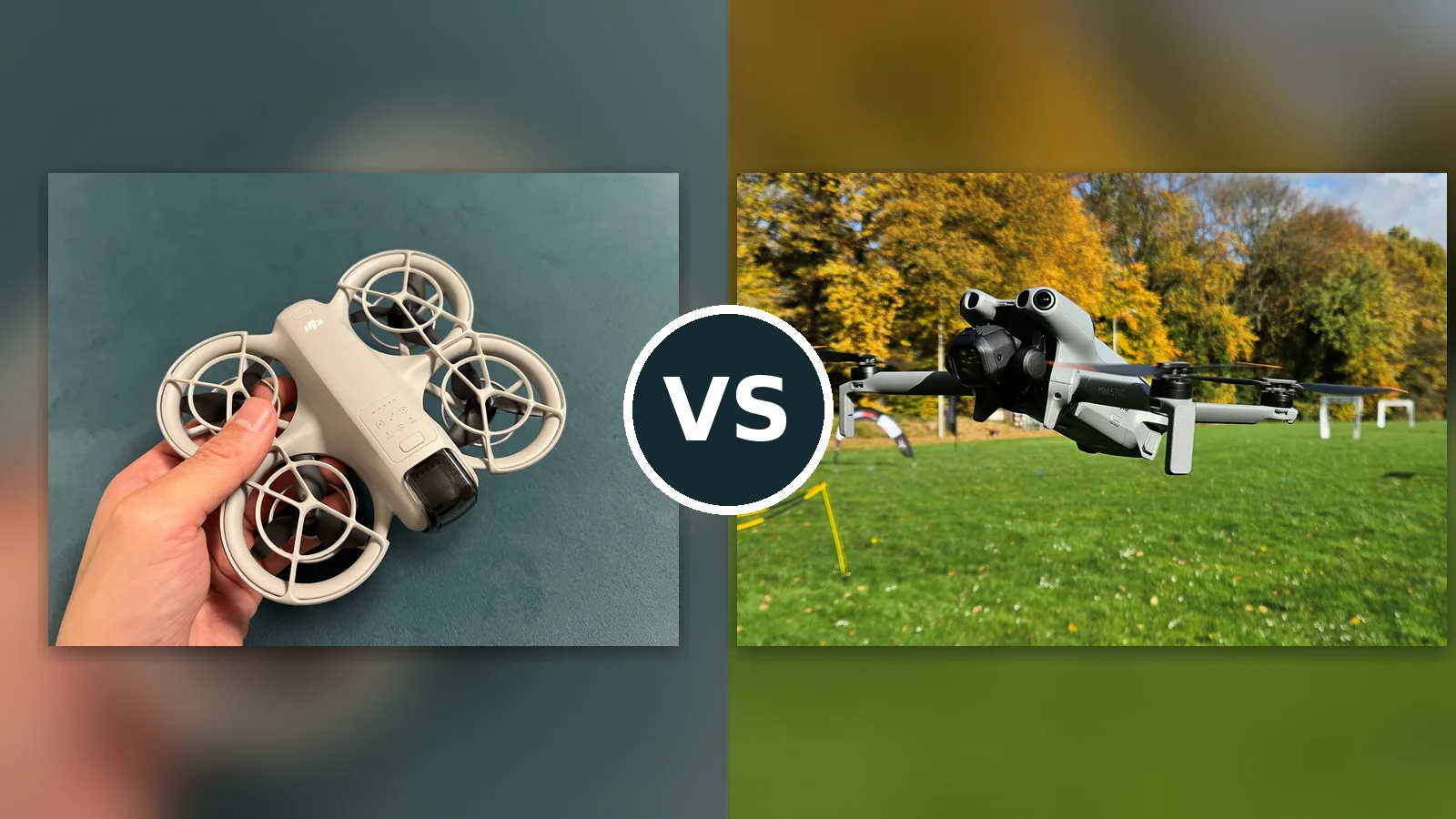
The dji neo vs mini 5 pro question is really two questions wearing one search query. The DJI Neo is a 135-gram palm drone that launched at $199 and flies with no controller: launch it from your hand, and it follows you. The DJI Mini 5 Pro is DJI’s most advanced sub-250g camera drone, with a 1-inch 50MP sensor, 4K/120fps video, and LiDAR-assisted sensing. One costs less than a nice dinner for two. The other costs four times as much and, in the US, is only available through third-party sellers. We compared camera, portability, flight features, and kit cost so you can decide which end of DJI’s lineup matches the way you shoot.
As an Amazon Associate, we earn from qualifying purchases.
Mini 5 Pro for creators. Neo for everyone else.
DJI Mini 5 Pro wins for serious creators: a 1-inch 50MP sensor, 4K/120fps, 36-minute flights, and LiDAR sensing are in a different league. DJI Neo wins on simplicity, size, and price: 135 g, $199, palm launches with no controller. Camera: Mini 5 Pro. Flight time: Mini 5 Pro. Portability and ease of use: Neo. Value: Neo, by a mile. US buying: Neo, since the Mini 5 Pro sells through third-party sellers only.
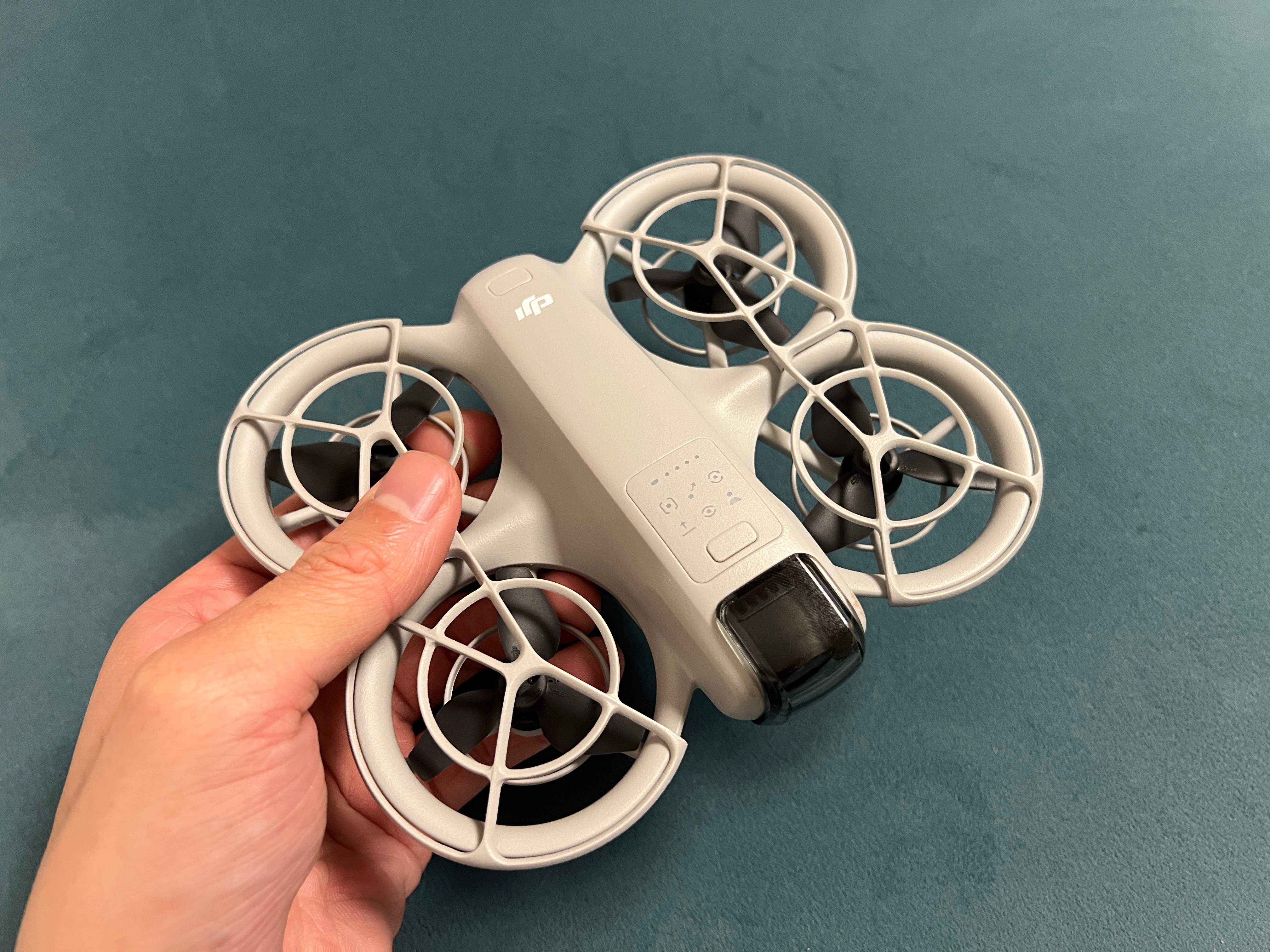
DJI Neo
For casual creators who want aerial selfies with zero setup
- Palm takeoff, AI subject tracking, six QuickShots, no controller needed
- Full-coverage propeller guards make indoor and close-quarters flying safe
- Compromises: 12MP JPEG-only stills, no forward obstacle sensing, 22 GB with no card slot
Check current price and available bundles on Amazon
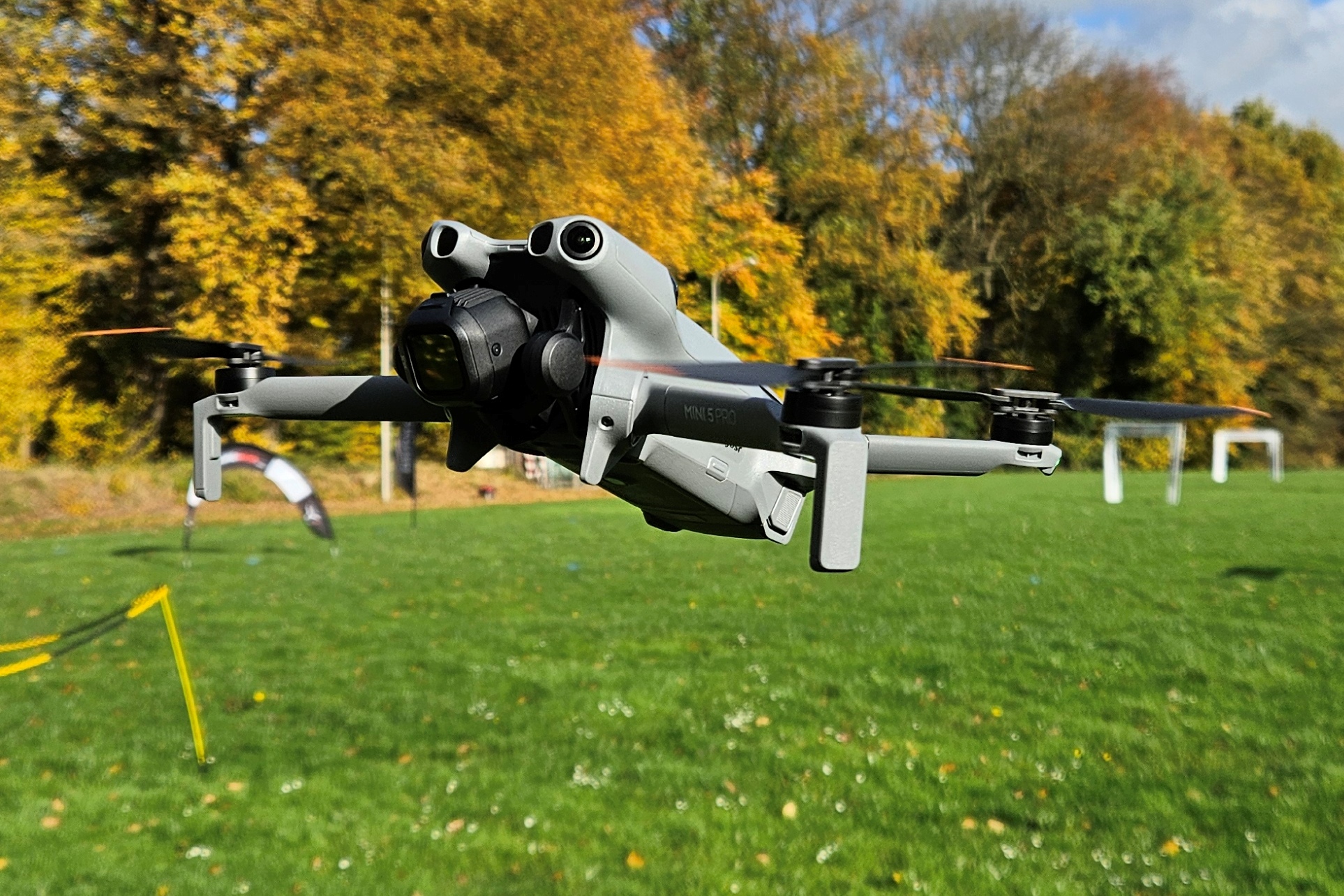
DJI Mini 5 Pro
For creators who want pro-level footage in a folding mini drone
- 1-inch 50MP sensor with 10-bit D-Log M, true vertical video, and 4K/120fps slow motion
- Omnidirectional sensing with forward LiDAR, working in near darkness
- Compromises: no official US launch, so you buy from third-party sellers with no DJI Care stateside
Check current price and available bundles on Amazon
DJI Neo vs DJI Mini 5 Pro: check the live price
Which drone fits your flying?
Start with your main use case. The best choice should solve your needs, without charging you for features you will rarely use.
Most people arriving at a dji neo vs mini 5 pro comparison are choosing between two different relationships with drones. The Neo is the drone you forget is a drone: 135 grams, palm-launched, no controller, following you down the trail while you keep walking. If your footage lives on social media and every extra setup step makes you leave the drone at home, the Neo removes every excuse.
The Mini 5 Pro is the drone you plan around. Its 1-inch sensor delivers dynamic range and low-light detail that used to need a drone twice its size. It asks more: a controller, flight planning, and in the US, a careful read of the seller’s warranty terms. Be honest about which pilot you are, and match the drone to the shooter, not the spec sheet.
Choose DJI Neo if…
- Effortless selfies and follow shots are your main use case, not landscapes or client work.
- You want the smallest possible drone: 135 g, palm takeoff, no controller.
- You prefer spending $199 (often less on sale) over $759 or more for a flagship.
- You can accept a 12MP JPEG-only camera, 18 minutes of flight time, and no forward obstacle sensing.
Choose DJI Mini 5 Pro if…
- Image quality is your main concern, from 50MP stills to graded 10-bit video.
- You need long flights, strong wind handling, and sensing that works after dark.
- You value intelligent modes like ActiveTrack 360 and Waypoint Flight.
- You can accept third-party sellers in the US, with no DJI Care stateside.
DJI Neo vs Mini 5 Pro: The Specs That Actually Matter
Compare the exact battery, controller and bundle versions you intend to buy.
| Feature | DJI Neo | DJI Mini 5 Pro |
|---|---|---|
| Best suited to | Selfies, follow shots, casual social video | Travel photography, landscapes, real estate, serious content |
| Takeoff weight | Approx. 135 g (with battery and propeller guards) | 249.9 g ±4 g standard battery; some units 252 to 253 g |
| Dimensions | 130 x 157 x 48.5 mm (fixed frame, prop guards integrated) | 157 x 95 x 68 mm folded; 304 x 380 x 91 mm unfolded |
| Sensor and lens | 1/2-inch CMOS, 12MP, 14mm equivalent, f/2.8, 117.6-degree FOV | 1-inch CMOS, 50MP, 24mm equivalent, f/1.8, 84-degree FOV |
| Video modes | 4K/30fps, 1080p/60fps; 75 Mbps max bitrate | 4K/60fps HDR, 4K/120fps, FHD/240fps |
| Color and codecs | Normal color profile only, H.264/H.265; JPEG stills only | 10-bit D-Log M and HLG; JPEG and DNG RAW stills |
| Gimbal and stabilization | Single-axis mechanical gimbal (tilt) plus RockSteady and HorizonBalancing EIS | 3-axis gimbal, 225-degree rotation; true vertical shooting |
| Vertical capture | Cropped in post; no native vertical mode | Native true vertical: gimbal rotates 90 degrees for vertical 4K |
| Obstacle sensing | Downward visual positioning with infrared only; no forward or side sensing | Omnidirectional vision plus forward LiDAR (down to 1 lux) |
| Subject tracking | AI subject tracking, six QuickShots (Dronie, Circle, Rocket, Spotlight, Helix, Boomerang) | ActiveTrack 360, Waypoint Flight, Cruise Control |
| Rated flight time | Approx. 18 minutes (17 with guards fitted) | Up to 36 minutes standard; up to 52 minutes with Plus battery |
| Real-world flight time | Not tested by us; reviewers report 12 to 15 minutes tracking | Not tested by us; reviewers report 28 to 30 minutes calm |
| Max speed | 16 m/s in Manual mode; 8 m/s in Sport mode | 19 m/s in Sport mode (with Plus battery) |
| Wind resistance | 8 m/s (Level 4) | 12 m/s |
| Video transmission | DJI O4, up to 10 km FCC; Wi-Fi phone control | DJI O4+, up to 20 km FCC |
| Internal storage | 22 GB built in; no microSD slot | 42 GB built in, plus microSD support |
| GNSS | GPS + GLONASS + Galileo + BeiDou | GPS + Galileo + BeiDou |
| Controller and bundle | None included (phone control); RC-N3, RC Motion 3, and Goggles 3 supported | RC-N3 or RC 2; third-party sellers in the US |
| Launch price | $199 drone only; $289 Fly More Combo; $369 FPV bundle | No official US pricing; observed from $759 (third-party) |
| Main trade-off | Tiny sensor, short flights, no obstacle avoidance beyond downward | Premium price, no official US channel, registration likely |
Manufacturer ratings are lab figures; real-world flight time is lower. Prices are launch or observed references; check the live listing. Last verified: October 20, 2026.
DJI Neo (12MP) vs DJI Mini 5 Pro (50MP)
DJI Neo: The Drone That Fits in Your Palm
DJI’s smallest camera drone trades raw image quality for something rarer: a drone you will actually use every day.
Overview: a flying action camera
The DJI Neo arrived in 2024 as DJI’s answer to a simple observation: most drones live in a bag because flying them is a production. At about 135 grams it takes off from your palm and needs no controller in its base kit: pick a shooting mode on the drone, and it films you. It launched at $199 drone-only, $289 for the Fly More Combo (RC-N3, three batteries), and $369 for the FPV bundle (Goggles 3, motion control), with street prices regularly dropping to $139 to $159 since.
The design is deliberate. Integrated propeller guards form a chunky rounded frame that bounces off doorways, branches, and hands, which makes the Neo the only DJI drone comfortable indoors or around kids and pets. The fixed 130 by 157 by 48.5 mm frame still slips into a jacket pocket. The trade-off is aerodynamic: the guards trim rated flight time to about 17 minutes fitted, versus 18 without.
Camera system: honest 4K, modest sensor
A 1/2-inch 12MP sensor behind an f/2.8 ultra-wide lens (117.6-degree field of view, about 14mm equivalent) records 4K/30fps or 1080p/60fps at up to 75 Mbps, with JPEG-only stills. In good daylight the footage is clean, colorful, and ideal for social media. A single-axis tilt gimbal plus RockSteady and HorizonBalancing electronic stabilization keeps it smooth.
The honest limits: a quarter the sensor area of the Mini 5 Pro’s 1-inch chip means noisy dusk footage, limited dynamic range, no slow motion beyond 1080p/60, no RAW, and no flat color profile. It is a memory-capture tool, not a creative instrument, and DJI priced it accordingly.
Flight performance: short hops, not expeditions
Real-world flight time lands around 12 to 15 minutes of active tracking against an 18-minute rating, which matches the mission: short bursts, not expeditions. The 22 GB of internal storage holds roughly 40 minutes of 4K/30 footage, and with no microSD slot you will offload to your phone regularly on a busy day. Level 4 wind resistance (8 m/s) is the lineup’s lowest: light breezes are fine, real gusts push the 135 g airframe around. Top speed is 16 m/s in Manual mode and 8 m/s in Sport, enough for cyclists and runners. Transmission is DJI O4, rated to 10 km with a controller.
Intelligent features: the easiest drone to fly
This is where the Neo earns its keep. Palm takeoff and landing, AI subject tracking, six one-tap QuickShots, and voice control get a complete beginner filming within minutes. Add the RC-N3 for a conventional camera drone with real range, or Goggles 3 and motion control for a tiny FPV cinewhoop. The catch: beyond downward positioning there is no obstacle avoidance, so manual flying demands full attention.
DJI Neo pros and cons
Reasons to choose it
- Palm takeoff, AI tracking, and QuickShots with no controller: the lowest-friction drone DJI sells
- 135 g with full propeller guards; safe indoors, around people, and in a jacket pocket
- $199 launch price with frequent discounts; the cheapest DJI drone by far
- Expandable into a real FPV drone with Goggles 3 and motion control
- Official US sales channel with standard DJI warranty and support
Reasons to reconsider
- 1/2-inch sensor, 12MP JPEG-only, no flat profile: weak in low light and limited for editing
- Short real-world flight time and Level 4 wind resistance
- No forward or side obstacle sensing whatsoever
- 22 GB internal storage with no microSD slot
DJI Mini 5 Pro: The 1-Inch Sensor Finally Fits in a Mini
The first sub-250g drone with a 1-inch camera is DJI’s most capable Mini ever, with one big asterisk for US buyers.
Overview: flagship camera, Mini body
The DJI Mini 5 Pro launched on September 17, 2025, and its headline needs exactly one sentence: a 1-inch 50MP sensor in a folding Mini airframe, roughly quadrupling the light-gathering area of every previous Mini. It pairs a 24mm-equivalent f/1.8 lens with 4K/120fps video, a 225-degree gimbal, and forward LiDAR sensing that works in near darkness. Rated flight time is 36 minutes standard, 52 with the Plus battery.
The asterisk is distribution. DJI never launched the Mini 5 Pro in the United States, a decision widely attributed to the regulatory climate around Chinese drones. Americans buy through third-party sellers on Amazon, observed from $759 for the RC-N3 base kit to $1,599 for the Fly More Combo with the RC 2. Warranty and support vary by seller, return terms need checking before you buy, and DJI Care is unavailable stateside. Outside the US, where DJI sells it directly, none of this applies.
Camera system: the main event
The 1-inch sensor changes what a Mini can do. Fifty megapixels with RAW (DNG) support gives stills real editing latitude, and the f/1.8 aperture pulls in meaningfully more light than f/2.8 lenses on smaller drones. Video runs to 4K/60fps HDR, 4K/120fps slow motion, and 1080p at up to 240fps, with 10-bit D-Log M and HLG for grading. A 2x in-sensor crop gives a 48mm-equivalent telephoto view without moving the drone.
Reviewers describe image quality closer to DJI’s Air series than to any previous Mini, with the low-light improvement the real story: dusk shots that would be mush on smaller sensors come out clean and gradable. The 225-degree gimbal enables true vertical shooting: 90-degree rotation for native vertical 4K. The compromise is physics: the bigger camera housing is part of why the weight story below is so tight.
Flight performance: long legs, real wind handling
Thirty-six minutes rated on the standard 2,788 mAh battery means roughly 28 to 30 minutes of real mixed flying. The 4,680 mAh Plus battery stretches the rating to 52 minutes but pushes well past 250 g and is not sold in Europe. Wind resistance is 12 m/s, top speed 19 m/s in Sport, and O4+ transmission is rated to 20 km FCC.
Now the weight question, because it matters more here than on any Mini before it. DJI lists 249.9 g with a ±4 g tolerance, and measured units land around 252 to 253 g. DJI’s own disclaimer tells owners to weigh their drone before flying unregistered. For US buyers the practical takeaway is simple: plan on registering with the FAA. Registration costs $5 for three years covering all your drones, plus the free TRUST safety test.
Intelligent features: LiDAR changes night flying
The sensing suite is the most advanced ever put in a Mini. Omnidirectional binocular vision covers every direction, and forward-facing LiDAR (which DJI calls LADAR) gives precise distance measurement that keeps working down to 1 lux, essentially moonlight. Obstacle avoidance and return-to-home behave noticeably better after dark than on any previous Mini. ActiveTrack 360 follows subjects from any angle, Waypoint Flight automates repeatable routes, and 42 GB of internal storage plus microSD means a forgotten card no longer ends a shoot. It is the safest Mini ever made, not one you can fly blind.
DJI Mini 5 Pro pros and cons
Reasons to choose it
- 1-inch 50MP sensor with f/1.8 lens: flagship image quality, RAW stills, 10-bit D-Log M
- 4K/120fps slow motion and 48mm-equivalent 2x tele crop
- LiDAR plus omnidirectional sensing that works in near darkness
- 36-minute rated flights and 12 m/s wind resistance
- True vertical shooting with a 225-degree gimbal
Reasons to reconsider
- No official US launch: third-party sellers only, variable warranty, no DJI Care stateside
- Weight tolerance means many units exceed 250 g; register with the FAA
- Four to eight times the price of the Neo depending on the bundle
- Bigger kit, real setup time, and a learning curve the Neo simply does not have
DJI Neo vs Mini 5 Pro: Five Differences That Matter
For each category in this dji neo vs mini 5 pro faceoff: the difference, its practical impact, and which buyer benefits.
1. Camera quality and creative flexibility
Edge: Mini 5 ProThe most lopsided category in the comparison. The Mini 5 Pro’s 1-inch sensor captures roughly four times the light of the Neo’s 1/2-inch chip: 50MP RAW stills against 12MP JPEG-only, an f/1.8 lens against f/2.8, 10-bit D-Log M and HLG against a single Normal profile, and a 3-axis gimbal with 225-degree rotation against single-axis tilt with electronic help. After sunset the gap becomes a chasm: the Neo gets noisy while the Mini 5 Pro keeps shooting clean, gradable footage deep into blue hour.
The Neo’s camera is honest rather than bad: ultra-wide lens, RockSteady stabilization, and 4K/30fps deliver watchable social video in good light. But there is no slow motion beyond 1080p/60, no RAW, no flat profile, and no native vertical mode. If you edit, print, or get paid, the Mini 5 Pro is the only choice.
2. Flight time and range
Edge: Mini 5 ProDJI rates the Mini 5 Pro at 36 minutes and the Neo at 18, and the real-world gap matches: roughly 28 to 30 minutes of mixed flying against 12 to 15. That changes how you shoot: the Mini 5 Pro scouts a location and flies a full waypoint mission on one battery, while the Neo works in short bursts. The Plus battery stretches the Mini 5 Pro to 52 minutes at the cost of blowing past 250 g; the Neo offers no battery options beyond the Fly More Combo’s three packs.
Range tells the same story. The Mini 5 Pro’s O4+ link is rated to 20 km FCC; the Neo’s O4 manages 10 km with a controller and far less on Wi-Fi. Neither should fly near those limits, but the stronger link means fewer signal warnings at normal distances.
3. Design and portability
Edge: NeoThe Neo wins portability so completely the comparison feels unfair. At 135 g it is lighter than most phones and needs no case, no unfolding, and no controller. It lives in a jacket pocket and launches from your palm in under a minute, and the integrated propeller guards shrug off the pocket, the backpack, and the occasional collision. For hiking, travel, and everyday carry, nothing in DJI’s lineup is this frictionless.
The Mini 5 Pro is portable by flagship standards: it folds to 157 by 95 by 68 mm, but it still needs a controller, charged batteries, and setup time. It travels beautifully in a camera bag; it does not disappear into a pocket. Image quality per gram favors the Mini 5 Pro. Grams alone favor the Neo by 115 of them.
4. Ease of use and intelligent features
Edge: TieThe two drones define “smart” differently. The Neo is the easiest drone DJI has made to operate: palm takeoff, AI tracking with no controller, one-tap QuickShots, and voice control put a beginner behind the camera within minutes. But its intelligence is shallow: no obstacle avoidance beyond downward positioning, no waypoint missions. It is easy because it does less.
The Mini 5 Pro is the most capable Mini ever: ActiveTrack 360, Waypoint Flight, Cruise Control, and LiDAR-assisted sensing in near darkness. It automates shots that take real skill to fly manually. But it is a conventional drone to operate, with controllers and preflight checks all on you. The Neo removes friction; the Mini 5 Pro accomplishes more. Neither advantage cancels the other.
5. Price and value
Edge: NeoThe Neo launched at $199 and regularly sells for $139 to $159, cheaper than most action cameras. At that price its compromises read as character: short flights and a small sensor are forgivable at the cost of a nice dinner. The $289 Fly More Combo adds the RC-N3 and three batteries, the better buy for frequent flyers, and even the $369 FPV bundle undercuts every other FPV entry point DJI sells.
The Mini 5 Pro is priced like the flagship it is. With no official US launch, Americans pay third-party prices observed from $759 to $1,599. It earns that premium only if you use it: the 1-inch sensor, LiDAR sensing, and 36-minute flights are professional tools at a prosumer price. But value is use divided by price, and most casual flyers will never exploit what it offers.
DJI Neo vs Mini 5 Pro: What You Gain and Give Up
DJI Neo
Reasons to choose it
- Palm takeoff, AI tracking, and QuickShots with no controller: the lowest-friction drone DJI sells
- 135 g with full propeller guards; safe indoors, around people, and in a jacket pocket
- $199 launch price with frequent discounts; the cheapest DJI drone by far
- Expandable into a real FPV drone with Goggles 3 and motion control
- Official US sales channel with standard DJI warranty and support
Reasons to reconsider
- 1/2-inch sensor, 12MP JPEG-only, no flat profile: weak in low light and limited for editing
- Short real-world flight time and Level 4 wind resistance
- No forward or side obstacle sensing whatsoever
- 22 GB internal storage with no microSD slot
DJI Mini 5 Pro
Reasons to choose it
- 1-inch 50MP sensor with f/1.8 lens: flagship image quality, RAW stills, 10-bit D-Log M
- 4K/120fps slow motion and 48mm-equivalent 2x tele crop
- LiDAR plus omnidirectional sensing that works in near darkness
- 36-minute rated flights and 12 m/s wind resistance
- True vertical shooting with a 225-degree gimbal
Reasons to reconsider
- No official US launch: third-party sellers only, variable warranty, no DJI Care stateside
- Weight tolerance means many units exceed 250 g; register with the FAA
- Four to eight times the price of the Neo depending on the bundle
- Bigger kit, real setup time, and a learning curve the Neo simply does not have
Check the bundle, not just the drone
The drone on the box is only half the purchase. Run through this checklist before you tap buy.
- US buyers, read this first: DJI never launched the Mini 5 Pro in the United States, so every Amazon listing is a third-party seller. Check the seller’s ratings, return window, and warranty terms before ordering, and confirm the exact bundle in the listing title. DJI Care is not available stateside.
- Weigh your Mini 5 Pro: DJI rates it at 249.9 g with a ±4 g tolerance, and measured units land around 252 to 253 g. Above 250 g, FAA registration is required. It costs $5 for three years covering all your drones; pair it with the free TRUST test. DJI’s own disclaimer says to weigh before flying unregistered.
- Controller: The Neo needs no controller, but the Fly More Combo’s RC-N3 gives it real range. The Mini 5 Pro ships with the RC-N3; the RC 2 with built-in screen costs more but skips phone mounting.
- Batteries: The Neo’s short flight time makes the Fly More Combo’s three batteries close to essential. For the Mini 5 Pro, two batteries cover most outings; the Plus battery pushes well past 250 g.
- Storage: The Neo’s 22 GB with no card slot fills up fast; offload to your phone regularly. The Mini 5 Pro’s 42 GB plus microSD support is far more forgiving, but a fast U3/V30 card is still worth buying.
- Local requirements: The Neo at 135 g is registration-free for recreational use in the US, though the TRUST test and airspace rules still apply. The Mini 5 Pro, as discussed, should be registered. Check your national aviation authority’s current rules before your first flight wherever you live.
The right choice comes down to the shooter, not the spec sheet.
If you want the best aerial camera that still folds into a travel kit, buy the Mini 5 Pro. It wins on image quality, flight time, wind handling, sensing, and intelligent features by margins that show up in every frame. Just go in with open eyes: in the US you buy from a third-party seller with no DJI Care, and you should register it with the FAA. If you want a drone you will actually fly every week, buy the Neo. It wins on size, simplicity, and price so decisively that for casual creators the footage you shoot beats the footage you planned.
Still deciding?
Is the Mini 5 Pro worth the upgrade over the Neo?
If image quality matters, yes: the 1-inch 50MP sensor, 4K/120fps, RAW stills, and 10-bit color are generations ahead of the Neo’s 12MP JPEG camera. But only if you will use it. For hands-free selfies and casual social video, the Neo does the job at a fifth of the price with far less hassle.
Which drone is better for beginners?
The Neo, comfortably. Palm takeoff, AI tracking, and no controller mean a beginner is filming within minutes, and the propeller guards forgive early collisions. The Mini 5 Pro is safer in the air thanks to LiDAR and omnidirectional sensing, but it is a real camera drone with a real learning curve.
Can I buy the DJI Mini 5 Pro in the US?
Yes, but only through third-party sellers: DJI never launched it officially in the US. Amazon listings from independent sellers are the main route, with base kits observed from $759. Check the seller’s ratings and return terms, and know that DJI Care is unavailable stateside.
Do I need to register the Neo or the Mini 5 Pro with the FAA?
The Neo at 135 g needs no registration for US recreational use, though the free TRUST test and airspace rules still apply. The Mini 5 Pro is trickier: DJI lists 249.9 g with a ±4 g tolerance, and measured units land around 252 to 253 g. Plan on registering it: $5, three years, every drone you own.
Which is better for travel?
The Neo is the ultimate travel companion: 135 g, pocketable, launching from your palm when a moment appears. The Mini 5 Pro is the better travel camera: it folds small for a flagship but needs its controller, batteries, and setup time. Backpacking favors the Neo; photography trips favor the Mini 5 Pro.
How were these drones compared?
Research-based: specs from DJI’s official pages, cross-checked against launch coverage and reviews; ASINs verified against exact product titles. We did not fly either drone.
How this comparison was prepared
This is a research-based comparison. We did not fly either drone for this article. Every specification above comes from DJI’s official documentation for both drones, with pricing and bundle contents cross-checked against launch coverage. Real-world flight times are attributed to the reviewers who measured them. ASINs were verified against exact product titles first; no tagged affiliate URL was ever opened or clicked.
Sources and verification
- DJI Neo official specifications (dji.com): weight, camera, gimbal, sensing, transmission, battery, storage
- DJI Mini 5 Pro official specifications (dji.com): weight and ±4 g tolerance, camera, flight time, sensing, transmission
- DJI Neo launch coverage: launch pricing and bundle contents
- Notebookcheck Mini 5 Pro launch coverage: launch date, 1-inch sensor, 4K/120fps, LiDAR, O4+ details
- DroneXL Mini 5 Pro coverage: third-party Amazon listings and observed pricing
- Dronestechie Mini 5 Pro review: US launch status, weight tolerance, DJI Care notes
- MyDearDrone DJI Neo review: battery observations and feature summary
- HiDronePilot comparison data: specification verification against the official manuals
- ASIN verification: Neo (B07FTPX71F, controller-free) and Mini 5 Pro (B0F6XJ7W9M, RC-N3 base kit) confirmed against Amazon-indexed titles
Last verified: October 20, 2026. Bundles, pricing, and specs vary by region. Prices are launch or observed references; check the live listing.