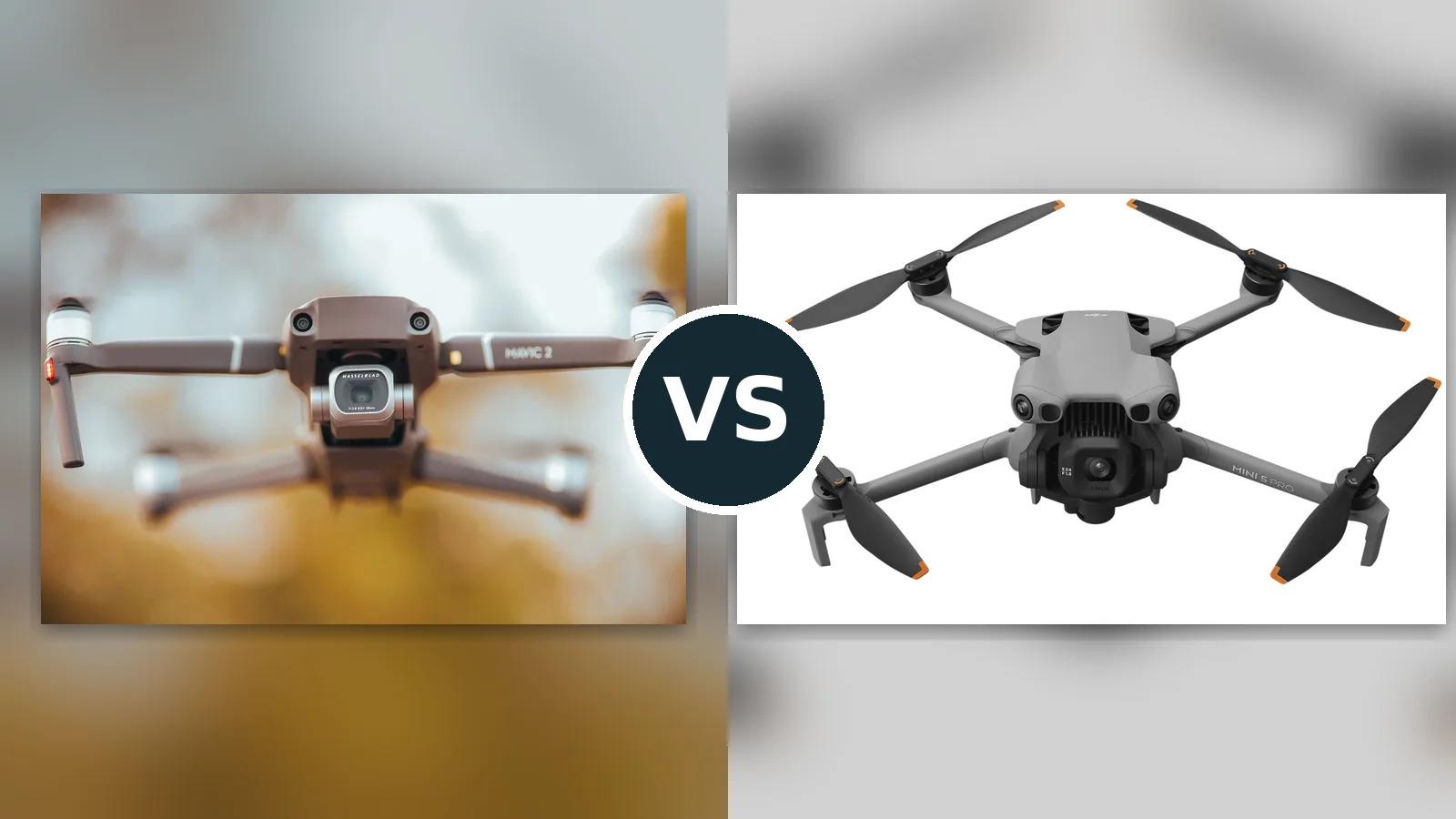
The mavic 2 pro vs mini 5 pro question is one of the strangest matchups in drones: a 2018 flagship with a Hasselblad camera against a 2025 pocket drone packing the same 1-inch sensor class into a body a third of the weight. The Mavic 2 Pro made serious aerial photographers take folding drones seriously. The Mini 5 Pro asks whether the big folding flagship still has a reason to exist. We compared the cameras, flight performance, sensing, and kit cost so you can decide whether the old king keeps the crown, or the new king has already taken it.
As an Amazon Associate, we earn from qualifying purchases.
Mini 5 Pro for most. Mavic 2 Pro for bargain hunters.
DJI Mini 5 Pro wins for most buyers: higher-resolution stills, far better slow motion, longer flights, a third of the weight, and LiDAR-assisted sensing. DJI Mavic 2 Pro keeps two edges: an adjustable f/2.8 to f/11 aperture and a heavier airframe that handles wind better, plus far cheaper used prices. The Mini 5 Pro takes camera, video, and portability; the Mavic 2 Pro takes aperture control and used prices.
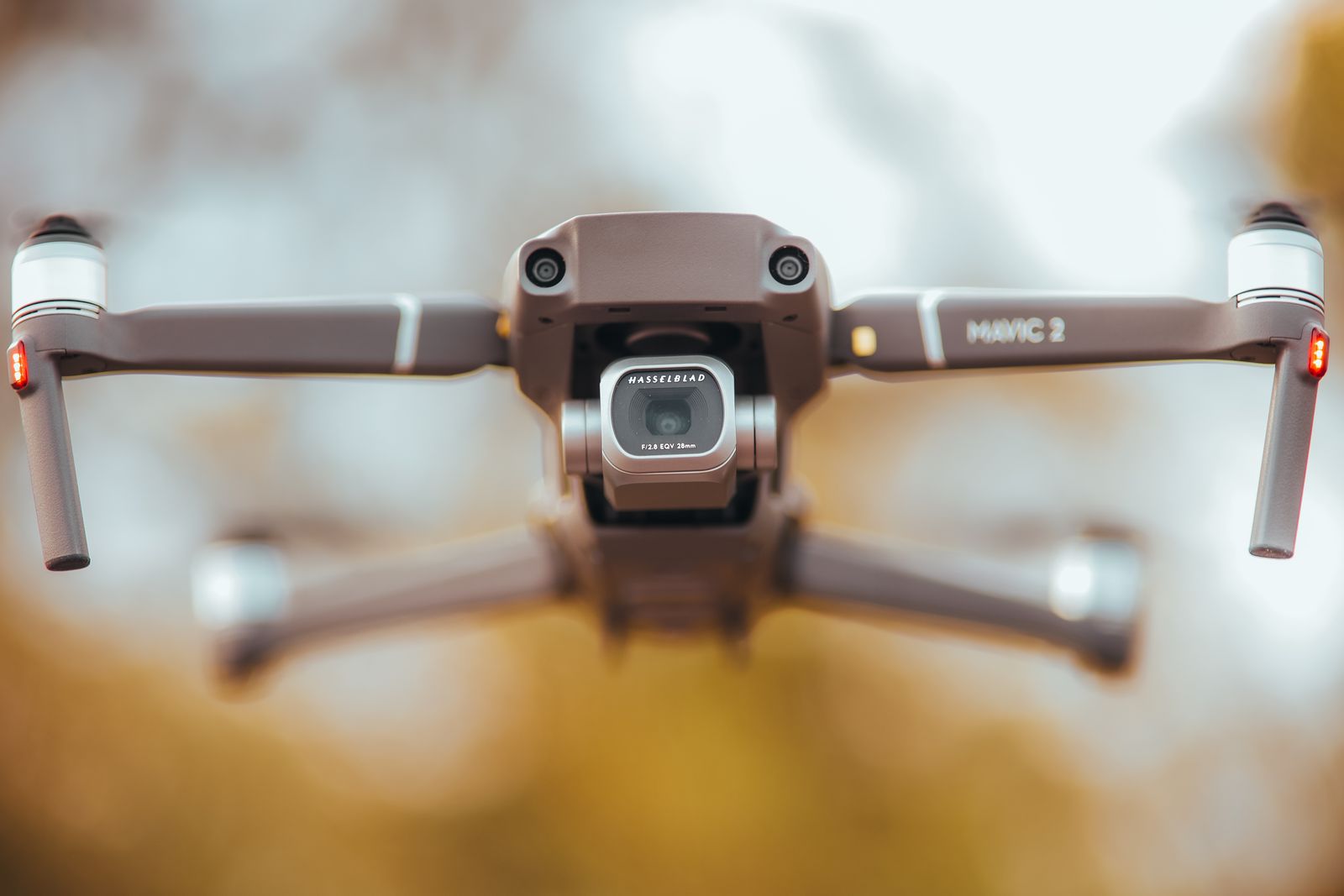
DJI Mavic 2 Pro
For photographers who want a Hasselblad 1-inch camera and an adjustable aperture at used-market prices
- Hasselblad L1D-20c with a real adjustable aperture, f/2.8 to f/11, plus Hasselblad Natural Colour Solution
- Heavier airframe holds position better in gusty wind than any sub-250g drone
- Discontinued, so you buy used or renewed; video tops out at 4K/30 with no 4K/60
Check current price and available bundles on Amazon
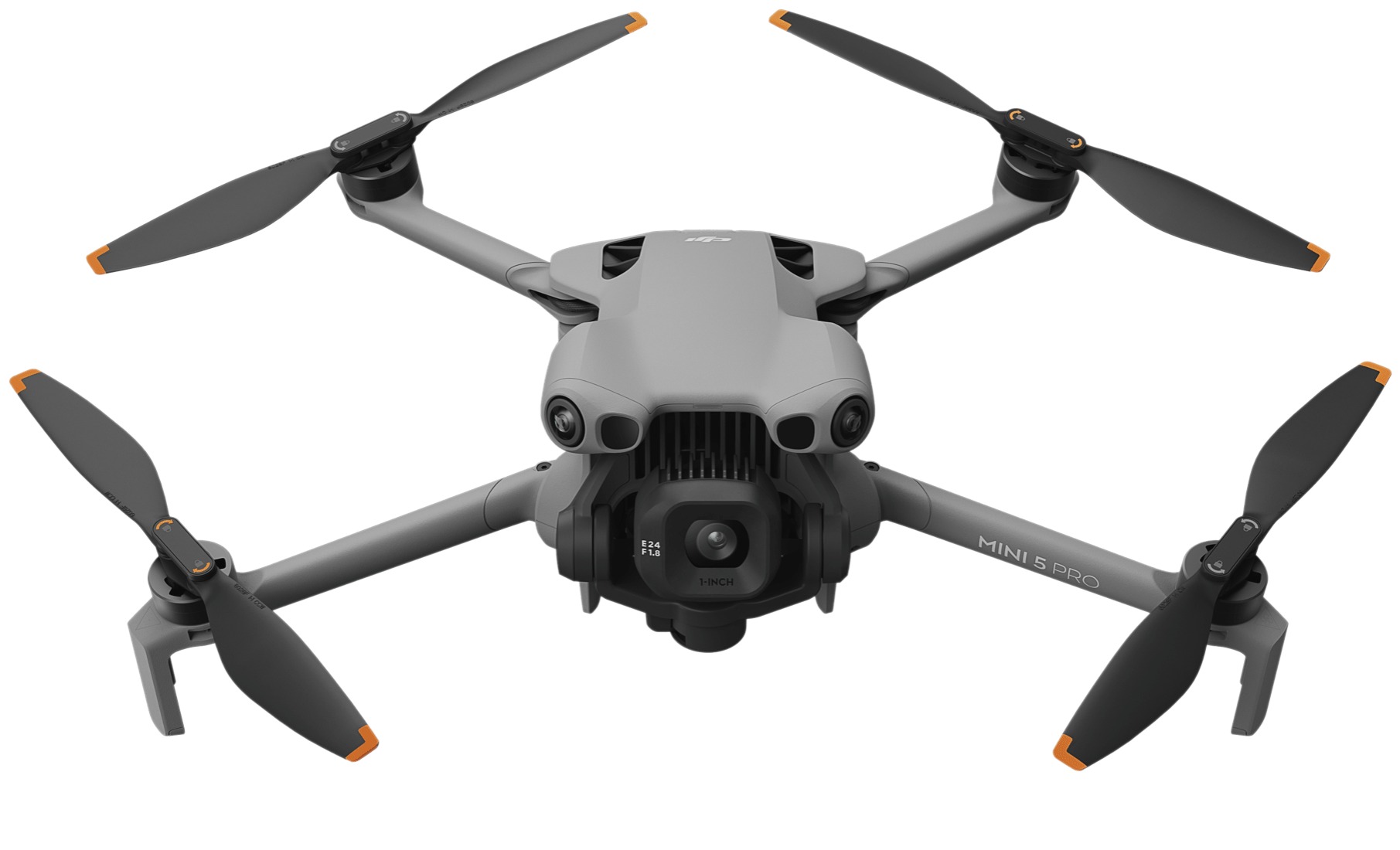
DJI Mini 5 Pro
For creators who want flagship-grade imaging in a sub-250g travel drone
- 1-inch 50MP sensor with 4K/120 slow motion, true vertical video, and 48mm med-tele mode
- Forward-facing LiDAR plus omnidirectional sensing that works in near darkness
- Fixed f/1.8 aperture, and the light airframe gets pushed around in real wind
Check current price and available bundles on Amazon
Which drone fits your flying?
Start with your main use case: the best choice solves your needs without charging you for features you will rarely use.
Most people reading a mavic 2 pro vs mini 5 pro comparison are asking whether the old flagship is still worth it. The Mavic 2 Pro launched in August 2018 at $1,449 and spent years as the default for serious aerial photography, with a Hasselblad co-engineered 1-inch camera on a folding airframe. Today it is discontinued and lives on through used and renewed listings: a legendary camera drone for a fraction of its launch price.
The Mini 5 Pro launched in September 2025: a brand-new, warranty-backed, sub-250g drone with a 1-inch 50MP sensor, 4K/120, and a forward-facing LiDAR for night-capable obstacle sensing. At 249.9 grams it skips registration in most countries: one of the most capable small drones ever made.
The tension is generational. The Mavic 2 Pro gives you an adjustable f/2.8 to f/11 aperture, a body that shrugs off wind, and Hasselblad color science many photographers still prefer. The Mini 5 Pro gives you everything else: better resolution, far better video, longer flight time, twice the range, smarter sensing, and a body you can palm launch.
Choose DJI Mavic 2 Pro if…
- Aperture control matters to you: f/2.8 to f/11 lets you manage depth of field and shutter speed without ND filters.
- You fly in wind and want the stability of a 907 g airframe rather than a featherweight.
- You shoot stills and love the Hasselblad Natural Colour Solution look straight out of camera.
- You can accept buying used or renewed, flying with the older DJI GO 4 app, and topping out at 4K/30 video.
Choose DJI Mini 5 Pro if…
- Modern video is the priority: 4K/120 slow motion, 4K/60 HDR, and true vertical shooting.
- You want a travel drone under 250 g that folds tiny and flies with LiDAR-assisted night sensing.
- You value long flight times, 20 km O4+ transmission, and 42 GB of internal storage.
- You can accept a fixed f/1.8 aperture and a light airframe that moves around in gusts.
Orange: DJI Mavic 2 Pro · Blue: DJI Mini 5 Pro
DJI Mavic 2 Pro: The 2018 Legend, Eight Years On
Overview: what the Mavic 2 Pro was, and what it is now
The Mavic 2 Pro launched in August 2018 at $1,449 and changed what a folding drone could do. After two years co-developing the L1D-20c camera with Hasselblad, DJI shipped the first consumer folding drone with a 1-inch sensor, 20-megapixel stills, and 10-bit video. Photographers bought it in droves: image quality that held up next to the Phantom 4 Pro in a body you could fold into a jacket pocket.
Time has moved on. The Mavic 2 Pro is discontinued, DJI GO 4 is in maintenance mode, and spare batteries are aging stock. It is a used-market drone now: a well-kept unit sells for a fraction of its launch price, and the camera that made it famous has not gotten any worse. Check battery cycle counts and swelling before you pay, since batteries degrade with age even on a shelf.
Camera system: Hasselblad color and a real aperture
The L1D-20c remains the headline act: a 1-inch CMOS sensor capturing 20-megapixel stills (5472 by 3648) through a 28mm-equivalent lens, with aperture adjustable from f/2.8 to f/11. That adjustable aperture is the single most important camera difference: stop down to f/5.6 or f/8 in bright light for cinematic shutter speeds without ND filters, or open to f/2.8 at dusk.
Hasselblad’s Natural Colour Solution bakes calm, natural-looking color into the JPEGs, and RAW shooters get full DNG files with real dynamic range plus 10-bit Dlog-M for grading. The limits: 4K tops out at 30fps, slow motion at 1080p/120. For stills-first shooters the 20MP files remain genuinely good; for video-first creators, this camera is a time capsule.
Flight performance: heavy, stable, and still quick
The Mavic 2 Pro weighs 907 grams and flies like it. That weight hurts for travel and regulation but helps in the air: it holds its line in gusty wind that pushes sub-250g drones around. DJI rates wind resistance at 29 to 38 kph (Level 5), top speed at 72 kph in Sport mode, and flight time at 31 minutes (29 hovering). Transmission is OcuSync 2.0 with up to 10 km FCC range and a 1080p live feed: a generation behind O4+, but proven and stable.
Obstacle sensing covers all directions with one caveat: the side sensors only work in ActiveTrack, Point of Interest, QuickShot, and Tripod modes, not in normal free flight. APAS routes the drone around obstacles in front and behind, and a downward auxiliary light helps the vision sensors hold position in dim light.
Intelligent features and the app situation
The Mavic 2 Pro flies with DJI GO 4 and the intelligent modes that defined the era: ActiveTrack 2.0, the full Hyperlapse suite, QuickShots, Point of Interest 2.0, and Waypoint 2.0. Missing is everything from recent DJI software: no ActiveTrack 360, no Cruise Control, no Night mode, no GPS-free smart return-to-home. The practical concern in 2026 is device compatibility, since DJI GO 4 targets older phone operating systems. Verify it installs and connects on your phone before buying.
Mavic 2 Pro pros and cons
Reasons to choose it
- Adjustable f/2.8 to f/11 aperture: the standout camera feature the Mini 5 Pro cannot match
- Hasselblad Natural Colour Solution with 20MP DNG RAW stills that hold up well
- 907 g airframe handles wind far better than any sub-250g drone
- 31-minute rated flight time and 72 kph top speed remain respectable
- Dramatically cheaper than launch price on the used and renewed market
Reasons to reconsider
- Discontinued: you buy used, with aging batteries and no warranty path
- Video tops out at 4K/30; no 4K/60, no 4K/120, no vertical video
- DJI GO 4 is aging; check compatibility with your phone before buying
- At 907 g it needs registration in most countries and is no travel drone
- Side obstacle sensing only works in specific intelligent modes
DJI Mini 5 Pro: Flagship Imaging at 249.9 Grams
Overview: the first 1-inch Mini
The Mini 5 Pro launched in September 2025 as the first Mini with a 1-inch sensor, and it changed the category: a 1-inch 50MP CMOS sensor, the same sensor class as the Mavic 2 Pro, in a folding body weighing 249.9 grams. DJI priced it from $759 with the RC-N3 controller: under half the Mavic 2 Pro’s launch price, with a warranty, fresh batteries, and a current app.
It launched in Europe, Canada, and other markets first, then reached the United States through Amazon and DJI’s own channels. By 2026 it is established on Amazon with regular discounts, deal trackers recording it as low as $679 for the standard kit. A brand-new 1-inch-sensor 4K/120 drone for a few hundred dollars more than a used Mavic 2 Pro is exactly why this comparison exists.
Camera system: 50 megapixels and video the Mavic 2 Pro cannot touch
The Mini 5 Pro’s 1-inch sensor outputs 50MP stills (8192 by 6144) or pixel-binned 12.5MP files through a 24mm-equivalent f/1.8 lens, as JPEG or DNG RAW. Reviewers rate its detail and dynamic range as the best ever in a sub-250g drone.
Video is where the generation gap becomes a chasm: 4K/60fps HDR in 10-bit, 4K at 120fps, 1080p at 240fps, 10-bit D-Log M and HLG, video ISO to 12800. The gimbal rotates a full 225 degrees for true vertical shooting plus dramatic roll moves, and the 48mm med-tele mode uses a 2x in-sensor crop for near-telephoto framing. The compromise is the fixed f/1.8 aperture: no stopping down, so bright-day video means ND filters. For photographers who live at f/8, it is the one camera spec where the eight-year-old Mavic 2 Pro still wins.
Flight performance: long legs, light bones
DJI rates the Mini 5 Pro at 36 minutes with the standard battery and 52 with the Plus battery. Reviewers report roughly 25 to 29 minutes of mixed flying on the standard battery, dropping toward 20 to 25 in wind. Even discounted for marketing optimism, that beats the Mavic 2 Pro. The Plus battery stretches things dramatically but pushes the drone past 250 g, erasing the regulatory advantage.
Transmission is O4+, rated to 20 km FCC with a 10-bit feed: double the Mavic 2 Pro’s range and more robust in practice. Top speed is 18 m/s (about 65 kph) in Sport mode. The 42 GB of internal storage is a quiet killer feature: forget your microSD card and you can still shoot. The light weight is a double-edged sword. At 249.9 g it skips registration in most countries and launches from your palm, but gusts the 907 g Mavic 2 Pro shrugs off visibly push it around. Perfect for calm-day travel shooting; not for coastal cliffs in a blow.
Sensing and intelligent features: LiDAR changes night flying
The headline safety feature is forward-facing LiDAR paired with omnidirectional vision sensors, keeping obstacle detection alive down to 1 lux: dusk and night flights that would blind the Mavic 2 Pro’s vision system, plus a smart return-to-home that memorizes routes and returns without GPS. ActiveTrack 360 is a generation ahead of the Mavic 2 Pro’s ActiveTrack 2.0, and Waypoint Flight, Cruise Control, rotating-gimbal QuickShots, and palm takeoff round out the modes, all running in the current DJI Fly app.
Mini 5 Pro pros and cons
Reasons to choose it
- 1-inch 50MP sensor with 4K/120, 4K/60 HDR, and 10-bit D-Log M: the best video ever in a Mini
- Forward-facing LiDAR plus omnidirectional sensing that works in near darkness
- 249.9 g: sub-250g regulation, pocketable, palm takeoff
- 36-minute rated flight time (52 with Plus), 20 km O4+ range, 42 GB internal storage
- 225-degree gimbal with true vertical shooting for social video
Reasons to reconsider
- Fixed f/1.8 aperture: no depth-of-field or shutter control without ND filters
- Light airframe gets pushed around in wind the Mavic 2 Pro would ignore
- Plus battery pushes it over 250 g and costs extra
- Real-world flight time is well under the 36-minute rating in wind
- Newer and pricier than a used Mavic 2 Pro, with less wind stability
mavic 2 pro vs mini 5 pro: The Specs That Actually Matter
Compare the exact battery, controller and bundle versions you intend to buy.
| Feature | DJI Mavic 2 Pro | DJI Mini 5 Pro |
|---|---|---|
| Best suited to | Stills photographers who want a Hasselblad 1-inch camera with aperture control at used prices | Travel creators who want flagship imaging and modern video in a sub-250g drone |
| Takeoff weight | 907 g | 249.9 g (standard battery); over 250 g with Plus battery |
| Dimensions (folded) | 214 x 91 x 84 mm | 157 x 95 x 68 mm |
| Sensor and lens | 1-inch CMOS, 20MP; 28mm equiv; f/2.8 to f/11 adjustable; 77-degree FOV | 1-inch CMOS, 50MP; 24mm equiv; f/1.8 fixed; 84-degree FOV |
| Photo resolution | 5472 x 3648 (20MP); JPEG and DNG RAW | 8192 x 6144 (50MP) or 12.5MP binned; JPEG and DNG RAW |
| Video modes | 4K at 24/25/30fps; 2.7K to 60fps; FHD to 120fps | 4K/60fps HDR; 4K to 120fps; FHD to 240fps; 48mm 2x med-tele crop |
| Color and codecs | 10-bit Dlog-M, 10-bit HLG HDR; up to 100 Mbps; H.264/H.265 | 10-bit D-Log M and HLG; 14 stops claimed dynamic range; H.264/H.265 |
| Vertical capture | No roll rotation; vertical only via stitched Panorama mode | Native true vertical: 225-degree gimbal rotation uses the full sensor |
| Gimbal | 3-axis mechanical (tilt, roll, pan) | 3-axis mechanical with 225-degree roll rotation |
| Obstacle sensing | Omnidirectional vision; side sensors only in ActiveTrack, POI, QuickShot, Tripod modes | Omnidirectional vision plus forward LiDAR; sensing works down to 1 lux |
| Subject tracking | ActiveTrack 2.0, Hyperlapse suite, Waypoint 2.0, QuickShots | ActiveTrack 360, Waypoint Flight, Cruise Control, QuickShots, palm takeoff |
| Rated flight time | 31 minutes (29 minutes hovering) | 36 minutes standard; 52 minutes with Plus battery |
| Transmission | OcuSync 2.0, up to 10 km FCC, 1080p live view | O4+, up to 20 km FCC, 10-bit live feed |
| Max speed | 72 kph in Sport mode | 18 m/s (about 65 kph) in Sport mode; 19 m/s with Plus battery |
| Wind resistance | 29 to 38 kph (Level 5); heavy airframe holds well in gusts | No headline wind figure; light airframe moves more in gusts |
| Internal storage | 8 GB plus microSD up to 128 GB | 42 GB plus microSD |
| Controller and bundle | Standard RC (phone required); Smart Controller was optional; discontinued. | DJI RC-N3 (phone required) or DJI RC 2 with built-in screen; from $759 |
| Main trade-off | Old platform: 4K/30 max video, aging app, used-market purchase | Fixed aperture and light weight: less control and less wind stability |
Manufacturer ratings are lab figures; real-world flight time is lower. Prices shown are launch or reference prices; check the live Amazon listing for the current price. Last verified: October 20, 2026.
Orange: DJI Mavic 2 Pro · Blue: DJI Mini 5 Pro
mavic 2 pro vs mini 5 pro: Five Differences That Matter
For each category, here is the difference, its practical impact and which buyer benefits.
1. Camera and image quality: 20MP Hasselblad vs 50MP modern
Edge: Mini 5 ProBoth drones carry a 1-inch sensor. The Mavic 2 Pro’s 20MP sensor with Hasselblad Natural Colour Solution produces beautiful stills, and the adjustable aperture is a genuine creative advantage: f/8 for sharp landscapes, f/2.8 for dusk.
The Mini 5 Pro counters with 50MP resolution, meaningfully better detail and cropping latitude, and low-light performance reviewers rate as the best in the sub-250g class. Its 24mm f/1.8 lens is a touch wider and faster than the Mavic 2 Pro’s 28mm f/2.8, helping at dusk without an adjustable iris. On video there is no contest: 4K/120, 4K/60 HDR, and 10-bit D-Log M against a 4K/30 ceiling. Stills-first shooters who love aperture control can stay with the Mavic 2 Pro; everyone else gets a camera two generations ahead.
2. Flight time and range: old ratings vs new ratings
Edge: Mini 5 ProDJI rated the Mavic 2 Pro at 31 minutes and the Mini 5 Pro at 36, and real-world testing compresses both: expect mid-20s from the Mavic 2 Pro and 25 to 29 from the Mini 5 Pro, dropping toward 20 to 25 in wind. The Plus battery stretches the Mini 5 Pro to a rated 52 minutes for those willing to give up the sub-250g advantage.
Range is a clearer win: O4+ at up to 20 km FCC against OcuSync 2.0 at 10 km. You will never legally fly either that far, but the newer link holds up better through interference. Another practical edge for the Mini 5 Pro: 42 GB of internal storage turns a forgotten microSD card into an inconvenience instead of a cancelled shoot. The Mavic 2 Pro’s 8 GB fills up fast.
3. Design and portability: 907 grams vs 249.9 grams
Edge: Mini 5 Pro (with one big caveat)The Mini 5 Pro folds to 157 by 95 by 68 mm, weighs 249.9 g, and in most countries needs no registration. It launches from your palm and disappears into a jacket pocket. The Mavic 2 Pro folds to 214 by 91 by 84 mm, weighs 907 g, and needs registration essentially everywhere.
The caveat is wind. The Mavic 2 Pro’s mass is a feature when the air gets rough: it holds position and tracks smoothly in gusts that visibly buffet the Mini 5 Pro. If you fly coastlines or mountains, the heavier airframe is not just nicer, it is safer.
4. Intelligent features and sensing: 2018 smarts vs LiDAR
Edge: Mini 5 ProThe Mavic 2 Pro’s intelligent modes were excellent for their time: ActiveTrack 2.0, Hyperlapse, Waypoint 2.0, and APAS. They still work. But the Mini 5 Pro is two generations ahead: ActiveTrack 360 tracks more reliably, and Cruise Control, rotating-gimbal QuickShots, and palm takeoff add capabilities the Mavic 2 Pro lacks.
The sensing gap is bigger than the features gap. The Mini 5 Pro’s forward-facing LiDAR plus omnidirectional vision keeps obstacle detection alive down to 1 lux: night and dusk flights that would blind the Mavic 2 Pro’s vision system. Its smart return-to-home memorizes routes and returns without GPS. The Mavic 2 Pro’s side sensors only engage in specific intelligent modes, and it has no answer for darkness.
5. Price and value: used legend vs new warranty
Edge: TieThe Mavic 2 Pro launched at $1,449 and now trades used for a fraction of that, often with batteries included: an enormous amount of camera drone for the money. The catch is everything used: aging batteries, no warranty, an aging app, and the risk of inheriting someone else’s crashed-and-repaired drone.
The Mini 5 Pro starts at $759 new with the RC-N3 controller, with Fly More combos at $929 and up, and deal trackers have seen it at $679: brand-new, warranty-backed, fresh batteries, current app, and a 1-inch 50MP camera with 4K/120. The honest summary: the Mavic 2 Pro is the cheaper way to get a 1-inch camera in the air, and the Mini 5 Pro is the better way to spend your money if you can stretch to it.
Check the bundle, not just the drone
The drone on the box is only half the purchase. Run through this checklist before you tap buy.
- Controller: The Mini 5 Pro ships with the RC-N3 (bring your phone) or the RC 2 with a built-in screen. The Mavic 2 Pro’s controller also needs a phone, so confirm DJI GO 4 runs on yours before buying used.
- Batteries: This matters most on the used Mavic 2 Pro: ask for cycle counts, check for swelling, and budget for replacements. For the Mini 5 Pro, two batteries cover most outings; the Plus battery adds flight time but pushes the drone past 250 g.
- Accessories: A fast microSD card is essential for both. ND filters matter more for the Mini 5 Pro with its fixed f/1.8 aperture; the Mavic 2 Pro can stop down instead.
- Listing: On Amazon, confirm the exact model name, controller, and battery count in the listing title. For used listings, read the condition notes and favor sellers with clear return terms.
- Local requirements: Check your aviation authority’s current rules. The Mini 5 Pro’s sub-249.9g weight simplifies recreational flying in the US and much of Europe, but airspace restrictions still apply. The 907 g Mavic 2 Pro needs registration in most countries.
- Price timing: The Mini 5 Pro sees regular discounts, so check the live listing before assuming the sticker price. Used Mavic 2 Pro prices vary wildly by condition, so compare several listings.
mavic 2 pro vs mini 5 pro: Who Should Buy Which?
Buy the Mavic 2 Pro if you are a stills photographer who thinks in apertures. The f/2.8 to f/11 range, Hasselblad color science, and 20MP RAW files give you a deliberate camera at used-market prices nothing else touches. It also suits pilots who fly in wind and want a heavy, planted airframe. Verify the batteries and app compatibility first, and accept that 4K/30 is the ceiling.
Buy the Mini 5 Pro if you want the best all-around small drone you can buy new: travel, hiking, social video, real estate, slow motion, vertical formats. LiDAR sensing, a 36-minute rated flight time, 20 km link, and 42 GB of storage add up to a drone that simply does more. The fixed aperture and light weight are real compromises, but for most buyers they are outweighed ten to one.
Already own a Mavic 2 Pro? The upgrade question is about video. If you keep bumping into the 4K/30 ceiling or want vertical video, the Mini 5 Pro is the natural next step.
The new king takes the crown, with one asterisk.
The Mini 5 Pro wins for almost everyone: better sensor, far better video, longer flight time, smarter sensing, and a travel-friendly body in a brand-new drone costing about half the Mavic 2 Pro’s launch price. The asterisk is the aperture: if you specifically want f/2.8 to f/11 control, or the cheapest route to a 1-inch Hasselblad camera, a clean used Mavic 2 Pro remains a smart buy.
Still deciding?
Is it still worth buying a Mavic 2 Pro in 2026?
Yes, with conditions. The camera remains excellent for stills, and used prices make it one of the cheapest routes to a 1-inch sensor with an adjustable aperture. But check battery cycle counts and swelling, confirm DJI GO 4 works on your phone, and favor sellers with clear returns.
Which drone takes better photos?
The Mini 5 Pro resolves more detail with its 50MP sensor and performs better in low light. The Mavic 2 Pro wins on control: its adjustable aperture manages depth of field and shutter speed in ways the fixed f/1.8 Mini 5 Pro cannot. Manual shooters may prefer the Mavic 2 Pro’s files. Everyone else gets better photos from the Mini 5 Pro.
Which is better for video?
The Mini 5 Pro, by a wide margin: 4K/120 slow motion, 4K/60 HDR, and 1080p/240 with 10-bit D-Log M, plus true vertical video. The Mavic 2 Pro tops out at 4K/30, which was excellent in 2018 but cannot compete today.
Do I need to register the Mini 5 Pro or the Mavic 2 Pro?
In the United States, recreational drones under 250 g, like the Mini 5 Pro with its standard battery, do not require FAA registration, while the 907 g Mavic 2 Pro does. The Plus battery pushes the Mini 5 Pro past 250 g and changes that. Rules differ by country, so check your aviation authority’s current requirements before your first flight.
Can the Mavic 2 Pro shoot vertical video for social media?
Not natively. Its gimbal cannot rotate 90 degrees along the roll axis, so the only vertical option is a stitched vertical panorama for stills. The Mini 5 Pro’s 225-degree gimbal rotates to true vertical and records full-sensor portrait video and stills. If Reels, Shorts, or TikTok are part of your plan, the Mini 5 Pro is the only sensible choice.
How were these drones compared?
This is a research-based comparison: we compiled specifications from DJI’s official Mavic 2 spec pages and the DJI Store’s Mini 5 Pro pages, then cross-checked them against independent reviews. We did not fly either drone for this article; rated figures are DJI’s lab numbers and real-world figures are attributed to the reviewers who measured them.
How this comparison was prepared
This is a research-based comparison; we did not fly either drone. Every specification comes from DJI’s official documentation: the DJI Mavic 2 spec and support pages for the Mavic 2 Pro, and the DJI Store’s Mini 5 Pro product pages. Mavic 2 Pro launch pricing comes from DJI’s August 2018 newsroom announcement. Real-world flight times are attributed to the reviewers who measured them. Amazon ASINs were matched against exact product titles and model numbers before any affiliate link was written.
Sources and verification
- DJI Mavic 2 official specifications (dji.com, accessed October 20, 2026): Mavic 2 Pro camera, aircraft, sensing system, gimbal, and battery figures
- DJI Mavic 2 support pages (dji.com, accessed October 20, 2026): dimensions, wind resistance, transmission range, app compatibility, and FAQ details
- DJI Mavic 2 Pro and Mavic 2 Zoom launch announcement (DJI newsroom, August 2018): launch pricing, Hasselblad L1D-20c details, and bundle contents
- DJI Mini 5 Pro product pages (DJI Store, accessed October 20, 2026): 1-inch sensor, 50MP stills, 4K/120 video, 36 and 52-minute flight times, O4+ range, LiDAR sensing, and bundle pricing
- Amateur Photographer DJI Mini 5 Pro review: measured flight times, 249.9 g weight, 42 GB storage, and real-world handling notes
- DroneXL Mini 5 Pro launch and deal coverage: September 2025 launch details, Amazon availability, and recorded street prices
- Notebookcheck Mini 5 Pro launch coverage: 1-inch sensor, f/1.8 aperture, 4K/120, and O4+ confirmation from DJI’s teaser
- ASIN verification: Mavic 2 Pro B07GDC5X74 (model CP.MA.00000019.01) confirmed against the live Amazon.com listing title and the manuals.plus ASIN record; Mini 5 Pro B0F6XK911R (model CP.MA.00000895.03) confirmed against the pricehistory.app Amazon record and independent affiliate-link citations. Direct Mini 5 Pro page opens were blocked by Amazon’s bot protection; no tagged link was ever opened or clicked
Last verified: October 20, 2026. Prices are launch or reference prices; check the live Amazon listing for the current price.