

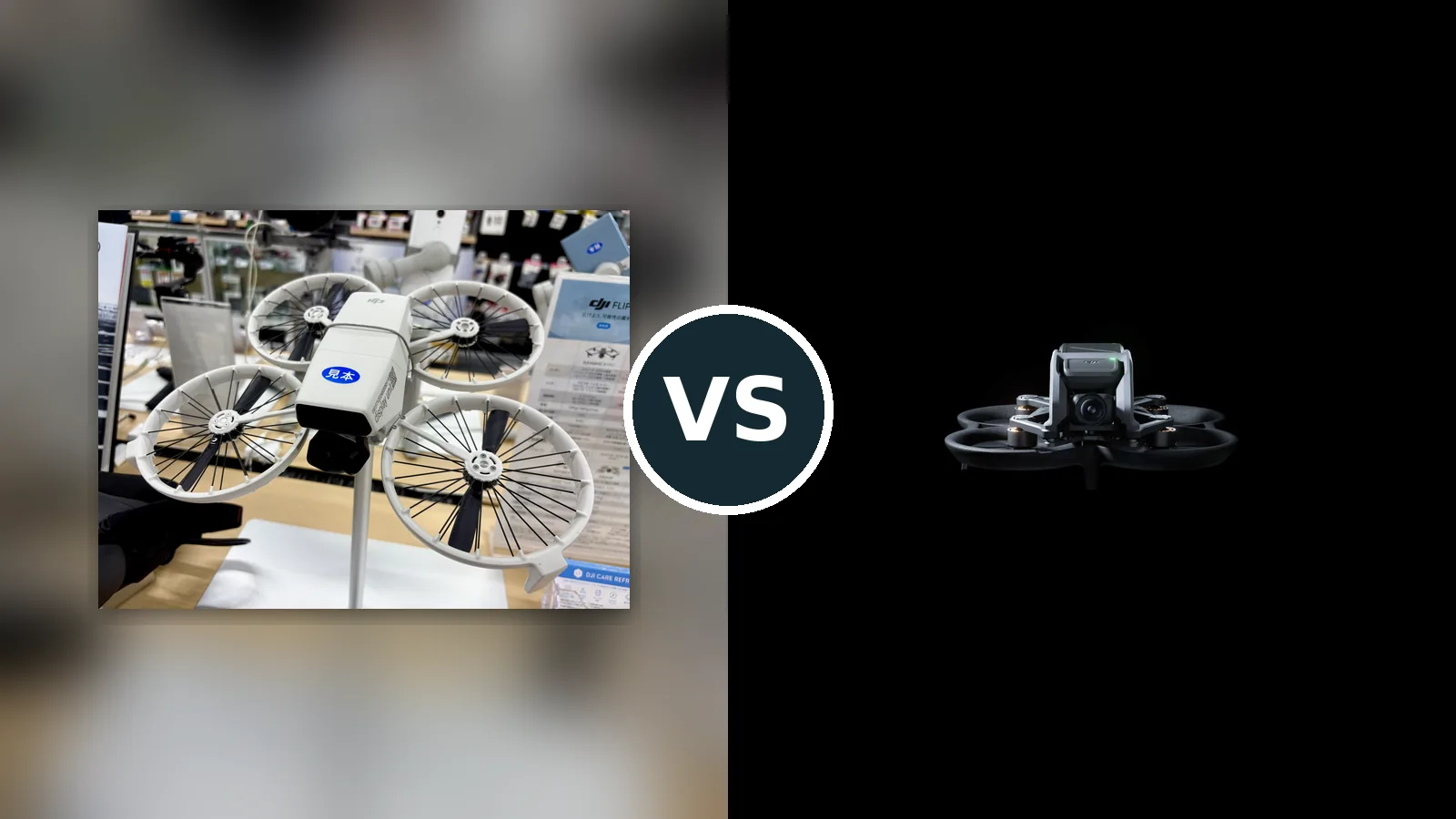
The dji flip vs dji avata matchup looks like a contest between two small drones with propeller guards, and it is actually a contest between two definitions of fun. The DJI Flip is the friendliest camera drone DJI has ever made: it unfolds in seconds, takes off from your palm, follows you on voice or app control with no controller in your hands at all, and wraps its propellers in full guards so a brush with a wall is an anecdote instead of a repair. It weighs under 249 g, shoots 4K/60 HDR from a 1/1.3-inch sensor, and records proper 10-bit D-Log M. The DJI Avata is a first-generation FPV cinewhoop: a 410-gram ducted quadcopter you fly wearing goggles, seeing through its 155-degree camera as you thread doorways, dive gaps, and skim floors at up to 27 m/s in Manual mode. One drone removes the pilot from the process. The other makes you the process. This comparison works through the cameras, the safety models, the control systems, and the honest costs of each approach, so you can buy the experience you actually want rather than the one that looked exciting in a launch video or a highlight reel.
Affiliate disclosure: As an Amazon Associate I earn from qualifying purchases. This page contains affiliate links. If you buy through them, we may earn a commission.
Flip for almost everyone. Avata for the goggles-curious.
DJI Flip is the pick if you want footage of your life with the least possible friction: palm takeoff, subject tracking, full propeller guards, a bigger sensor with 10-bit D-Log M, 31 minutes of rated flight, and no registration headaches under 249 g. DJI Avata is the pick if the flying itself is the hobby: goggles-on FPV immersion, a ducted frame built to bounce off the world, and manual acro speed that no camera drone in this comparison will follow. Camera file: Flip. Convenience: Flip, by a mile. Safety help: Flip. Pure thrill per flight: Avata, every single time. Decide which column sounds like your weekends.

DJI Flip
For creators who want guarded, palm-launched, track-me footage without learning to pilot.
- Flies with no controller at all: palm takeoff, voice control, and app-based subject tracking
- Full-coverage propeller guards and forward 3D infrared braking for close-quarters confidence
- Forward sensing only, and no braking help while tracking: it watches ahead, not around
Check current availability and bundle options on Amazon

DJI Avata
For pilots who want the cockpit view, ducted durability, and manual-mode speed.
- A true cinewhoop: integrated ducts, a 155-degree camera, and up to 27 m/s in Manual mode
- Flies with Goggles 2 or Integra and a motion controller or FPV remote for real immersion
- Goggles are mandatory, stills are JPEG only, and there is no subject tracking at all
Check current availability and bundle options on Amazon
A camera that flies itself, or a cockpit you wear
Start with the launch. One of these drones leaves from your open hand. The other starts with a headset, a pairing ritual, and a pilot’s mindset.
The Flip’s whole design argues that piloting is overhead. Its arms fold out with the propeller guards already in place, it can launch from your palm and return to it, and its subject tracking modes (Follow, Dronie, Circle, Rocket, Spotlight) run from a phone app or voice commands if no controller is anywhere nearby. Underneath the friendliness sits a serious camera: a 1/1.3-inch 48MP sensor behind a 24mm f/1.7 lens, 4K/60 HDR video, 4K/100 slow motion, and 10-bit D-Log M at up to 150 Mbps, plus JPEG and DNG RAW stills. The guards do more than protect fingers; they make the Flip the rare drone you can fly in a garden, a campsite, or a family gathering without everyone flinching.
The Avata argues the opposite: piloting is the point. It is a cinewhoop, which means its propellers live inside integrated ducts that shrug off bumps, and its camera sees a 155-degree field of view so the world rushes past the edges of your goggles. You fly it with DJI Goggles 2, Integra, or the earlier FPV Goggles V2, steering with a motion controller or a conventional FPV remote. In Manual mode it reaches 27 m/s and leans into true acro flight; in Normal mode it slows to 8 m/s and behaves almost politely. What it never does is fly itself. There is no tracking, no obstacle sensing beyond downward positioning sensors, and no shot the pilot did not personally frame.
The choice, then, is about where your attention goes. Flip owners spend attention on the scene and let the drone handle the flying; Avata owners spend all of their attention on the flying and get a scene as the reward. Neither is a diluted version of the other. They are complete, opposite products that happen to share a badge, a 4K badge on the box, and a similar place in the catalog. Buy for the attention pattern you will still enjoy on the fiftieth flight, not the fifth.
There is also a learning-curve asymmetry worth naming plainly. A Flip owner is productive on day one: the first flight can produce a shareable, tracked, 4K clip, and the skills that improve over time are composition skills, the same ones that improve any camera work. An Avata owner’s first week is humbler: short, careful flights in Normal mode, a genuine adjustment to flying through goggles, and footage that improves as stick or motion control becomes muscle memory. That apprenticeship is exactly what FPV pilots come to love about the discipline. It is also exactly what makes the Avata the wrong gift for someone who simply wanted nice holiday video.
Choose DJI Flip if…
- Automation is the point: palm takeoff, voice control, and tracking modes film you while you do the activity.
- You fly around family, pets, and property and want full propeller guards plus a sub-249 g airframe.
- You want the better file: a 1/1.3-inch sensor, 10-bit D-Log M, 4K/100 slow motion, and DNG stills for edits.
- You want 31 rated minutes per battery and the option to fly with just a phone, or no controller at all.
Choose DJI Avata if…
- Immersion is the point: goggles on, world rushing past a 155-degree lens, flying as the experience itself.
- You shoot fly-throughs, interiors, and close-proximity lines where a ducted frame forgives contact.
- You want manual acro capability up to 27 m/s and a drone that rewards genuine piloting skill.
- You accept the full kit reality: goggles and a motion controller or FPV remote are required, not optional.
Flip vs Avata: The Spec Sheet, Line by Line
Read this table as a study in priorities. The Flip spends its budget on the camera, the battery, and being easy to live with. The Avata spends its budget on the airframe and the flight experience.
| Feature | DJI Flip | DJI Avata |
|---|---|---|
| Best suited to | Palm-launched vlogging, family footage, travel clips, and tracked solo content | Immersive FPV flying, cinematic fly-throughs, and close-proximity video |
| Takeoff weight | Under 249 g | Approx. 410 g |
| Dimensions | Folded 136 x 62 x 165 mm; unfolded 233 x 280 x 79 mm | 180 x 180 x 80 mm; fixed cinewhoop frame, does not fold |
| Sensor and lenses | 1/1.3-inch CMOS, 48MP; 24mm equivalent, f/1.7, 82.1-degree field of view | 1/1.7-inch CMOS, 48MP effective (12MP stills); 12.6mm equivalent, f/2.8, 155-degree field of view |
| Photo resolution | 48MP stills, JPEG and DNG RAW | 12MP stills (4000 x 3000), JPEG only |
| Video modes | 4K/60 HDR, 4K/100 slow motion, FHD up to 100fps | 4K/60, 2.7K/120, 1080p/120 |
| Color and codecs | 10-bit D-Log M; H.264 and H.265 up to 150 Mbps | D-Cinelike (8-bit); H.264 and H.265 up to 150 Mbps |
| Vertical capture | 2.7K cropped vertical video for social formats | No native vertical mode; footage is framed for widescreen FPV flying |
| Obstacle sensing | Forward 3D infrared auto-braking in Normal, Cine, and RTH flight; none during tracking | Downward binocular vision and ToF infrared only; nothing forward or to the sides |
| Subject tracking | FocusTrack suite plus palm-launch Follow, Dronie, Circle, Rocket, and Spotlight modes; tracking up to 12 m/s | None; the pilot frames every shot. Turtle mode recovers from upside-down landings |
| Rated flight time | 31 minutes; 28 minutes hovering | Approx. 18 minutes |
| Measured flight time | Not tested by us | Not tested by us |
| Rated wind resistance | 10.7 m/s, Level 5 (guards catch wind in gusts) | 10.7 m/s, Level 5 |
| Max speed | 12 m/s in Sport mode | 27 m/s in Manual mode; 14 m/s Sport; 8 m/s Normal |
| Transmission | DJI O4, up to 13 km FCC, 1080p/60 live view; Wi-Fi phone control for close range | DJI O3+, up to 10 km FCC, 1080p/100 live view to the goggles |
| Storage | 2 GB internal plus microSD up to 512 GB | 20 GB internal plus microSD up to 256 GB |
| Controller and bundle | No controller required: palm, voice, and app control; optional DJI RC-N3 or RC 2 | Goggles required: Goggles 2, Integra, or FPV Goggles V2, with Motion Controller, RC Motion 2, or FPV Remote Controller 2 |
| Main trade-off | No tracking-time obstacle sensing and a bulkier fold than the Mini line | Total immersion, but you supply all the skill, tracking, and obstacle awareness |
Manufacturer flight times are best-case lab figures, and real flights come in shorter, especially in wind or aggressive flying. Measured flight time is listed as not tested because this is a research-based comparison; see the methodology section for how the figures above were verified.
Five Differences That Actually Decide This One
Five differences decide this matchup: the flying experience, the camera file, the safety model, the everyday practicality, and the speed ceiling waiting at the top end.
1. The flying experience: autopilot butler vs wearable cockpit
Edge: Tie, by designNothing else in this comparison matters until this is settled. A Flip flight can begin with the drone sitting on your palm: it rises, locks onto you, and follows while you walk, ride, or talk to camera, directed by app buttons or your voice. The skill being exercised is content judgment: where to stand, when the light is right, which mode to pick. The flying is handled, deliberately and completely.
An Avata flight begins with goggles over your eyes and the real world replaced by the drone’s 155-degree view. Every meter is steered. The reward is a sensation no tracking mode produces: speed you feel in your stomach, lines through gaps you chose, footage that looks like the camera itself is alive. The cost is that there is no off switch for responsibility. Battery, obstacles, framing, and the flight path are yours from takeoff to landing, every time.
2. The camera file: bigger sensor and 10-bit color vs the FPV look
Edge: DJI FlipJudged purely as cameras, the Flip is a class above. Its 1/1.3-inch 48MP sensor is larger than the Avata’s 1/1.7-inch unit, gathers more light through an f/1.7 lens, and records 10-bit D-Log M at up to 150 Mbps, with 4K/60 HDR and 4K/100 slow motion on the mode list. Stills are full 48MP captures in JPEG or DNG RAW, so the Flip doubles as a genuine stills camera in a way the Avata never attempts.
The Avata camera is built for a different job. Its stills are 12MP JPEGs and its D-Cinelike profile is 8-bit, both real limitations in an edit. But its 155-degree lens and RockSteady 2.0 plus HorizonSteady stabilization produce the unmistakable FPV look: wide, fast, horizon-locked when you want it, and fluid through moves no gimbal drone can physically fly. The Flip produces the better file. The Avata produces the more dramatic shot. Editors know which one their project needs.
3. Safety: guards and braking vs ducts and durability
Edge: DJI FlipThe Flip’s safety story has two layers. Physically, its full-coverage propeller guards mean the spinning parts never meet fingers, branches, or walls, and at under 249 g the whole aircraft carries little energy into any mistake. Electronically, a forward 3D infrared sensor provides auto-braking in Normal, Cine, and return-to-home flight. The honest caveat is printed in DJI’s own documentation: there is no obstacle braking while subject tracking is active, so a follow shot through trees is flown on your judgment.
The Avata’s safety story is one layer, made of plastic. The ducted frame is genuinely tough: cinewhoops are built to glance off doorframes and survive the learning curve, and Turtle mode flips the drone upright after a tumble so you can take off again instead of walking over. But there is no forward or side sensing at all, the drone weighs 410 g, and in Manual mode it travels at 27 m/s. It protects itself superbly. Protecting everything else is the pilot’s job, with goggles covering the pilot’s eyes and a spotter recommended whenever people are anywhere near the flight line.
4. Everyday practicality: 31 minutes and no kit vs 18 minutes and a full rig
Edge: DJI FlipThe Flip is rated for 31 minutes per battery against the Avata’s 18, and the gap widens in practice because their kits differ so much. A Flip outing can be the drone alone in a jacket pocket: unfold, palm launch, land on your hand, done. Its O4 link reaches a rated 13 km FCC when a controller is used, but the deeper point is that no link is required at all for its core tricks. Storage is the one practical weak spot: 2 GB internally means a microSD card is effectively mandatory.
An Avata outing is a production: drone, goggles, motion controller or FPV remote, and batteries for both the aircraft and the headset, because the experience ends when either dies. The 18-minute rating is normal for a cinewhoop working hard, and the O3+ feed to the goggles is excellent at up to 10 km FCC with a 1080p/100 live view, but none of it is pocketable or spontaneous. The Avata rewards planned sessions. The Flip rewards moments, and most people’s lives contain more moments than sessions.
5. The top end: where the Avata simply leaves
Edge: DJI AvataEvery section above has a Flip answer except this one. The Avata in Manual mode reaches 27 m/s, more than double the Flip’s 12 m/s Sport mode, and it flies with an acro freedom that lets skilled pilots dive buildings, chase action sports, and carve lines a stabilized camera drone cannot imitate. The Flip’s 12 m/s tracking ceiling and careful manners are virtues for its audience and hard limits for anyone else.
This is also where the Avata’s ecosystem points forward: the same goggles and controllers carry into DJI’s wider FPV line, so skills and hardware compound across upgrades. The Flip’s ceiling is deliberate: it trades the top end for a bottom end so gentle that a first-time flyer can be filming within minutes. Neither trade is wrong. They are aimed at people standing in different places on the same hobby’s road.
Flip vs Avata: What You Gain, What You Give Up
DJI Flip
Reasons to choose it
- Palm takeoff, voice control, and app tracking: the lowest-effort filming DJI has ever shipped
- The better camera file: 1/1.3-inch sensor, 10-bit D-Log M, 4K/100, and 48MP DNG stills
- Full propeller guards, forward infrared braking, and a sub-249 g weight that skips recreational registration in the US
- 31 minutes rated per battery, with or without a controller in the bag
Reasons to reconsider
- No obstacle braking during tracking, and no sensing beyond the forward direction
- Only 2 GB of internal storage, so a microSD card is effectively mandatory
- A 12 m/s ceiling that fast subjects and FPV ambitions will outgrow
DJI Avata
Reasons to choose it
- True FPV immersion through goggles, with a 155-degree camera and motion or stick control
- Ducted cinewhoop frame that survives bumps, plus Turtle mode recovery after tumbles
- Manual mode speed up to 27 m/s and genuine acro capability
- 20 GB internal storage plus microSD, and a controller ecosystem shared with DJI’s FPV line
Reasons to reconsider
- Goggles are mandatory and stills are 12MP JPEG only, with 8-bit D-Cinelike video
- No tracking, no forward sensing, and roughly 18 minutes per battery
- At 410 g it requires registration and carries more energy into every mistake
Goggles in the box or not: check the bundle twice
One of these drones is a complete product in a single box. The other is the start of a kit. Make sure the listing you order matches the flying you plan to do.
- Goggles reality, Avata: The Avata cannot fly without goggles and a controller. Confirm the bundle includes Goggles 2 or Integra and either a Motion Controller or RC Motion 2 (or a DJI FPV Remote Controller 2), because drone-only listings assume you already own them.
- Controller choice, Flip: The Flip flies with no controller, a phone, the RC-N3, or the screen-equipped RC 2. Decide how you will actually fly before paying for a controller you may never carry.
- Batteries and session length: Rated times are 31 minutes for the Flip and about 18 for the Avata, whose goggles have their own battery to manage. FPV sessions live or die on spare packs; budget accordingly.
- Storage: The Flip includes only 2 GB internally, so add a fast microSD card to the order. The Avata includes 20 GB plus a card slot and is more forgiving.
- Registration: The Flip stays under 249 g and skips recreational registration in the US. The Avata, at about 410 g, requires it. Both are ready to fly once the paperwork matches your local rules.
- Listing checks: Verify the exact model name (the Avata is the first generation, not the Avata 2), what is in the box, battery condition, and region version before ordering, especially where drone-only and combo listings sit side by side.
Effortless footage or the pilot’s high. Pick your hobby.
Choose the DJI Flip if the footage is the hobby: it is the easier drone to live with, the safer drone to fly around your life, the owner of the better camera file, and the only one here that works with no controller at all. Choose the DJI Avata if the flying is the hobby: goggles-on FPV through a ducted frame at up to 27 m/s is an experience the Flip does not attempt, and its skills and hardware open the door to DJI’s whole FPV world. Most buyers asking this question want the Flip and are tempted by the Avata’s drama. Be honest about which one you will still be charging batteries for in six months, because the best drone in this comparison is simply the one whose flights fit the shape of your actual weekends.
Still deciding?
Can the DJI Flip be flown FPV with goggles?
No. The Flip is a conventional camera drone: you watch its live view on a phone or on the RC 2 controller screen, and it has no goggles FPV mode. It does offer an immersive-feeling alternative in its tracking modes, where the drone follows you automatically. If goggles-on flight is what you want, that is the Avata’s entire reason to exist.
Does the DJI Avata really need goggles to fly?
Yes. The Avata has no phone-only flight mode. It pairs with DJI Goggles 2, Integra, or the earlier FPV Goggles V2 for the video feed, and you steer with a Motion Controller, RC Motion 2, or the FPV Remote Controller 2. Budget for the full kit if you do not already own compatible goggles, and check whether a listing is a combo or the drone alone.
Which drone is safer around people and property?
The Flip, clearly. It weighs under 249 g, wraps its propellers in full guards, and adds forward infrared auto-braking in normal flight. The Avata’s ducts also enclose its propellers, which is genuinely protective for the drone, but it weighs about 410 g, flies far faster, and is steered by a pilot whose eyes are inside goggles. For family and travel flying, the Flip is the responsible design.
Which drone shoots better video?
On file quality, the Flip: a larger 1/1.3-inch sensor, 10-bit D-Log M color, 4K/60 HDR, and 4K/100 slow motion against the Avata’s 1/1.7-inch sensor and 8-bit D-Cinelike. On drama, the Avata: its 155-degree lens and FPV flight dynamics produce movement and immersion the Flip cannot replicate. Most editors should take the Flip’s file; FPV storytellers should take the Avata’s shots.
Do I need to register either drone?
The Flip stays under the 249 g threshold, so recreational registration is not required for it in the US. The Avata weighs about 410 g and does require registration for recreational flying. Commercial operations bring certification requirements for either aircraft, and rules vary by country, so check your local regulations before flying.
How were these drones compared?
This is a research-based comparison built from DJI’s published specifications, manuals, and goggles and controller compatibility documentation for both drones, cross-checked for consistency across the two product lines. We did not fly either drone for this article, so flight times are DJI’s rated figures and measured flight time is listed as not tested. See the methodology section for the source list.
How this comparison was prepared
This comparison is research-based. We did not fly either drone for this article, and nothing here should be read as hands-on testing. Every specification in the table was taken from DJI’s published documentation for the DJI Flip and DJI Avata, including official specification listings, user manuals, and goggles and controller compatibility notes, and each figure was checked against the matching figure for the other drone so that rated values are compared like for like. Where a capability was not present in the verified specification set, the table says so rather than filling the gap with an estimate. Flight times quoted are manufacturer rated maximums under ideal conditions; real flights are shorter. Sources are listed by name only below, in line with this site’s editorial policy.
Sources
- DJI Flip official specifications
- DJI Avata official specifications
- DJI Flip user manual
- DJI Avata user manual
- DJI Goggles 2 and motion controller compatibility documentation
Last verified: October 20, 2026. Specifications, bundles, and availability may vary by region and version.


