

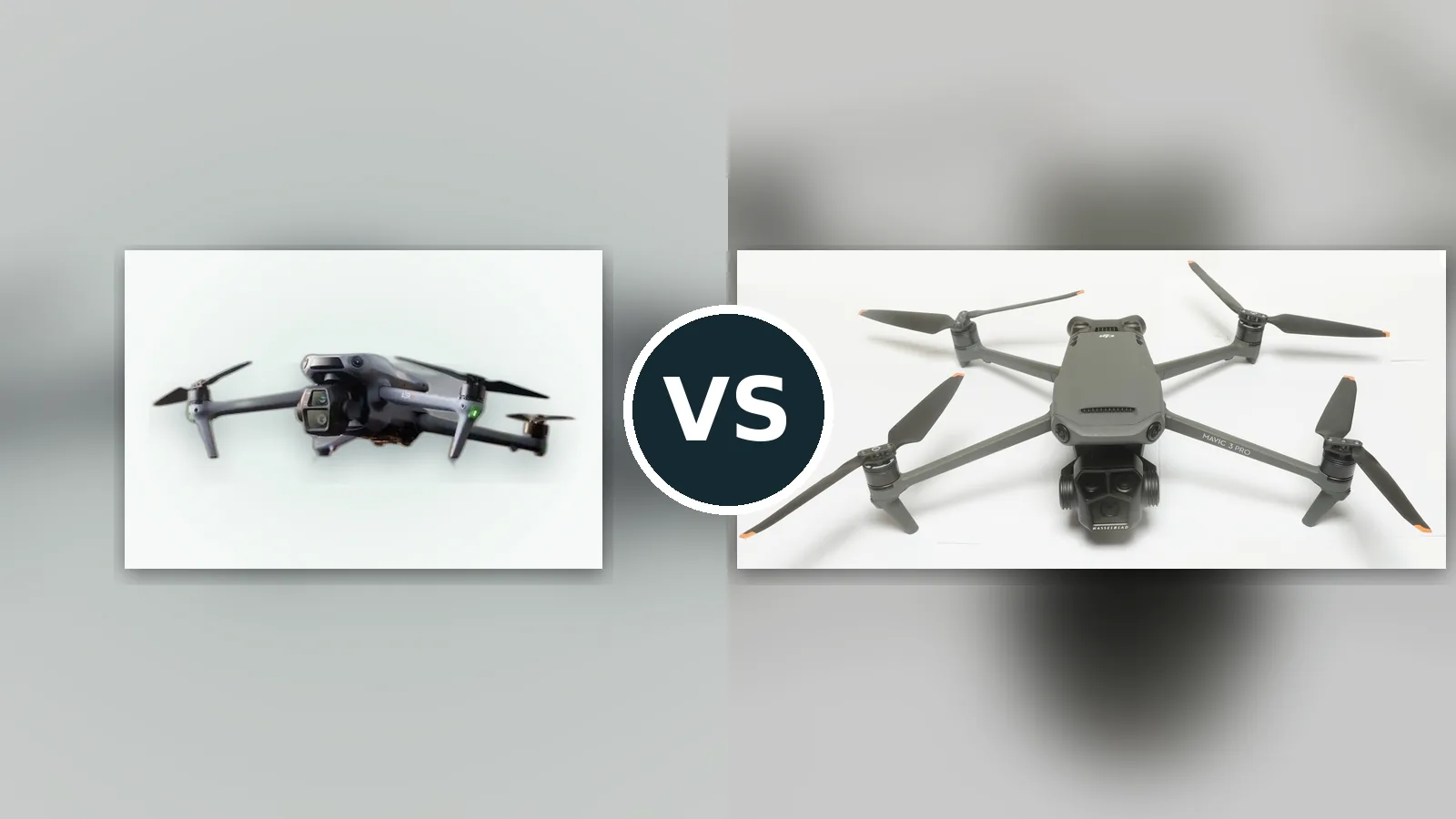
The air3s vs mavic 3 pro debate is where DJI’s own lineup starts arguing with itself. The DJI Air 3S is the overachieving middleweight: a 1-inch main camera, a proper 70mm medium telephoto, nightscape obstacle sensing with LiDAR and 45 minutes of rated flight in a 724 g folding frame. The DJI Mavic 3 Pro is the flagship statement: a 4/3-inch Hasselblad main camera, three focal lengths up to 166mm, an adjustable aperture and the professional feature set of the Mavic line. They overlap so much that choosing wrong is hard and choosing well is subtle. The flagship costs meaningfully more and weighs 234 g extra. The middleweight gives up sensor size and the longest lens. We compared the cameras, the sensing systems, the endurance math and the full kits to find where the flagship premium actually shows up in your footage.
Affiliate disclosure: As an Amazon Associate I earn from qualifying purchases. This page contains affiliate links. If you buy through them, we may earn a commission.
Mavic 3 Pro for image quality. Air 3S for almost everything else.
DJI Mavic 3 Pro owns the camera categories: the bigger 4/3 sensor, the adjustable aperture and the third lens at 166mm. DJI Air 3S answers with better low light sensing, two extra rated minutes, a lighter frame, a built-in vertical mode and a lower price, while matching the Pro’s beloved 70mm focal length. Camera ceiling: Mavic 3 Pro. Night confidence, travel and value: Air 3S.
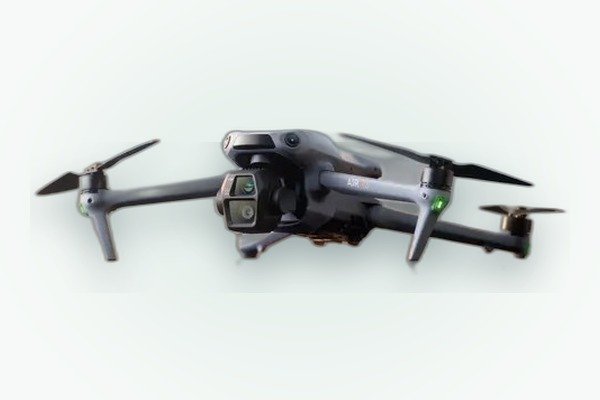
DJI Air 3S
For travel and commercial creators who want dual cameras, LiDAR sensing and long flights without flagship weight
- 1-inch main sensor and a real 70mm telephoto in a lighter frame
- LiDAR nightscape sensing works down to 1 lux, with non-GPS return
- Main sensor is smaller than the Pro’s 4/3, and there is no third lens
Check current price and available bundles on Amazon
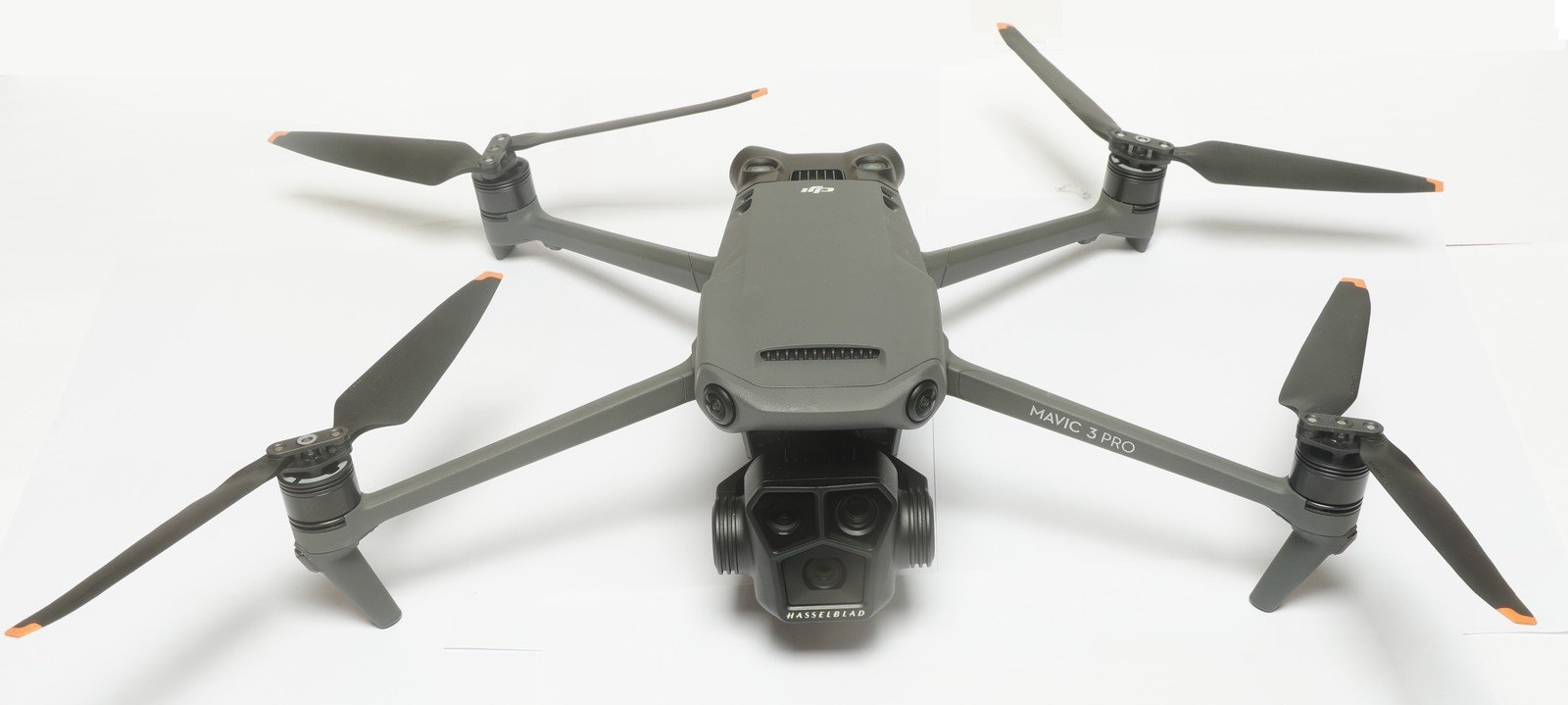
DJI Mavic 3 Pro
For professionals who want the 4/3 Hasselblad sensor, adjustable aperture and three-lens coverage
- Largest sensor of the pair with an f/2.8 to f/11 adjustable aperture
- 24mm, 70mm and 166mm: the full focal range in one flight
- Heaviest and priciest option here, with no LiDAR sensing
Check current price and available bundles on Amazon
The middleweight learned the flagship’s best tricks
The Air line used to be the compromise you made on the way to a Mavic. The Air 3S ends that story: it matches the Pro’s working focal lengths and beats its sensing, conceding only sensor size and reach.
The pattern appears across the details. Both drones shoot 24mm wide and 70mm medium tele, the two focal lengths that dominate professional aerial work. Both record 10-bit log color at high bitrates, track subjects with mature software, and fold for travel. The Pro’s case rests on three pillars: the 4/3-inch sensor’s cleaner files and shallower depth character, the adjustable aperture that working pilots use to hold shutter angles, and the 166mm third camera for reach. The Air 3S counters with pillars of its own: a forward LiDAR that keeps obstacle sensing alive nearly to darkness, a native 2.7K vertical mode the Pro lacks entirely, 42 GB of internal storage, and a frame light enough to notice on a long carry. Read the categories with your own footage in mind, because the winner genuinely changes with the brief.
DJI Air 3S in detail
The Air 3S is built around two strong cameras rather than three. The wide camera’s 1-inch 50MP sensor shoots 4K up to 120fps and 4K/60fps HDR in 10-bit D-Log M with up to 14 stops of dynamic range, numbers that would have headlined a flagship not long ago. The 70mm medium telephoto on a 1/1.3-inch 48MP sensor matches the Pro’s most used lens for compression and isolation work. Sensing is where the Air 3S embarrasses its price class: omnidirectional vision plus a forward LiDAR and downward infrared give it nightscape awareness to 1 lux and the ability to return home without satellite signal. ActiveTrack 360 includes Subject Focusing for keeping a chosen subject sharp, and the intelligent flight suite covers MasterShots, QuickShots, Waypoint Flight and Hyperlapse. Endurance is rated at 45 minutes with 41 minutes of hovering, transmission is O4 to 20 km, and the whole package folds into a shape that disappears into a camera bag’s spare corner. Its compromises are sensor physics and reach: the 1-inch sensor trails the 4/3 in highlight handling and high ISO cleanliness, and there is no lens beyond 70mm.
DJI Mavic 3 Pro in detail
The Mavic 3 Pro remains the image quality reference in DJI’s folding range. The 4/3-inch Hasselblad main camera pairs 20MP stills and 5.1K video with an adjustable f/2.8 to f/11 aperture, a working tool that lets cinematographers hold a 180-degree shutter in bright light with gentler filtration while landscape shooters stop down for depth. Color science is the house Hasselblad tuning, natural and calm, in 10-bit D-Log and D-Log M at up to 200 Mbps. The 70mm medium telephoto equals the Air 3S’s on paper, and the 166mm telephoto extends the system into scouting, wildlife distance and compression work the Air cannot attempt. Pro software includes Waypoint Flight, Cruise Control and Night Shots, the sensing is omnidirectional vision with APAS 5.0, and the O3+ link reaches 15 km. The physical costs are 958 g on the scale and a top-tier price, and the generational costs are visible too: no LiDAR, no native vertical mode and a 43-minute rating that trails its cheaper sibling by two minutes.
What neither drone gives you
Neither drone is a sub-250 g traveler, so registration and, for paid work, certification come with both. Neither shoots RAW video or the Apple ProRes of the Pro’s Cine sibling, and neither matches the enterprise line for zoom, thermal or survey payloads. Both are also big enough that truly discreet flying is off the table; these are working cameras that happen to fold, and they should be budgeted, insured and flown like it.
Choose DJI Air 3S if…
- Travel and night work feature heavily: lighter frame, LiDAR sensing.
- Your focal lengths live between 24mm and 70mm.
- You want vertical video without post cropping gymnastics.
- You can accept a 1-inch sensor as the ceiling on image quality.
Choose DJI Mavic 3 Pro if…
- Maximum image quality is the brief: 4/3 sensor, adjustable aperture.
- You need 166mm reach for subjects you cannot approach.
- You deliver client work where the flagship files earn their premium.
- You can accept flagship weight, price and no built-in vertical mode.
The specs that actually matter
Two dual-purpose camera platforms separated by one lens and one sensor size class. Confirm the controller in each bundle, because both drones ship with phone and screen controller options at different prices.
| Feature | DJI Air 3S | DJI Mavic 3 Pro |
|---|---|---|
| Best suited to | Travel photography, real estate, commercial work and night flying | Professional aerial video, real estate and travel cinematography |
| Takeoff weight | 724 g | 958 g |
| Dimensions | Folded 214.19 x 100.63 x 89.17 mm | Folded 231.1 x 98 x 95.4 mm |
| Camera sensor | Wide: 1-inch CMOS, 50MP; Tele: 1/1.3-inch CMOS, 48MP | 4/3-inch CMOS 20MP wide; 1/1.3-inch CMOS 48MP medium tele; 1/2-inch CMOS 12MP tele |
| Main lens | 24mm equivalent, f/1.8 | 24mm equivalent, f/2.8 to f/11 adjustable aperture, 84-degree FOV |
| Tele lenses | 70mm equivalent, f/2.8 | 70mm equivalent f/2.8; 166mm equivalent f/3.4 |
| Photo resolution | 50MP wide, 48MP tele; JPEG and DNG RAW | 20MP wide, 48MP medium tele, 12MP tele; JPEG and DNG RAW |
| Video modes | 4K up to 120fps, 4K/60fps HDR, FHD up to 240fps, 2.7K vertical to 60fps on both cameras | 5.1K up to 50fps and 4K up to 120fps on wide; 4K up to 60fps on both tele cameras; FHD up to 200fps |
| Color and codecs | 10-bit D-Log M and HLG, H.264/H.265 up to 130 Mbps, up to 14 stops dynamic range | 10-bit D-Log, D-Log M and HLG, H.264/H.265 up to 200 Mbps; Apple ProRes on the Cine version |
| Vertical capture | 2.7K cropped vertical (1512 x 2688) on both cameras | No native vertical mode; crop in post |
| Obstacle sensing | Omnidirectional vision plus forward LiDAR and downward infrared ToF; nightscape sensing to 1 lux | Omnidirectional vision sensing with APAS 5.0; AirSense ADS-B receiver |
| Subject tracking | ActiveTrack 360, Subject Focusing, MasterShots, QuickShots, Waypoint Flight, Hyperlapse | ActiveTrack 5.0, Waypoint Flight, Cruise Control, MasterShots, QuickShots, Hyperlapse, Night Shots |
| Rated flight time | 45 minutes; 41 minutes hovering | 43 minutes; 37 minutes hovering |
| Real-world flight time | Not tested by us; reviewers report low-to-mid thirties in mixed conditions | Not tested by us; reviewers report roughly 32 to 35 minutes of real shooting per battery |
| Video transmission | DJI O4, up to 20 km (FCC) / 10 km (CE) | DJI O3+, up to 15 km (FCC), 1080p/60fps live view |
| Max speed | 21 m/s | 21 m/s (Sport mode); 19 m/s max in EU regions |
| Wind resistance | 12 m/s | 12 m/s (Level 6 rating) |
| GNSS | GPS + Galileo + BeiDou | GPS + Galileo + BeiDou |
| Internal storage | 42 GB plus microSD; Off-State QuickTransfer | 8 GB plus microSD up to 512 GB (1 TB SSD on the Cine version) |
| Controller options | DJI RC-N3 (phone) or DJI RC 2 with built-in screen | DJI RC, DJI RC Pro |
| Main trade-off | Smaller main sensor and no lens past 70mm; newer platform with a shorter history | Top weight and price; no LiDAR and no vertical mode |
Flight times are manufacturer maximums. The Cine version of the Mavic 3 Pro is a separate, pricier product with Apple ProRes and a 1 TB SSD; it is not the aircraft compared here.
The transmission row deserves a practical footnote. The Air 3S’s newer O4 system is rated further and handles interference gracefully in reviewers’ long-term use, while the Pro’s O3+ remains thoroughly proven and pairs with the brighter RC Pro controller. In legal visual-line-of-sight flying, both links are far stronger than the pilot’s eyes, so treat range as headroom rather than a working distance on either drone.
Also read the photo row with a calculator nearby. The Air 3S’s 50MP wide stills out-resolve the Pro’s 20MP wide files and crop beautifully for print, while the Pro’s sensor makes each of its fewer pixels cleaner, especially past dusk. Resolution is not quality, and quality is not resolution; photographers who print big will feel the difference in opposite directions depending on the light they shoot in, which is exactly why both drones have loyal professional users.
Five differences worth paying attention to
The flagship wins the categories it was built to win. The surprise is how many of the remaining categories the middleweight takes, and by margins that matter weekly.
1. Camera quality and creative flexibility
Edge: DJI Mavic 3 ProThe Pro’s 4/3-inch sensor is the biggest in this comparison and it behaves like it: cleaner high ISO files, gentler highlight rolloff, more cropping headroom from 20MP stills and the subtle depth character that smaller sensors cannot imitate. The adjustable aperture is the professional’s quiet favorite, holding cinematic shutter angles in bright conditions and giving landscape shooters real depth control. Then there is the third lens: the 166mm telephoto turns distant subjects into compositions, where the Air 3S simply has no answer beyond flying closer. The Air 3S counters strongly, though. Its 1-inch sensor is excellent, honestly closer to the 4/3 in daylight than the price gap suggests, its 70mm telephoto matches the Pro’s middle lens, and it adds a working 2.7K vertical mode for social deliverables that the Pro cannot shoot natively.
Editors will also weigh pipelines: both record 10-bit log with generous bitrates, the Pro’s 200 Mbps ceiling edging the Air’s 130 Mbps in fast-moving detail. For delivery to a television or a client monitor in good light, most viewers will never separate them. For pixel-level work and reach, the flagship earns its name.
2. Portability and travel
Edge: DJI Air 3STwo hundred and thirty-four grams is the difference between a drone that rides in the camera bag and a drone that gets left at the hotel twice a week. The Air 3S folds smaller, weighs less and carries three batteries in the space the Pro’s kit occupies with two, and across a travel season those small mercies compound. Both drones trigger the same registration tier in most regions, so the Air’s advantage is purely physical rather than legal. Setup is equally fast on both, and the Air’s 42 GB of internal storage adds a traveller’s grace note: a forgotten card never ends a shoot.
The Pro’s portability defense is that professionals expect to carry it: it replaces a multi-lens camera system that would weigh five times as much. True, and irrelevant to the hiker choosing one drone for a mountain week.
3. Flight confidence and tracking
Edge: DJI Air 3SBoth drones sense obstacles in every direction in daylight and reroute or brake with mature software. After dark they diverge completely. The Air 3S’s forward LiDAR and infrared systems keep its sensing alive down to about 1 lux, and its nightscape system can guide a return home without GPS, which makes dusk real estate, evening events and tree-lined work meaningfully safer. The Pro’s vision-only sensing fades with the light, as all vision-only systems do. Tracking is close: ActiveTrack generations differ in name, both hold subjects well, and the Air’s Subject Focusing adds a photographer’s touch for stills work.
No sensing suite repeals physics or regulations, and both brands publish the same limits about wires, branches and glass. But for confidence after sunset, this category is the Air 3S’s clearest win in the entire comparison.
4. Battery life and time in the air
Edge: DJI Air 3SThe Air 3S is rated 45 minutes to the Pro’s 43, and hovering extends the gap, 41 against 37, because the Pro carries 234 g more airframe and gimbal on a similar energy budget. Real-world flying compresses both into the low-to-mid thirties, but the ranking never flips, and the Air does it while feeding a LiDAR and a newer transmission system. Charging ecosystems are family affairs on both sides, with multi-battery hubs in the combo kits doing sequential charging that rewards owners who plug in the night before. Neither drone fast-charges its way out of poor planning.
Translate the numbers into a working day and the Air 3S’s edge is roughly one extra short flight per three-battery rotation. Small, real and free, which is the best kind of advantage.
5. Value of the complete kit
Edge: DJI Air 3SBuilt out like-for-like, screen controller, three batteries, hub, filters and case, the Air 3S kit lands well below the Mavic 3 Pro’s equivalent bundles, and the gap is large enough to fund a serious second tool: a gimbal camera, a lighting kit, a year of client software. The Pro’s defense is that its premium buys the two things the Air cannot add later at any price, sensor size and the 166mm lens, and professionals bill for exactly those. The Air’s defense is that most briefs never ask for either.
Resale adds a wrinkle: Mavic flagships hold value stubbornly, and the Pro’s professional demand keeps its used prices firm, which returns some of the premium at upgrade time. The Air 3S is newer, with a shorter resale record but strong early demand of its own.
What you gain. What you give up.
DJI Air 3S
Reasons to choose it
- Dual cameras with a true 70mm telephoto in a 724 g frame
- LiDAR nightscape sensing and non-GPS return to home
- 45 rated minutes, 42 GB storage and a native vertical mode
Reasons to reconsider
- 1-inch sensor trails the 4/3 in dynamic range and high ISO work
- No lens beyond 70mm for distant subjects
DJI Mavic 3 Pro
Reasons to choose it
- 4/3 Hasselblad sensor with adjustable aperture for pro files
- Three focal lengths including 166mm reach
- 200 Mbps recording and the full Mavic pro feature set
Reasons to reconsider
- Heaviest and most expensive route to this feature set
- No LiDAR, no native vertical mode, two fewer rated minutes
The honest summary is generational: the Air 3S is the newer design with the newer safety systems, and the Mavic 3 Pro is the older flagship with the bigger camera. Newer wins most days. Bigger wins the days when the light is bad and the subject is far away and the client is paying. If you are genuinely torn after all of this, rent or borrow each for a weekend of your real work. Two days of your own footage will settle what ten comparisons can only frame, and both drones hold their value well enough that a careful buyer risks little either way. Pilots upgrading from older Air or Mavic models will feel at home in either cockpit within a single flight of practice.
Check the bundle, not just the drone
- Controller: Air 3S bundles use the RC-N3 or the screen equipped RC 2; Mavic 3 Pro bundles use the RC or RC Pro. The controller changes both price and daily pleasure, so value it properly.
- Batteries: The two drones use different battery families. Never assume cross-compatibility, and budget three batteries for working days on either.
- Accessories: Confirm ND filters, charging hub, spare propellers and case. The Mavic 3 Pro Cine is a separate product; do not let a listing blur it into a standard Pro.
- Listing: Verify the exact model name and seller. Air 3S and Air 3 are different drones, as are Mavic 3 Pro and Mavic 3 Pro Cine.
- Local requirements: At 724 g and 958 g both drones need registration in most regions and certification for commercial work. Check your aviation authority before the first paid flight.
The right choice comes down to sensor versus system.
Pick the DJI Mavic 3 Pro if the image is the product: its 4/3 sensor, adjustable aperture and third lens make it the finest camera in DJI’s folding range, and professionals will feel that ceiling lift on difficult work. Pick the DJI Air 3S if the flying is the product: it matches the working focal lengths, senses better after dark, flies a touch longer, travels lighter and leaves real money in the budget. For most creators reading this page, the Air 3S is the recommendation we would defend over coffee. For the minority whose clients zoom into the corners of every frame, the Pro remains untouchable here, and they already know who they are.
Still deciding?
Is the DJI Mavic 3 Pro worth the upgrade over the Air 3S?
For image-first professionals, yes: the 4/3 sensor, adjustable aperture and 166mm lens are capabilities the Air 3S cannot be upgraded into, and client work notices them. For everyone else the honest answer flips: the Air 3S matches the Pro’s working focal lengths, senses better in the dark, flies longer and costs less, which makes it the better purchase for most creators.
Which drone is better for beginners?
Neither is a beginner drone by weight or price, but the Air 3S is the gentler teacher: its LiDAR keeps obstacle sensing useful into dim conditions and its lower replacement cost hurts less. Both demand registration, open-space practice and respect for their size. A first flagship is also a first insurance conversation, and the cheaper aircraft is kinder on every one of those fronts while you build hours and judgment.
Which is better for travel and vertical video?
The Air 3S on both counts: it is 234 g lighter, folds smaller and shoots a native 2.7K vertical mode on both of its cameras, while the Mavic 3 Pro crops in post. The Pro remains the better stills camera for the same trip, so photographers who travel light face a real choice rather than a wrong one.
How much better is the 4/3 sensor, really?
Enough to see in the files, not enough to ruin the Air 3S. Expect cleaner shadows at high ISO, more highlight headroom in contrasty scenes and slightly more crop tolerance from the Pro. In good light at web sizes, the Air 3S’s 1-inch output is close enough that clients rarely comment, which is exactly why this comparison is a debate at all.
Which bundle should I buy?
Working shooters on either platform should buy the Fly More style combo for three batteries and the hub. Air 3S buyers should choose the RC 2 bundle for the screen; Mavic 3 Pro buyers working commercially should price the RC Pro bundle honestly against the standard RC kit before deciding the brighter screen is optional.
How were these drones compared?
This is a research-based comparison built from DJI’s official specification pages for both models, cross-checked against independent reviews and spec databases. We did not fly these two units side by side. Flight times, ranges and sensing figures are manufacturer ratings, and real-world endurance expectations are attributed to independent reviewers.
How this comparison was prepared
This comparison was prepared from the manufacturers’ published specifications and documentation for both aircraft, cross-checked against independent editorial reviews and spec databases. Where two reputable sources disagreed on a figure, we followed the manufacturer’s official specification page and flagged the figure during drafting for a second check. Flight times, ranges and speeds quoted as ratings are the manufacturers’ laboratory figures; where real-world results are mentioned, they are attributed to independent reviewers rather than presented as our own testing.
Sources and verification
- DJI Air 3S official specifications (dji.com)
- DJI Mavic 3 Pro official specifications (dji.com)
- DJI Air 3S and Mavic 3 Pro user manuals and support documentation (dji.com)
- Independent reviews and spec databases, including Trusted Reviews coverage of the Air 3S
Last verified: October 20, 2026. Bundle availability, app features, firmware behavior and specifications may vary by region, firmware version and production batch over time, so confirm the current listing details before ordering.


