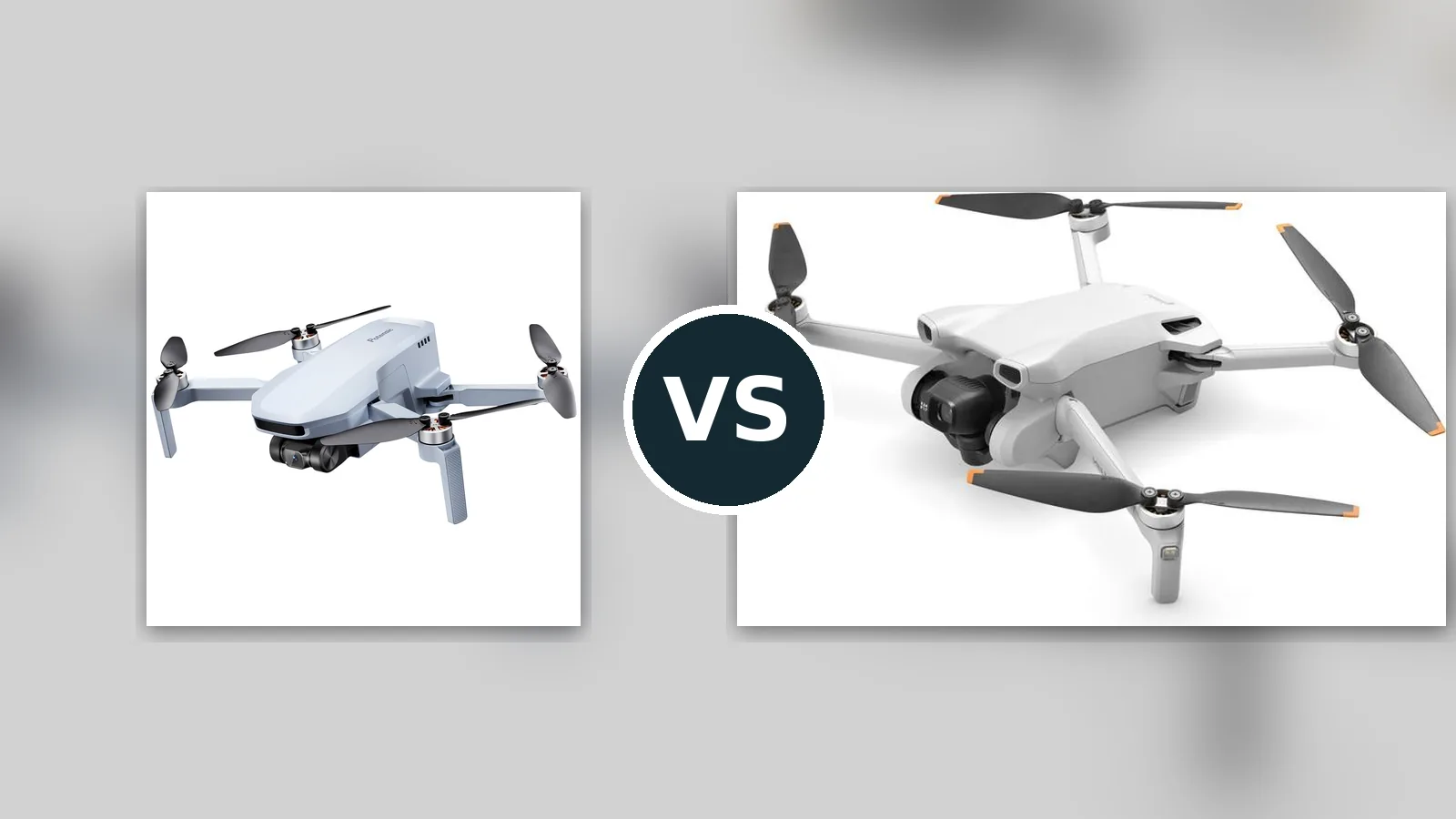
The potensic atom se vs dji mini 3 debate is the classic budget drone question: how much does the DJI badge actually buy you? The Atom SE is Potensic’s sub-249g answer to DJI’s entry level lineup, a 4K GPS drone that launched at about half the Mini 3’s price with two batteries in the box. The Mini 3 is DJI’s refined December 2022 entry, with a much larger 1/1.3-inch sensor, a true 3-axis gimbal, and 38 minutes of rated flight time. We compared the camera, flight time, range, intelligent features and complete kit value so you can decide whether the savings are worth it.
Affiliate disclosure: As an Amazon Associate I earn from qualifying purchases. This page contains affiliate links. If you buy through them, we may earn a commission.
Mini 3 for most. Atom SE for tight budgets.
DJI Mini 3 wins this comparison for most buyers: a far larger image sensor, a true 3-axis gimbal with vertical shooting, longer flight time, and 10 km O2 transmission that the Atom SE cannot match. Potensic Atom SE wins on price by a wide margin, and it is the only one of the two with Follow Me and waypoint flight. Camera: Mini 3. Flight time and range: Mini 3. Intelligent tracking modes: Atom SE. Value per dollar: Atom SE, easily.
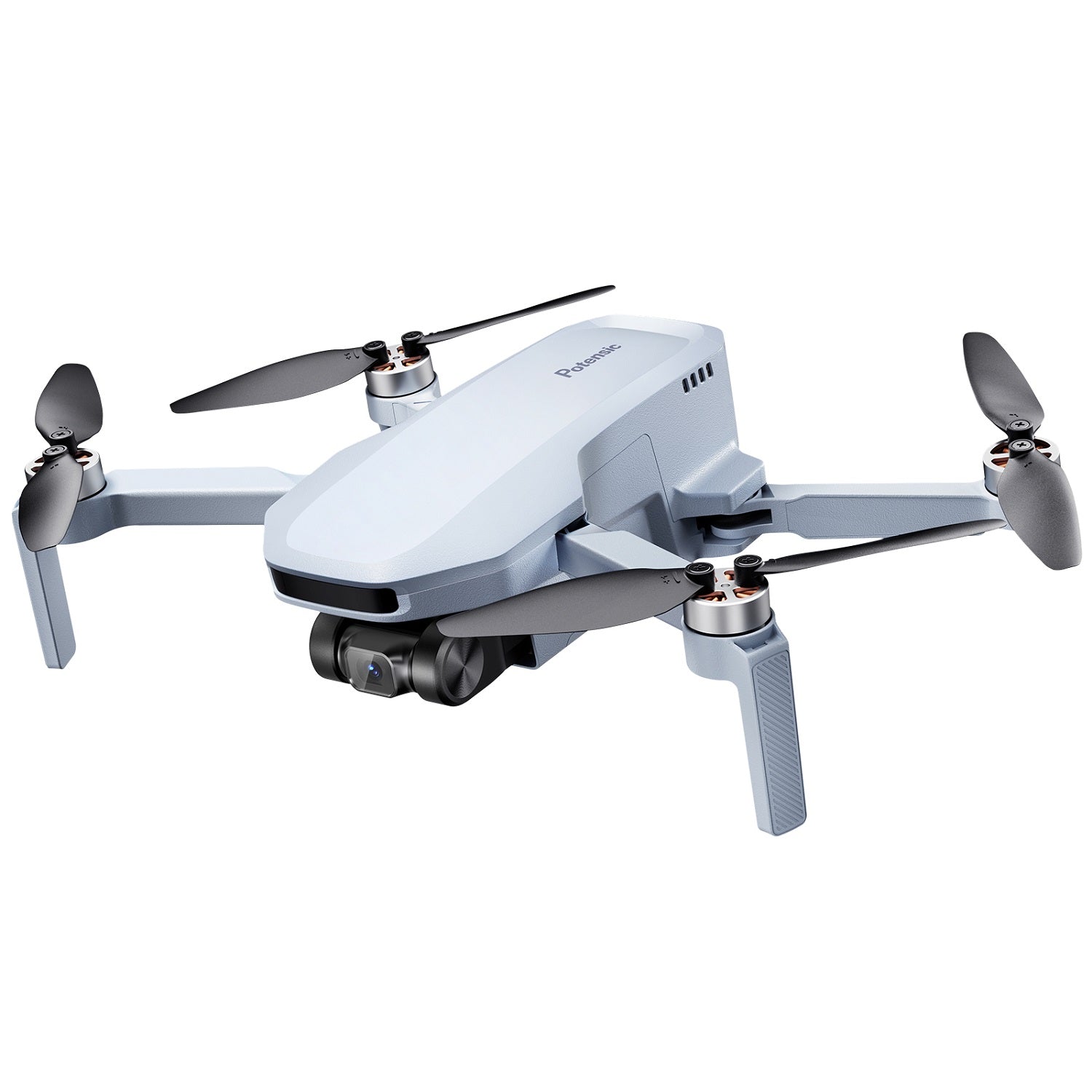
Potensic Atom SE
For beginners who want 4K GPS flying at the lowest honest price
- Launched at about half the Mini 3’s price, with two batteries in the standard kit
- Follow Me, Circle Flight and Waypoint Flight included, which the Mini 3 lacks
- Single-axis gimbal plus EIS, and a smaller sensor, so the camera is the compromise
Check current price and available bundles on Amazon
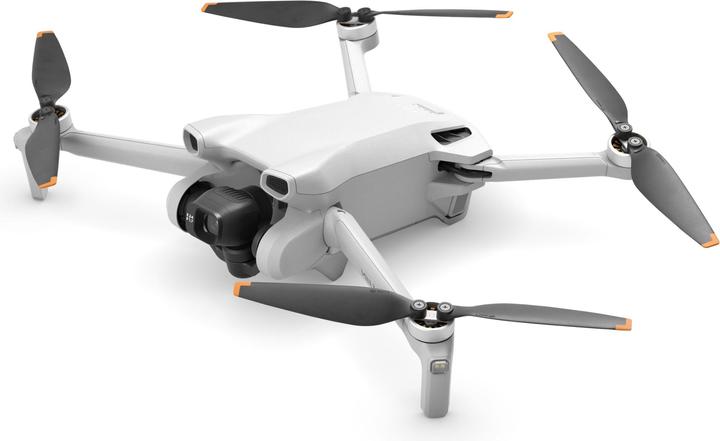
DJI Mini 3
For buyers who want the best sub-250g camera for the money
- Much larger 1/1.3-inch sensor with f/1.7 lens, 3-axis gimbal and true vertical video
- DJI O2 transmission reaches 10 km with a rock-solid 720p live feed
- No subject tracking at all, and it costs roughly twice the Atom SE
Check current price and available bundles on Amazon
Which drone fits your flying?
Start with your main use case. The best choice should solve your needs, without charging you for features you will rarely use.
Most people comparing the potensic atom se vs dji mini 3 are first-time drone buyers with a simple goal: good-looking aerial video without spending a fortune or registering with the aviation authority. Both drones clear the second bar easily, staying under 249 grams, and both shoot 4K. The difference is what happens between the lens and the memory card, and how much of your money stays in your pocket.
The Atom SE is the value play, and it does not hide it. Potensic launched it in early 2023 at $299 for a kit with two batteries, directly undercutting DJI’s entry level. You get GPS positioning, return to home, brushless motors, level 5 wind resistance, and a 4K camera with electronic stabilization, all in a folding airframe a beginner can learn on. Reviewers keep recommending it as the default first drone for adults precisely because the bundle is so complete for the money. Where it gives ground is the camera system: a smaller 1/3-inch sensor and a single-axis gimbal that tilts but does not roll or pan, leaning on electronic stabilization for the rest.
The Mini 3 is the quality play. DJI took the Mini 3 Pro’s excellent 1/1.3-inch camera, kept the f/1.7 lens and the 3-axis gimbal with true vertical shooting, and removed the obstacle sensors and some frame rates to hit $559 with the RC-N1 controller. What remains is, by most reviewers’ judgment, the best camera you can put in the air for the money at this weight. It flies longer, sees farther, and its footage holds up in low light where the Atom SE’s small sensor starts to fall apart. What it does not do is follow you: DJI stripped out subject tracking entirely, so if autonomous follow shots matter to you, the cheaper drone ironically has the smarter software.
One more honest note before the details: neither drone is for everyone. If you need obstacle avoidance, 4K/60fps, or a camera you can grade heavily, you are shopping one tier up, at the Mini 3 Pro or the newer Potensic Atom. But if your budget tops out around $300 to $600 and you want the most drone for it, this is exactly the right comparison, and the answer is closer than the price gap suggests.
Choose Potensic Atom SE if…
- Budget is your main concern, and saving roughly $250 to $300 matters more than squeezing out the last bit of image quality.
- You want Follow Me, Circle Flight or waypoint missions, since the Mini 3 offers none of them.
- You like the idea of two batteries in the standard box, giving you over an hour of rated flight time from day one.
- You can accept a smaller sensor, a single-axis gimbal, and a shorter 4 km transmission range.
Choose DJI Mini 3 if…
- Image quality is your main concern, from low-light video to stills worth printing.
- You want true vertical video for social platforms, shot natively by a rotating gimbal rather than cropped in post.
- You value DJI’s mature app, reliable O2 link, and the strongest resale value in the category.
- You can accept the higher price and the complete absence of subject tracking.
Potensic Atom SE (orange) vs DJI Mini 3 (blue)
Potensic Atom SE vs DJI Mini 3: The Specs That Actually Matter
Compare the exact battery, controller and bundle versions you intend to buy.
| Feature | Potensic Atom SE | DJI Mini 3 |
|---|---|---|
| Best suited to | Budget beginners, casual travel video, first GPS drone | Travel photography and video, creators, social content |
| Takeoff weight | Under 249 g (with battery and propellers) | 248 g (standard battery); about 290 g with Plus battery |
| Dimensions (folded) | 143 x 88 x 58 mm | 148 x 90 x 62 mm |
| Sensor and lens | 1/3-inch Sony CMOS, 12MP, f/2.2, 118-degree FOV | 1/1.3-inch CMOS, 12MP and 48MP modes, f/1.7, 82.1-degree FOV |
| Video modes | 4K/30fps, 2.7K/30fps, 1080p/60fps and 30fps | 4K/30fps HDR, 2.7K/60fps, 1080p/60fps |
| Color and codecs | H.264, up to 50 Mbps; JPG and JPG plus RAW (DNG) stills | H.264, up to 100 Mbps; JPEG and DNG RAW stills |
| Gimbal | Single-axis mechanical (pitch +20 to -90 degrees) plus ShakeVanish EIS | 3-axis mechanical gimbal (tilt, roll, pan) |
| Vertical capture | No native vertical mode; crop the 16:9 frame in post | Native true vertical: gimbal rotates 90 degrees |
| Obstacle sensing | Downward vision and ToF sensors only; no obstacle avoidance | Downward vision only; no obstacle avoidance |
| Subject tracking | Follow Me, Circle Flight, Waypoint Flight (Points of Interest) | None; QuickShots only (Dronie, Helix, Rocket, Circle, Boomerang) |
| Rated flight time | 31 minutes (2500 mAh battery; two included in standard kit) | 38 minutes (2453 mAh); 51 minutes with Plus battery (sold separately) |
| Real-world flight time | Not tested by us; expect mid-20s minutes in mixed real flying | Not tested by us; reviewers report roughly 25 to 30 minutes per session |
| Max speed | 16 m/s in Sport mode | 16 m/s in Sport mode |
| Video transmission | PixSync 2.0, up to 4 km, 720p live view | DJI O2, up to 10 km FCC, 720p/30fps live view |
| Wind resistance | Level 5 | 10.7 m/s (Level 5) |
| GNSS | GPS, GLONASS and BeiDou | GPS, GLONASS and Galileo |
| Internal storage | None; microSD card required (not included) | None; microSD card required (not included) |
| Controller and bundle | Phone-based controller included; standard kit has drone, 2 batteries, bag (launched at $299) | DJI RC-N1 (launched at $559) or DJI RC with built-in screen (launched at $699) |
| Main trade-off | Smaller sensor and single-axis gimbal limit image quality | No subject tracking; roughly twice the price |
Manufacturer ratings are lab figures; real-world flight time is lower. Prices shown are launch prices; check the live Amazon listing for the current price. Last verified: October 20, 2026.
Potensic Atom SE (orange) vs DJI Mini 3 (blue)
Potensic Atom SE vs DJI Mini 3: Five Differences That Matter
For each category, here is the difference, its practical impact and which buyer benefits.
1. Camera quality and creative flexibility
Edge: Mini 3This is the widest gap in the comparison, and it comes down to physics. The Mini 3’s 1/1.3-inch sensor is roughly four times the area of the Atom SE’s 1/3-inch Sony chip, and it sits behind a brighter f/1.7 lens versus the Atom SE’s f/2.2. In daylight both drones shoot pleasant 4K/30fps video, and casual viewers may not spot much difference on a phone screen. But as the light drops, the Mini 3 pulls ahead decisively: its dual native ISO design and chip-level HDR keep shadows clean and highlights intact at dusk, while the Atom SE’s small sensor gets noisy fast. DJI also gives you 48MP stills and DNG RAW on the Mini 3, against 12MP JPG plus RAW on the Atom SE, and the 3-axis gimbal stabilizes tilt, roll and pan mechanically.
The Atom SE answers with ShakeVanish electronic stabilization paired with its single-axis tilt gimbal. It works: reviewers describe the footage as smooth and perfectly usable for social posts and travel memories in good light. The 118-degree field of view is noticeably wider than the Mini 3’s 82.1 degrees, which suits sweeping landscapes. But electronic stabilization crops the frame and cannot fully hide micro-jitter in gusty wind the way a 3-axis gimbal can, and there is no native vertical mode, so TikTok and Reels creators are cropping 16:9 footage. If the camera is the reason you are buying a drone, this category is not close.
2. Flight time and range
Edge: Mini 3On rated flight time the Mini 3 leads 38 minutes to 31, and the gap is real in the air too. Independent reviewers report roughly 25 to 30 minutes of mixed flying from the Mini 3’s 2453 mAh battery, while the Atom SE’s 31-minute lab rating settles into the mid-20s once you are actually maneuvering. The Mini 3 also offers the Plus battery for up to 51 minutes, though it pushes the drone to about 290 g and out of the sub-250g sweet spot, so most buyers should treat 38 minutes as the practical ceiling.
Potensic softens the blow with the bundle: the standard Atom SE kit includes two batteries, so you unbox with 62 rated minutes of flight, against 38 for the base Mini 3. The three-battery Fly More combo stretches that to 93 rated minutes for not much more money. Range is a clearer Mini 3 win. DJI’s O2 system reaches 10 km under FCC rules with a stable 720p feed and strong interference rejection, while the Atom SE’s PixSync 2.0 tops out at 4 km on 2.4 GHz. In practice most beginners never fly beyond a kilometer, but the O2 link’s resistance to breakup around trees and buildings is something you feel on every flight, not just long-range ones.
3. Design and portability
Edge: TieThese are two of the most travel-friendly drones ever made, and there is almost nothing between them. The Atom SE folds to 143 by 88 by 58 mm and weighs under 249 g; the Mini 3 folds to 148 by 90 by 62 mm and weighs 248 g. Both slip into a jacket pocket or a camera bag’s side pouch, both skip FAA registration for recreational use in the US, and both carry the EU C0 class marking that keeps things simple in Europe. Setup is equally quick: unfold the arms, power on, and both are in the air in about a minute.
The differences are in the details. Potensic’s controller is a compact phone-based unit with a retractable holder, while DJI gives you the choice of the RC-N1 (also phone-based) or the DJI RC with a built-in 5.5-inch screen, which is a genuinely nicer experience in bright sunlight and means one less device to charge. Build quality favors DJI slightly; the Mini 3 feels denser and more refined, while the Atom SE is light and plasticky in a way that is honest about its price. Neither drone has obstacle avoidance, so both demand the same careful flying around trees and buildings.
4. Intelligent features and tracking
Edge: Atom SEHere the script flips, and it is the most surprising result in this comparison. The Atom SE ships with Follow Me, Circle Flight and Waypoint Flight (Points of Interest), letting you plot a path or have the drone track you hands-free. They are basic compared to DJI’s tracking on the Pro models, reviewers note the follow logic can be a little rough, but they exist and they work, which is remarkable at this price. Add GPS return to home on signal loss or low battery, a dedicated RTH button, headless mode, and three flight modes from gentle Video to 16 m/s Sport, and the little Potensic is generously equipped.
The Mini 3, by contrast, has no subject tracking whatsoever. DJI removed ActiveTrack to separate it from the Mini 3 Pro, leaving only the five QuickShots automated moves: Dronie, Helix, Rocket, Circle and Boomerang. Those are genuinely useful for solo creators, and the Mini 3 executes them smoothly, but they are pre-programmed camera moves, not tracking. If your dream shot is the drone following you down a trail or orbiting you while you move, the Atom SE can attempt it and the Mini 3 simply cannot. Both drones share the same safety basics otherwise: precise GPS hovering, auto takeoff and landing, and return to home.
5. Price and value of the complete kit
Edge: Atom SECompare what you actually pay to start flying. The Atom SE launched at $299 with the drone, a phone-based controller, two batteries, spare props and a carry bag. That is a complete flying kit for little more than half the Mini 3’s $559 RC-N1 launch price, and Potensic’s street prices have only drifted lower since. The three-battery Fly More combo, with a charging hub and shoulder bag, typically costs less than the base Mini 3 alone. For a beginner who is not sure the hobby will stick, that math is very forgiving.
Beyond the sticker price, think about the cost of ownership. Spare Atom SE batteries are cheap and the standard kit already gives you two, so most buyers never spend another dollar on power. Mini 3 batteries cost more apiece, and the Fly More combo that most enthusiasts end up wanting adds over $150 to the buy-in. On the other hand, DJI Care Refresh is available for the Mini 3 and not for the Atom SE, so a crash costs you less with DJI if you insure it. There is no wrong answer, only different budgets: the Atom SE is the cheapest honest way into 4K GPS flying, and the Mini 3 is the cheapest way into DJI-grade image quality.
Potensic Atom SE vs DJI Mini 3: What You Gain and Give Up
Potensic Atom SE
Reasons to choose it
- Unbeatable price: a complete 4K GPS kit with two batteries for about half the Mini 3’s launch price
- Follow Me, Circle Flight and Waypoint Flight included, features the Mini 3 does not have at all
- Under 249 g and folding, with GPS return to home, brushless motors and level 5 wind resistance
- 12MP stills with RAW (DNG) support and 4K/30fps video that looks great in good light
- Simple, beginner-friendly package that reviewers consistently recommend as a first drone
Reasons to reconsider
- Small 1/3-inch sensor and single-axis gimbal mean noisier low-light footage and visible limits in wind
- 4 km PixSync range and 2.4 GHz-only link are more prone to breakup than DJI’s O2
- No native vertical video mode, so social creators are stuck cropping
- PotensicPro app and support are functional but nowhere near DJI’s polish, and resale value is weak
- 31-minute rating shrinks to the mid-20s in real mixed flying
DJI Mini 3
Reasons to choose it
- Best-in-class budget camera: 1/1.3-inch sensor, f/1.7, 3-axis gimbal, 4K/30fps HDR and true vertical video
- 38 minutes rated flight time, with a 51-minute Plus battery option for long sessions
- DJI O2 transmission to 10 km with a stable, interference-resistant 720p feed
- DJI Fly app, QuickShots, panorama modes and 4x digital zoom make solo creating easy
- Strong resale value and the option of DJI Care Refresh protection
Reasons to reconsider
- No subject tracking of any kind, a strange omission the cheaper Atom SE does not share
- Roughly twice the Atom SE’s price, and the Fly More combos climb past $700
- No obstacle avoidance, so beginners get no safety net around trees and buildings
- 4K tops out at 30fps with no 48 or 60fps option, limiting slow-motion work
- No internal storage, so a microSD card is effectively mandatory
Check the bundle, not just the drone
The drone on the box is only half the purchase. Run through this checklist before you tap buy.
- Controller: The Atom SE’s standard kit includes its phone-based controller, and you will need your phone mounted for every flight. The Mini 3 comes with the RC-N1 (phone required) or the DJI RC with a built-in 5.5-inch screen; the screen version costs more but is worth it if you fly in bright sun or hate cable fiddling.
- Batteries: The Atom SE standard kit already includes two 2500 mAh batteries, which is generous; the Fly More adds a third plus a charging hub. The Mini 3 ships with one 2453 mAh battery, so budget for a spare, and note the Plus battery pushes the drone past 249 g with registration consequences.
- Accessories: Neither drone includes a microSD card, and both need one: get a U3/V30 card, up to 256 GB for the Atom SE and up to 512 GB for the Mini 3. ND filters help both in bright light. A landing pad is cheap insurance for dusty fields.
- Listing: On Amazon, confirm the exact model name, controller and battery count in the listing title. For the Atom SE, check whether you are buying the two-battery standard kit or the three-battery Fly More combo. For the Mini 3, confirm RC-N1 versus DJI RC, since similarly named listings are easy to confuse.
- Local requirements: Both drones stay under 249 g with their standard batteries, which keeps recreational flying free of FAA registration in the US and simple across much of Europe, but airspace rules still apply everywhere. Check your aviation authority’s current requirements before your first flight.
- Price timing: Both drones are discounted regularly. The Atom SE launched at $299 and routinely sells for less; the Mini 3 launched at $559 with the RC-N1 and sees frequent sales too. If the price looks high today, check again in a week.
The right choice comes down to camera versus cash.
Buy the Mini 3 if image quality is the point. Its larger sensor, 3-axis gimbal, true vertical video, longer flight time and rock-solid O2 link make it the better drone in almost every measurable way, and it is the one we would recommend to most people reading this comparison. Buy the Atom SE if the budget is the point. It gets you into 4K GPS flying with two batteries, Follow Me and waypoint flight for roughly half the money, and for casual daylight clips it is honestly hard to argue with. Just know what you are trading: the camera gap is real, and it shows up exactly when the light gets interesting.
Still deciding?
Is the DJI Mini 3 worth twice the price of the Potensic Atom SE?
If you care about image quality, yes. The Mini 3’s 1/1.3-inch sensor, 3-axis gimbal, 4K HDR and true vertical video produce visibly better footage, especially in low light, and it flies longer with a far stronger transmission link. If you mostly want fun flights and casual daylight clips, the Atom SE keeps roughly $250 to $300 in your pocket and you will barely notice the difference on a phone screen.
Which drone is better for beginners?
Both are beginner-friendly, but in different ways. The Atom SE is the lower-risk first purchase: cheaper to replace, two batteries in the box, and simple intelligent modes to play with. The Mini 3 is the easier drone to get good footage from, thanks to its superior stabilization and the polished DJI Fly app. Neither has obstacle avoidance, so both demand careful flying around trees and buildings.
Can the Atom SE shoot vertical video for TikTok and Reels?
Not natively. The Atom SE’s single-axis gimbal tilts from +20 to -90 degrees but does not rotate, so vertical video means cropping the 16:9 frame in post and losing resolution. The Mini 3’s gimbal rotates a full 90 degrees for native vertical 4K, which is a genuine advantage if social platforms are your main outlet.
Which has better subject tracking?
The Atom SE, by default, because it actually has it. Follow Me, Circle Flight and Waypoint Flight come standard on the Atom SE. The Mini 3 has no subject tracking at all, only pre-programmed QuickShots moves. If follow-me shots are a priority, this single feature can decide the whole comparison.
Do I need to register either drone?
With their standard batteries, both drones stay under 249 g, so recreational pilots in the US do not need FAA registration, and rules are similarly light across much of Europe. The Mini 3’s optional Plus battery pushes it to about 290 g, which changes that. Airspace restrictions still apply regardless of weight, so check your national aviation authority’s current rules before flying.
How were these drones compared?
This is a research-based comparison: we compiled specifications from Potensic’s official user manual and DJI’s official spec pages, then cross-checked them against independent reviews from outlets like Space.com, TechRadar, Notebookcheck and Dronios. We did not fly either drone for this article, so rated figures are the manufacturers’ lab numbers and real-world figures are attributed to the reviewers who measured them. See the methodology section below for the full source list.
How this comparison was prepared
This is a research-based comparison. We did not fly either drone for this article, and we do not imply otherwise. Every specification in the table above comes from the manufacturers’ official documentation: the Potensic ATOM SE user manual (single-axis gimbal, Sony 1/3-inch sensor, 4K/30fps video, 31-minute rated flight time, PixSync 2.0 transmission) and DJI’s official Mini 3 specifications page (248 g takeoff weight, 1/1.3-inch sensor, 4K/30fps HDR, 38-minute rated flight time, O2 transmission). Launch pricing was cross-checked against launch coverage from Notebookcheck, TechRadar and FoneArena, and real-world flight time notes are attributed to the reviewers who measured them. Amazon ASINs were verified by matching each ASIN against the exact product title, model number and bundle contents across Amazon-indexed listing data and independent price trackers before any affiliate link was written.
Sources and verification
- Potensic ATOM SE user manual (manuals.plus mirror of official manual, accessed October 2026): single-axis gimbal, camera specs, flight modes, package contents
- Potensic ATOM SE official store page (store.potensic.com, accessed October 2026): product imagery and bundle contents
- DJI Mini 3 official specifications (dji.com, accessed October 2026): weight, dimensions, camera, flight time, transmission and sensing figures
- DJI Mini 3 launch coverage (Notebookcheck, TechRadar, FoneArena, December 2022): launch pricing and bundle configurations
- Space.com Potensic Atom SE review: flight modes, handling notes and beginner assessment
- TechRadar DJI Mini 3 review: real-world assessment, price and feature verdict
- Dronios Potensic ATOM SE review (2026): camera and flight performance analysis
- MyDearDrone Potensic lineup guide: Atom SE positioning and pricing context
- ASIN verification: Atom SE listing (B0BFWS4N4T, standard two-battery kit, model DSDR04B) confirmed via pricehistory.app product record and independent review video description; Mini 3 listing (B0BL3T49JF, DJI RC-N1 bundle, model MT3PD) confirmed via Amazon-indexed listing data, idealo.co.uk review record and shopabunda.com listing mirror
Last verified: October 20, 2026. Bundle availability, pricing, and specifications may vary by region and version. Prices in this article are launch reference prices; check the live Amazon listing for the current price.