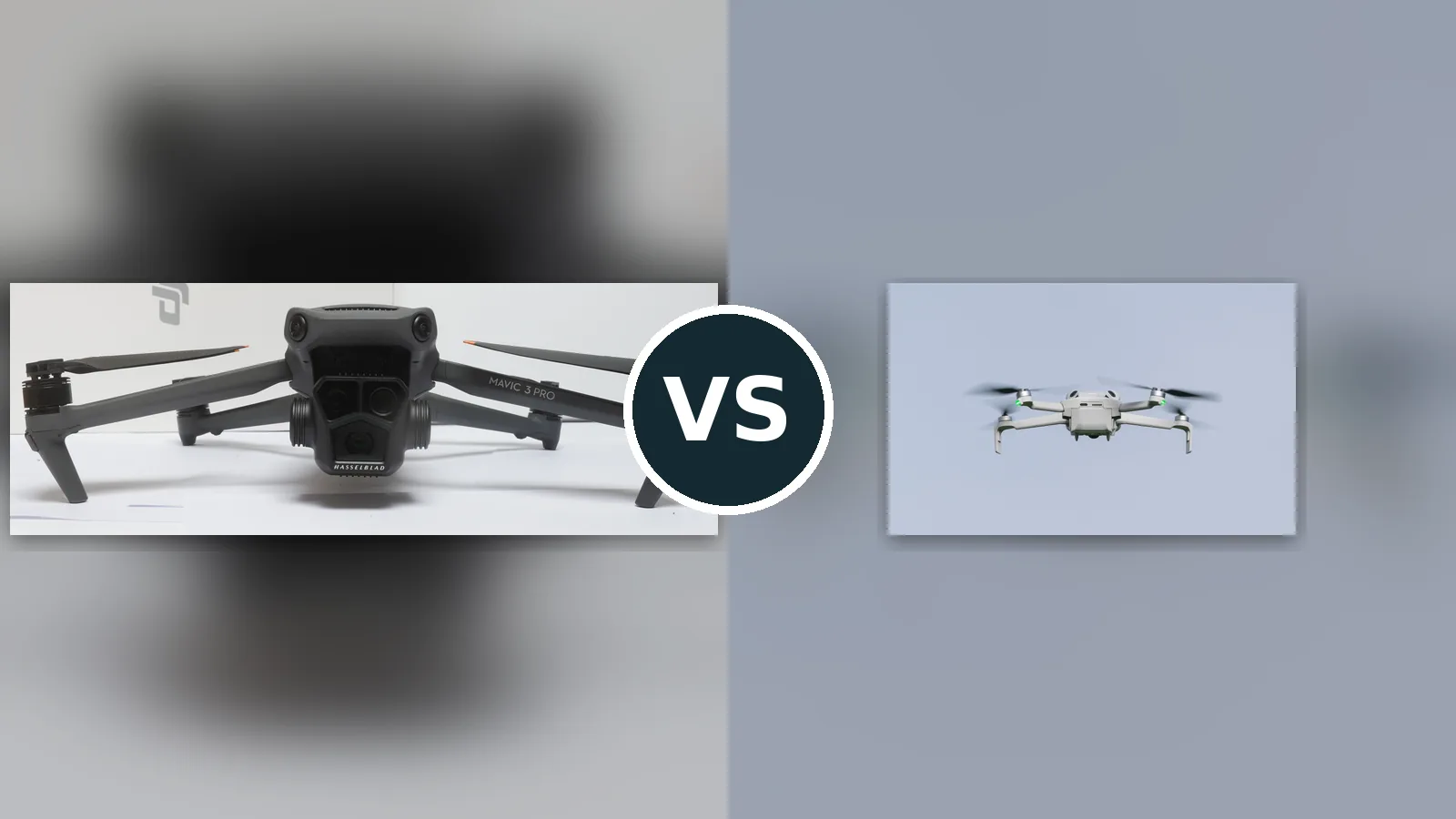
The mavic 3 pro vs mini 4 pro debate is really about how serious your aerial photography ambitions are. The Mavic 3 Pro is DJI’s flagship triple-camera drone: a 958-gram professional tool with a Four Thirds Hasselblad camera, two telephoto lenses, and 43 minutes of rated flight time. The Mini 4 Pro is the king of the sub-250g class: a folding travel companion that shoots 48MP stills and 4K/100fps slow motion, and slips past registration rules in most countries. We compared cameras, flight time, range, sensing, portability, and kit cost, so you can see exactly what the flagship premium buys you.
As an Amazon Associate, we earn from qualifying purchases.
Mavic 3 Pro for pros. Mini 4 Pro for most everyone else.
DJI Mavic 3 Pro wins on image-making: Four Thirds Hasselblad sensor, three focal lengths, 5.1K video, 43-minute flights. DJI Mini 4 Pro wins on value and portability: under 249 g, 48MP stills, native vertical video, a fraction of the price. Camera: Mavic 3 Pro. Flight time: Mavic 3 Pro. Range: Mini 4 Pro. Portability and value: Mini 4 Pro.
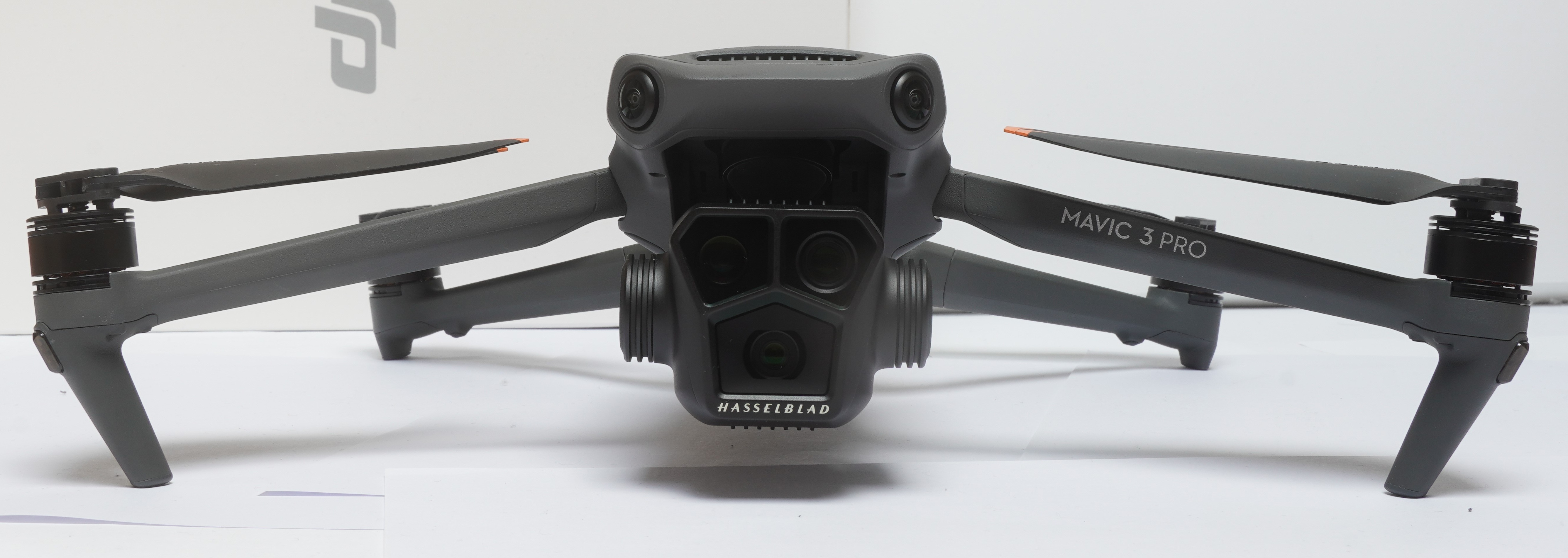
DJI Mavic 3 Pro
For professionals and serious creators who need a triple-camera aerial system
- Three lenses (24mm, 70mm, 166mm) on one gimbal for unmatched framing flexibility
- Four Thirds sensor with 5.1K/50fps, 10-bit D-Log, and up to 12.8 stops of dynamic range
- Nearly four times the takeoff weight and price of the Mini 4 Pro, with registration required
Check current price and available bundles on Amazon
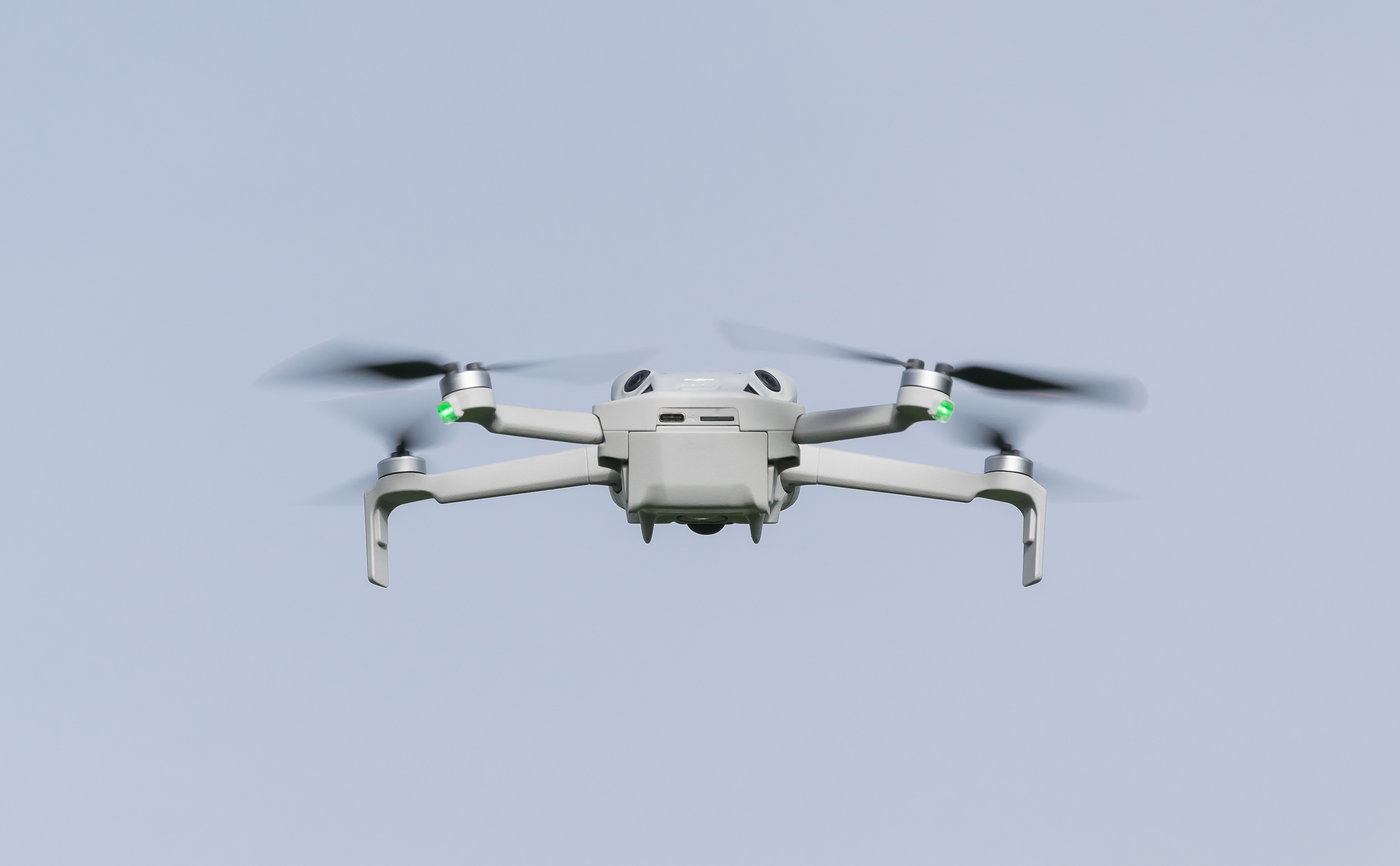
DJI Mini 4 Pro
For travelers and creators who want pro-level footage under 249 grams
- 48MP stills with RAW plus native vertical video from a rotating gimbal
- Omnidirectional sensing and ActiveTrack 360 in a pocket-size folding body
- Single fixed lens and smaller sensor mean less creative reach than the flagship
Check current price and available bundles on Amazon
DJI Mavic 3 Pro (Fly More Combo with DJI RC) · DJI Mini 4 Pro (DJI RC 2 edition)
DJI Mavic 3 Pro: The Triple-Camera Workhorse
Three lenses, one gimbal, and a sensor four times the size of the Mini’s. This is the drone working pros actually fly.
Overview: a flying camera system, not just a drone
When DJI launched the Mavic 3 Pro in April 2023, it did something no consumer drone had done before: it put three cameras with three different focal lengths on a single 3-axis gimbal. The idea was simple and, for working photographers, transformative. Instead of flying closer to change the composition, you switch lenses mid-flight: 24mm wide for the establishing shot, 70mm medium telephoto for the compressed landscape, 166mm telephoto for the detail you cannot safely fly near. Reviewers from TechGearLab to The Drone Girl have called it the best prosumer drone DJI makes.
The trade is size and weight. At 958 grams it flies like a bigger aircraft: steadier in wind, faster at 21 m/s in Sport mode, planted in the air. It folds to 231.1 by 98 by 95.4 mm, so it travels, but in a camera bag, not a jacket pocket. In the US it needs FAA registration, and commercial pilots face full Part 107 requirements.
Camera system: the Four Thirds advantage
The headline camera is the Hasselblad main camera: a Four Thirds CMOS sensor shooting 20MP stills through a 24mm equivalent lens with an adjustable f/2.8 to f/11 aperture. That sensor is roughly four times the area of the Mini 4 Pro’s chip, and it shows in every difficult scene: cleaner shadows, more highlight headroom, better low-light footage, and dynamic range DJI rates at up to 12.8 stops. It records 5.1K at up to 50fps, DCI 4K at up to 120fps, and 1080p at up to 200fps, all in 10-bit D-Log, D-Log M, or HLG. Stills come as 20MP JPEG plus DNG RAW with Hasselblad’s Natural Colour Solution, which needs very little grading to look right.
The two telephoto cameras are where the Mavic 3 Pro pulls away from every drone near its price. The medium telephoto is a 48MP 1/1.3-inch sensor behind a 70mm equivalent f/2.8 lens, a true 3x zoom shooting 4K/60fps. The long telephoto is a 12MP 1/2-inch sensor at 166mm f/3.4, a 7x optical zoom with 28x hybrid reach, also shooting 4K/60fps. A firmware update added 10-bit D-Log M and HLG to the 70mm camera, so it cuts with the main camera in the edit. The one gap: no native vertical video. The gimbal does not rotate 90 degrees, so vertical content means cropping in post.
Flight performance: 43 minutes of confident airtime
DJI rates the Mavic 3 Pro at 43 minutes of flight time and 37 minutes hovering, from a 5,000 mAh battery. Real-world testing lands lower, as always: reviewers report roughly 28 to 35 minutes of mixed flying, still substantially more than the Mini 4 Pro manages. Longer flights mean fewer battery swaps interrupting a shoot and more time waiting for the light. Wind resistance is rated at 12 m/s, a step above the Mini 4 Pro, and the heavier mass holds its line better in gusts. The DJI O3+ transmission reaches 15 km under FCC rules with a 1080p/60fps live feed: shorter on paper than the Mini 4 Pro’s newer O4 link, but a mature connection pros trust. Omnidirectional sensing with eight vision sensors and APAS 5.0 watches every direction while you frame the shot.
Intelligent features, bundles, and honest limits
The Mavic 3 Pro carries DJI’s full pro feature set: ActiveTrack, MasterShots, Hyperlapse, Waypoint Flight, Cruise Control, QuickShots, Panorama, and QuickTransfer at up to 80 MB/s over Wi-Fi 6. It ships with the DJI RC or the DJI RC Pro. At launch it started at $2,199 with the DJI RC, stepping up to $4,799 for the Cine Premium Combo. The honest limits: big, heavy, impossible to fly discreetly, and expensive once you add batteries and filters. The telephoto cameras cannot match the main camera in low light. Buy it for what it is: a professional aerial camera system that happens to fly.
DJI Mini 4 Pro: The Sub-250g Overachiever
Pocket-size body, flagship-grade video modes, and a price thousands below the Mavic 3 Pro. This is the drone most people should buy.
Overview: the whole point is the weight
The DJI Mini 4 Pro, launched in September 2023, exists because of one number: 249 grams. Stay under it with the standard battery, and recreational flying in the US needs no FAA registration, with similarly light-touch rules across much of Europe and the UK. DJI folded flagship ambitions into that limit: a 48MP camera, 4K/100fps slow motion, omnidirectional obstacle sensing, and a 3-axis gimbal that rotates for true vertical video. It folds to 148 by 94 by 64 mm and disappears into a jacket pocket.
That portability changes how often you fly. The Mavic 3 Pro is a production you plan; the Mini 4 Pro is a habit: unfold, power on, airborne in under a minute. For travel and everyday content, that difference in friction matters more than any spec sheet. Reviewers call it the best sub-250g drone ever made.
Camera system: small sensor, big ambition
The Mini 4 Pro’s camera is a 1/1.3-inch CMOS sensor shooting 48MP stills through a 24mm equivalent f/1.7 lens. The bright aperture does real work compensating for the smaller sensor, and the results impress: detailed 48MP RAW (DNG) stills plus JPEG, 4K/60fps HDR video, 4K at up to 100fps, and 1080p at up to 200fps. Color options include 10-bit D-Log M and HLG at up to 150 Mbps, giving the footage real grading latitude.
The standout trick is the rotating gimbal. Unlike the Mavic 3 Pro, the Mini 4 Pro’s gimbal turns 90 degrees to shoot native vertical video at 4K/60fps using the full sensor, not a crop. For anyone publishing to phones, that is a genuine workflow advantage. The honest limits sit where you would expect: the smaller sensor cannot match the Four Thirds chip for dynamic range or low light, there is only one lens so framing comes from where you fly, and top frame rates crop into the sensor. Within those limits, it is remarkable how close this little camera gets to the big one in good light.
Flight performance: 34 minutes and a longer leash than the flagship
DJI rates the Mini 4 Pro at 34 minutes with the standard battery and 45 minutes with the Plus battery; independent testers report roughly 26 to 28 minutes of real mixed flying on the standard pack. The catch with the Plus battery is weight: it pushes the drone past 249 g and erases the regulatory advantage. Here is the surprise of this comparison: the Mini 4 Pro out-ranges the flagship. Its DJI O4 transmission reaches up to 20 km under FCC rules, against the Mavic 3 Pro’s 15 km on O3+. Both fly far beyond visual line of sight, so the number is academic, but it shows how fast DJI’s tech moves. Speed tops out at 16 m/s in Sport mode, wind resistance is rated at 10.7 m/s (Level 5), and omnidirectional sensing with APAS 5.0 gives it the same all-directions protection philosophy as the flagship.
Intelligent features, price, and honest limits
The Mini 4 Pro borrows liberally from the pro playbook: ActiveTrack 360, Waypoint Flight, Cruise Control, and Advanced RTH, a safety net and a film crew in one. The 2 GB of internal storage means a microSD card (up to 512 GB) is effectively mandatory. Pricing is the killer argument: $759 with the RC-N2 controller at launch, $959 with the RC 2 and its built-in 5.5-inch screen. That is the entire buy-in for 48MP RAW stills, 4K slow motion, true vertical video, and omnidirectional sensing. The honest limits: one fixed lens means no telephoto compression, the small sensor shows its limits at dawn and dusk, and the 249-gram airframe gets pushed around in real wind. For most people, most of the time, that deal is worth it.
Mavic 3 Pro vs Mini 4 Pro: The Specs That Actually Matter
Compare the exact battery, controller and bundle versions you intend to buy.
| Feature | DJI Mavic 3 Pro | DJI Mini 4 Pro |
|---|---|---|
| Best suited to | Professional photo and video work, commercial jobs, telephoto shots | Travel, hiking, social content, everyday creators under 249 g |
| Takeoff weight | 958 g (963 g Cine version) | Under 249 g with standard battery; over 249 g with Plus battery |
| Dimensions (folded) | 231.1 x 98 x 95.4 mm | 148 x 94 x 64 mm |
| Sensor and lenses | 4/3 CMOS 20MP 24mm f/2.8-f/11; 1/1.3″ 48MP 70mm f/2.8 (3x); 1/2″ 12MP 166mm f/3.4 (7x) | 1/1.3″ CMOS, 48MP, 24mm f/1.7, 82.1-degree FOV (single lens) |
| Video modes | Wide: 5.1K/50fps, 4K/120fps, FHD/200fps; teles: 4K/60fps | 4K/60fps HDR, 4K/100fps, FHD/200fps |
| Color and codecs | 10-bit D-Log/M/HLG; H.264/H.265; 12.8 stops DR; ProRes on Cine | 10-bit D-Log M/HLG; H.264/H.265; up to 150 Mbps |
| Photo resolution | 20MP (wide), 48MP (medium tele), 12MP (tele); JPEG and DNG RAW on all three | 48MP; JPEG and DNG RAW |
| Vertical capture | Cropped in post; no native vertical mode | Native true vertical: gimbal rotates 90 degrees for 4K/60fps vertical video |
| Gimbal | 3-axis mechanical | 3-axis mechanical, rotates 90 degrees |
| Obstacle sensing | Omnidirectional: eight vision sensors, APAS 5.0 | Omnidirectional with APAS 5.0 |
| Subject tracking | ActiveTrack, MasterShots, Waypoint Flight, Cruise Control, Hyperlapse | ActiveTrack 360, Waypoint Flight, Cruise Control, Advanced RTH |
| Rated flight time | 43 min max; 37 min hovering (5,000 mAh) | 34 min standard; 45 min with Plus battery |
| Real-world flight time | Not tested by us; reviewers report roughly 28 to 35 minutes mixed | Not tested by us; tests report roughly 26 to 28 minutes |
| Max speed | 21 m/s (Sport mode) | 16 m/s (Sport mode); 12 m/s Normal and Cine |
| Video transmission | DJI O3+, up to 15 km FCC, 1080p/60fps live view | DJI O4, up to 20 km FCC, 1080p/60fps live view |
| Wind resistance | 12 m/s | 10.7 m/s (Level 5) |
| Max takeoff altitude | 6,000 m | 4,000 m |
| GNSS | GPS + Galileo + BeiDou | GPS + Galileo + BeiDou |
| Internal storage | 8 GB (1 TB on Cine version), plus microSD up to 512 GB | 2 GB, plus microSD up to 512 GB |
| Controller options | DJI RC (built-in screen) or DJI RC Pro | DJI RC-N2 (phone required) or DJI RC 2 (built-in screen) |
| Launch price (reference) | From $2,199 (DJI RC); $3,889 Fly More (RC Pro); $4,799 Cine | $759 (RC-N2); $959 (DJI RC 2) |
| Main trade-off | Heavy, pricey, needs registration; no native vertical; teles weaker in low light | Single lens, smaller sensor; Plus battery kills the sub-250g edge |
Manufacturer ratings are lab figures; real-world flight time is lower. Prices shown are launch reference prices; check the live Amazon listing for the current price. Last verified: October 20, 2026.
DJI Mavic 3 Pro (Fly More Combo with DJI RC) · DJI Mini 4 Pro (DJI RC 2 edition)
Mavic 3 Pro vs Mini 4 Pro: Five Differences That Decide It
For each category, here is the difference, its practical impact and which buyer benefits.
1. Camera and image quality: Four Thirds versus 1/1.3-inch
Edge: Mavic 3 ProThis is the biggest gap, and it is not close. The Four Thirds sensor has roughly four times the light-gathering area of the Mini 4 Pro’s chip: cleaner shadows, more highlight headroom, better low light, and up to 12.8 stops of dynamic range. The 24mm Hasselblad lens (f/2.8 to f/11) shoots 5.1K/50fps and 20MP RAW stills with 10-bit D-Log, and the two telephoto lenses (70mm 3x and 166mm 7x) offer framing no single-lens drone can fake.
The Mini 4 Pro’s answer is a very good single camera: 48MP stills, 4K/60fps HDR, 4K/100fps slow motion, 10-bit D-Log M, and a bright f/1.7 lens that punches above its sensor size. In bright daylight, casual viewers would struggle to tell the footage apart. Push into golden hour or heavy grading, and the Four Thirds advantage becomes obvious.
2. Flight time and transmission range
Edge: SplitFlight time goes to the flagship. The Mavic 3 Pro’s 43-minute rating beats the Mini 4 Pro’s 34 minutes, and the real-world gap is similar: roughly 28 to 35 minutes against roughly 26 to 28. On a long shoot, that margin means fewer battery swaps and more time waiting for the light. But range goes to the little drone: the Mini 4 Pro’s newer DJI O4 link reaches up to 20 km under FCC rules, against the Mavic 3 Pro’s 15 km on O3+. Both fly far beyond visual line of sight, so the number is academic, but it shows how fast DJI’s tech moves.
3. Design, portability, and the 249-gram line
Edge: Mini 4 ProThe Mini 4 Pro folds to 148 by 94 by 64 mm and stays under 249 g: no FAA registration for recreational US flying, simpler rules in Europe, pocket-size, airborne in under a minute. The Mavic 3 Pro weighs 958 g, needs registration, and travels as a camera bag.
The consequence is how often each drone leaves the house. The Mavic 3 Pro is a production you plan; the Mini 4 Pro is a habit that lives in your daypack. The flagship fights back with wind authority: 12 m/s rated resistance and nearly four times the mass hold its line in gusts that push the little drone around. But for travel convenience and regulatory simplicity, the Mini 4 Pro wins by a mile.
4. Intelligent features and ease of use
Edge: TieThe overlap here is striking. Both drones have omnidirectional obstacle sensing with APAS 5.0, ActiveTrack subject tracking, Waypoint Flight, Cruise Control, Hyperlapse, and QuickShots. The Mini 4 Pro even gets ActiveTrack 360, tracking from any angle you choose. For a beginner, either drone forgives the mistakes that used to end in a tree.
The difference is emphasis. The Mavic 3 Pro leans professional: MasterShots, 10-bit color across cameras, QuickTransfer at 80 MB/s, and a Cine version with 1 TB and Apple ProRes. The Mini 4 Pro packages the same autonomy in a drone that costs a third as much. Neither is crash-proof, and both demand respect for airspace rules.
5. Price and value of the complete kit
Edge: Mini 4 ProThe Mini 4 Pro launched at $759 with the RC-N2 and $959 with the RC 2. The Mavic 3 Pro launched at $2,199 with the DJI RC, $3,889 for the Fly More Combo with the RC Pro, and $4,799 for the Cine. Kitted out, the flagship costs three to four times the Mini.
Value is price against what you get. The Mavic 3 Pro earns its premium if you need the Four Thirds sensor, the triple lenses, and the 43-minute flights; for commercial work those pay for themselves. If you do not specifically need them, you are paying thousands for performance you will rarely use. The Mini 4 Pro gives you most of the practical image quality, all of the intelligent features, and better portability for roughly a third of the money.
Which Drone Fits Your Flying?
Start with your main use case. The best choice should solve your needs, without charging you for features you will rarely use.
Most people comparing the mavic 3 pro vs mini 4 pro are choosing between two philosophies. The Mavic 3 Pro says the camera is everything: biggest sensor, most lenses, longest flight time, and accept the weight, price, and paperwork. The Mini 4 Pro says the drone you actually fly is everything: light, simple, affordable.
Here is the honest test. If you earn money from your footage, shoot in difficult light, or need telephoto compression, the Mavic 3 Pro’s advantages show up in your deliverables. If you shoot for fun, travel, or social media, the Mini 4 Pro gives you nearly everything you will use, in a package you will actually take everywhere.
Choose DJI Mavic 3 Pro if…
- Image quality is the job. You shoot professionally, grade your footage, or print stills large, and the Four Thirds sensor earns its keep.
- You need telephoto reach: the 70mm and 166mm lenses give you shots no single-lens drone can get.
- You fly long missions and want 43-minute rated endurance plus real wind authority.
- You can accept 958 g, FAA registration, a bigger bag, and a professional price tag.
Choose DJI Mini 4 Pro if…
- Portability is the priority. You want a drone that lives in your daypack and flies on every trip, hike, and outing.
- You shoot vertical video for social: the rotating gimbal gives you native 4K/60 vertical with no crop.
- You want sub-250g freedom: no FAA registration for recreational US flying, simpler rules abroad.
- You can accept one lens, a smaller sensor, and less wind authority in exchange for a third of the price.
Mavic 3 Pro vs Mini 4 Pro: What You Gain and Give Up
DJI Mavic 3 Pro
Reasons to choose it
- Four Thirds Hasselblad sensor with 5.1K/50fps and 10-bit D-Log for genuinely professional image quality
- Three focal lengths on one gimbal (24mm, 70mm, 166mm) for framing flexibility no single-lens drone can match
- 43-minute rated flight time and 12 m/s wind resistance for long, confident missions
- Omnidirectional sensing with APAS 5.0, 8 GB internal storage, MasterShots, and QuickTransfer
- Cine version available with 1 TB SSD and Apple ProRes for production workflows
Reasons to reconsider
- 958 g means FAA registration and a drone you cannot fly discreetly
- Professional pricing: thousands more than the Mini 4 Pro with Fly More accessories
- No native vertical video; the gimbal does not rotate, so vertical means cropping in post
- Telephoto cameras cannot match the main camera in low light, so the smaller sensors show their limits at dusk
- O3+ transmission tops out at 15 km, technically shorter than the Mini 4 Pro’s newer O4 link
DJI Mini 4 Pro
Reasons to choose it
- Under 249 g: pocket-size, no FAA registration for recreational flying, simple rules in most countries
- Excellent single camera: 48MP RAW stills, 4K/60fps HDR, 4K/100fps, 10-bit D-Log M at f/1.7
- Native vertical video: the gimbal rotates 90 degrees for true 4K/60 vertical with no crop
- Omnidirectional sensing with APAS 5.0 and ActiveTrack 360 at a fraction of the flagship’s price
- DJI O4 transmission reaches 20 km FCC, longer on paper than the Mavic 3 Pro’s O3+ link
Reasons to reconsider
- Single fixed lens: no telephoto compression; framing comes from where you fly
- Smaller sensor cannot match the Four Thirds chip for dynamic range or low light
- 249-gram airframe gets pushed around in real wind; physics favors the heavier drone
- The Plus battery pushes it past 249 g, erasing the regulatory advantage
- Top frame rates crop into the sensor, and 2 GB of internal storage makes a microSD card mandatory
Check the bundle, not just the drone
The drone on the box is only half the purchase. Run through this checklist before you tap buy.
- Controller: The Mavic 3 Pro ships with the DJI RC (5.5-inch built-in screen) or the brighter DJI RC Pro. The Mini 4 Pro comes with the RC-N2 (bring your phone) or the RC 2 with a built-in screen, worth it if you hate cables.
- Batteries: One battery is never enough. The Mavic 3 Pro Fly More Combo’s three batteries and 100W hub suit real shooting days. For the Mini 4 Pro, two to three standard batteries cover most outings; the Plus battery pushes it past 249 g.
- Accessories: A fast microSD card (U3/V30, up to 512 GB) is essential, especially for the Mini 4 Pro with 2 GB internal. ND filters help both in bright light; the Mavic 3 Pro Fly More Combo includes a set.
- Listing: On Amazon, confirm the exact model, controller, and battery count in the title, and check the seller’s return terms. Similarly named combos are easy to confuse.
- Local requirements: Check your aviation authority’s current rules. The 958 g Mavic 3 Pro needs FAA registration in the US; the sub-249g Mini 4 Pro simplifies recreational rules, but airspace restrictions still apply.
- Price timing: Both drones see regular discounts. If the price looks high today, check again in a week; launch prices here are reference points.
The right choice comes down to camera versus convenience.
If you need the best aerial camera DJI makes short of a cinema rig, buy the Mavic 3 Pro. Its Four Thirds Hasselblad sensor, triple lenses, and 43-minute flights justify every gram and every dollar for working photographers. If you want the most drone for the least money and hassle, buy the Mini 4 Pro: 48MP stills, true vertical video, sub-249g freedom, and roughly a third of the flagship’s price. Choose the camera you need, not the camera you admire.
Still deciding?
Is the Mavic 3 Pro worth the extra money over the Mini 4 Pro?
For professional work, difficult light, telephoto shots, or large prints, the Four Thirds sensor and triple lenses deliver results the Mini cannot match, and the premium pays for itself. For travel and everyday flying in good light, the Mini 4 Pro gets you most of the practical quality for roughly a third of the price.
Which drone is better for travel?
The Mini 4 Pro, comfortably. It folds to pocket size, weighs under 249 g, and its gimbal rotates for native vertical video. The Mavic 3 Pro travels as professional equipment: bigger bag, more batteries, more planning.
Can the Mini 4 Pro match the Mavic 3 Pro’s camera?
In bright daylight, surprisingly close. The gap opens in difficult conditions: the Four Thirds sensor captures cleaner shadows and better low-light footage, and the two telephoto lenses offer framing the Mini 4 Pro does not have. One lens versus three is the fundamental difference.
Which bundle should I buy for each drone?
For the Mavic 3 Pro, the Fly More Combo with the DJI RC is the sensible start: three batteries, the 100W hub, ND filters, and a bag. For the Mini 4 Pro, the RC-N2 version is the value pick; the RC 2 with its built-in screen suits bright-sunlight flying. Fly More combos pay off if you fly weekly.
Do I need to register the Mavic 3 Pro or the Mini 4 Pro?
In the United States, recreational drones under 250 g, like the Mini 4 Pro with its standard battery, do not require FAA registration, while the 958 g Mavic 3 Pro does. Commercial use requires Part 107 either way. Rules differ by country, so check your aviation authority before your first flight.
How were these drones compared?
This is a research-based comparison: we compiled specifications from DJI’s official spec pages and launch announcements, then cross-checked them against independent reviews. We did not fly either drone; rated figures are DJI’s lab numbers and real-world figures are attributed to the reviewers who measured them.
How this comparison was prepared
This is a research-based comparison. We did not fly either drone for this article. Every specification comes from DJI’s official documentation, with launch pricing cross-checked against DJI’s newsroom announcements. Real-world flight times are attributed to independent reviewers: roughly 28 to 35 minutes for the Mavic 3 Pro and 26 to 28 for the Mini 4 Pro. ASINs were verified against the live Amazon listing titles: Mavic 3 Pro Fly More Combo with DJI RC (B0BV21WGH6) and Mini 4 Pro with DJI RC 2 (B0CFF1SJ3P).
Sources and verification
- DJI Mavic 3 Pro official specifications (dji.com, October 20, 2026): aircraft, camera, sensing, transmission, battery
- DJI Mini 4 Pro official specifications (dji.com support, October 20, 2026): weight, camera, flight time, sensing
- DJI Mavic 3 Pro launch coverage (DJI newsroom, April 2023): pricing and bundle contents
- DJI Mini 4 Pro product page (dji.com, October 20, 2026): features and bundle pricing
- TechGearLab DJI Mavic 3 Pro review: measured takeoff weight (937 g) and scoring
- The Drone Girl Mavic 3 Pro review: real-world flight time and pricing
- B and H Photo and Adorama Mavic 3 Pro listings: specification cross-check (weight, sensors, video modes)
- Amazon.com live listing, Mavic 3 Pro Fly More Combo with DJI RC (B0BV21WGH6): title, model, ASIN confirmed October 20, 2026
- Mini 4 Pro listing (B0CFF1SJ3P, DJI RC 2 edition) confirmed against Amazon-indexed title and model data
Last verified: October 20, 2026. Bundle availability, pricing, and specifications may vary by region and version. Prices in this article are launch reference prices; check the live Amazon listing for the current price.