

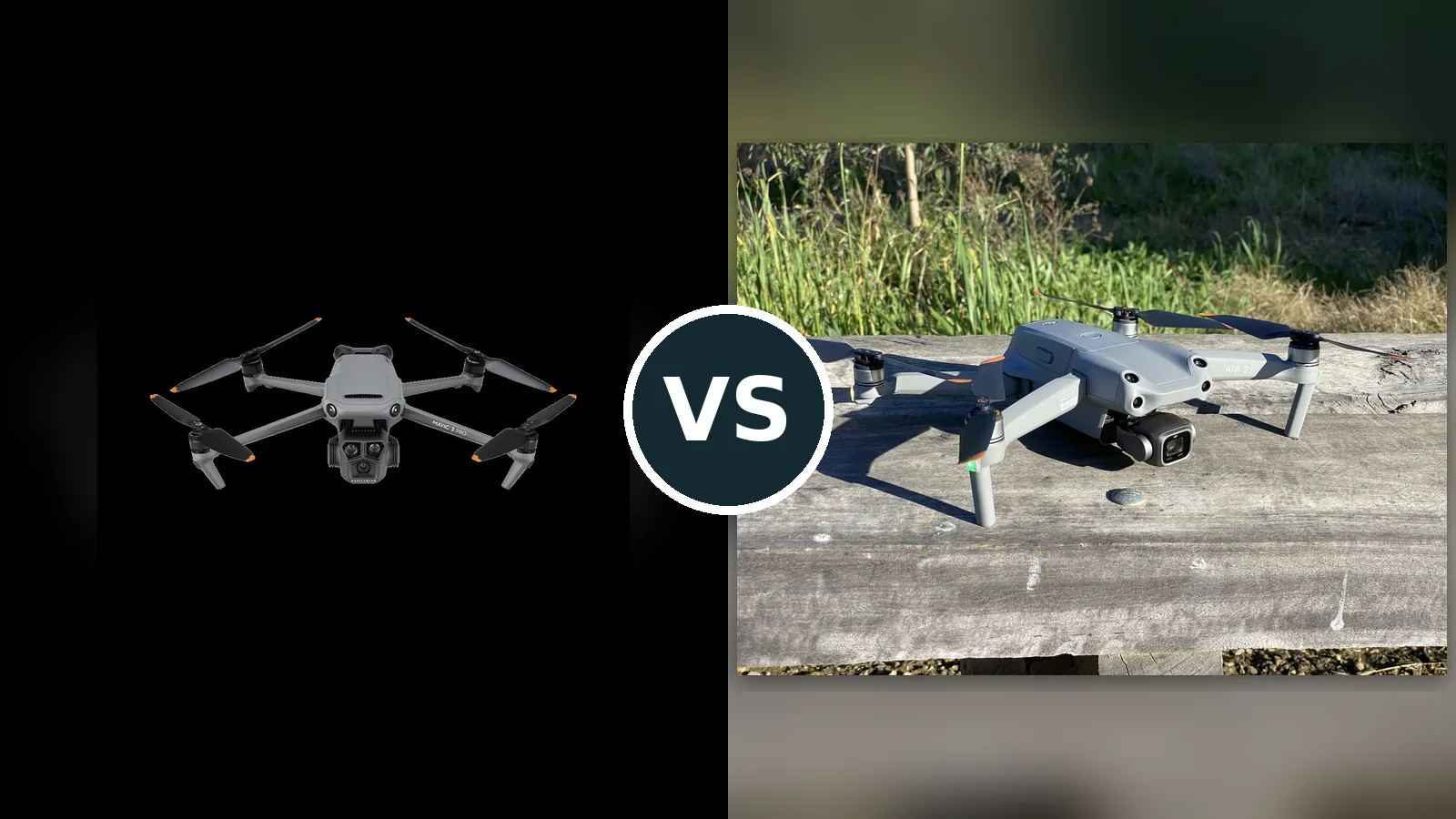
The dji mavic 3 pro vs air 2s matchup pits DJI’s triple-camera flagship against the lightweight 1-inch favorite that half the drone world already owns. The Mavic 3 Pro brings a 4/3-inch Hasselblad camera with an adjustable aperture, a 70mm medium telephoto and a 166mm telephoto with 7x optical zoom, 43 minutes of rated flight time and omnidirectional sensing, all in a 958 g professional airframe. The Air 2S counters with the oldest trick in its book: it weighs just 595 g, folds smaller, costs far less, and its single 1-inch camera still shoots 5.4K video that clients happily accept. So the question is not which drone is better in the abstract. The Pro wins that argument on capability. The real question is whether your work needs three cameras and flagship endurance, or whether the lighter, simpler drone does everything you ask of it. We compared the camera systems, flight hardware, sensing, portability and total kit value to help you decide.
Affiliate disclosure: As an Amazon Associate I earn from qualifying purchases. This page contains affiliate links. If you buy through them, we may earn a commission.
Pro for professional work. Air 2S for everyone lighter.
DJI Mavic 3 Pro is the pick for paid work and serious creators: a bigger 4/3-inch Hasselblad sensor, three focal lengths from 24mm to 166mm, adjustable aperture, 43-minute rated flights and omnidirectional sensing with APAS 5.0. DJI Air 2S is the pick for travelers, hobbyists and careful budgets: nearly the same real-world image quality in good light from its 1-inch sensor, at 595 g and a fraction of the kit weight and cost. Camera range: Pro, clearly. Portability and value: Air 2S, clearly.
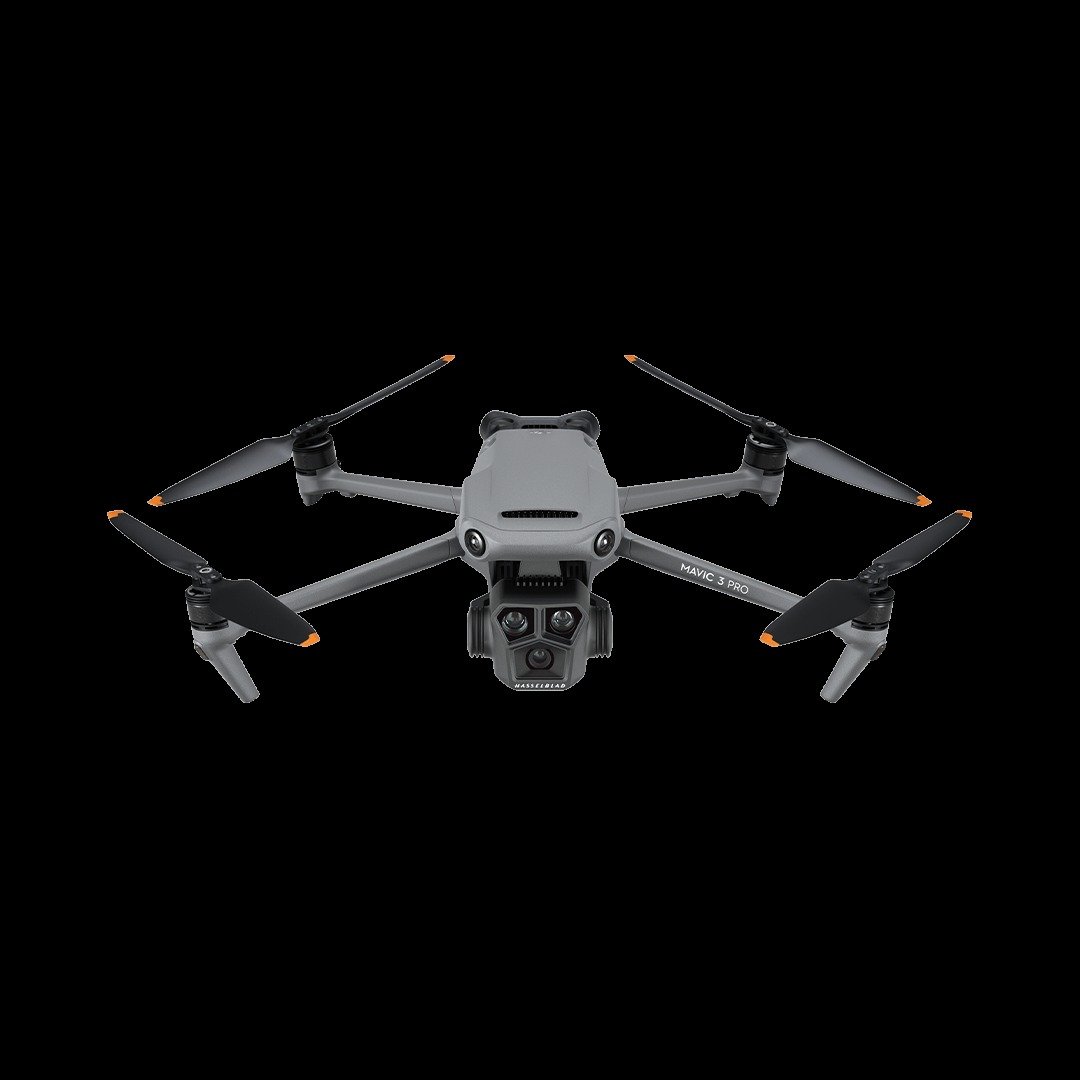
DJI Mavic 3 Pro
For professionals and serious creators who want three cameras and flagship flight performance
- Three cameras: 24mm Hasselblad wide, 70mm medium tele and 166mm tele with 7x optical zoom
- Adjustable f/2.8 to f/11 aperture, 5.1K video and 10-bit D-Log M across all cameras
- Heavy at 958 g and priced like the professional tool it is
Check current price and available bundles on Amazon

DJI Air 2S
For travelers and hobbyists who want a proven 1-inch camera in the lightest serious package
- 1-inch 20MP sensor with 5.4K/30fps video and 10-bit D-Log M color
- 363 g lighter than the Pro, with a smaller kit and a much friendlier price
- Single camera, four-directional sensing and 31-minute rated flights
Check current price and available bundles on Amazon
Which drone fits your flying?
Start with your main use case. The best choice should solve your needs, without charging you for features you will rarely use.
Start by being honest about what your footage is for. The Mavic 3 Pro was built for people whose drone footage earns money or anchors a serious body of work: wedding and event filmmakers who need a 70mm look without repositioning, real estate and inspection pilots who read details from a safe distance, landscape photographers who want an adjustable aperture and the cleanest files DJI sells in a folding drone. Its three cameras are not decoration. Each one covers shots the others cannot, and switching between them mid-flight, without landing, changes how a whole shoot flows.
The Air 2S was built for a different pilot, and it serves that pilot extremely well. If you hike to your locations, shoot for yourself and your channels, and deliver in 4K, the Air 2S gives you a 1-inch sensor, honest 10-bit color and a package so light you forget it is in the bag until the light turns good. Most viewers, on most screens, will never see the difference between its footage and the Pro’s wide camera in daylight. The differences show up at the edges: dusk, distance, and demanding color work. If your flying rarely visits those edges, the Pro’s advantages stay theoretical while its weight and price stay very real.
Budget deserves a plain word here, because the gap is not small. A Mavic 3 Pro kit with spare batteries costs multiples of a good Air 2S kit, and that difference can fund a season of travel, a better editor, or the second drone you keep as a backup. Professionals recover the Pro’s price in a handful of jobs, which flips the math completely. Hobbyists recover it never, which does not make the Pro a bad purchase, just one that should be bought for love of the craft with eyes open. Neither drone embarrasses its owner. They are simply aimed at different definitions of enough.
There is also the question of what sits around the drone. Air 2S owners stepping up will find their old batteries and some accessories stay behind, because the Mavic line uses its own larger packs, hubs and controllers. First-time flagship buyers skip that sunk cost. And pilots who already own Mavic 3 series batteries or a compatible controller will find the Pro slots into their kit in a way the Air 2S never could. Ecosystem gravity is real, and it pulls in both directions depending on where you stand today.
Workflow separates them too. The Pro grades beautifully across all three cameras because every one of them records 10-bit D-Log M, so a sequence that cuts from 24mm to 70mm to 166mm keeps one consistent color pipeline in the edit. The Air 2S grades well from its single camera, and its 5.4K files downscale into crisp 4K timelines, but any tighter framing is a crop, not a lens. Creators who publish vertical cuts should also note the practical difference: cropping a detailed telephoto frame for social formats keeps far more quality than cropping a wide shot, which quietly favors the Pro for modern mixed-format work.
Choose DJI Mavic 3 Pro if…
- Paid or serious creative work is your main use, and clients or your own standards demand the best files.
- You need real telephoto reach: a 70mm medium tele and a 166mm tele with 7x optical zoom.
- You shoot in mixed light and want an adjustable aperture plus the dynamic range of a 4/3-inch sensor.
- You can accept a 958 g airframe, a bigger bag and a professional-level budget.
Choose DJI Air 2S if…
- Light travel is your main concern, and 595 g with a compact fold wins hikes and carry-ons.
- You shoot wide landscapes, travel and real estate where a single 24mm camera does the work.
- You want 5.4K video headroom and 10-bit color without flagship pricing.
- You can accept four-directional sensing, one fixed focal length and 31-minute rated flights.
The specs that actually matter
Compare the exact battery, controller and bundle versions you intend to buy. Figures below come from DJI’s official specification pages for both models.
| Feature | DJI Mavic 3 Pro | DJI Air 2S |
|---|---|---|
| Best suited to | Professional aerial photo and video work across three focal lengths | Travel, landscape and hobbyist shooting with a light 1-inch camera |
| Takeoff weight | 958 g | 595 g |
| Camera sensor | Wide: 4/3-inch CMOS Hasselblad, 20MP. Medium tele: 1/1.3-inch CMOS, 48MP. Tele: 1/2-inch CMOS, 12MP | 1-inch CMOS, 20MP (single camera) |
| Lenses | 24mm equiv. f/2.8 to f/11 adjustable; 70mm equiv. medium tele; 166mm equiv. tele, 7x optical zoom, 28x hybrid zoom | 24mm equivalent, f/2.8 fixed aperture |
| Photo modes | 20MP wide, 48MP medium tele and 12MP tele stills, JPEG and DNG RAW | 20MP stills, JPEG and DNG RAW |
| Video modes | Wide: 5.1K/50fps and 4K/120fps. Medium tele: 4K/60fps. Tele: 4K/60fps | 5.4K/30fps, 4K/60fps, 1080p/120fps slow motion |
| Color and codecs | 10-bit D-Log M on all three cameras, HLG, H.264 and H.265 | 10-bit D-Log M and HLG, H.264 and H.265 |
| Obstacle sensing | Omnidirectional binocular vision sensing with APAS 5.0 | Four-directional: forward, backward, upward and downward vision sensing, APAS 4.0 |
| Tracking and intelligent modes | ActiveTrack 5.0, MasterShots, Waypoint Flight, QuickShots, Hyperlapse | FocusTrack (ActiveTrack, Spotlight, Point of Interest), MasterShots, QuickShots, Hyperlapse |
| Rated flight time | 43 minutes maximum | 31 minutes maximum |
| Video transmission | DJI O3+, up to 15 km, 1080p live view | DJI O3 (OcuSync 3.0), up to 12 km, 1080p live view |
| Max speed | 21 m/s in Sport mode | 19 m/s in Sport mode |
| Wind resistance | 12 m/s class performance per DJI specifications | Level 5 class performance per DJI guidance |
| Battery | 5000 mAh, 77 Wh Intelligent Flight Battery | 3500 mAh, 40.42 Wh Intelligent Flight Battery |
| Internal storage | 8 GB on this standard model | 8 GB |
| GNSS | GPS, Galileo and BeiDou | GPS, GLONASS and Galileo class positioning per launch documentation |
| Main trade-off | Weight, size and flagship pricing | Single camera, side blind spots in sensing and shorter flights |
Manufacturer flight times are measured in controlled conditions. Expect less in wind, cold weather and aggressive flying, on both drones. The Mavic 3 Pro figures here are for the standard model with 8 GB storage, not the Cine variant.
Five differences worth paying attention to
For each category, we explain the difference, its practical impact and which buyer benefits.
1. Camera system: three lenses and a bigger sensor vs one proven lens
Edge: Mavic 3 ProThis is the heart of the comparison, and the Pro wins it on two fronts at once. Its main camera uses a 4/3-inch Hasselblad sensor, physically larger than the Air 2S 1-inch sensor, with 20MP stills, 5.1K/50fps video, 4K/120fps slow motion and an adjustable aperture running from f/2.8 to f/11. That aperture ring matters more than it sounds: you can hold a cinematic shutter speed in bright light without stacking ND filters for every small change, and the bigger sensor holds cleaner shadows and gentler highlight rolloff when the light turns difficult. The Hasselblad color science, tuned for natural skin tones and skies, is the other quiet advantage professionals cite.
Then there are the two cameras the Air 2S simply does not have. The 70mm medium telephoto, on a 1/1.3-inch 48MP sensor recording 4K/60fps, is the portrait lens of the sky: it flattens landscapes into layers, isolates subjects without hovering over them, and produces parallax-rich video passes that a wide camera cannot fake. The 166mm telephoto, on a 1/2-inch 12MP sensor with 7x optical zoom and 28x hybrid zoom at 4K/60fps, handles scouting, wildlife at a respectful distance and detail shots from a safe standoff. The Air 2S counters with one honest argument: its 5.4K/30fps mode oversamples beautifully and gives editors cropping room. It is a good argument. It is still one lens against three.
One more practical note for stills shooters: the Pro wide camera and medium tele both offer high-resolution modes that reward careful tripod-style aerial work, with files that print large and crop gracefully. The Air 2S 20MP stills print well at moderate sizes and look superb on screen, which covers most real needs. The gap is real but it lives at the extremes of print size, cropping and darkness, and honest buyers will recognize whether their work actually visits those extremes.
2. Portability: the Air 2S is in another weight class
Edge: Air 2SNumbers first, because they are stark. The Mavic 3 Pro takes off at 958 g. The Air 2S takes off at 595 g. That 363 g difference grows once you build the real kits: the Pro’s larger 77 Wh batteries, bigger controller and bulkier case turn a daypack load into a dedicated camera bag decision, while the Air 2S kit slips into a small sling with room left for lunch. For travel photographers, hikers, cyclists and anyone who earns their locations on foot, this category is not a footnote. It is the whole ballgame.
Both drones fold, both set up in about a minute, and both exceed the sub-250 g class, so neither escapes registration and standard operating rules in most countries. Where the Pro claws ground back is presence in the air: its mass and motors hold position in gusts that shove the lighter drone around, and gimbal footage stays calmer at the long end of a windy ridge. Think of the trade plainly. The Air 2S is easier to bring. The Pro is steadier once it is up. Your locations decide which virtue you feel more often.
There is a subtler portability point hiding in the charging drawer. Air 2S batteries are smaller and lighter, so a three-pack travel set adds little bulk, and spares are easy to tuck into odd corners of a bag. Pro batteries are substantial units that organize a bag around themselves. Neither fact should decide the purchase alone, but together with the airframe weights they explain why Air 2S owners describe their kit as grab-and-go and Pro owners describe theirs as load-out.
3. Flight time, range and transmission: flagship endurance
Edge: Mavic 3 ProThe Pro is rated at 43 minutes per battery against the Air 2S at 31 minutes, and the real-world gap follows the rated one. Twelve extra minutes per pack changes how a shoot breathes: longer golden-hour windows, fewer forced landings mid-sequence, and location coverage that takes two Air 2S batteries handled by one Pro battery with time to spare. The Pro’s 5000 mAh, 77 Wh pack is the physical reason, and its charging ecosystem is built for rotation work, with hubs that keep a professional’s set cycling through a shoot day.
Transmission tells a similar flagship story. The Pro uses DJI O3+, rated to 15 km with a high-quality 1080p live feed, while the Air 2S uses O3, rated to 12 km. Legal flight stays within visual line of sight, so read those numbers as link-quality headroom: the Pro feed holds up better around structures, terrain and radio-busy environments, which is exactly where professional work tends to happen. Add the Pro’s 21 m/s Sport mode pace against 19 m/s, and the flagship simply covers ground faster and stays connected harder while doing it.
Endurance also shapes confidence in small ways that add up. With 43 rated minutes, a Pro pilot waits for the better light instead of racing the battery clock, repositions for a second angle without landing, and still comes home with reserve. With 31 rated minutes, an Air 2S pilot plans tighter, shoots the plan, and swaps. Both workflows produce good footage. Only one of them regularly produces the extra take you did not know you needed.
4. Sensing and tracking: omnidirectional vs four-directional
Edge: Mavic 3 ProThe Air 2S watches four directions: forward, backward, upward and downward. Its sides are unguarded, which every Air 2S owner learns to respect during sideways moves and orbits. APAS 4.0 steers around what the drone can see, and in good light it does so capably, but the geometry of the blind spots never changes. The Mavic 3 Pro watches every direction with omnidirectional binocular vision sensing, and APAS 5.0 uses that full picture to route around obstacles more smoothly and with fewer dead stops.
Tracking widens the gap in daily use. ActiveTrack 5.0 on the Pro locks subjects with more tenacity through clutter and reframing challenges, and the Pro adds Waypoint Flight for repeatable, planned routes, the kind of feature inspection and cinematography work leans on heavily. The Air 2S FocusTrack suite covers the classic moves well: follow, spotlight and point of interest, all perfectly serviceable for vehicles, boats and people in open spaces. The difference is not that the Air 2S feels unsafe or incapable. It is that the Pro gives a working pilot more margin in tighter, busier places, and margin is what professionals actually buy.
Neither system excuses careless flying, and both manufacturers say so in their own manuals. Vision sensing struggles with thin branches, wires, glass and mirror-calm water on any drone, flagship included. The Pro advantage is coverage and processing, not magic: it sees more directions and reacts with more information. Treat the Air 2S four-direction system with respect and it will return the favor. Treat the Pro system as invincible and it will eventually correct that impression at your expense.
5. Value of the complete kit: flagship money vs the people’s 1-inch drone
Edge: Depends on the buyerLet us talk about total cost honestly, because the drone body is only the opening line. A working Pro kit means the aircraft, several 77 Wh batteries, a charging hub, ND filters for three cameras, a bag that fits it all, and usually a screen controller. That stack costs several times a complete Air 2S kit, whose batteries, filters and cases trade at friendly prices in a deep, mature accessory market. For a professional, the Pro stack is a business asset that pays for itself across a season of jobs, and its three-in-one camera system replaces what once took multiple drones to cover.
For a hobbyist, the same stack is a luxury, and the Air 2S is the rational hero of this comparison: flagship-adjacent image quality, honest flight manners and a total outlay that leaves money for the trips that make drone footage interesting in the first place. One more angle matters, and it is longevity. The Pro sits on DJI’s flagship Mavic platform, with broad controller compatibility and an accessory ecosystem built for working pilots, while the Air 2S ecosystem is older and slowly thinning. Buy the Air 2S for value today. Buy the Pro for capability across years.
Ownership costs continue after checkout, too. Pro batteries and propellers cost more per unit, and a flagship attracts flagship insurance and care-plan pricing. Air 2S running costs stay gentle across the board. Over a three-year horizon the gap between the two ownership experiences is larger than the sticker gap suggests, which is worth modeling if the drone is a hobby. If the drone is a business, model the revenue side instead, where the Pro’s extra deliverables usually close the argument quickly.
What you gain. What you give up.
DJI Mavic 3 Pro
Reasons to choose it
- 4/3-inch Hasselblad camera with adjustable f/2.8 to f/11 aperture and 5.1K video
- Three focal lengths: 24mm, 70mm and 166mm with 7x optical zoom
- 43-minute rated flights, O3+ transmission and omnidirectional sensing with APAS 5.0
- 10-bit D-Log M across all cameras for consistent professional grading
Reasons to reconsider
- 958 g takeoff weight and a full-size kit to carry and store
- Flagship pricing across the drone, batteries and accessories
- Standard model carries 8 GB internal storage, so card discipline matters
DJI Air 2S
Reasons to choose it
- Proven 1-inch 20MP sensor with 5.4K/30fps video and 10-bit D-Log M
- Only 595 g, with a compact fold and a light, affordable total kit
- Simple single-camera workflow that beginners grow into quickly
- Deep used and accessory market keeps ownership costs low
Reasons to reconsider
- One fixed 24mm camera, with no telephoto option at any price
- Four-directional sensing leaves the sides uncovered
- 31-minute rated flights and the older O3 transmission generation
Check the bundle, not just the drone
- Model check: Confirm you are buying the standard Mavic 3 Pro with 8 GB storage. The Cine variant is a different, pricier model with a large internal SSD and ProRes recording, and listings are not always clear about which one is on offer.
- Controller: Pro bundles pair with different controllers, including screen-equipped options. Air 2S kits use an earlier controller generation. Verify exactly which controller is included and whether it matches gear you already own.
- Batteries: The two drones use entirely different battery families. Count the batteries in the bundle, and for the Air 2S ask about charge cycles and cell health, since its packs have more years on them.
- Filters and extras: The Pro needs ND filters sized for its camera system, and pros should budget for them. Check whether filters, the charging hub, spare propellers and a case are included before comparing listings.
- Listing: Check the exact model name, condition, seller, warranty and return terms. For any pre-owned Air 2S, confirm the drone is unbound from the previous owner’s DJI account before it ships.
- Local requirements: Both drones exceed 250 g by a wide margin, so registration, remote identification and category rules apply in many regions. Check your aviation authority’s current requirements for your location and type of flying.
The right choice comes down to how serious the work is.
If the drone earns money, or you simply want the most capable folding camera DJI has put in this class, buy the Mavic 3 Pro. Three cameras, a 4/3-inch Hasselblad sensor, flagship endurance and full sensing coverage make it the complete professional tool. If the drone serves your travels and your joy, buy the Air 2S and spend the savings on going somewhere worth filming. It remains one of the best value-for-weight camera drones ever made, and its footage still holds up where it counts: on the screen, in good light, telling the story you flew to tell.
Still deciding?
Is the Mavic 3 Pro camera much better than the Air 2S camera?
On the wide camera, the Pro’s 4/3-inch sensor is a real step up in dynamic range, low-light cleanliness and grading flexibility, and its adjustable aperture adds control the fixed f/2.8 Air 2S lens cannot offer. In bright daylight the gap narrows a lot. The bigger difference is scope: the Pro adds 70mm and 166mm cameras, so the honest answer is that the Pro system is much more capable, while the Air 2S single camera is still very good.
Which drone is better for travel?
The Air 2S, and it is not close. At 595 g with smaller batteries and a compact fold, the whole kit disappears into a daypack. The Mavic 3 Pro at 958 g, with its larger batteries and case, becomes a deliberate packing decision. Travelers who shoot professionally sometimes accept that trade, but for personal travel the Air 2S is the drone you actually bring, and the drone you bring takes the photos.
Do I need the Mavic 3 Pro for real estate or inspection work?
For standard real estate shoots, the Air 2S wide camera covers interiors-adjacent exteriors, lots and neighborhoods perfectly well. The Pro earns its place when the work adds distance: roof and facade details from a safe standoff, compressed hero shots with the 70mm, and repeatable waypoint routes. If clients pay for those deliverables, the Pro pays for itself. If they do not, it is capability you are donating.
Which is better for beginners?
Start with the Air 2S. It costs less to buy, less to insure against mistakes, and its single camera keeps the learning curve focused on flying. The Pro is not hard to fly, in fact its omnidirectional sensing is more forgiving, but its price turns every early mistake into an expensive lesson. Grow into the flagship when your flying and your footage both demand it.
Can these drones share batteries, controllers or filters?
No for batteries and filters: the Mavic 3 Pro and Air 2S use different battery designs and different filter fittings, and neither interchanges. Controller compatibility varies by generation and model, so check DJI’s compatibility documentation for the exact controller in a bundle before assuming cross-use with gear you already own.
How were these drones compared?
This is a research-based comparison built from DJI’s official specification pages for the Mavic 3 Pro and the Air 2S, DJI launch documentation, and corroborating retailer sources for bundle contents. Rated figures such as flight time and transmission range are DJI’s published numbers. See the methodology section below for the full source list.
How this comparison was prepared
This comparison was prepared from manufacturer documentation rather than hands-on flight testing, and every specification in the table comes from DJI’s published material. We worked from the official specification pages for the DJI Mavic 3 Pro and the DJI Air 2S, covering the triple-camera system, adjustable aperture, transmission systems, sensing coverage, battery capacities and rated flight times. Mavic 3 Pro figures in this article describe the standard model with 8 GB of internal storage; the separate Cine variant, with its large internal SSD and ProRes recording, is a different model and is flagged wherever confusion is likely.
Bundle contents and controller options were verified against retailer documentation for current listings, because configurations change over time. Where a figure is a manufacturer rating, such as the 43-minute and 31-minute flight times or the transmission ranges, the article labels it as rated and notes that real-world results vary with wind, temperature and flying style. No prices are quoted in this article, because listing prices change constantly; readers should check the live listings linked above for current figures.
Sources and verification
- DJI Mavic 3 Pro official specifications
- DJI Air 2S official specifications
- DJI Mavic 3 Pro launch documentation and product announcements
- DJI Air 2S launch documentation and product announcements
- DJI support and compatibility documentation for controllers and batteries
- Retailer specification listings for bundle contents verification
Last verified: October 20, 2026.


