

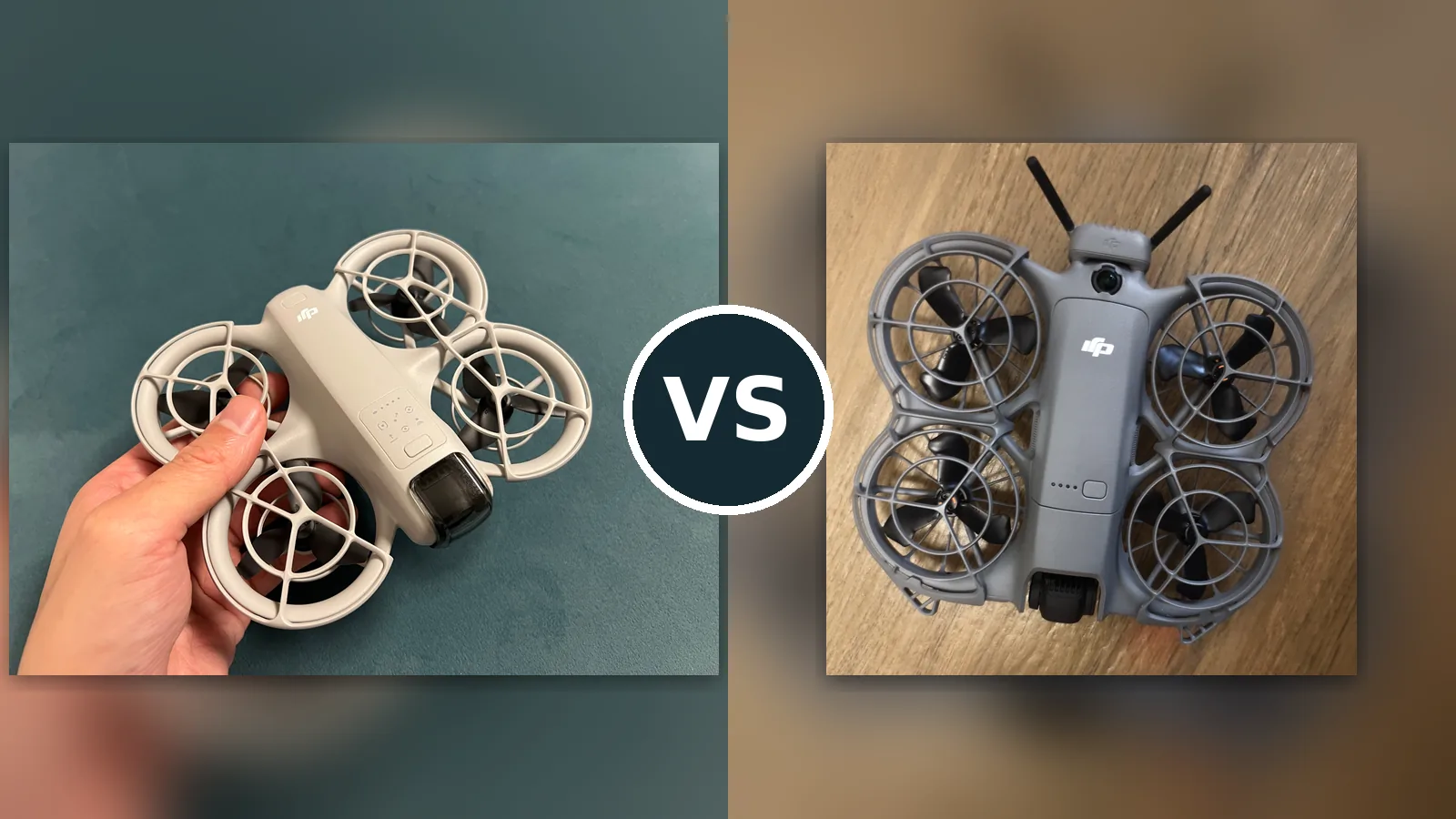
The dji neo vs neo 2 battery life question is the one every Neo owner asks first, and the honest answer (19 rated minutes against 18) is the least interesting part of this comparison. The original DJI Neo, at roughly 135 grams, essentially invented the palm drone: it takes off from your hand, tracks you with AI subject following, shoots stabilized 4K/30, and lands back on your palm, all without a controller anywhere in the process. The Neo 2 keeps that entire formula and rebuilds everything around it: omnidirectional obstacle sensing with a forward LiDAR where the Neo had downward sensors only, 4K/60 and 4K/100 recording where the Neo stopped at 4K/30, native vertical video, a two-axis gimbal, and 49 GB of internal storage against 22 GB. It also weighs 151 grams, needs an add-on module for its longest-range transmission, and asks more money for the privilege. So is the generation jump worth it, and does the battery really last longer once the new sensing and tracking systems start drawing power? We work through the endurance math, the cameras, the safety systems, and the control options to find out.
Affiliate disclosure: As an Amazon Associate I earn from qualifying purchases. This page contains affiliate links. If you buy through them, we may earn a commission.
Neo 2, almost everywhere. The Neo still wins on weight and simplicity.
DJI Neo is the pick if you want the lightest, simplest version of the palm drone idea: 135 grams, 22 GB of storage, honest 4K/30, and direct compatibility with DJI’s standard controllers for a 10 km O4 link when you want one. DJI Neo 2 is the pick if you fly anywhere near obstacles or movement: full sensing with LiDAR, ActiveTrack in eight directions, 4K/60 and 4K/100 video, native vertical shooting, and one extra rated minute of flight time. Battery life: Neo 2 by a nose on paper, near enough a tie in real sessions. Safety: Neo 2, and it is not close. Video: Neo 2. Minimalism: the original Neo, still undefeated.

DJI Neo
For pilots who want the original palm drone at its lightest, with no modules and no fuss.
- Palm takeoff and landing, AI subject tracking, and six QuickShots with no controller required
- Full O4 transmission up to 10 km when paired with a standard DJI controller, no add-on module needed
- Downward-only sensing, a single-axis gimbal, 4K/30 ceiling, and Level 4 wind resistance
Check current availability and bundle options on Amazon

DJI Neo 2
For creators who want real obstacle sensing, faster tracking, and better video from the same palm-sized idea.
- Omnidirectional monocular vision, forward LiDAR, and downward infrared sensing in a palm drone
- 4K/60 plus 4K/100 slow motion, native 2.7K vertical video, and ActiveTrack up to 12 m/s in 8 directions
- Long-range O4 needs the add-on Digital Transceiver module, which takes weight to 160 g
Check current availability and bundle options on Amazon
The drone that started the palm era, against the one that grew up
Start with what these little drones are for. Both exist to film you without a pilot. The difference is how much protection and polish the second generation wraps around that trick.
The original Neo is a study in subtraction. At about 135 grams with full propeller guards, it launches from a flat palm, follows you using AI subject tracking, fires off QuickShots like Dronie and Rocket from a button press, and returns to your hand when the shot is done. Its camera is a 1/2-inch 12MP sensor behind a 14mm f/2.8 lens, stabilized by a single-axis gimbal working with RockSteady and HorizonBalancing software, recording 4K at 30fps or 1080p at 60. What it does not have is any sense of the world around it beyond downward vision and infrared sensors for landing: fly it backward toward a tree and the tree wins. Its Level 4 wind rating (8 m/s) and roughly 18-minute battery ask for calm days and short, deliberate clips.
The Neo 2 answers nearly every item on that limitation list. Sensing becomes a full suite: omnidirectional monocular vision, a forward-facing LiDAR, and downward infrared, so the drone can watch for obstacles in every direction a selfie drone actually drifts. ActiveTrack now follows at up to 12 m/s in eight directions, with a dedicated Cycling mode and SelfieShot framing, and the camera steps up to 4K/60 with a 4K/100 slow-motion mode and native 2.7K vertical video up to 60fps, through a wider f/2.2 lens on a two-axis gimbal. Storage more than doubles to 49 GB. The costs are weight (151 g, or 160 g with the transmission module fitted) and complexity: the headline one-minute battery gain is real but modest, and the longest-range link now lives in an accessory.
Read the two as a before-and-after of the same idea. The Neo proved a drone could be a camera accessory; the Neo 2 tries to make it a dependable one, safe around trees, playgrounds, and moving subjects. If your flying is open sky and simple follow shots, the original already does the job and does it lighter. If your flying happens in the real world of branches, railings, and bike paths, the Neo 2’s sensing alone is worth the upgrade conversation.
A word about daily habits, because palm drones live or die on them. Both generations ask to be treated like camera accessories: grab, fly a handful of short clips, land, and move on. That pattern flatters both batteries and keeps either drone welcome in places a full-size quadcopter would feel like an event. The Neo 2 simply tolerates more ambitious versions of the same habit: longer tracking runs, breezier days within its Level 5 wind rating, and locations where its sensors earn their keep on every single flight out of the palm.
Choose DJI Neo if…
- Lightest is best: at 135 g the Neo disappears into a pocket or pack and asks nothing of your day.
- You already own a DJI controller and want the 10 km O4 link without buying an add-on transmission module.
- Your shots are simple: open spaces, slow subjects, QuickShots, and 4K/30 footage for social sharing.
- You found the original at a friendly price and the essentials (palm launch, tracking, guards) are the whole point.
Choose DJI Neo 2 if…
- You fly near things: omnidirectional vision and forward LiDAR protect the shots the Neo cannot protect.
- Your subjects move: ActiveTrack at up to 12 m/s in eight directions, Cycling mode, and SelfieShot keep riders and runners framed.
- You post vertical video and want native 2.7K vertical at 60fps instead of cropping a horizontal frame.
- You want the better file and the longer session: 4K/60, 4K/100, 49 GB of storage, and a 19-minute rating.
Neo vs Neo 2: The Spec Sheet, Line by Line
Read this table as a generational checklist. The Neo 2 improves nearly every row; the interesting rows are the first one in most buyers’ minds (flight time) and the transmission row, where the original quietly holds an advantage.
| Feature | DJI Neo | DJI Neo 2 |
|---|---|---|
| Best suited to | Simple palm-launched clips, first-drone owners, open-space follow shots | Tracked action, vertical social content, and flying near obstacles |
| Takeoff weight | Approx. 135 g | 151 g; 160 g with the Digital Transceiver module fitted |
| Dimensions | 130 x 157 x 48.5 mm | 147 x 171 x 41 mm with propeller guards; 167 x 171 x 54 mm with transceiver fitted |
| Sensor and lenses | 1/2-inch CMOS, 12MP; 14mm equivalent, f/2.8, 117.6-degree field of view | 1/2-inch CMOS, 12MP; 16.5mm equivalent, f/2.2, 119.8-degree field of view |
| Photo resolution | 12MP stills | 12MP stills |
| Video modes | 4K/30, 1080p/60 | 4K/60, 4K/100 slow motion, 2.7K vertical up to 60fps |
| Color and codecs | Standard color; H.264 and H.265 up to 75 Mbps | Standard color; H.264 and H.265 up to 80 Mbps |
| Vertical capture | No native vertical mode; crop the horizontal frame in post | Native vertical shooting with 2.7K vertical video up to 60fps |
| Obstacle sensing | Downward vision and infrared positioning only | Omnidirectional monocular vision, forward LiDAR, and downward infrared sensing |
| Subject tracking | AI subject tracking plus six QuickShots (including Dronie, Circle, Rocket) | ActiveTrack up to 12 m/s in 8 directions, Cycling mode, SelfieShot, Return to Palm |
| Rated flight time | Approx. 18 minutes; approx. 17 minutes with propeller guards fitted | Approx. 19 minutes; approx. 17 minutes with propeller guards fitted; 18 minutes hovering |
| Measured flight time | Not tested by us | Not tested by us |
| Rated wind resistance | 8 m/s, Level 4 | 10.7 m/s, Level 5 |
| Max speed | 16 m/s in Manual mode with FPV controls; slower in automatic modes | 12 m/s in Sport mode; tracks at up to 12 m/s |
| Transmission | DJI O4 up to 10 km with a compatible controller; short-range Wi-Fi with a phone | Wi-Fi up to 500 m built in; DJI O4 up to 10 km with the add-on Digital Transceiver module |
| Storage | 22 GB internal; no card slot | 49 GB internal; no card slot |
| Controller and bundle | No controller required: palm, voice, and app control; optional RC-N3 or goggles with motion controller | No controller required: palm, voice, and app control; optional RC-N3 or Goggles N3 with motion controller |
| Main trade-off | Minimal sensing and a 4K/30 ceiling in exchange for the lightest, simplest package | One extra rated minute and full sensing, paid for with weight and a module-based long-range link |
Manufacturer flight times are best-case lab figures, and real flights come in shorter, especially in wind or aggressive flying. Measured flight time is listed as not tested because this is a research-based comparison; see the methodology section for how the figures above were verified.
Five Differences That Actually Decide This One
Five differences decide this matchup: the battery math everyone asks about, the sensing suite, the camera upgrade, the tracking brain, and the transmission fine print.
1. Battery life: 18 minutes against 19, and what the numbers hide
Edge: Neo 2, narrowlyStart with the headline figures. DJI rates the Neo at about 18 minutes per battery and the Neo 2 at about 19 minutes. With propeller guards fitted, both ratings settle at about 17 minutes, because guards cost efficiency on any small drone. Hovering ratings tell the same story in miniature: the Neo 2 hovers for about 18 minutes. On the spec sheet, the newer drone wins the battery comparison. It wins it by roughly one minute, or about five percent.
Real sessions complicate the headline in both directions. The Neo 2 spends power on systems the Neo lacks: constant omnidirectional sensing, LiDAR, faster tracking computation, and higher-frame-rate recording all draw from the same small pack, and aggressive tracked flights in wind will eat its paper advantage. The Neo, with less to run, sometimes lands closer to its rating in gentle use. Either way, both drones live in the same practical world: plan shoots in short clips, carry spare batteries for anything resembling a session, and treat the guards-on 17-minute figure as the honest planning number for both.
2. Sensing: downward-only against a full electronic lookout
Edge: Neo 2The Neo positions itself with downward vision and infrared sensors. That is enough for stable hovering, palm landings, and gentle tracking in open space, and it is all the original ever claimed. What it cannot do is notice the branch behind it, the fence beside it, or the goalpost ahead during a tracking move. Every Neo flight near obstacles is a flight the owner has personally scouted.
The Neo 2’s sensing suite is the generational headline: omnidirectional monocular vision watches every horizontal direction, a forward LiDAR measures what the cameras see, and downward infrared handles the ground. For a drone whose entire purpose is flying itself near people and places, this changes the risk profile fundamentally. It is also why the Neo 2’s wind rating climbs to Level 5 (10.7 m/s) against the Neo’s Level 4 (8 m/s): the newer drone knows where it is and what is around it, and holds its position with more authority.
3. The camera: 4K/30 with one gimbal axis against 4K/60 with two
Edge: Neo 2Both cameras use a 1/2-inch 12MP sensor, so stills resolution and basic image character are shared. The Neo records 4K at up to 30fps and 1080p at 60, stabilized by a single-axis gimbal with RockSteady and HorizonBalancing software doing the rest. The results are genuinely good for social footage in daylight, which is the assignment the drone was designed for.
The Neo 2 widens every video dimension: 4K at 60fps for smoother motion, a 4K/100 slow-motion mode, a brighter f/2.2 lens, a two-axis mechanical gimbal for steadier footage before software even starts, and bitrates up to 80 Mbps against 75 Mbps. Its native 2.7K vertical mode at up to 60fps deserves its own mention: social creators no longer crop away most of the frame, because the drone shoots the 9:16 frame directly. Neither camera is a low-light tool, but in daylight the Neo 2 file is simply the more flexible one.
4. Tracking and shot modes: QuickShots against a real tracking brain
Edge: Neo 2The Neo’s intelligence is preset-shaped: six QuickShots (Dronie, Circle, Rocket, Spotlight, Helix, Boomerang modes in DJI’s standard set) plus AI subject tracking for follow shots at modest speeds. For walking pace content, family clips, and travel moments, it covers the brief with almost zero learning curve, and its return-to-palm landing remains the neatest trick in the category.
The Neo 2 turns tracking into the main event. ActiveTrack follows subjects at up to 12 m/s in eight directions, which is the difference between following a stroll and following a cyclist, and a dedicated Cycling mode tunes the behavior for riders. SelfieShot handles the framed self-portrait use case the line was born for. Combined with the sensing suite watching for obstacles while the brain watches the subject, the Neo 2 can be trusted with moving shots the original should only attempt in wide-open space.
5. Transmission and control: the module question
Edge: Tie, by designHere the original strikes back. Pair the Neo with a compatible DJI controller such as the RC-N3 and you get the full O4 link, rated up to 10 km, with no extra hardware on the aircraft. The Neo also flies happily on a short-range Wi-Fi phone connection for its palm-drone tricks. It is a clean arrangement: controller owners get flagship transmission from a 135-gram drone.
The Neo 2 rearranges the deal. Built in, it offers Wi-Fi control out to a rated 500 m, far beyond the Neo’s phone range and enough for any tracking shot. The full O4 link, again rated up to 10 km, now requires the add-on Digital Transceiver module, which clips the weight up to 160 g and adds a purchase to the kit. In exchange, the module also enables goggles flying with the Goggles N3 and motion control. Whether that is a downgrade or a fair trade depends entirely on whether you already own DJI controllers or plan to fly FPV.
Neo vs Neo 2: What You Gain, What You Give Up
DJI Neo
Reasons to choose it
- The lightest palm drone DJI has made at about 135 g, with full propeller guards
- Palm takeoff, AI tracking, and QuickShots with zero controller required
- Direct O4 transmission up to 10 km with standard DJI controllers, no module needed
- 22 GB of internal storage and a proven, simple formula that still delights
Reasons to reconsider
- Downward-only sensing: no obstacle awareness in any other direction
- 4K stops at 30fps, the gimbal is single-axis, and there is no native vertical video
- Level 4 wind rating and the joint-shortest battery planning figure with guards fitted
DJI Neo 2
Reasons to choose it
- Omnidirectional vision plus forward LiDAR: the first Neo that watches where it flies
- 4K/60 and 4K/100 recording, a two-axis gimbal, and native 2.7K vertical video
- ActiveTrack up to 12 m/s in eight directions with Cycling mode and SelfieShot
- 49 GB of storage, Level 5 wind resistance, and one extra rated minute per battery
Reasons to reconsider
- Heavier at 151 g, and 160 g with the transceiver module the long-range link requires
- The battery advantage is a single rated minute, and sensing draws power in real flights
- Costs more, and the best transmission setup now involves an accessory purchase
Modules, guards, and spare packs: check the bundle twice
These drones look simple and sell in deceptively different configurations. The box contents decide which transmission system and battery count you actually get.
- Transceiver module, Neo 2: Decide whether you need the Digital Transceiver before ordering. Without it you get 500 m Wi-Fi control; with it you get the 10 km O4 link and goggles compatibility, at 160 g total weight.
- Battery planning: Ratings are 18 minutes (Neo) and 19 minutes (Neo 2), settling near 17 minutes for both with propeller guards fitted. For any real session, budget for spare batteries rather than trusting the headline minute.
- Storage is fixed: Neither drone has a card slot. The Neo holds 22 GB and the Neo 2 holds 49 GB, so offload habits matter; heavy 4K/60 and 4K/100 shooting fills the Neo 2 faster than its bigger storage suggests.
- Guards and weight: Both drones fly with full propeller guards for their palm tricks, which cost flight time on both. The Neo 2’s guards are part of its 147 mm span; check your case and pocket fit either way.
- Registration: Both drones stay under 250 g in all configurations, so recreational registration is not required in the US. The Neo 2 with its module fitted reaches 160 g, still comfortably below the line.
- Listing checks: Verify the exact model (the Neo 2 is frequently confused with the original in marketplace titles), what is in the box, whether the transceiver module is included, and battery condition before ordering.
One minute apart on paper. One generation apart in practice.
Choose the DJI Neo 2 if this is a new purchase or an upgrade you will feel: the sensing suite changes what the drone can safely do, the camera and tracking upgrades change what it can film, and the storage and vertical video remove the original’s daily annoyances. Its battery edge is small, and you should buy it for everything except the battery. Choose the original DJI Neo if light, simple, and proven is the brief, or if you already own one and your flying is open-sky and gentle; it remains a delightful little camera that happens to fly. The generational story here is not endurance. It is awareness, and the Neo 2 is the first of the two that truly knows where it is.
Still deciding?
Which drone really has better battery life, the Neo or the Neo 2?
The Neo 2, by a small margin. DJI rates it at about 19 minutes per battery against the Neo’s roughly 18 minutes, and both ratings fall to about 17 minutes with propeller guards fitted. In real flying the gap can shrink further, because the Neo 2’s sensing, LiDAR, and faster recording modes draw extra power. Plan sessions around spare batteries for either drone rather than choosing on this row alone.
Is the Neo 2 worth upgrading to if I own a Neo?
For most owners, yes, if you fly near anything. The sensing suite, eight-direction ActiveTrack, 4K/60 recording, native vertical video, and double the storage are felt on every flight. If your Neo only ever flies in open fields at walking pace and you are happy with 4K/30, the upgrade is a luxury rather than a necessity, and your money may serve you better as spare batteries.
Can the Neo 2 fly long range without the transceiver module?
It can fly farther than the original could on a phone: built-in Wi-Fi control is rated to 500 m, which covers every tracking and selfie scenario. The full O4 link rated up to 10 km, and compatibility with DJI Goggles N3 for FPV flying, require the Digital Transceiver module. The module also raises takeoff weight from 151 g to 160 g.
Which Neo is better for vertical social video?
The Neo 2, clearly. It records native 2.7K vertical video at up to 60fps, using the frame you actually publish. The original Neo has no native vertical mode, so vertical posts mean cropping a horizontal 4K frame and discarding most of its width. For TikTok, Reels, and Shorts-first creators, this single feature can justify the newer drone.
Do either of these drones need registration?
Not for recreational flying in the US: the Neo weighs about 135 g and the Neo 2 weighs 151 g (160 g with its transceiver module), all comfortably under the 250 g threshold. Commercial work brings the usual certification requirements, and rules differ by country, so confirm your local position before flying for clients.
How were these drones compared?
This is a research-based comparison built from DJI’s published specifications, manuals, and Digital Transceiver module documentation for both drones, cross-checked for consistency across the two generations. We did not fly either drone for this article, so flight times are DJI’s rated figures and measured flight time is listed as not tested. See the methodology section for the source list.
How this comparison was prepared
This comparison is research-based. We did not fly either drone for this article, and nothing here should be read as hands-on testing. Every specification in the table was taken from DJI’s published documentation for the DJI Neo and DJI Neo 2, including official specification listings, user manuals, and Digital Transceiver module documentation, and each figure was checked against the matching figure for the other drone so that rated values are compared like for like. Where a capability was not present in the verified specification set, the table says so rather than filling the gap with an estimate. Flight times quoted are manufacturer rated maximums under ideal conditions; real flights are shorter. Sources are listed by name only below, in line with this site’s editorial policy.
Sources
- DJI Neo official specifications
- DJI Neo 2 official specifications
- DJI Neo user manual
- DJI Neo 2 user manual
- DJI Neo 2 Digital Transceiver module documentation
Last verified: October 20, 2026. Specifications, bundles, and availability may vary by region and version.


