


This dji avata 360 vs dji mini 4 pro matchup pairs two drones that solve opposite problems. The DJI Avata 360 is a non-folding cinewhoop with integrated propeller guards and dual fisheye lenses that record the full sphere around the aircraft in 8K/60 HDR 360-degree video. You fly the line first and choose the framing later, in the edit, because the cameras saw everything at once. The DJI Mini 4 Pro is the opposite philosophy in metal and plastic: a foldable camera drone under 249 grams with the standard battery, a 3-axis gimbal, and a single forward camera that you frame carefully in the moment. One records everything and decides later. The other decides on the day and travels almost anywhere with almost no fuss. Both record 10-bit D-Log M, both offer ActiveTrack 360, and both sit near the top of what DJI sells to creators, which is exactly why this choice confuses people. The real questions are simpler than the spec sheets suggest. Do you want immersive FPV footage you can reframe into several different shots from one flight? Or do you want smooth, gimbal-stabilized travel footage from a drone that folds into a jacket pocket and stays under the 249-gram line that matters in so many regions? This comparison works through the cameras, the flying experience, the sensing systems, the flight times, and the complete kits, so you can pick based on the footage you actually want to publish, not on which spec list looks longer on a product page.
Affiliate disclosure: As an Amazon Associate I earn from qualifying purchases. This page contains affiliate links. If you buy through them, we may earn a commission.
Avata 360 for reframed immersion. Mini 4 Pro for light, smooth travel footage.
DJI Avata 360 is the pick if you want to record everything at once: dual 1/1.1-inch sensors, 8K/60 HDR 360-degree video, single-lens 4K/60, and the freedom to reframe one flight into many shots after you land. DJI Mini 4 Pro is the pick if you want the classic travel camera drone: under 249 grams with the standard battery, a foldable frame, a 3-axis gimbal, 4K/60 HDR from a 1/1.3-inch sensor, and up to 34 minutes of rated flight time. Camera freedom after the flight: Avata 360. Portability and smooth, ready-to-share footage: Mini 4 Pro, and it is not close.
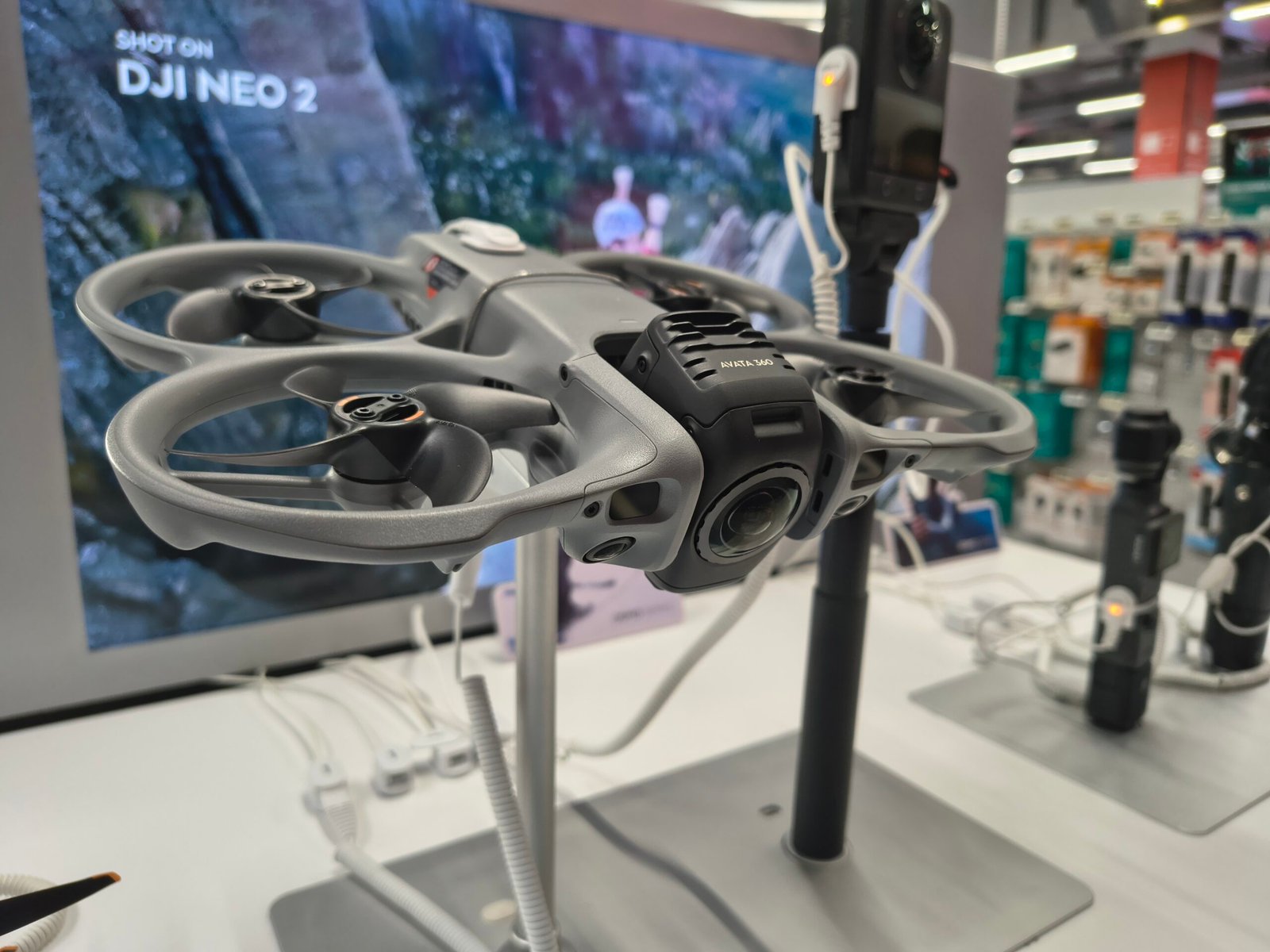
DJI Avata 360
For FPV pilots and creators who want full-sphere capture and reframing freedom after every flight
- Records the full sphere in 8K/60 HDR 360-degree video, so framing choices happen after landing, not in the air
- Omnidirectional obstacle sensing plus forward LiDAR in 360 mode, with ActiveTrack 360 for tracked subjects
- Heavier non-folding cinewhoop at 455 grams, with 23 minutes of rated flight time per battery
Check current availability and bundle options on Amazon
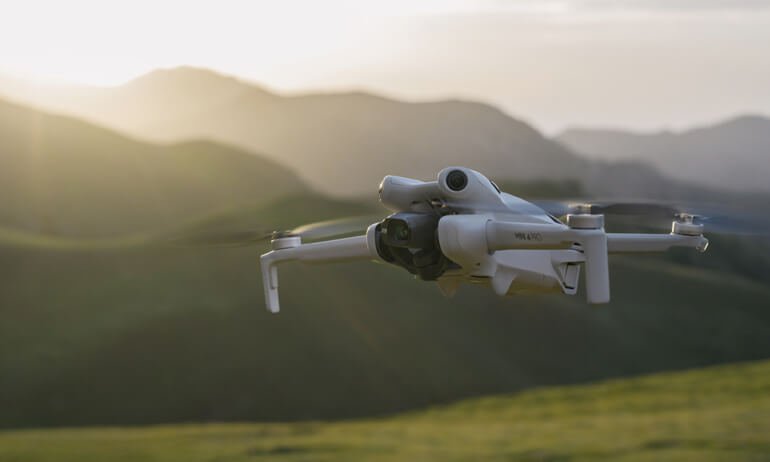
DJI Mini 4 Pro
For travelers and creators who want gimbal-smooth footage from a foldable drone under 249 grams
- Under 249 grams with the standard battery and a foldable frame that travels in a pocket or small sling
- 3-axis gimbal, 1/1.3-inch 48MP camera, 4K/60 HDR video, and true vertical shooting for social formats
- Longer rated flights: 34 minutes with the standard battery, 45 minutes with the Plus battery, which pushes weight over 249 grams
Check current availability and bundle options on Amazon
Record everything, or frame it right the first time?
Start with how you like to work. One of these drones moves the hardest creative decision to the edit suite. The other asks you to make that decision in the air, then rewards you with footage that needs almost no work at all.
The Avata 360 is built around a simple idea: capture first, compose later. Its dual 200-degree f/1.9 fisheye lenses and dual 1/1.1-inch CMOS sensors record the entire sphere in 8K/60 HDR 360-degree video, so a single pass through a warehouse, a forest trail, or a city block contains every possible angle at once. Back at your desk you reframe that sphere into a forward chase shot, a side-tracking shot, a look-back reveal, or a vertical clip, all from the same flight. For creators who publish several cuts from one outing, that changes the economics of a shooting day completely. The catch is weight and workflow. At 455 grams with a non-folding body measuring 246 x 199 x 55.5 mm, it travels as a deliberate kit, not a pocket extra, and every 360 clip needs reframing work before it looks like a finished video. Its single-lens mode, at 4K/60 and 2.7K/120, covers conventional FPV shots when you do not need the sphere.
The Mini 4 Pro is built around the opposite idea: compose in the air, publish with minimal effort. The 1/1.3-inch 48MP sensor behind its 24mm f/1.7 lens sits on a 3-axis gimbal, so footage comes out smooth and level even when the airframe is working against a breeze. It shoots 4K/60 HDR, 4K/100 slow motion, and FHD at 200fps, offers 10-bit D-Log M and HLG for color work, and supports true vertical shooting for social formats without cropping. It folds flat, weighs under 249 grams with the standard battery, and is rated for 34 minutes per standard battery, or 45 minutes with the Plus battery. That Plus option deserves a clear warning: fitting it pushes the takeoff weight over 249 grams, which can change how the drone is treated under local rules in many places. If low weight is your reason for buying, the standard battery is the honest configuration.
Neither drone is a stepping stone to the other, and that is worth saying plainly. If you are weighing the older goggles drone against this same travel camera, our DJI Avata 2 vs DJI Mini 4 Pro comparison covers that pairing in full. Buy the Avata 360 if your best days involve goggles, planned lines, and an evening of reframing in the edit. Buy the Mini 4 Pro if your best days involve a light bag, a quick unfolding at a viewpoint, and clean footage that is nearly finished the moment it lands on your card. The spec table below matters, but your working style decides this one first.
Choose DJI Avata 360 if…
- Reframing freedom is the point: you want several finished shots from a single flight, chosen after you land.
- You fly FPV lines through interiors, trails, and tight spaces where a guarded cinewhoop frame belongs.
- You want the largest sensors here, dual 1/1.1-inch units, with 8K/60 HDR 360 video and 120MP stills.
- You can accept a heavier non-folding kit at 455 grams and a 23 minute rated flight time.
Choose DJI Mini 4 Pro if…
- Portability is the point: you want a foldable drone under 249 grams with the standard battery.
- You want gimbal-smooth travel footage, true vertical shooting, and 4K/100 slow motion from a single camera.
- You want longer flights, rated at 34 minutes standard and 45 minutes with the Plus battery.
- You can accept framing every shot live, with no full-sphere capture to rescue a missed angle later.
Avata 360 vs Mini 4 Pro: The Spec Sheet, Line by Line
Read this table as two budgets spent in different places. The Avata 360 spends weight on a second sensor, a second lens, and a guarded frame. The Mini 4 Pro spends its design effort on folding arms, a gimbal, and minutes in the air. Almost every row crowns a different winner, which is why the working style matters more than the totals.
| Feature | DJI Avata 360 | DJI Mini 4 Pro |
|---|---|---|
| Best suited to | Immersive 360 FPV capture with reframing in the edit | Foldable travel filming with gimbal-smooth footage |
| Takeoff weight | 455 g | Under 249 g with the standard battery; the Plus battery pushes it over 249 g |
| Form and size | Non-folding cinewhoop, 246 x 199 x 55.5 mm, integrated propeller guards | Foldable camera drone with a 3-axis gimbal |
| Sensor and lenses | Dual 1/1.1-inch CMOS, 64MP; dual 200-degree f/1.9 fisheye lenses | 1/1.3-inch CMOS, 48MP; 24mm f/1.7 lens |
| Video modes | 8K/60 HDR 360-degree video; single-lens mode 4K/60 and 2.7K/120 | 4K/60 HDR, 4K/100 slow motion, FHD 200fps |
| Photo | 120MP stills from the dual-sensor system | 48MP sensor stills |
| Color | 10-bit D-Log M | 10-bit D-Log M and HLG |
| Vertical capture | No dedicated vertical mode listed; choose vertical framing when you reframe 360 footage | True vertical shooting |
| Obstacle sensing | Omnidirectional obstacle sensing plus forward LiDAR in 360 mode | Omnidirectional obstacle sensing with APAS 5.0 |
| Subject tracking | ActiveTrack 360 | ActiveTrack 360 |
| Rated flight time | 23 minutes maximum | 34 minutes with the standard battery; 45 minutes with the Plus battery |
| Measured flight time | Not tested by us | Not tested by us |
| Max speed | 18 m/s in Sport mode | 16 m/s in Sport mode |
| Rated wind resistance | Level 5, 10.7 m/s | Level 5 |
| Transmission | DJI O4+, up to 20 km (FCC) | DJI O4, up to 20 km (FCC) |
| Storage | 42 GB internal storage plus a microSD card slot | 2 GB internal storage plus a microSD card slot |
| Controllers and viewing | Goggles 3, Goggles N3, RC Motion 3, FPV Remote Controller 3, RC 2, RC-N2, RC-N3 | Conventional controller flying with live view; confirm the bundled controller in the listing |
| Main trade-off | Full-sphere freedom, at the cost of weight, size, and reframing work in post | Light and smooth, at the cost of framing every shot correctly in the air |
Manufacturer flight times are best-case lab figures, and real flights come in shorter, especially in wind or fast flying. Measured flight time is listed as not tested because this is a research-based comparison; see the methodology section for how the figures above were verified.
Five Differences That Actually Decide This One
Five differences decide this matchup: the camera workflow, the bag it travels in, the safety net, the practical numbers, and the kit you operate. Work through them and your winner will be obvious.
1. The camera: reframe later vs frame it now
Edge: Avata 360The Avata 360 records with dual 1/1.1-inch CMOS sensors, each rated at 64MP, behind dual 200-degree f/1.9 fisheye lenses. Together they capture 8K/60 HDR 360-degree video and 120MP stills, with 10-bit D-Log M for color grading. The creative consequence is huge: a missed pan is no longer a missed shot, because the sphere contains the angle you wish you had chosen. One flight can yield a forward hero shot, a reverse angle, and a vertical cut, each reframed from the same recording. Its single-lens mode, at 4K/60 and 2.7K/120, handles days when you want a conventional FPV file instead.
The Mini 4 Pro takes the classic route and executes it very well. Its 1/1.3-inch 48MP sensor and 24mm f/1.7 lens shoot 4K/60 HDR, 4K/100 slow motion, and FHD at 200fps, with 10-bit D-Log M and HLG on offer. The 3-axis gimbal keeps the horizon level and the footage calm in a way a fixed FPV camera cannot match, and true vertical shooting serves social formats natively. What you see through the live view is what you publish, for better and worse: great framing is rewarded instantly, and a badly chosen angle is simply gone.
2. Portability: pocket folder vs deliberate kit
Edge: Mini 4 ProThe Mini 4 Pro folds, and that single fact reshapes how often it gets used. Under 249 grams with the standard battery, it drops into a small sling or a large pocket, unfolds in seconds, and asks for no ritual at the flying spot. That low weight also keeps it in the lightest category in many regions when flown with the standard battery, which is a genuine practical advantage for travel days and spontaneous stops. Remember the boundary clearly: the Plus battery extends flight time, but it pushes takeoff weight over 249 grams.
The Avata 360 does not fold at all. At 455 grams and 246 x 199 x 55.5 mm, with integrated propeller guards that are part of the structure, it travels in a proper case alongside goggles and a controller. Nobody slips this drone into a jacket on the way out for coffee. In return, the guarded cinewhoop body is built for the tight, contact-prone flying that a folding travel drone should never attempt. Portability here is not a flaw so much as a trade: you carry more because the drone is meant to go places, indoors and through gaps, that the Mini 4 Pro only films from a respectful distance.
3. Sensing and tracking: two safety nets, different styles
Edge: Tie, different toolsOn paper this section looks level, because both drones offer omnidirectional obstacle sensing and ActiveTrack 360. The details pull them apart by flying style. The Avata 360 pairs its omnidirectional sensing with forward LiDAR in 360 mode, which matters most in the FPV world it lives in: close quarters, doorways, and lines where obstacles arrive fast and from odd angles. Sensing on an FPV drone is a last line of defense for a pilot who is already watching closely, and the LiDAR addition strengthens exactly the forward direction where a cinewhoop spends its flight.
The Mini 4 Pro pairs its omnidirectional sensing with APAS 5.0, the assistance layer that helps the drone plan around obstacles during assisted flight and tracking. For a camera drone that often flies orbit, follow, and reveal shots with the pilot watching a screen rather than the aircraft, that behavior is the right kind of help. ActiveTrack 360 on both machines means either can hold a moving subject, but the experience differs: tracking from a gimbal camera gives calm, watchable follow footage, while tracking from the 360 platform lets you choose the final angle after the run is over. Neither system makes its drone crash-proof, and thin branches, glass, and poor light still defeat sensors.
4. Flight time, speed, range, and storage
Edge: Mini 4 ProEndurance is the Mini 4 Pro’s clearest win. It is rated for 34 minutes with the standard battery and 45 minutes with the Plus battery, against 23 minutes maximum for the Avata 360. All of these are ideal-condition lab figures and real flights land sooner, but the gap is large enough to survive real-world discounting. On a travel day, the Mini pilot scouts, waits for light, and still has battery in reserve. The Avata 360 pilot plans tighter sorties and leans on spare batteries for multi-take FPV lines.
The supporting numbers split more evenly. Top speed favors the Avata 360 at 18 m/s in Sport mode against 16 m/s for the Mini 4 Pro, a small edge that suits its chase and dive work. Transmission reaches 20 km under FCC rules on both, with the Avata 360 on O4+ and the Mini 4 Pro on O4. Storage flips the story: the Avata 360 carries 42 GB internally plus a microSD slot, while the Mini 4 Pro offers just 2 GB internally plus its microSD slot, so a card is effectively mandatory on the Mini and merely sensible on the Avata. Both are rated at Level 5 wind resistance, with the Avata 360 figure specified at 10.7 m/s.
5. Control options and the complete kit
Edge: Avata 360 for flexibilityThe Avata 360 has an unusually wide control menu. The documented compatibility list includes Goggles 3 and Goggles N3 for immersive viewing, the RC Motion 3 and FPV Remote Controller 3 for FPV control styles, and the RC 2, RC-N2, and RC-N3 for conventional controller flying. That breadth matters if you already own DJI controllers, or if you want one airframe that can be flown as a full FPV machine on Saturday and in a more conventional way for a client flight on Monday. The kit is bigger, and goggles remain central to its best experience, but the options are real.
The Mini 4 Pro keeps the classic camera drone arrangement: a compact folding airframe, a controller, spare batteries, and a small bag, with the whole outfit sized for travel rather than for a dedicated flying session. Its simplicity is a feature. There is less to charge, less to pack, and less to learn, and the footage workflow ends at a card full of gimbal-smooth clips rather than a reframing session. Judge this section by your shelf and your calendar: an existing DJI controller collection makes the Avata 360 easier to adopt, while a light travel bag makes the Mini 4 Pro easier to live with every single week.
Avata 360 vs Mini 4 Pro: What You Gain, What You Give Up
DJI Avata 360
Reasons to choose it
- Full-sphere 8K/60 HDR 360-degree recording, so one flight becomes several finished shots
- Dual 1/1.1-inch sensors, 120MP stills, and 10-bit D-Log M for serious color work
- Omnidirectional sensing plus forward LiDAR in 360 mode, with ActiveTrack 360
- Wide controller compatibility, 42 GB of internal storage, and O4+ transmission up to 20 km
Reasons to reconsider
- 455 grams and non-folding: a deliberate case-and-goggles kit, never a pocket drone
- 23 minutes of rated flight time, well short of the Mini 4 Pro standard battery figure
- Every 360 clip needs reframing work before it is ready to publish
DJI Mini 4 Pro
Reasons to choose it
- Under 249 grams with the standard battery, in a foldable frame that travels anywhere
- 3-axis gimbal footage with 4K/60 HDR, 4K/100 slow motion, and true vertical shooting
- Rated 34 minutes per standard battery, or 45 minutes with the Plus battery
- Omnidirectional sensing with APAS 5.0 and ActiveTrack 360
Reasons to reconsider
- No full-sphere capture: a missed angle in the air is missed for good
- Only 2 GB of internal storage, so a microSD card is effectively required
- The Plus battery that unlocks 45 minutes also pushes takeoff weight over 249 grams
Batteries, goggles, and the 249-gram line: check the bundle twice
These two drones punish bundle assumptions in different ways: one revolves around goggles and controller choices, the other around which battery is in the box. Check these points against the exact listing in front of you.
- Viewing and control, Avata 360: Confirm which of the compatible options the bundle includes. The documented list covers Goggles 3, Goggles N3, RC Motion 3, FPV Remote Controller 3, RC 2, RC-N2, and RC-N3, but a given listing may include only some of them, or none.
- Battery choice, Mini 4 Pro: The standard battery keeps takeoff weight under 249 grams and is rated for 34 minutes. The Plus battery is rated for 45 minutes and pushes weight over 249 grams. Know which battery, or which mix, the bundle actually contains.
- Spare batteries: Rated times are 23 minutes for the Avata 360 and 34 minutes standard for the Mini 4 Pro, with real flights shorter. Budget for at least one spare for either drone, and two if you shoot multi-take FPV lines or long travel days.
- Storage: The Avata 360 carries 42 GB internally plus a microSD slot. The Mini 4 Pro carries 2 GB internally plus a microSD slot. On the Mini, treat a fast, generous card as part of the purchase, not an accessory.
- Weight and local rules: At 455 grams the Avata 360 sits in a heavier class than the sub-249-gram Mini 4 Pro configuration in many regions. Check your aviation authority’s current registration and operating rules for the exact configuration you plan to fly.
- Listing checks: Verify the exact model name, what is in the box, battery type and condition, and return terms before ordering, and confirm any goggles or controller you are counting on is actually included.
Freedom in the edit, or freedom in the bag?
Choose the DJI Avata 360 if your creativity happens after the flight. Dual 1/1.1-inch sensors recording 8K/60 HDR 360-degree video, a guarded non-folding cinewhoop frame, forward LiDAR in 360 mode, and a wide controller menu make it the most forgiving shooting platform here: fly the line boldly, then find the best shots in the sphere. Choose the DJI Mini 4 Pro if your creativity happens in the moment. Under 249 grams with the standard battery, a 3-axis gimbal, true vertical shooting, and 34 minutes of rated flight time make it the drone that actually comes along on trips, walks, and weekends, and its footage needs the least finishing work. The wrong answers are easy to spot: buying the Avata 360 hoping it will disappear into a daypack, or buying the Mini 4 Pro hoping to fix framing mistakes at your desk. Pick the workflow you will enjoy every week.
Still deciding?
Can the DJI Avata 360 shoot normal, non-360 video?
Yes. Alongside its 8K/60 HDR 360-degree mode, the Avata 360 offers a single-lens mode at 4K/60 and 2.7K/120 for conventional FPV-style footage. Many owners mix both on one outing: 360 capture for the hero lines where reframing insurance matters, and single-lens recording when a straightforward forward shot is all the scene needs.
Is the DJI Mini 4 Pro really under 249 grams?
With the standard battery, yes: DJI rates that configuration at under 249 grams, and it is also the configuration rated for 34 minutes of flight. Fitting the Intelligent Flight Battery Plus extends the rating to 45 minutes but pushes takeoff weight over 249 grams. If staying under that line matters for your local rules or your travel plans, buy and fly the standard battery configuration.
Which drone shoots better video, the Avata 360 or the Mini 4 Pro?
They win different contests. The Avata 360 has the larger imaging system, dual 1/1.1-inch sensors capturing an 8K/60 HDR sphere with 10-bit D-Log M, and it wins on reframing freedom and second chances. The Mini 4 Pro wins on immediate polish: gimbal-stabilized 4K/60 HDR, 4K/100 slow motion, FHD at 200fps, HLG alongside D-Log M, and true vertical shooting. Graders and editors lean Avata 360. Shoot-and-share creators lean Mini 4 Pro.
Which drone is better for travel?
The Mini 4 Pro, clearly. It folds, it weighs under 249 grams with the standard battery, and it is rated for 34 minutes per battery, so it earns its place in a small bag and gets used at unplanned stops. The Avata 360 travels as a dedicated kit with goggles and a controller at 455 grams for the aircraft alone, which suits planned FPV sessions rather than carry-everywhere travel.
Do both drones track subjects automatically?
Yes. Both offer ActiveTrack 360 according to their published specifications. The experience around that shared feature differs: the Mini 4 Pro combines tracking with omnidirectional sensing and APAS 5.0 for assisted camera work, while the Avata 360 combines tracking with omnidirectional sensing and forward LiDAR in 360 mode, and its full-sphere recording lets you choose the final framing of a tracked run after the flight.
How were these drones compared?
This is a research-based comparison built from DJI’s published specifications, manuals, and transmission and controller compatibility documentation for both drones, cross-checked for consistency across the two product lines. We did not fly either drone for this article, so flight times are DJI’s rated figures and measured flight time is listed as not tested. See the methodology section for the source list.
How this comparison was prepared
This comparison is research-based. We did not fly either drone for this article, and nothing here should be read as hands-on testing. Every specification in the table was taken from DJI’s published documentation for the DJI Avata 360 and DJI Mini 4 Pro, including official specification listings, user manuals, and transmission and controller compatibility notes, and each figure was checked against the matching figure for the other drone so that rated values are compared like for like. Where a detail was not present in the verified specification set, the article says so rather than filling the gap with an estimate. Flight times quoted are manufacturer rated maximums under ideal conditions; real flights are shorter. Sources are listed by name only below, in line with this site’s editorial policy.
Sources
- DJI Avata 360 official specifications
- DJI Mini 4 Pro official specifications
- DJI Avata 360 user manual
- DJI Mini 4 Pro user manual
- DJI Goggles 3 and O4+ transmission compatibility documentation
Last verified: October 20, 2026. Specifications, bundles, and availability may vary by region and version.


