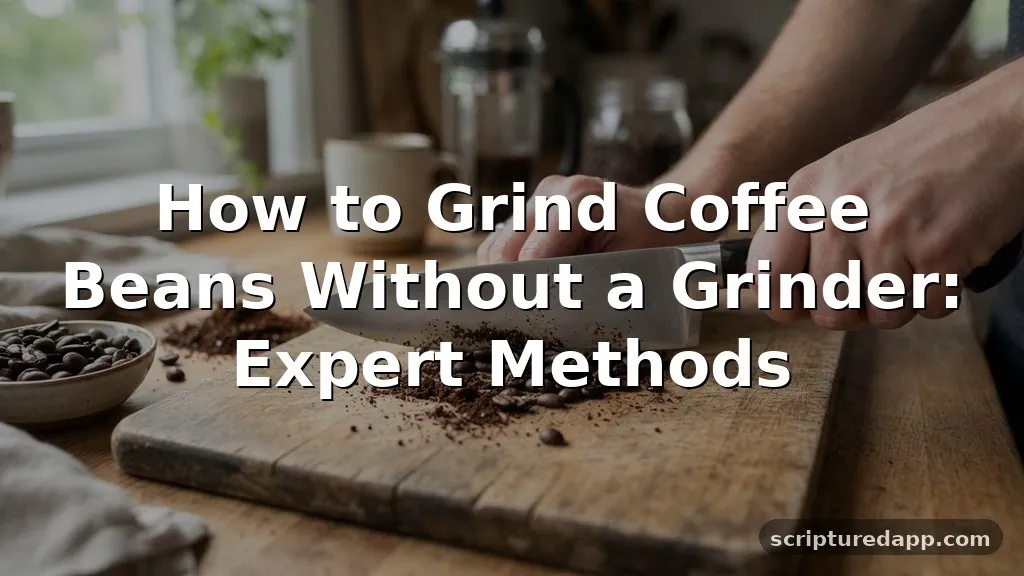

Finding yourself staring down a bag of whole coffee beans with no mechanical appliance in sight happens more often than you might think, making the knowledge of how to grind coffee beans without a grinder an essential kitchen skill. Whether your electric blade model gave out mid-morning or you are waking up in a minimalist vacation rental, a lack of specialized gear does not mean you have to sacrifice your daily brew. A rich, aromatic cup coffee is entirely achievable using common household instruments that crush, smash, or slice coffee beans into workable fragments.
Mastering these alternative techniques requires understanding how particle consistency impacts extraction and overall flavor. By leveraging items you likely already own, you can adapt your approach to suit your preferred brewing style, from coarse French press setups to finer espresso extraction.
Using a Chef Knife or Cleaver
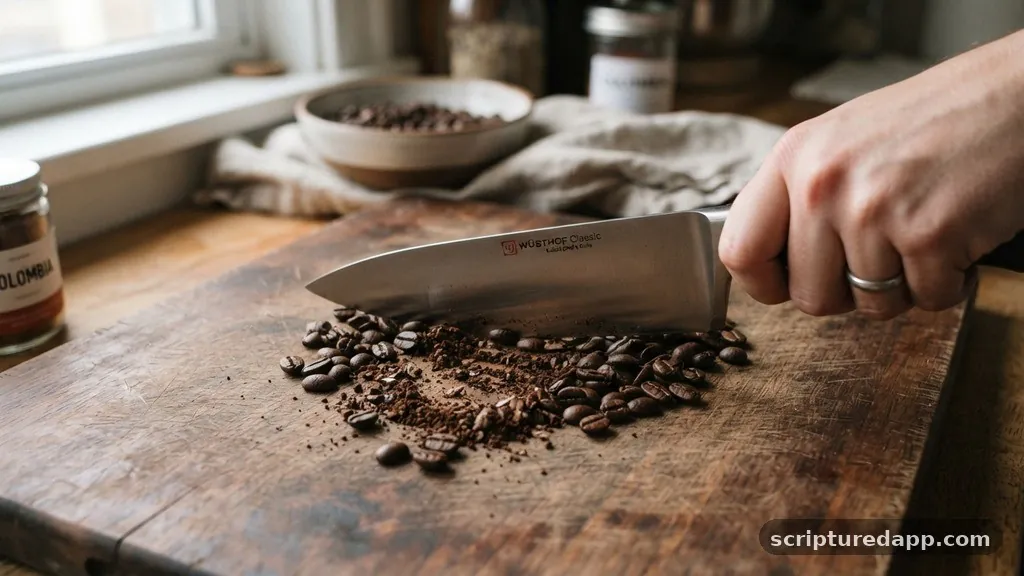
A heavy, broad-bladed chef knife or a kitchen cleaver offers a surprisingly effective manual method for crushing whole coffee beans on a sturdy cutting board. This technique relies on percussion and pressure rather than slicing, making it safe when executed with controlled movements and steady focus. Place a small handful of coffee beans onto a clean wooden cutting board, ensuring they are spread out in a single layer so they do not roll away unpredictably.
Position the flat side of the blade directly on top of the beans, with the sharp edge facing safely away from your body and your non-dominant hand resting flat on the spine of the knife. Apply firm, downward body weight with the palm of your hand to crack the hulls open, or gently tap the spine with a wooden mallet or rolling pin.
Once the beans are initially cracked, rock the blade back and forth or use a chopping motion to break the fragments down further into your desired consistency. While this technique requires patience and careful attention to safety, it produces remarkably uniform results for drip machines.
- Use a heavy wooden cutting board to absorb shock and prevent slipping.
- Keep the sharp edge angled away from your hands at all times.
- Work in small batches to maintain control over the final texture.
- Scrape the fragments into a pile frequently to ensure even reduction.
Leveraging a Kitchen Blender for Uniform Extraction
A standard kitchen blender serves as a quick alternative when you need to process a larger quantity of coffee beans without a dedicated burr mill. Because blenders rely on high-speed spinning blades, they tend to create a wide distribution of particle sizes, ranging from powdery dust to large chunks.
To mitigate this unevenness, pulse the blender in short, controlled bursts rather than running it continuously at top speed. This prevents the motor from generating excess heat, which can prematurely cook the volatile oils and ruin the flavor of your roast.
Tilt the blender pitcher slightly while pulsing if your model allows, as this encourages the beans to tumble back down into the path of the blades. Sifting the resulting grounds through a fine-mesh kitchen sieve helps separate any oversized fragments, ensuring that your final brew extracts evenly. This approach works best for immersion brewing methods that are forgiving of mixed grind sizes, such as a standard drip maker.
Crushing Beans with a Rolling Pin
A heavy rolling pin provides a controlled, tactile way to shatter coffee beans by hand without relying on electricity or sharp blades. Place your beans inside a heavy-duty freezer bag or between two sheets of thick parchment paper to contain the fragments and prevent them from scattering across your counter. Press down firmly and roll back and forth across the bag, applying steady pressure to crush the hard outer shells.
For finer results, you can transition from a rolling motion to a direct tapping action, using the heavy barrel of the pin like a mallet. This method gives you excellent tactile feedback, allowing you to feel the resistance change as the beans break down. It is an ideal option for travelers or campers who packed whole coffee beans but forgot to bring a portable hand mill.
Employing a Mortar and Pestle
The traditional mortar and pestle is perhaps the oldest tool for breaking down dry goods and remains one of the most reliable options for manual bean processing. The heavy stone, ceramic, or wooden bowl traps the beans securely while the pestle allows you to apply concentrated crushing force. Grind only a small number of beans at a time to ensure the pestle makes direct contact with every piece rather than riding over a deep bed of loose fragments.
Use a grinding motion—pressing and twisting the pestle against the sides of the bowl—rather than just pounding downward, as this shears the bean material more effectively. This technique excels at producing a fine, consistent texture suitable for pour-over cones or traditional Turkish brewing. The physical control you maintain over the process ensures you stop exactly when you reach your target texture.
Alternative Heavy Objects and Household Tools
Resourceful coffee lovers can utilize clean hammers, heavy skillets, or even the bottom of a sturdy mug to crush beans in a pinch. When using a hammer, always place the beans inside a sealed, durable plastic bag and rest the setup on a stable, impact-resistant surface like a concrete patio or a heavy countertop. Tap the bag gently at first to crack the outer layers, then increase your force gradually until the desired texture is achieved.
A heavy cast-iron skillet can also be pressed directly down onto beans resting on a cutting board, using your body weight to crush them in a grinding motion. While these unconventional tools lack the precision of specialized coffee equipment, they get the job done efficiently during emergencies. Always prioritize food safety by ensuring any tool you use is thoroughly cleaned and free of chemical residues.
| Alternative Method | Best Brew Style | Pros | Cons |
|---|---|---|---|
| Kitchen Blender | Drip Coffee | Fast, handles large batches | Uneven particle size |
| Rolling Pin | French Press | Quiet, highly controlled | Labor-intensive for large amounts |
| Chef Knife | Pour Over | No extra gadgets needed | Requires high knife safety |
| Mortar and Pestle | Fine / Espresso | Great consistency control | Slow process per batch |
Matching Alternative Textures to Brewing Equipment
Different extraction methods demand specific particle dimensions to extract optimal flavors without over-extracting bitter compounds or under-extracting sour notes. When you rely on improvised crushing techniques, controlling these dimensions becomes a deliberate exercise in observation and adjustment.
Coarse textures resemble coarse sea salt and work wonderfully for immersion techniques where water sits in contact with the grounds for several minutes. Medium grinds feel like standard table salt and suit flat-bottom drip filter baskets.
Fine textures approach the feel of powdered sugar and are typically required for pressurized espresso machines or stove-top moka pots. Because manual techniques often yield a mix of fine dust and larger chunks, running your finished grounds through a mesh strainer allows you to isolate the uniform fraction you need. Taking a moment to evaluate your output before adding hot water prevents a muddy, over-extracted cup.
Frequently Asked Questions
Can I use a food processor instead of a blender?
Yes, a food processor works similarly to a blender for processing larger batches of beans. However, because food processor bowls are wider, the beans may scatter along the outer edges without hitting the blades. Pulse carefully and shake the bowl periodically to ensure even results.
How do I prevent my manual coffee grounds from becoming too powdery?
To avoid creating excessive dust, work in small batches and use light, controlled pressure rather than heavy force. Stop frequently to check your progress and remove already-crushed pieces from the work area before continuing with the remaining whole beans.
Is it possible to get an espresso-fine grind without a proper grinder?
Achieving a true espresso-fine grind manually is extremely difficult without a specialized burr mechanism. A mortar and pestle can get you close, but you will likely need to sift out larger particles to avoid clogging your espresso basket.
Why does grind consistency matter so much for my coffee?
Uniform particle size ensures that water extracts flavors, oils, and acids evenly from every piece of coffee. Mixed sizes lead to over-extracted bitter notes from the dust and under-extracted sour notes from the larger chunks.
Concluding Thoughts
Adapting to a kitchen without a dedicated appliance opens up resourceful new ways to enjoy your morning routine using tools you already own. By understanding how different crushing techniques influence extraction, you can consistently brew a flavorful cup coffee even under unexpected circumstances. Embrace the process, experiment with your available utensils, and enjoy the rich rewards of your resourcefulness.
best coffee grinder guide BestCoffeeGrindersHub.com Best Coffee Grinders Hub bestcoffeegrindershub.com coffee grinder buying tips this coffee grinder guide Best Coffee Grinders Hub reviews check out this buying guide Best Coffee Grinders Hub guide Best Coffee Grinders Hub guide BestCoffeeGrindersHub.com choosing the right grinder Best Coffee Grinders Hub guide Best Coffee Grinders Hub Best Coffee Grinders Hub Best Coffee Grinders Hub BestCoffeeGrindersHub.com this coffee grinder guide choosing the right grinder BestCoffeeGrindersHub.com Best Coffee Grinders Hub buying guide BestCoffeeGrindersHub.com BestCoffeeGrindersHub.com coffee grinder reviews and ratings bestcoffeegrindershub.com BestCoffeeGrindersHub.com Best Coffee Grinders Hub coffee grinder reviews and ratings best coffee grinder guide choosing the right grinder