
Understanding the true touché meaning requires looking beyond a simple dictionary entry to see how this borrowed term functions in everyday conversation. While many people use it as a quick retort during a debate, its roots in fencing and the French language provide a much deeper context for why it feels so satisfying to say.
By grasping the history and the proper social application of the word, you can avoid common missteps and use this classic expression to acknowledge a clever point with precision. Whether you are curious about its linguistic evolution or simply want to use it more effectively in your next argument, this deep dive provides the clarity you need.
The Linguistic Roots of the Term

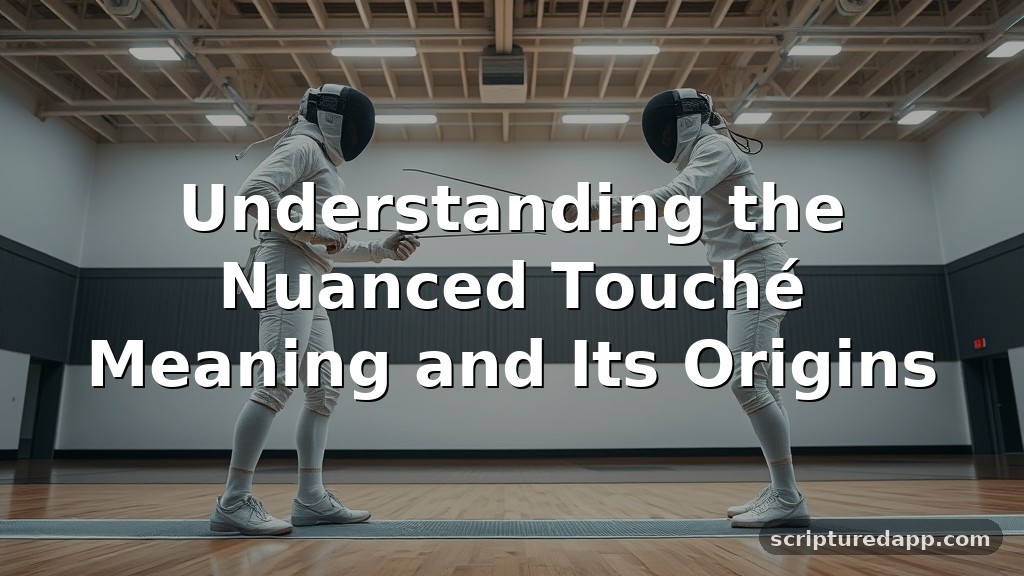
At its core, the term is a past participle of the French verb toucher, which translates directly to “to touch.” In the context of its original home, the French language, this wasn’t about physical affection but rather the literal act of a fencer’s blade making contact with their opponent.
When a fencer successfully landed a hit, they would call out this word to acknowledge that the other person had indeed scored a point. It serves as a formal, almost chivalrous admission that a strike was valid and well-placed.
The transition from the fencing piste to common English conversation highlights how we often adopt technical jargon to describe intellectual victories. Just as a fencer acknowledges a physical hit, we use the term to signal that someone has landed a metaphorical blow in a discussion.
It is a way of saying, “Your point is valid, and I acknowledge its accuracy.” By retaining this connection to its Old French origins, we maintain a sense of sportsmanship even when the subject matter is trivial or highly heated.
How the Word Functions in Modern Discourse
In contemporary society, the touché meaning has evolved into a standard rhetorical device used to concede a point gracefully. When you find yourself in a debate where the other person makes an observation that effectively undermines your own argument, saying this word acts as a social lubricant.
It prevents the conversation from becoming overly defensive or hostile. Instead, it signals that you are a rational participant who respects a sharp observation.
Using the word effectively requires a specific tone. It is rarely a shout; rather, it is often delivered with a slight nod or a wry smile. If you say it too aggressively, it can come across as sarcastic, which defeats the purpose of acknowledging the other person’s cleverness.
It is meant to be a nod to the “hit” you’ve just taken. When you use it correctly, you show that you are confident enough in your own position to admit when you have been outmaneuvered in a specific instance.
Common Misconceptions and Social Pitfalls
One of the most frequent errors people make is assuming the word is a universal “I surrender” button. That is not the case.
It is a specific acknowledgment of a single, well-made point, not an admission that your entire worldview is incorrect. If you concede every point with a heavy-handed usage of the term, it loses its impact and starts to sound like you are mocking your opponent.
Another pitfall involves the pronunciation and spelling. Because it is a loanword, many people struggle with the accent mark. While you don’t need to be a linguist to use it, knowing that it is a french past participle helps you remember that it is a distinct, borrowed term.
Avoid using it in highly formal professional emails unless you have a very close, informal relationship with the recipient. In a boardroom, a simple “that is a fair point” is almost always better than a theatrical “touché.”
Comparing Intellectual Parrying to Physical Fencing
To fully appreciate why we use this word, it helps to look at the parallels between a debate and a duel. In both scenarios, the goal is to land a clean hit while maintaining your own defense. The following table illustrates how the terminology of the sport maps onto the dynamics of a verbal exchange.
| Fencing Concept | Verbal Equivalent |
|---|---|
| The Lunge | Making a sudden, strong argument |
| The Parry | Deflecting a criticism or challenge |
| The Touché | Acknowledging a valid, inescapable point |
| The Bout | A spirited, back-and-forth discussion |
This comparison helps clarify why the word feels so appropriate in heated discussions. It frames the disagreement as a game of skill rather than a personal attack. By adopting this mindset, you can lower the emotional stakes of a conversation, turning a potential argument into a productive exchange of ideas.
The Evolution of Loanwords in English
The English language is notorious for absorbing words from other cultures, and this term is a perfect example of that process. We often look for words that capture a specific feeling that our native vocabulary lacks.
There isn’t a perfect one-word equivalent in our tongue that captures the exact spirit of a “fair hit” in an argument. Because of this, the word has become a permanent fixture in our lexicon, appearing in everything from casual text messages to high-brow literary critiques.
It is interesting to note how these words migrate across borders. While the dutch or italian languages have their own ways of expressing concession, the French version has a particular flair that has stuck in our collective consciousness.
It feels sophisticated yet accessible. This is a common pattern for many terms we pull from abroad; they arrive as exotic imports and eventually become so integrated that we forget they weren’t ours to begin with.
Identifying Topical Gaps in Common Definitions
Many people turn to a quick dictionary search to find the definition, but these entries often fail to explain the emotional weight behind the word. For instance, most sources define it as an acknowledgment of a hit, but they don’t explain the “why.”
Why do we feel the need to say it? It is because we value the appearance of being a “good sport.”
Another gap is the lack of context regarding when it is appropriate to use. You won’t find many guides that explain that this is essentially a verbal “white flag” for a specific micro-argument.
By recognizing that it serves as a boundary marker, you can use it to stop a circular argument in its tracks. It is the ultimate tool for de-escalation when you realize you’ve been “out-pointed” and don’t want to waste any more energy defending a losing position.
The Role of Tone and Body Language
Words are only half the battle. The delivery of this specific term is heavily dependent on your non-verbal cues.
If you are rolling your eyes while saying it, the meaning shifts from “I respect your point” to “I am annoyed by your point.” This is why it is often better to use it in face-to-face settings where your facial expression can clarify your intent.
In text-based communication, the risk of misinterpretation is much higher. Without the benefit of tone, a simple “touché” can be read as dismissive or sarcastic. If you decide to use it in a chat or email, consider adding a follow-up sentence to ensure your sincerity is clear.
Something like, “Touché, I hadn’t considered that angle,” removes any ambiguity and keeps the dialogue friendly. You can find more on the linguistic nuances of such terms at the Online Etymology Dictionary for further research.
Historical Context and Cultural Usage
Historically, the term was never intended to be used in polite company outside of the fencing hall. It was a technical instruction. However, as the 19th and 20th centuries progressed, the term leaked into literature and theatre.
Playwrights and authors began using it to characterize intellectual sparring matches between protagonists. This fictional usage is likely why it became a staple in our everyday vocabulary.
It is fascinating to see how a word that once belonged to a specific, elite sport became a household term for the general public. This reflects the broader trend of how language democratizes over time.
We take the specialized tools of the past and repurpose them for the needs of the present. While the original fencers would likely be baffled by us using their terminology to discuss politics or sports results, the core spirit of acknowledging a “hit” remains perfectly intact.
Variations and Synonyms for the Concept
While the term is unique, there are other ways to express the same sentiment if you feel that using a French loanword is a bit too pretentious for your specific situation. Depending on the setting, you might prefer to use a more plain-spoken alternative. These alternatives carry the same weight of concession but feel more grounded in everyday speech.
- Fair point: A simple, direct way to acknowledge someone’s logic.
- You’ve got me there: A more casual, slightly self-deprecating way to concede.
- That is a valid observation: Useful in professional or academic settings.
- I hadn’t thought of it that way: Highlights the value of the other person’s perspective.
- Point taken: Short, punchy, and effective for ending a minor dispute.
Choosing the right phrase depends on the audience. If you are among friends, “You’ve got me there” sounds much more natural than the more formal, borrowed term. Save the original for when you want to inject a bit of wit or theatrical flair into the conversation.
The Psychology of Concession
Why do we find it so hard to admit when someone else is right? The psychology behind this is complex, involving our ego and our desire to be perceived as knowledgeable.
By using a word that acknowledges a “hit,” we are essentially gamifying the process of losing an argument. It allows us to step back from our ego and look at the situation objectively.
This is a powerful social skill. When you can admit defeat with a smile and a quick acknowledgment of the other person’s skill, you actually end up looking more confident, not less. It signals that you are secure in your position.
You aren’t fragile enough to be shattered by one incorrect assumption or one missed fact. Embracing the touché meaning is, in many ways, an act of intellectual maturity.
Common Questions About the Usage
Is the word considered a compliment?
Yes, it is often viewed as a backhanded compliment. By saying it, you are admitting the other person was clever enough to find a flaw in your logic. It shows you respect their ability to construct a winning argument, even if it was at your expense.
Can you use the word in a professional setting?
It is generally best to avoid it in formal business environments. While it is not offensive, it can sound overly casual or even slightly smug depending on the office culture. Stick to clearer, more professional language to avoid any potential for misinterpretation in high-stakes meetings.
Does it always mean you are giving up?
Not necessarily. It means you are conceding that specific point.
You can still hold your own stance on the broader topic while acknowledging that your opponent landed a solid hit on a specific detail. It is a tactical retreat, not a total surrender of your argument.
What is the best way to respond if someone says it to you?
A simple nod or a polite smile is the best response. You don’t need to gloat or press your advantage further.
The goal of the exchange has already been reached: you made a point, and they acknowledged it. Keeping things gracious keeps the conversation open and productive.
Conclusion
Mastering the use of this classic term is about understanding both its history and its social utility. By viewing it as a way to acknowledge a sharp observation rather than just a way to end an argument, you can improve the quality of your daily interactions. It serves as a reminder that even in the heat of a debate, we can remain civil and appreciative of a well-crafted argument.
Next time you find yourself in a discussion where someone makes a point that catches you off guard, don’t feel the need to scramble for a defense. Acknowledge the hit, learn from the perspective offered, and keep the dialogue moving forward.
Language is a living tool, and knowing when to reach for the right word makes all the difference in how we connect with others. Feel free to explore these nuances and share your own experiences with using this timeless expression in your conversations.