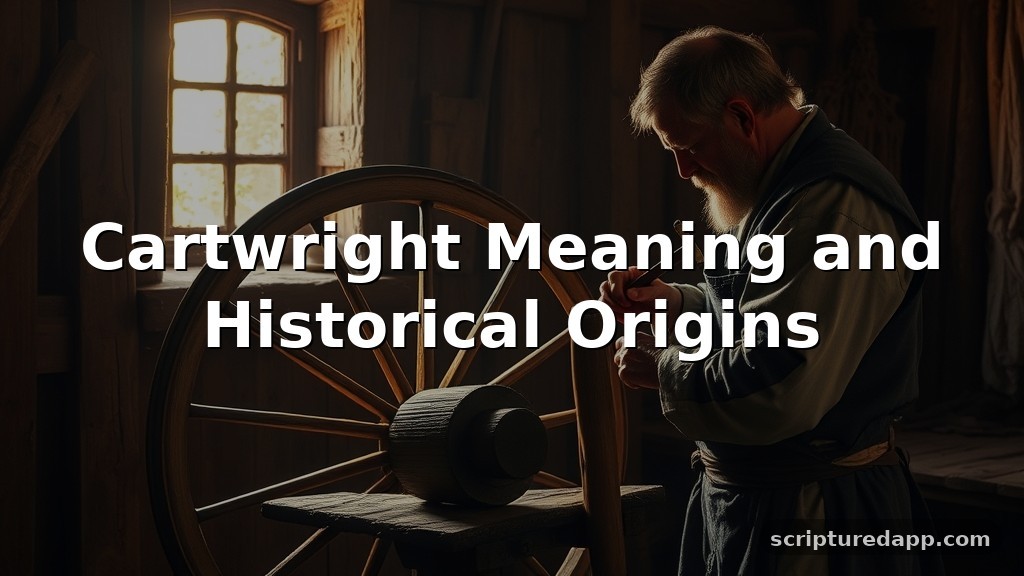

Exploring the historical roots of the cartwright meaning reveals a fascinating window into medieval trade and the evolution of language. Names often serve as a bridge to our ancestors’ daily lives, and this particular occupational surname describes a profession that was once essential to the infrastructure of society.
By looking at how these terms were formed, we gain a better understanding of why certain identifiers persist in modern culture. Whether you are researching your family history or simply interested in how language preserves the past, grasping the nuances behind this term provides a clearer picture of historical labor and the development of English surnames.
The Etymology of the Surname
At its core, the surname is a compound word derived from the Middle English period. It is formed by combining the noun cart with the suffix wright. In the context of medieval English, a wright was a skilled worker or a shaper of materials—essentially a carpenter or a craftsman.
Therefore, the definition of the occupation is straightforward: a person who makes carts and wagons. This was a highly specialized trade, as the construction of wooden transport vessels required precise knowledge of joinery, axle alignment, and durable materials like oak or ash.
The significance of this profession cannot be overstated during the era when transport relied entirely on animal power. Every village needed someone capable of building and repairing the vehicles that hauled crops, firewood, and trade goods.
Because this was a localized and vital service, it was natural for the trade to become a primary identifier for the person performing it. Over generations, what began as a description of a job title transitioned into a permanent family name.
Distinguishing Cartwright from Wheelwright
While the terms are often grouped together, there is a distinct difference between a cartwright and a wheelwright. A wheelwright focused exclusively on the complex engineering of wheels, which required a mastery of steam-bending wood and fitting iron rims.
Meanwhile, the cartwright was responsible for the broader assembly of the vehicle itself. This included the chassis, the body, and the seating arrangements necessary for the cart to function as a complete unit.
Despite these specialized roles, the two professions often overlapped in smaller communities. A single craftsman might be referred to as both, depending on which part of the vehicle he was working on at the time.
This crossover is common in occupational surnames, where the distinction between one type of woodworker and another became blurred in the eyes of the general public. Understanding this technical division helps clarify why these terms are categorized together in historical trade records.
Geographical Distribution and Historical Records
The surname is firmly rooted in the British Isles, with its earliest concentrations found in the northern and midland counties of England. Records from the 13th and 14th centuries often list individuals by their trade, providing a clear map of where these craftsmen were most active. As rural populations grew, the demand for local transport equipment pushed these workers into nearly every parish.
Over time, the name spread globally through migration and colonial expansion. You will find significant populations with this surname in countries like the United States, Canada, and New Zealand.
Each region has its own local history of how the name was documented, often reflecting the spelling conventions of census takers or parish clerks. For those interested in genealogy, tracing these records often leads back to specific rural English villages where the trade was passed down through apprenticeships.
The Evolution of Occupational Surnames
Occupational surnames were rarely static. They evolved alongside the industries they represented.
As manufacturing techniques improved and the industrial revolution changed how goods were produced, the role of the individual artisan began to decline. However, the names remained, serving as a permanent sign of the ancestor’s contribution to their community.
This process of naming is a core component of the English linguistic landscape. When surnames became hereditary, the name became disconnected from the actual job performed by the descendants.
Today, millions of people carry the name without any direct link to the craft of cart building. This shift from a functional job title to a hereditary marker is a prime example of how language adapts to changing social structures.
Cartwright in Modern Pop Culture
In contemporary society, the term has moved beyond its origins as a trade description. It frequently appears in media, literature, and even as a shorthand for specific character archetypes. For instance, the famous Cartwright family from the television series Bonanza brought the name into the living rooms of millions, associating it with values like family loyalty, hard work, and western resilience.
This cultural association has given the name a new layer of meaning that has nothing to do with the original medieval occupation. When people hear the name today, they are just as likely to think of a fictional rancher as they are a historical craftsman. This evolution illustrates how names are living entities that acquire new meanings through the stories we tell about them.
Technical Challenges in Medieval Cart Construction
Building a cart in the Middle Ages was not merely a matter of nailing boards together. It required a deep understanding of physics and material science.
The axle, for example, had to be perfectly centered to reduce friction and prevent the cart from veering off course. The materials had to be seasoned properly; if the wood were too green, it would shrink and loosen the joints, leading to a catastrophic structural failure under a heavy load.
A skilled cartwright had to source the right timber, often choosing different types of wood for different parts of the vehicle. For example, elm was often used for the hubs of the wheels because it was resistant to splitting, while ash was used for the frame due to its flexibility and strength. This level of technical expertise was the hallmark of a master craftsman, and it is why the trade was held in such high regard in rural communities.
Linguistic Variations and Spelling
The spelling of the name has seen many variations throughout history. In early records, it was common to see spellings like Cartwryght, Kartwright, or even simpler versions that reflected the local dialect. These variations occurred because literacy was not standardized, and names were often written down phonetically by clerks who were not always consistent.
When analyzing historical data, it is important to look for these variations to get an accurate picture of family lineage. The National Archives of the United Kingdom provides extensive resources on how these names were recorded in tax rolls, parish registers, and manorial records. By understanding these spelling shifts, researchers can bridge the gap between early medieval documents and modern records.
Topical Gaps: Addressing Common Misconceptions
Many people look for a “medical” or “slang” meaning for the term, often confused by the existence of the Cartwright Award in certain medical circles or urban dictionary entries that attempt to link the name to modern slang. It is important to clarify that there is no historical or etymological basis for these alternative definitions. The term is strictly an occupational noun.
Addressing the Medical Confusion
Some users mistakenly believe the term has a medical definition because of its association with specific historical hospital wings or research awards named after prominent individuals with the surname. These are eponyms, not definitions. The name itself remains tied to the historical trade of making wagons.
Urban Dictionary and Slang
Internet-based dictionaries often contain user-generated content that attempts to assign modern slang meanings to traditional names. These entries are anecdotal and do not represent the linguistic reality of the word. The term has no recognized slang usage in standard English dictionaries.
Comparative Analysis of Trade-Based Surnames
The following table compares the cartwright profession with other common trade-based surnames to show how they fit into the broader category of medieval labor.
| Surname | Trade | Primary Material |
|---|---|---|
| Cartwright | Cart Maker | Wood/Iron |
| Wheelwright | Wheel Maker | Wood/Iron |
| Smith | Metalworker | Iron/Steel |
| Cooper | Barrel Maker | Wood |
This comparison highlights how the English language categorized workers based on their specific contribution to the economy. Each of these names follows the same pattern of identifying the worker by the object they produced.
Tracing the Legacy of the Trade
Today, the legacy of the cartwright is preserved in museums and historical sites that demonstrate the tools and techniques of the trade. You can still see original examples of these vehicles in agricultural museums, showcasing the sophisticated joinery that defined the craft. These physical artifacts are the best way to understand the reality behind the name.
The preservation of these historical skills is vital for our understanding of pre-industrial technology. While we no longer rely on wooden carts for our daily logistics, the principles of joinery and structural engineering developed by these craftsmen are still relevant in modern carpentry and furniture making. The name serves as a reminder of an era where craftsmanship was the primary driver of technological progress.
- The term is a compound of the noun cart and the suffix wright.
- It originated as an occupational identifier in medieval England.
- The trade required expertise in woodworking, joinery, and vehicle assembly.
- The name eventually became a hereditary surname as trade-based identification became permanent.
- Regional variations in spelling are common in historical records due to inconsistent literacy standards.
Frequently Asked Questions
What does it mean to call someone a cartwright?
Calling someone by this name historically identifies them as a descendant of a person whose profession was building carts and wagons. There is no modern slang or derogatory meaning associated with the term; it is purely an occupational surname that has become hereditary over several centuries.
What is the definition of a cartwright?
The definition of a cartwright is a craftsman who specializes in the construction and repair of carts, wagons, and other horse-drawn vehicles. The term is derived from the Middle English words cart and wright, which literally translates to one who works with or creates carts.
What was the historical importance of a cartwright?
In medieval and early modern society, a cartwright was essential to the economy. They provided the primary means of transport for agricultural goods, fuel, and trade items. Without their specialized skills in joinery and vehicle construction, rural communities would have struggled to move heavy materials or distribute their produce.
Is the name Cartwright common?
Yes, it is a relatively common English surname found throughout the United Kingdom and in many English-speaking countries. Its prevalence is a result of the trade being widespread and necessary in almost every parish throughout England during the Middle Ages, leading to the name being adopted by many distinct families.
Conclusion
The cartwright meaning is deeply embedded in the history of English labor and the evolution of surnames. By recognizing that the name began as a functional description of a vital medieval trade, we can appreciate the connection between our modern identities and the skilled craftsmen of the past. Whether you are exploring your own family history or investigating the origins of language, understanding these occupational roots provides a meaningful link to a time when every object was crafted by hand.
If you have been researching your lineage or are interested in the history of trades, the best next step is to examine local parish records or historical trade guild archives in the regions where your ancestors lived. Engaging with these primary sources brings the history of the name to life.