
So you typed in “tristan name meaning in bible” and landed here — maybe you’re naming a baby, maybe you had a dream about the name, or maybe you just heard it somewhere and got curious. Either way, you’re in the right spot. The short answer is that Tristan does not appear in the Bible, but that’s honestly only half the story. The deeper meaning of this name lines up with some of the most powerful themes in Scripture: sorrow, endurance, and the kind of faith that gets refined through hard seasons. Let’s actually dig into where this name comes from and why so many Christian parents still feel drawn to it.
Is Tristan Mentioned in the Bible?
No, Tristan is not found anywhere in the Old or New Testament. There’s no character, tribe, or place by this name in Scripture. Tristan actually comes from Celtic and French roots, and it became a household name centuries later thanks to medieval European literature — specifically the legend of Tristan and Isolde.
That said, plenty of names parents love today (Aria, Brielle, even Wesley) have zero biblical roots either, and nobody really questions whether those are “allowed.” What matters more to most Christian families isn’t whether a name shows up in a concordance, it’s whether the meaning behind it reflects something true and good. And honestly, Tristan’s meaning checks that box pretty well once you look past the surface.
Origin and Etymology of Tristan
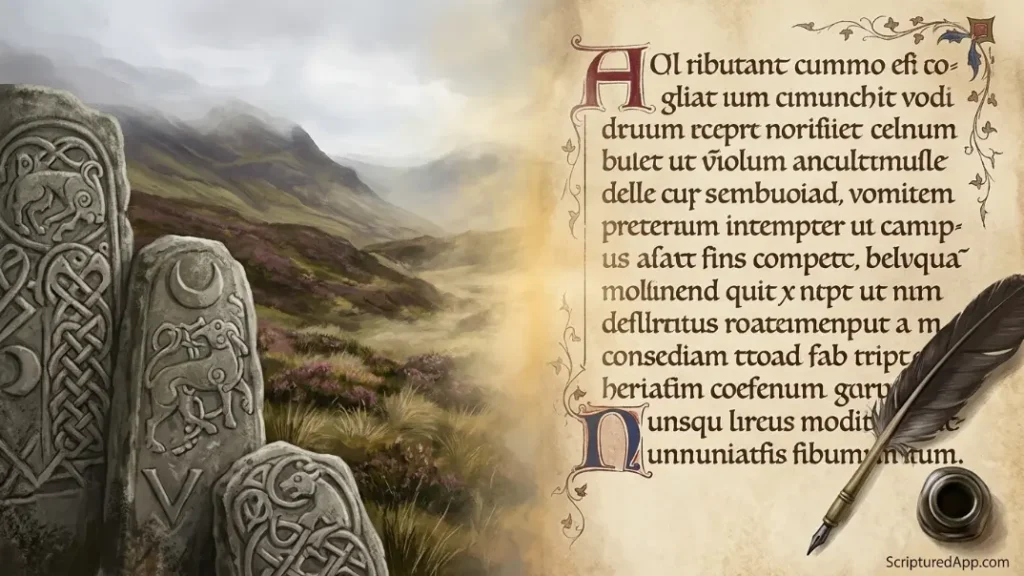
Tristan’s history is actually a little messier than most baby-name sites let on, which is kind of refreshing. Scholars generally trace it back to two different roots that eventually merged together.
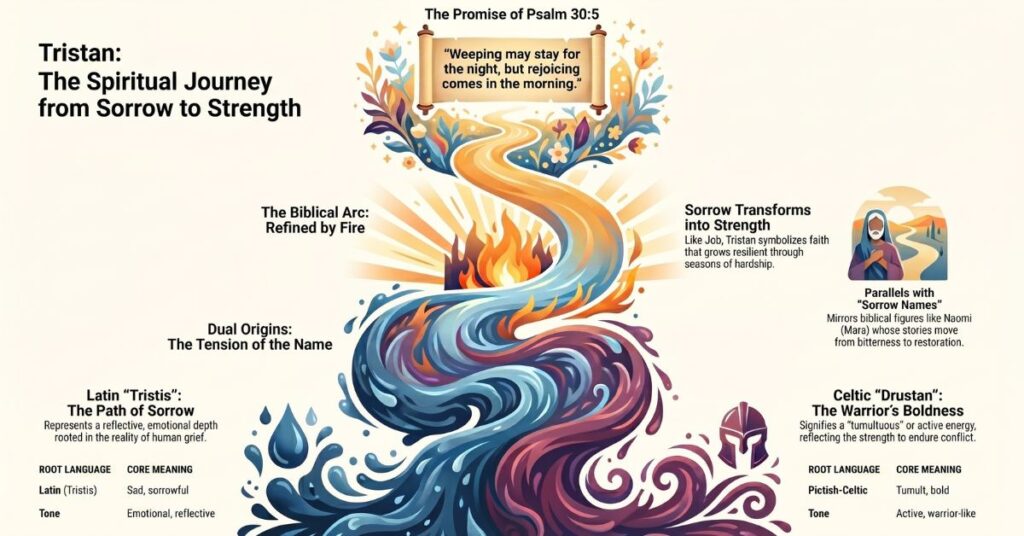
Tristan → derives from → Latin “Tristis” and Pictish “Drustan.” Both of these feed into the name we know today, and each one gives the name a slightly different flavor:
- Latin influence: The word tristis means “sad” or “sorrowful.” This is where most people get the idea that Tristan is a melancholy name, and it’s also the root that ties most directly into the legendary love story.
- Celtic influence: The older Pictish form, Drustan (related to drust), leans more toward “tumult,” “riot,” or even “bold.” This isn’t a passive sadness — it’s closer to the energy of a warrior or someone caught in conflict.
| Root | Language | Core Meaning | Tone |
|---|---|---|---|
| Tristis | Latin | Sad, sorrowful | Emotional, reflective |
| Drustan/Drust | Pictish-Celtic | Tumult, riot, bold | Active, warrior-like |
So really, Tristan carries two personalities baked into one name — one quiet and feeling, one bold and fighting. That tension is actually part of what makes the name so interesting from a faith perspective.
What Does Tristan Mean in the Bible? (Even Though It’s Not There)
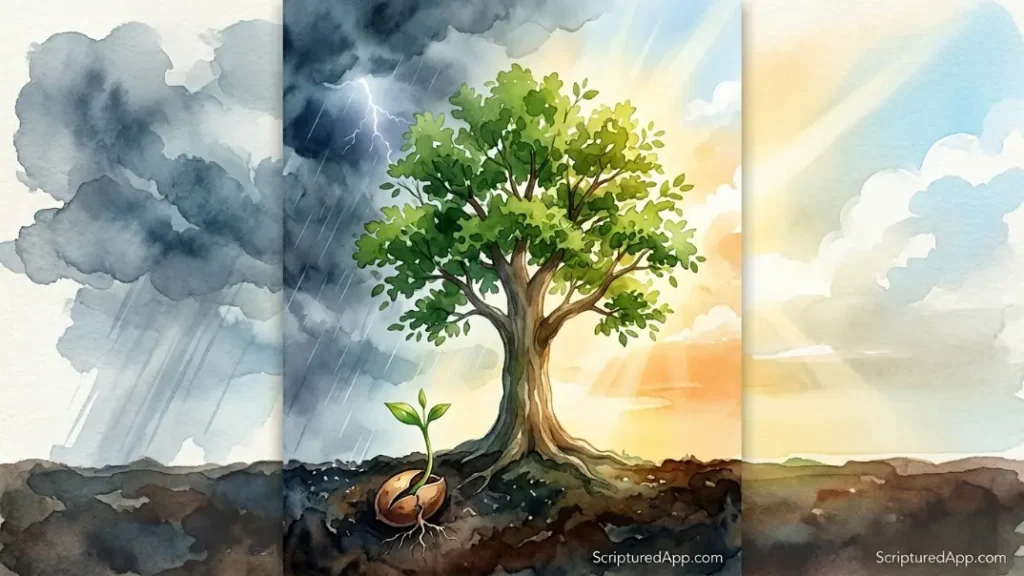
Here’s where it gets good. Even though you won’t find Tristan printed on a page of Scripture, the meaning behind it — sorrow that eventually turns into strength — shows up constantly in the Bible. Sorrow → leads to → spiritual refinement, and that’s basically the whole arc of several major biblical figures.
Think about it this way: the Bible doesn’t shy away from sadness. It doesn’t pretend grief is something to skip past. Job lost everything. David wrote half the Psalms while weeping. Even Jesus himself wept at Lazarus’s tomb. So a name rooted in “sorrow” isn’t out of step with biblical values, it’s actually deeply in step with them.
Job’s Story and the Meaning of Tristan
Job → endured → catastrophic sorrow → and remained → faithful to God. That single sentence basically sums up the entire book of Job, and it’s the clearest biblical parallel to Tristan’s meaning. Job lost his family, his health, and his wealth, yet he still said in Job 1:21, “the Lord gave and the Lord has taken away; may the name of the Lord be praised.” That’s not denial of sorrow — that’s sorrow held together with trust.
Bible Verses That Reflect Tristan’s Meaning
A handful of verses keep popping up whenever people search for this topic, and for good reason, they speak directly to the sorrow-to-strength arc.
- Psalm 30:5 (NIV) — “Weeping may stay for the night, but rejoicing comes in the morning.” This one basically sums up Tristan’s whole symbolic journey in a single line.
- Romans 8:18 (NIV) — Paul reminds believers that present suffering can’t even compare to the glory that’s coming. Suffering isn’t the final word.
- Psalm 34:18 (NIV) — “The Lord is close to the brokenhearted and saves those who are crushed in spirit.” If sorrow is part of someone’s story, this verse says God is closest right there in it.
- James 1:2-3 (NIV) — Trials, of all things, “produce perseverance.” Tristan’s tumultuous Celtic root actually pairs nicely with this verse.
- Isaiah 53:3 (NIV) — Even Christ is described as “a man of suffering, familiar with pain,” which gives sorrow a kind of holy weight rather than something shameful.
None of these verses mention Tristan directly obviously, but together they build a pretty strong case that sorrow, in biblical terms, is rarely the end of someone’s story.
How Christians Actually Assign Spiritual Meaning to Non-Biblical Names
This is the part most articles on this topic skip right over, and it’s honestly the question people are really asking underneath all the searches: how exactly does a name with zero biblical roots end up being treated as “spiritually meaningful” by Christian families?
It’s not random, and it’s not just wishful thinking either. There’s actually a fairly consistent pattern Christians have followed for centuries:
- Etymological bridging — Believers look at what the name literally means (in this case, sorrow or tumult) and find Scripture passages that speak to that same emotional or spiritual territory. This is exactly what’s happening when Tristan gets linked to Psalm 30:5.
- Character parallel — Rather than finding a name match, people find a person match. Tristan’s sorrow gets compared to Job’s suffering or David’s lament psalms, not because the names are similar, but because the emotional arc is.
- Virtue extraction — The name’s meaning gets distilled down into a value (endurance, compassion, resilience) rather than a literal definition, and that value is then framed as a “Christian trait” worth naming a child after.
- Patron or namesake tradition — In some Christian traditions (especially Catholic ones), parents pair a non-biblical first name with a confirmation or middle name tied to a recognized saint, which gives the child a biblical or saintly anchor even if the first name itself isn’t scriptural.
So when someone says “Tristan symbolizes faith through suffering,” what they’re really doing is step two and three of that process — borrowing Job’s story and extracting the virtue of endurance from it. It’s a legitimate and pretty old practice, it’s just rarely explained out loud, which is probably why so many parents feel a little unsure if it’s “okay” to do.
Tristan in Hebrew and Greek — Does It Carry Any Meaning?
Tristan has no native meaning in Hebrew or Greek because it simply isn’t a Hebrew or Greek word to begin with — it’s Celtic through and through. In Hebrew, the name can only be transliterated phonetically as טריסטן, and in Greek it becomes Τρίσταν. Neither version translates into an actual word with its own meaning; it’s purely a sound-for-sound conversion, kind of like writing “pizza” in Hebrew letters. It doesn’t suddenly become a Hebrew word just because it’s spelled with Hebrew characters.
This trips a lot of people up because biblical names like Daniel or Hannah genuinely do carry Hebrew meaning baked into them. Tristan just isn’t built that way, and that’s fine — it doesn’t make the name less meaningful, it just means the meaning has to come from etymology and symbolism rather than direct translation.
Spiritual Symbolism of the Name Tristan

If you strip away the literary legend and the linguistics for a second, what’s left is a pretty compelling spiritual arc. A lot of pastors and Christian writers frame it in four stages:
Sorrow → Strength. Pain, when carried with faith, tends to build resilience that comfort alone never really produces. This is basically refining fire imagery — gold doesn’t get purer by sitting around, it gets purer through heat.
Trials → Trust. Every hard season is, in a weird way, an invitation to trust God a little more than the last time. It’s less about intellectual belief and more about lived, tested faith.
Pain → Purpose. Nothing in someone’s story is wasted, not even the painful parts. A lot of ministry and compassion work actually comes out of people’s worst seasons, not their easiest ones.
Faith → Restoration. This is really the whole point. The sorrow isn’t the destination, restoration is. Psalm 30:11 puts it beautifully — God turns mourning into dancing.
Tristan in Legend vs. Christian Truth
It’s worth pausing here because the medieval legend of Tristan and Isolde and the Christian reading of the name are honestly pulling in two very different directions, even though they share the same root word.
| Aspect | Medieval Legend | Christian Interpretation |
|---|---|---|
| View of sorrow | Tragic, unavoidable fate | Temporary and purposeful |
| Source of hope | Romantic love | Christ and God’s promises |
| Outcome | Death and unfulfilled longing | Redemption and restoration |
| Driving force | Passion and destiny | Faith and divine purpose |
The legend ends in tragedy — Tristan and Isolde’s love story is genuinely one of the saddest in medieval literature. Christian symbolism takes that same emotional rawness and basically redirects it toward hope instead of doom. Same root word, completely different ending.
How Tristan Compares to Other “Sorrowful” Biblical Names
One thing most articles never actually do is put Tristan side-by-side with names that already carry sorrow-related meanings in Scripture itself. This is a genuinely useful comparison if you’re trying to understand where Tristan fits in the bigger picture.
- Job — not a name meaning, but a person whose entire identity became synonymous with suffering held with integrity.
- Mara (Naomi’s chosen name in Ruth 1:20) — literally means “bitter,” and Naomi adopts it after losing her husband and sons. Like Tristan, it’s a sorrow-rooted name that later gets reversed through restoration.
- Jabez — means “he causes pain,” referencing the pain of his mother’s childbirth, yet he prays for blessing and God grants it (1 Chronicles 4:10).
What’s interesting is that Tristan, Mara, and Jabez all follow the exact same narrative shape — a name born out of sorrow that ends up symbolizing the opposite by the time the story’s done. Tristan isn’t biblical, but it fits right into this lineage of “sorrow names” almost perfectly.
Is Tristan a Good Christian Name?
Yes, Tristan works well as a Christian name, even without a biblical origin. A lot of Christian parents choose names based on the values they hope to instill rather than strict scriptural presence, and Tristan’s meaning lines up with values like endurance, compassion, and quiet strength.
- It reflects honest emotion rather than forced positivity, which is actually very biblical (the Psalms are full of lament).
- It pairs naturally with verses about comfort and restoration.
- Its dual Latin-Celtic roots give it both a tender side (sorrow) and a strong side (boldness/tumult).
Common Nicknames and Spelling of Tristan
Most people who go with Tristan end up using a shorter nickname day-to-day. The most common ones are Tris (modern and clean), Stan (a bit more old-school), and occasionally Tan for a more unique option. As for spelling, Tristan is the standard and most widely recognized form, though variants like Tristen, Triston, and Tristyn do show up, usually for stylistic reasons rather than any meaning difference.
Final Thoughts
At the end of the day, Tristan tells a story of sorrow that doesn’t stay sorrowful. It starts in Latin sadness and Celtic tumult, gets shaped into tragedy through medieval legend, and then — through a Christian lens — gets pulled toward something hopeful instead. Sorrow becomes strength. Trials become trust. Pain becomes purpose. Faith becomes restoration. Even though you won’t find this name written in any biblical manuscript, its meaning sits comfortably alongside some of the Bible’s most honest and hopeful truths.
FAQs
Is Tristan a biblical name?
No, Tristan doesn’t appear in Scripture. It’s of Celtic and Latin origin, but its meaning of sorrow connects well with biblical themes like endurance, faith, and redemption found throughout the Old and New Testament.
What does the name Tristan mean spiritually?
Spiritually, Tristan represents sorrow transformed into strength. Many Christians link it to figures like Job, who stayed faithful through suffering, suggesting the name reflects resilience, compassion, and faith refined through hardship.
What Bible verse fits the meaning of Tristan?
Psalm 30:5 fits well: “Weeping may stay for the night, but rejoicing comes in the morning.” It mirrors Tristan’s meaning of sorrow giving way to eventual joy and restoration.
Is Tristan a good name for a Christian baby?
Yes, many Christian parents choose Tristan because its symbolic meaning — sorrow leading to strength and faith — aligns with biblical values, even though the name itself has no direct scriptural origin.