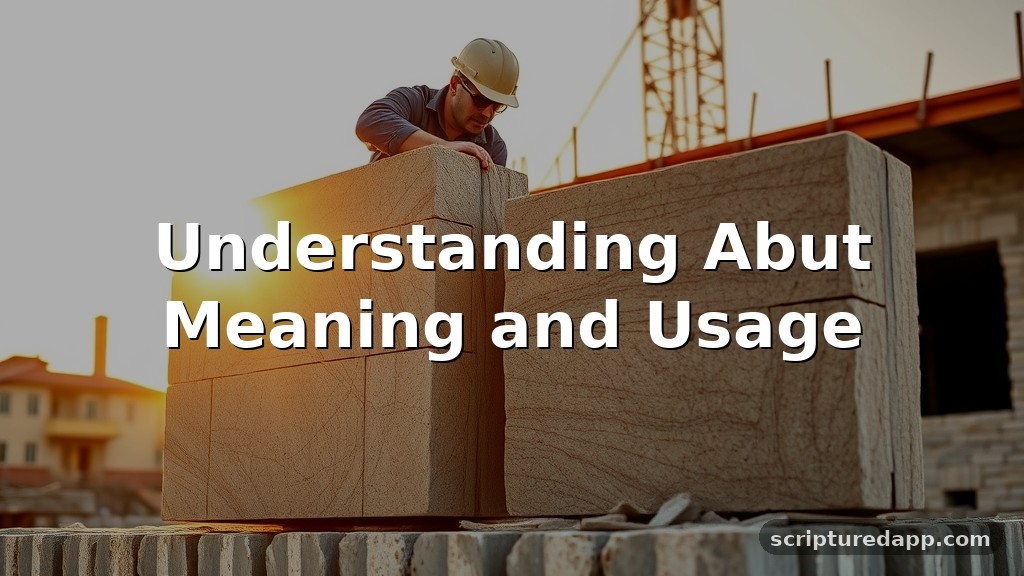

When you encounter the word abut in a sentence, it often signals a physical connection or a precise boundary between two objects. Many people wonder about the exact abut meaning because it appears frequently in technical, legal, and architectural contexts where precision is paramount.
Mastering this term helps you describe spatial relationships with clarity, whether you are discussing property lines or the way structural components meet. By exploring its origins, grammatical nuances, and practical applications, you will gain a firm grasp of how to use this precise verb effectively in your own writing and professional communication.
The Etymological Roots of Abut

Understanding the history of a word often sheds light on its current usage. The term originates from the Old French word abuter, which literally means to touch at the end.
This roots the word in the concept of two things coming together at their extremities. It is fascinating to look at how this evolved through various languages, including influences from the Middle French bouter, meaning to thrust or push.
This historical context explains why we use the word today to describe things that are pressed against one another. When something abuts another, there is a sense of one object reaching its limit and making contact with a second object.
You can see the connection to the word butt, as in the end of a log or a physical projection. This linguistic lineage highlights the importance of physical boundaries, which remains the primary focus of the word in modern English.
Defining the Core Concept
At its most fundamental level, the term describes a state where two items share a common boundary. To say that one piece of land abuts another is to state clearly that they share a property line.
It implies that there is no space between the two entities; they are directly touching. This is why you will rarely see the word used to describe two items that are merely near each other or in the same vicinity.
The distinction is critical because it separates this term from synonyms like adjacent or nearby. While adjacent indicates proximity, it does not necessarily require physical contact.
When you describe a fence that abuts a neighbor’s garage, you are specifying that the fence is physically pressed against or meeting the structure of the garage. This level of specificity is what makes the word so valuable in fields where ambiguity can lead to significant real-world consequences, such as in land surveying or structural engineering.
Legal Applications and Property Boundaries
In the world of real estate and law, the word carries significant weight. When a legal document states that a parcel of property abuts a public road, it defines a specific legal relationship between the land and the infrastructure.
This terminology is used to establish access rights, maintenance responsibilities, and even tax obligations. A misinterpretation of this term in a contract could lead to litigation or disputes over land usage.
Legal professionals rely on this precision to ensure that boundaries are defined without room for interpretation. If a developer claims that their project site abuts a protected wetland, they are making a claim about the physical contact between their development and that sensitive area.
This simple verb acts as a definitive marker in property descriptions, surveys, and zoning ordinances. It serves as a bridge between the physical reality of the land and the abstract nature of property rights.
Architectural and Construction Contexts
Construction professionals use the term to describe how building materials or structural elements meet. For instance, you might hear a carpenter mention how a piece of trim abutted against a door frame.
This signifies that the wood was cut to fit exactly against the frame, leaving no gap. Achieving this level of precision is often referred to as a butt joint, which is a common technique in woodworking and framing.
The structural integrity of a building often depends on how different components meet and transfer loads. When a beam is designed to abut a load-bearing wall, the connection must be secure to ensure stability.
Architects use this language to instruct builders on how to assemble complex structures. By ensuring that components are correctly aligned, they prevent gaps that could lead to air leaks, water intrusion, or structural failure.
Linguistic Variations and Pronunciation
The pronunciation of this word is straightforward, following standard English patterns for two-syllable verbs. You stress the second syllable, emphasizing the “but” sound.
While it may seem like a simple word, its usage can vary depending on the context, from formal legal documents to casual descriptions of a backyard fence. Understanding these variations helps you integrate the word naturally into your vocabulary.
You might encounter different forms of the word as you read through various technical documents:
- Abut: The base form of the verb used in the present tense.
- Abuts: The third-person singular form, common when describing a single object.
- Abutted: The past tense, used when describing a completed action or historical boundary.
- Abutting: The present participle, used to describe an ongoing state of contact.
This flexibility allows you to use the term across different tenses and subjects without awkward phrasing. Whether you are writing a report or explaining a construction detail, choosing the right form of the word ensures your message remains clear and professional.
Synonyms and Semantic Relationships
While the term is specific, it is helpful to know how it relates to other words in the English language. Synonyms such as “adjoin,” “border,” and “touch” share some of the same meaning but often lack the precise connotation of meeting at an edge. For example, while two states might adjoin each other, saying they abut implies a more focused look at the specific line of contact.
To better understand these relationships, consider the following table that compares common terms used to describe spatial proximity and contact:
| Term | Core Meaning | Level of Contact |
|---|---|---|
| Abut | To touch at an edge or end | Direct contact |
| Adjoin | To be next to or share a boundary | Usually shared border |
| Adjacent | Located nearby or next to | Proximity, not necessarily contact |
| Border | To form a boundary around | External contact |
By reviewing these distinctions, you can select the word that best fits your specific intent. If you want to emphasize the physical meeting of two edges, this is your best choice. If you simply want to note that two things are next to each other, you might opt for a broader term like adjacent.
Addressing Common Topical Gaps
One common question that often arises is whether the term can be used in non-physical contexts. While its primary meaning is spatial, it can sometimes be used metaphorically to describe events or concepts that are closely linked or that meet at a point of transition.
However, using it for abstract concepts can sometimes sound forced. Stick to physical or structural descriptions to ensure your writing remains clear and authoritative.
Another gap involves the confusion between “abut” and “butt.” While they share an etymological root, they serve different functions. You “butt” something against an object, which is an action.
You say that an object “abuts” another, which is a state of being. Remembering this distinction will help you avoid common grammatical errors. For those looking for further reading on linguistic precision, you can consult the Oxford English Dictionary for more detailed etymological histories and usage examples.
Medical and Biological Usage
Beyond architecture and law, the term appears in medical and biological contexts, particularly when discussing anatomy. Doctors might describe how a bone or an organ abuts a nerve or a blood vessel.
This usage is crucial for diagnostic imaging, where radiologists look for evidence of structures pressing against one another. If a tumor abuts an artery, it indicates a high level of clinical concern that requires surgical planning.
In biology, you might see the term used to describe how cell membranes or tissues meet. Researchers studying cellular structures often need to specify whether cells are merely adjacent or if they are in direct contact, as this influences cell signaling and chemical transport. In these highly technical fields, the word is an essential tool for describing the precise spatial organization of the human body.
Common Misconceptions and Usage Errors
A frequent error is assuming that the word implies a merger or a fusion. Two things can abut each other without becoming a single unit.
They remain distinct entities that happen to share a border. If you are writing a report, make sure you don’t imply that the objects are joined, welded, or merged unless that is actually the case.
Another mistake is using the word to describe things that are distant. You would not say that a house in New York abuts a house in New Jersey. The word carries a requirement for immediate, direct contact.
If there is a road, a sidewalk, or a buffer zone between two objects, they do not abut. Being precise with this word helps maintain your credibility as a writer who understands the nuances of spatial relationships.
Practical Tips for Effective Communication
When you incorporate this word into your writing, consider the audience. In a technical or legal document, the word is perfectly appropriate and expected.
In more casual writing, you might prefer a simpler phrase like “touches” or “borders.” However, if you want to convey a sense of precision and professional expertise, this term is an excellent choice.
Try to avoid overusing it. Because it is a specific, high-utility word, it stands out. Using it once or twice in a document is usually enough to establish the spatial relationship.
If you find yourself using it in every paragraph, look for synonyms or rephrase your sentences to maintain a natural flow. Good writing is about finding the right balance between precise vocabulary and readable, engaging prose.
Frequently Asked Questions
What is a good synonym for abut?
A good synonym depends on your intent. If you mean to touch at an edge, “adjoin” or “border” are excellent choices. If you want to emphasize physical contact, “touch” or “meet” can also work, though they lack the specific connotation of an edge-to-edge connection that “abut” provides.
Is abut used in medical terminology?
Yes, it is common in medical imaging and anatomy. Doctors use it to describe when an organ, bone, or growth is physically touching another structure. For example, a report might note that a mass abuts a major nerve, which is a critical detail for surgical planning.
Can things abut without being joined?
Absolutely. Two objects can share a border or touch edges without being physically attached or fused. A property line is a perfect example: two plots of land abut each other, but they remain separate legal entities with distinct ownership, maintenance, and usage rights.
How do I use this word in a sentence?
Use it to describe direct contact between two objects. For example: “The garage abuts the back fence.” You can also use the past tense: “The new addition abutted the original structure seamlessly.” It works best when you are clearly defining a spatial boundary or meeting point.
Summary and Next Steps
Mastering the use of this specific term allows you to communicate spatial relationships with a high degree of accuracy. Whether you are dealing with legal property lines, architectural blueprints, or medical diagnostics, the word provides a clear, professional way to describe items that meet at an edge. By understanding its origins, avoiding common usage errors, and choosing the right form for your context, you can elevate the precision of your writing.
We invite you to practice using this term in your next technical or descriptive project. Pay attention to how it clarifies the physical world around you, and notice how often it appears in professional documentation.
By integrating this word naturally, you will find that your descriptions become more concise and authoritative. If you have any specific examples or further questions about how to apply this in your work, feel free to explore more resources on precise language and technical writing.