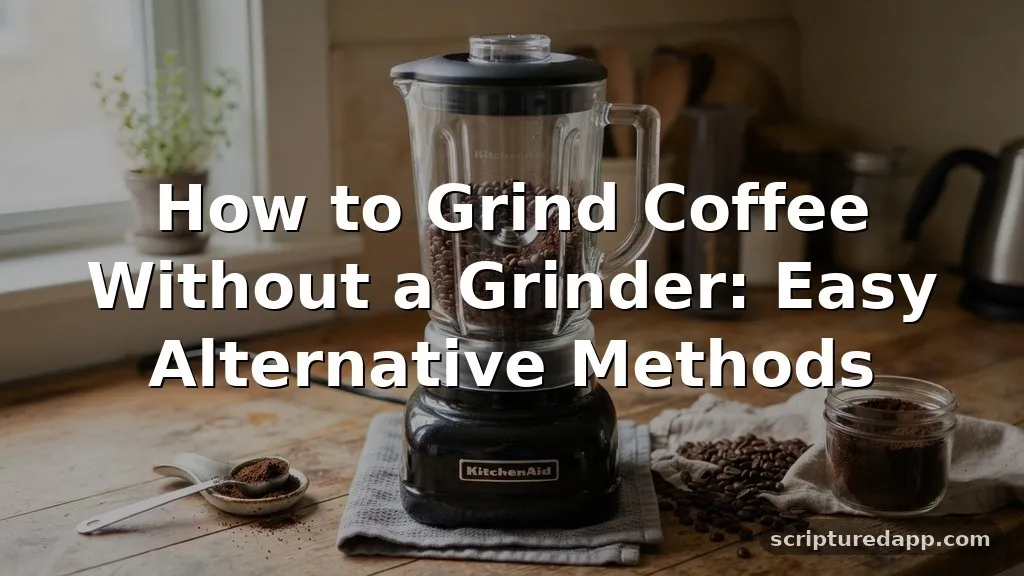

If you woke up craving a fresh cup of coffee only to realize your electric burr mill just died, you probably wondered how to grind coffee without a grinder. Nobody wants to settle for instant crystals or a sad trip to the local cafe in their pyjamas when there are actual whole beans sitting right on the counter.
Luckily, your kitchen is full of heavy, blunt, or spinning household items that can shatter beans into usable particles. You just need to know which tools actually work and how to avoid turning your morning roast into an uneven, powdery mess.
Using a Kitchen Blender for Uniform Grounds
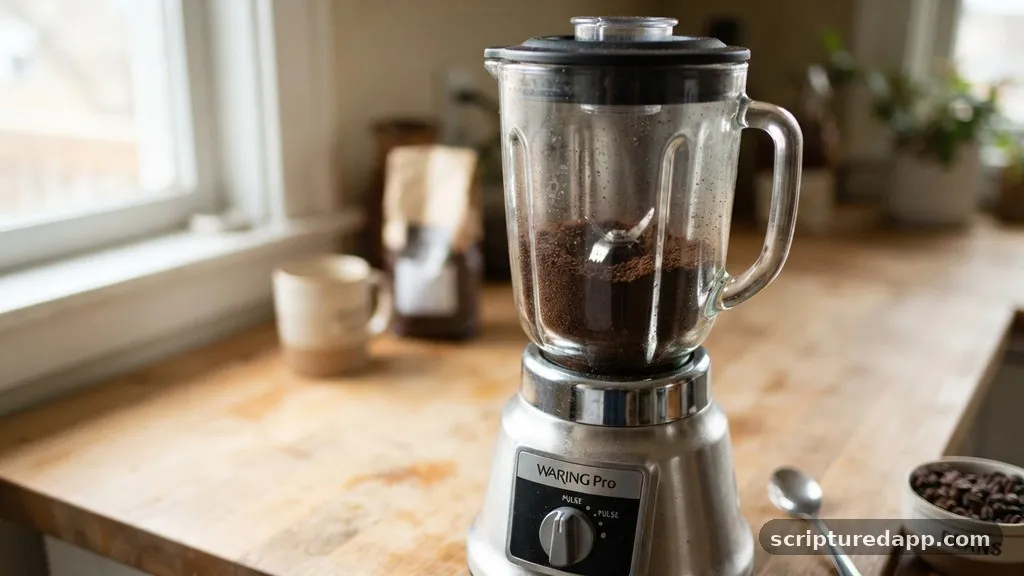
A standard countertop blender represents the most accessible electric appliance for pulverizing coffee beans when you lack a dedicated burr or blade unit. To achieve the best results, pulse the motor in short, controlled bursts rather than running it continuously on high speed. Continuous blending generates intense friction heat, which prematurely cooks the essential oils and leaves your brew tasting burnt or bitter before hot water ever touches the grounds.
Pulse about five to ten times, shake the pitcher to redistribute the trapped chunks, and repeat until you reach the desired grind size. This approach works reasonably well for drip machines and immersion methods, though you might still spot some stray boulders mixed alongside ultra-fine dust.
Crushing Beans with a Mortar and Pestle
The traditional mortar and pestle offers a remarkably tactile, manual way to process coffee beans without relying on electricity or noisy motors. Place a small handful of whole beans into the heavy stone or ceramic bowl, then use a rolling and crushing motion with the pestle. You have complete control over the pressure applied, which drastically reduces the amount of unwanted coffee dust compared to high-speed blades.
It takes a bit of elbow grease and a few minutes of steady pacing, but the resulting grind coffee particles remain remarkably uniform. This traditional technique is especially well suited for Turkish coffee or manual pour-over cones where particle consistency directly dictates extraction quality.
Flattening Beans with a Rolling Pin
A sturdy rolling pin combined with a heavy cutting board provides a surprisingly effective makeshift milling station for your morning caffeine fix. Pour your beans into a heavy-duty freezer bag or wrap them tightly inside a clean kitchen towel to prevent them from bouncing across the kitchen floor. Press down firmly and roll back and forth over the pouch, applying heavy body weight to crack the tough outer shells.
Once the beans fracture into smaller pieces, switch to a hammering or crushing motion with the rolling pin to refine the texture further. While this method requires some physical effort, it creates very few fines and keeps your kitchen counters remarkably clean.
Alternative Household Crushing Implements
When standard kitchen gadgets are unavailable, alternative household implements like a clean hammer, a cast-iron skillet, or a heavy-bottomed saucepan can save your morning routine. Pour the beans onto a secure, flat surface protected by parchment paper, then gently tap them until they break apart.
| Tool Name | Effort Level | Grind Consistency | Best Brew Style |
|---|---|---|---|
| Kitchen Blender | Low | Inconsistent | Drip Coffee |
| Mortar and Pestle | High | Very Good | Pour Over |
| Rolling Pin | Medium | Moderate | French Press |
| Hammer or Mallet | High | Variable | Cold Brew |
Each of these household alternatives comes with distinct trade-offs regarding particle size and effort, meaning you should match your chosen tool to the brewing equipment you plan on using.
- Ensure your chosen crushing surface is impeccably clean to avoid strange food flavors transferring into your morning cup.
- Process small batches at a time to maintain better control over the final texture and particle distribution.
- Adjust your water temperature and steeping time based on how coarse or fine your makeshift grounds end up looking.
- Store any leftover cracked beans in an airtight container to preserve their delicate aromatic compounds for later.
Selecting the Right Texture for Your Brew
Matching your makeshift particle size to your specific brew style remains essential for extracting a balanced, pleasant flavor profile. Coarse fragments work wonders in a French press because larger particles prevent sludge from clogging the mesh filter plunger. Medium textures suit standard drip makers and flat-bottom basket filters, whereas ultra-fine powders are strictly necessary for espresso machines or Turkish cezves.
If your makeshift technique produces too many fine particles, your cup coffee might taste aggressively bitter due to over-extraction. Conversely, overly chunky bits will yield a watery, sour beverage because the water cannot extract enough soluble compounds in time.
Preventing Common Kitchen Milling Mistakes
Attempting to pulverize whole beans without proper equipment often leads to frustrating culinary mishaps if you rush the process or ignore basic physics. Many people make the mistake of over-filling their blender or food processor, which traps whole beans at the bottom while the top layer remains untouched.
Another frequent error involves ignoring the heat generated by friction, which ruins the delicate aromatic oils before the brewing process even begins. Take your time, inspect your grounds frequently, and resist the temptation to mash everything into a uniform powder unless your specific brewing vessel demands it.
Frequently Asked Questions
Can I use a food processor instead of a blender?
Yes, a food processor works similarly to a blender for crushing beans, though its wider base can scatter particles into the corners. Pulse carefully and scrape down the sides often to ensure even results.
Is it possible to get an espresso grind without a mill?
Achieving a true espresso grind without specialized burrs is extremely difficult. Most manual alternatives produce particles that are too coarse, leading to weak and under-extracted shots.
How do I keep bean pieces from flying everywhere?
Always place your beans inside a sealed ziplock bag, heavy-duty plastic pouch, or folded towel before hammering or rolling them to contain stray fragments.
Will manual crushing damage my cutting board?
Heavy rolling or pounding can dent wooden or plastic boards. Use a sturdy silicone mat, a thick towel underneath, or a granite countertop to protect your kitchen surfaces.
Conclusion
Mastering how to grind coffee without a grinder is a handy skill that saves your morning routine when your primary equipment fails unexpectedly. By utilizing everyday kitchen items like blenders, rolling pins, or mortars with patience and care, you can still enjoy a genuinely satisfying brew. Experiment with these alternative techniques the next time you find yourself without proper gear, and join the conversation by sharing which makeshift tool worked best for your kitchen setup.
Best Coffee Grinders Hub guide Best Coffee Grinders Hub buying guide Best Coffee Grinders Hub BestCoffeeGrindersHub.com Best Coffee Grinders Hub reviews choosing the right grinder this coffee grinder guide Best Coffee Grinders Hub buying guide Best Coffee Grinders Hub guide BestCoffeeGrindersHub.com best coffee grinder guide Best Coffee Grinders Hub reviews Best Coffee Grinders Hub guide choosing the right grinder this coffee grinder guide burr vs blade grinder guide bestcoffeegrindershub.com check out this buying guide Best Coffee Grinders Hub reviews this coffee grinder guide best coffee grinder for espresso best budget coffee grinder guide best coffee grinder guide Best Coffee Grinders Hub reviews Best Coffee Grinders Hub choosing the right grinder Best Coffee Grinders Hub buying guide Best Coffee Grinders Hub buying guide Best Coffee Grinders Hub Best Coffee Grinders Hub