

Few things match the aroma of freshly brewed coffee, but discovering your mechanical or electric grinder has broken down just as you want to make a morning cup coffee can ruin the routine. Fortunately, learning how to grind coffee without a coffee grinder is entirely achievable using common household tools that crush or slice whole coffee beans into usable particles. Whether you are dealing with a power outage or simply traveling without your favorite kitchen gear, mastering alternative techniques ensures you never have to resort to instant coffee when cravings strike.
Every alternative method approaches the delicate balance of particle reduction differently, requiring careful management of your brewing style. From high-speed countertop appliances to old-school manual crushing tools, each substitute impacts the eventual extraction rate and flavor profile. Exploring these kitchen workarounds will help you adapt to any situation while maintaining control over your morning routine.
Using a Kitchen Blender for Rapid Particle Breakdown
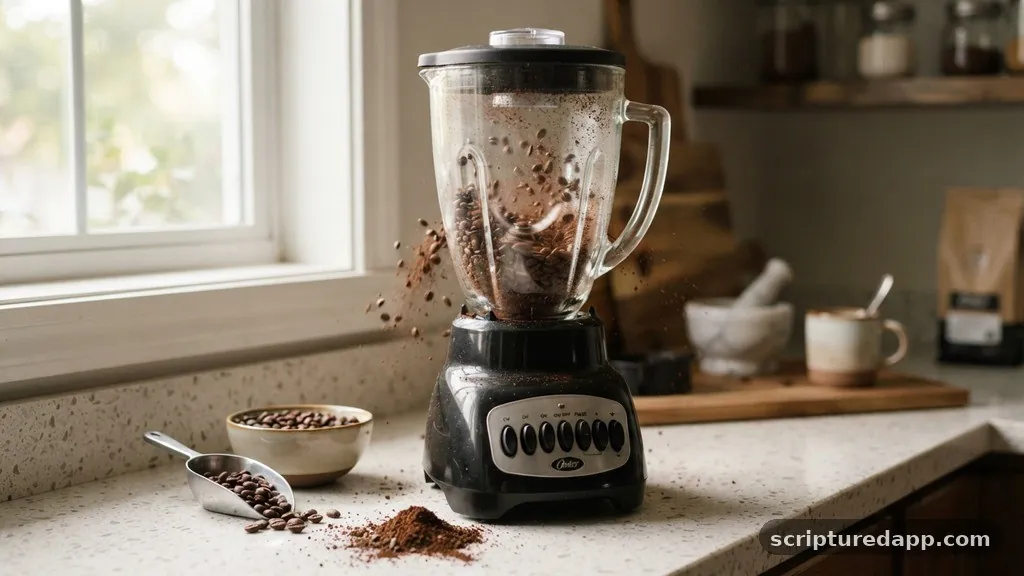
A standard kitchen blender is often the quickest appliance-based solution when you need to grind coffee in a pinch. Because the stainless steel blades spin at incredible speeds, they can easily shatter whole coffee beans into smaller particles.
However, standard blenders tend to create an uneven distribution of sizes, producing everything from large chunks to powdery dust in the same batch. To mitigate this issue, you must pulse the machine in short, controlled bursts rather than running it continuously on high speed.
Continuous blending generates excess friction and heat, which can prematurely cook the delicate volatile oils inside the beans and ruin the flavor before extraction even begins. To achieve an even grind size, tilt the blender container slightly while pulsing so the beans fall back into the path of the blades more uniformly. This technique works exceptionally well for coarser brew styles like a French press, where uniform particle size matters slightly less than it does for pressurized espresso machines.
Optimizing Your Blender Settings
Achieving the right consistency requires specific handling of your appliance. Always start with a dry, completely clean pitcher to prevent unwanted flavors from transferring into your morning brew.
Pulse the machine for roughly two seconds at a time, shaking the container between bursts to redistribute the bean mass. If your appliance has a designated ice-crush mode, that setting often provides a more rhythmic impact that mimics a true burr mechanism better than standard pureeing speeds.
Employing a Food Processor for Larger Batches
A food processor operates on a similar principle to a blender but features a wider base and flatter blade design that can handle larger quantities of whole beans at once. While this makes it convenient for processing enough material for a full pot, the large surface area means many beans will avoid the blades entirely during the first few rotations. You will need to stop the machine frequently, scrape down the sides with a spatula, and redistribute the material to ensure an even texture.
Because food processors cut rather than crush, they frequently produce a wide spectrum of particle sizes that can clog paper filters or result in an over-extracted, bitter cup. If you choose this method, aim for a medium-coarse consistency and consider running the resulting grounds through a fine-mesh sieve to sift out unwanted boulders and ultra-fine dust.
Crushing Beans with a Heavy Rolling Pin
If you prefer a completely manual approach that offers absolute control over the crushing process, a heavy rolling pin combined with a sturdy cutting board or a thick ziplock bag serves as an excellent surrogate tool. Place your beans inside a heavy-duty, freezer-grade plastic bag to prevent them from scattering across your countertops or absorbing foreign odors from the wooden board. Seal the bag tightly while leaving a small gap for trapped air to escape, then lay it flat on a stable, hard surface.
Roll the cylinder firmly back and forth across the bag, applying steady downward pressure to crack the outer shells of the beans. Once the beans are broken into smaller pieces, you can switch from a rolling motion to a hammering motion by lifting the ends of the tool and tapping sharply on stubborn chunks. This hands-on method lets you visually inspect the progress constantly, making it easy to stop the moment you reach your desired texture.
The Hammer and Mallet Method for Manual Crushing
When you need a more forceful impact to break down stubborn, densely roasted beans, a household hammer, rubber mallet, or even the flat bottom of a heavy cast-iron skillet can get the job done. Much like the rolling pin technique, sealing the beans inside a durable bag is mandatory to keep your kitchen clean and sanitary. Place the bag on a sturdy countertop or butcher block that can absorb the shock without cracking.
Tap the beans gently at first, gradually increasing the force of your strikes until the material breaks down into a uniform coarse meal. Avoid hitting the bag with maximal strength immediately, as this can instantly pulverize a portion of the beans into a muddy dust while leaving others completely intact. Maintaining a rhythmic, controlled tapping motion ensures a much more predictable and even result across the entire batch.
Using a Mortar and Pestle for Precision Control
A traditional stone, ceramic, or wooden mortar and pestle is arguably the most authentic manual option for grinding coffee beans without a mechanical device. This ancient kitchen tool allows you to crush the beans gradually, giving you intimate tactile feedback on the resistance of the material beneath the heavy pestle head. Pour a small handful of beans into the bowl at a time to prevent overcrowding, which makes even crushing difficult.
Instead of aggressively pounding straight down, use a grinding motion by pressing the pestle head firmly against the side of the bowl in a circular sweeping pattern. This rolling friction shears the beans apart rather than smashing them into random fragments, resulting in a remarkably consistent texture suitable for pour-over cones or drip machines. While it requires physical effort and a few minutes of steady labor, the resulting grounds offer exceptional clarity in the cup.
Comparing Alternative Grinding Methods
Different substitute tools yield vastly different results in terms of particle consistency, time investment, and effort required. Understanding these performance metrics helps you choose the right household implement for your specific brewing gear.
| Alternative Tool | Speed | Consistency | Best Brew Method |
|---|---|---|---|
| Kitchen Blender | Fast | Uneven (Mixed fines and chunks) | French Press |
| Food Processor | Medium | Coarse and irregular | Cold Brew |
| Rolling Pin | Slow | Medium-Coarse | Drip Coffee Maker |
| Mortar and Pestle | Slow | Uniform and controllable | Pour-Over |
Addressing Common Challenges and Topical Gaps
Working without dedicated coffee equipment introduces unique hurdles, particularly when it comes to static electricity and retention. When you crush beans inside plastic bags or dry blender carafes, static charge often causes fine particles to cling stubbornly to the walls of the container. A clever way to minimize this static cling is to moisten a spoon tip with water and stir the whole beans before processing, a technique known in the coffee community as the Ross Droplet Technique.
Furthermore, managing extraction rates with uneven alternative grinds requires adjustments to your brewing parameters. Because improvised tools typically produce more fine particles than a quality burr grinder, your brew time may speed up or slow down unexpectedly.
If your cup tastes sour and watery, your alternative grind was likely too coarse; if it tastes overly bitter and astringent, too many fine dust particles over-extracted the brew. Adjusting your water temperature slightly cooler can help balance out the imperfections of an improvised crush.
Frequently Asked Questions
Can I use a spice grinder instead of a coffee grinder?
A dedicated spice grinder works similarly to a blade coffee grinder and will easily pulverize your beans. Just ensure the chamber is thoroughly cleaned beforehand so your morning brew does not taste like cumin, garlic, or other lingering savory spices.
How do I make espresso without a proper burr grinder?
Making true espresso requires an ultra-fine, uniform grind that standard blenders struggle to produce safely. If you must use a blender, aim for the finest powder possible, but expect a faster extraction and less crema than a commercial machine yields.
Why does my alternative grind taste bitter?
Improvised methods often create a high volume of microscopic coffee dust alongside large chunks. These ultra-fine particles extract very rapidly in hot water, releasing harsh, bitter flavor compounds that overpower the balanced sweetness of the roast.
Can I crush coffee beans with a knife?
Using the flat side of a heavy chef knife is a classic culinary trick for crushing garlic, but it is generally unsafe and messy for coffee beans. Whole beans tend to slip out unpredictably under pressure, creating a dangerous hazard for your fingers.
Conclusion
Navigating morning coffee preparation without a proper appliance may seem daunting, but mastering how to grind coffee without a coffee grinder turns a frustrating obstacle into a fun kitchen experiment. By applying steady manual pressure with a rolling pin or pulsing a blender with care, you can still extract rich flavors from your favorite beans. Take a moment to assess the tools available in your kitchen, experiment with your extraction times, and enjoy a delicious fresh cup regardless of equipment failures.
bestcoffeegrindershub.com coffee grinder reviews and ratings best coffee grinder guide this coffee grinder guide BestCoffeeGrindersHub.com BestCoffeeGrindersHub.com BestCoffeeGrindersHub.com BestCoffeeGrindersHub.com burr vs blade grinder guide BestCoffeeGrindersHub.com Best Coffee Grinders Hub buying guide Best Coffee Grinders Hub buying guide choosing the right grinder bestcoffeegrindershub.com bestcoffeegrindershub.com BestCoffeeGrindersHub.com BestCoffeeGrindersHub.com Best Coffee Grinders Hub Best Coffee Grinders Hub guide BestCoffeeGrindersHub.com best burr coffee grinder bestcoffeegrindershub.com Best Coffee Grinders Hub Best Coffee Grinders Hub reviews Best Coffee Grinders Hub bestcoffeegrindershub.com Best Coffee Grinders Hub reviews best burr coffee grinder BestCoffeeGrindersHub.com best burr coffee grinder