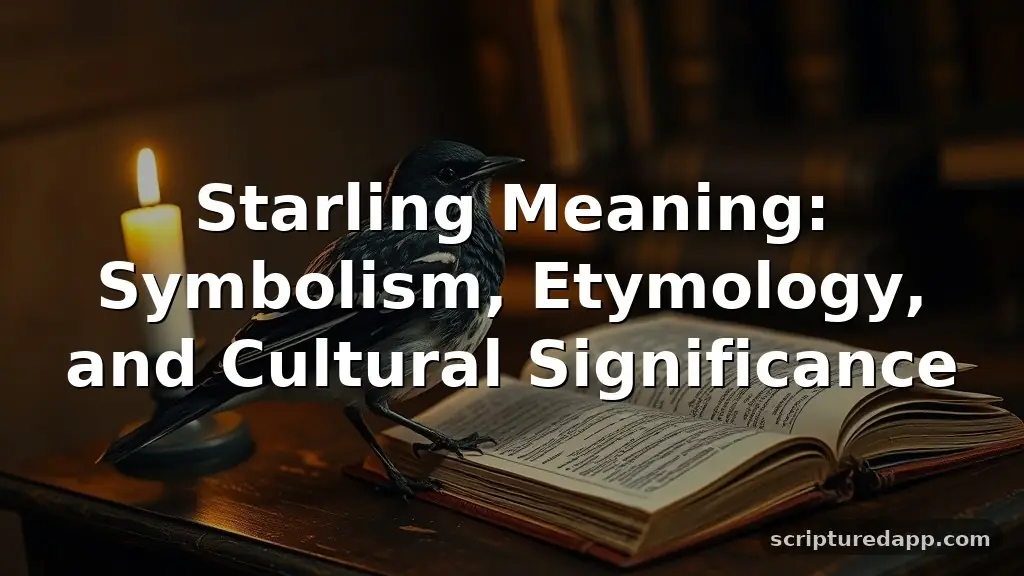

The starling meaning transcends its biological classification as a common bird. While many people immediately visualize the iridescent plumage of the Sturnus vulgaris, the term carries weight across linguistic, literary, and symbolic domains.
To understand the depth of this word, one must look beyond the mere taxonomy of the species and examine how it has permeated human communication, folklore, and even modern slang. Whether you are encountering the term in an English dictionary or observing these creatures in their natural habitat, the significance is layered with centuries of linguistic evolution and cultural observation.
Etymological Roots and Old English Origins

The linguistic history of the word is rooted in the Germanic languages, providing a window into how early speakers observed the natural world. The starling meaning originates from the Old English word stær, which itself is derived from the Proto-Germanic starnaz.
This ancient connection highlights how the bird was named for its appearance and its distinct presence in the landscape. When looking at the vocabulary of bird names, many are descriptive, but the starling’s name specifically emphasizes its star-like appearance when its feathers catch the light.
In German, the word Star remains the direct descendant of this root, showcasing the stability of the term across Northern European languages. As the language evolved, the diminutive suffix “-ling” was added, effectively meaning “little star.”
This word serves as a perfect example of how descriptive imagery shapes our lexicon. The entry for this term in historical linguistic databases often points to its role as a common, ubiquitous creature that was so deeply embedded in the rural environment that it required a specific, recognizable name that persisted through centuries of phonetic change.
Biological Classification of Sturnus Vulgaris
At its core, the starling is defined by the scientific name Sturnus vulgaris. This species is perhaps one of the most successful avian colonizers in human history. Native to Europe, Asia, and North Africa, they have been introduced to nearly every corner of the globe.
Their biological success is tied to their adaptability—they are omnivorous, intelligent, and highly social. When we discuss the starling meaning in a biological context, we are discussing a creature that thrives in both urban and rural environments, often interacting with human infrastructure in ways that have made them both admired and maligned.
The physical characteristics of these birds are notable for their glossy, metallic feathers that appear black from a distance but shimmer with purple and green iridescence upon closer inspection. This visual change is a key identifier.
They are often confused with the myna bird, a cousin within the Sturnidae family, which shares similar vocalization abilities. While the myna is more common in tropical regions, the starling has mastered the temperate and cooler climates, moving in massive, synchronized flocks known as murmurations that remain one of the most spectacular displays in the natural world.
Cultural Symbolism and Literary Presence
Throughout history, the starling has appeared in literature as a symbol of intelligence, mimicry, and sometimes, the uncanny. Perhaps the most famous literary reference is found in Laurence Sterne’s A Sentimental Journey Through France and Italy, where a captive starling cries, “I can’t get out!”
This specific starling meaning—the bird as a metaphor for imprisonment and the yearning for liberty—solidified its place in the Western literary canon. It transformed the bird from a mere creature of the field into a poignant symbol of the human condition.
Beyond literature, these birds appear in various mythologies. In some Welsh traditions, they were associated with the souls of the departed, while in other folklore, their tendency to gather in massive numbers was viewed as an omen.
Because they are often seen near the window or nesting in human-made structures, they have a unique intimacy with human dwellings. This proximity has allowed them to act as a bridge between the wild and the domestic, influencing how we interpret their presence in poetry, art, and even in the translation of ancient texts where their behaviors were used as allegories for social order or chaotic movement.
Murmurations: The Science of Social Intelligence
One of the most profound aspects of the starling meaning is the phenomenon of the murmuration. These large, coordinated flight patterns are not guided by a single leader but by the collective intelligence of the flock. Each individual bird follows a set of simple rules, reacting to the movements of its nearest neighbors.
This creates a fluid, organic shape in the sky that seems to defy the laws of physics. Scientists have spent decades studying this to understand decentralized systems.
When we observe these murmurations, we gain insight into the biological necessity of cooperation. The need for group protection against predators drives this complex behavior. It serves as a reminder that individual actions, when synchronized, can lead to massive, powerful results.
This aspect of their nature has been used in management theory and social science to explain how groups can function efficiently without top-down hierarchy. The starling, in this sense, represents the power of the collective, a sharp contrast to its earlier literary portrayal as a lonely, trapped captive.
Linguistic Variations and Global Translation
The word has traveled across borders, resulting in fascinating linguistic shifts. In Spanish, the translation is estornino, which shares a similar root structure to the English term.
The way different languages categorize this creature reveals how much cultural weight we place on specific animal behaviors. If you look at an English dictionary or a multilingual vocabulary database, you will find that the word often carries connotations of nuisance due to their sheer numbers, but also admiration for their mimicry.
The ability of starlings to mimic sounds, including human speech and mechanical noises, has made them the subject of curiosity in linguistics. They are among the few avian species that can replicate complex sound patterns with high fidelity.
This has influenced the starling meaning in various cultures to include the concept of a “mimic” or “trickster.” When someone uses the word in a metaphorical sense, they may be referring to someone who repeats words without understanding their context, a direct nod to the bird’s natural mimicry.
| Language | Term | Common Connotation |
|---|---|---|
| English | Starling | Common, social, mimic |
| German | Star | Familiar, ubiquitous |
| Spanish | Estornino | Agricultural pest |
| French | Étourneau | Noisy, social |
Addressing Topical Gaps: Beyond the Bird

A common search query involves the starling meaning outside of ornithology. In the world of finance and technology, “Starling” has been adopted by various entities, most notably banking institutions.
For instance, Starling Bank is a prominent example of how a biological term is repurposed in the modern corporate landscape to signify agility, intelligence, and modern connectivity. When users search for the meaning of the term, they are frequently looking for this secondary, commercial definition.
Furthermore, there is a recurring confusion regarding the starling meaning as a verb. While not a standard dictionary verb, it is occasionally used in creative writing to describe the act of moving in a flock or mimicking sounds.
This is a classic example of “functional shift” in the English language, where a noun is adapted to describe an action. Understanding these nuances is essential for anyone interested in how language evolves to incorporate new technological or social realities.
The Role of Starlings in Pest Management
Because the starling is so widespread, it has become a significant factor in agriculture. Their diet consists largely of insects, which can be beneficial to farmers, yet their tendency to congregate in massive flocks means they can consume entire fruit harvests in a matter of hours.
The starling meaning in an agricultural context is therefore often synonymous with “crop damage.” This has led to the development of various non-lethal deterrents, such as sound recordings and visual scare tactics.
The struggle between the starling and human industry is a classic environmental tension. It forces us to balance the value of a species as part of an ecosystem against the economic reality of food production.
Many farmers now use specialized log tracking to monitor flock migration patterns, hoping to save their crops by predicting the arrival of these birds. This practical application of knowledge is a far cry from the poetic symbolism of the 18th century, yet it is equally important in defining how we interact with the natural world today.
Symbolism in Art and Design
The visual profile of the bird has influenced design aesthetics for centuries. From Victorian-era illustrations to modern minimalist logos, the starling’s silhouette is recognizable.
Its iridescent feathers have inspired color palettes in textiles and fashion, where designers use “starling blue” or “starling green” to describe the deep, shifting tones of the bird’s plumage. This application demonstrates the meaning of the bird as a source of aesthetic inspiration.
In jewelry design and sculpture, the starling is often depicted in mid-flight, capturing the dynamic energy of the murmuration. These artistic representations serve to immortalize the grace of the bird, contrasting with the common perception of them as noisy or intrusive. By focusing on the elegance of their movement, artists attempt to elevate the starling meaning from a mundane garden visitor to a symbol of natural beauty and fluid, kinetic energy.
Comparative Analysis: Starling vs. Myna
Distinguishing between a starling and a myna is a frequent point of confusion for amateur birdwatchers. While both belong to the family Sturnidae, their geographic ranges and specific behaviors differ.
The myna is often associated with tropical climates and has a more pronounced yellow facial patch, whereas the starling is characterized by its spotted winter plumage and shorter tail. Understanding these differences is crucial for accurate identification.
This comparison also highlights the global nature of the Sturnidae family. Both birds have shown an incredible ability to adapt to human environments, often thriving where other species fail.
Their shared vocabulary of calls—whistles, clicks, and mimicry—makes them some of the most vocal residents in any environment they inhabit. When we identify the meaning of these birds, we are really identifying a group of highly intelligent, opportunistic survivors that have successfully integrated themselves into the human-altered landscape.
The Future of the Species and Conservation
Conservationists are increasingly interested in the long-term impact of starlings on biodiversity. Because they are so aggressive in competing for nesting sites, they can sometimes displace native species.
This has sparked debates about the need for population management in certain regions. The starling meaning is thus evolving to include a discussion on invasive species management and ecological balance.
Research into their migration and population trends is ongoing. Using modern technology, scientists can track individual birds and entire flocks with unprecedented accuracy.
This data helps us understand how climate change is affecting their distribution and how they might adapt to future environmental pressures. As we look forward, the starling remains a subject of intense study, not just for its beauty or its mimicry, but as a sentinel species that reflects the health and state of our changing global environment.
FAQ
What is the symbolic meaning of a starling?
The starling often symbolizes social intelligence, cooperation, and the power of the collective. In literature, it has been used to represent the desire for freedom, while in various cultures, it is viewed as a messenger or a creature of transformation due to its iridescent, changing plumage.
Is there a difference between a starling and a blackbird?
Yes, while both appear black from a distance, they are different species. Starlings are generally smaller, have shorter tails, and possess speckled plumage that shimmers with purple and green. Blackbirds (specifically the Common Blackbird) are typically solid black with a distinct yellow beak and a more uniform, rounded appearance.
What does it mean if a starling appears at my window?
In folklore, birds appearing at windows are often seen as messengers or omens. Because starlings are highly social and intelligent, their presence is sometimes interpreted as a sign of impending change or a reminder to stay connected to your community, reflecting their own highly coordinated, social nature.
Why are starlings considered an invasive species in some areas?
Starlings are considered invasive in North America because they were introduced by humans and have proliferated rapidly. They are aggressive competitors for nesting holes, often displacing native cavity-nesting birds, and can cause significant damage to agricultural crops when they congregate in large, hungry flocks.
Meta Description: Discover the multifaceted starling meaning, from its etymological roots and literary symbolism to its role in ecology, mimicry, and global culture.