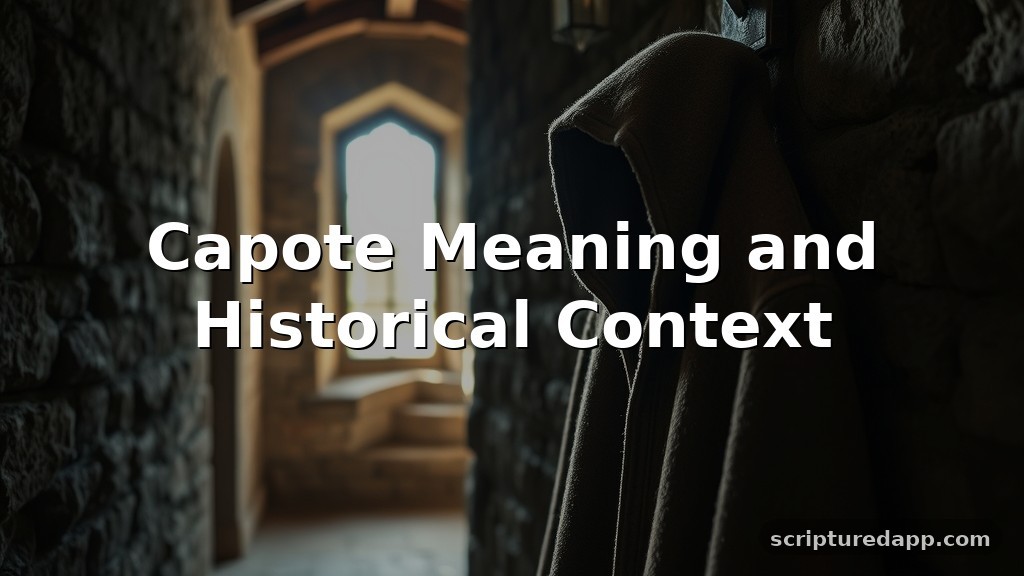

Understanding the true capote meaning requires looking beyond a single definition, as this term has evolved across languages, fashion history, and literature. At its core, the word often describes a specific style of garment, though its nuances change depending on whether you are examining historical attire or the surname of a famous American author.
Whether you are curious about the linguistic roots of this term or its practical application in vintage clothing, exploring how the word functions helps clarify its various uses. By breaking down the etymology and usage of this term, you will gain a clearer perspective on why it remains a relevant subject for historians and linguists alike.
The Etymological Roots of the Term
The term finds its primary origin in the French language, where it functions as a noun denoting a type of long cloak or head covering. Historically, the French word capote refers to a woman’s bonnet with a soft crown and a brim that frames the face, or a military overcoat.
When you look at the structure of the word, it relates to cape, sharing a linguistic lineage that emphasizes covering or protection. Understanding these roots is essential because it explains why the word appears in various European languages with slightly shifted connotations.
When you research the capote meaning in a standard dictionary entry at Merriam-Webster, you see that it essentially describes a long, hooded garment. This definition has remained fairly stable over the centuries, even as fashion trends have moved away from such heavy outerwear.
The connection to the head—or caput in Latin—is the key to unlocking why this word was used for both cloaks and bonnets. It is a protective layer, designed to shield the wearer from the elements, which provides a fascinating glimpse into the practical needs of past generations.
Capote in Historical Fashion
In the 18th and 19th centuries, the garment known as a capote was a staple of both civilian and military wardrobes. These were not merely fashion statements; they were functional pieces of equipment meant to handle harsh weather.
A soldier’s capote was often a heavy, wool-based coat that provided necessary insulation during long marches or cold nights in the field. For women, the capote bonnet became an iconic silhouette of the Regency and Victorian eras, often featuring intricate ribbons and soft, fabric construction that differed significantly from the rigid, straw-based hats of the time.
This distinction between the coat and the bonnet highlights how the capote meaning can drift based on context. If you are reading historical fiction or studying military history, you will likely encounter the term in its capacity as a protective overcoat.
Conversely, if your interest lies in the history of costume design, the word almost exclusively points toward the soft, hooded headgear. Recognizing these two distinct paths allows you to categorize the word correctly when you encounter it in period literature or museum archives.
The Author Truman Capote and His Legacy
Beyond its status as a piece of clothing, the name Capote carries significant cultural weight due to the American writer Truman Capote. In this instance, the word is not a common noun but a proper surname of French-Cuban origin.
His influence on 20th-century literature, particularly with works like “In Cold Blood” and “Breakfast at Tiffany’s,” has made the name globally recognizable. Because of his outsized personality and literary contributions, many people now associate the word with his specific persona rather than its original definitions related to cloaks or bonnets.
When discussing the author, the name functions as a brand of sorts, signaling a specific style of Southern Gothic writing and high-society commentary. It is a common point of confusion for those searching for the capote meaning online; they often land on pages dedicated to the author while searching for definitions of the garment. Understanding this dual identity—the historical clothing item versus the legendary writer—is crucial for anyone trying to master the nuances of the word in modern discourse.
Commonly Confused Words and Synonyms
The English language is full of commonly confused words, and because this term is relatively rare in daily conversation, it is often misidentified or grouped with similar-sounding items. You might find that people mistakenly use it interchangeably with words like “cape,” “mantle,” or “hoodie.” While these synonyms share the function of covering, they lack the specific historical weight and structural design that define a true capote.
Distinguishing Between Similar Terms
* Cape: A sleeveless outer garment that hangs from the shoulders.
* Mantle: A loose, sleeveless cloak or shawl worn over other clothes.
* Capote: A specific type of long, often hooded, coat or a soft-crowned bonnet.
When you look at this words list, you’ll see that while they share semantic space, they are not strictly identical. A capote specifically implies a hood or a covering for the head, which is a detail that separates it from a standard cape. If you are writing or speaking about historical costume, being precise with these definitions ensures that you are providing accurate information to your audience.
Regional Variations in Usage
The way we define a word often shifts depending on where we are. In some Spanish-speaking regions, for instance, the word capote takes on a very specific meaning related to bullfighting.
It refers to the large, magenta-and-yellow cape used by the matador during the initial stages of a bullfight. This usage is completely removed from the French definition of a hooded cloak or bonnet, illustrating how language evolves to suit local traditions and cultural practices.
If you are navigating literature from Spain or Latin America, you must adjust your understanding of the capote meaning accordingly. In a bullfighting context, the word is an essential tool of the trade, representing a specific interaction between the human and the animal. This regional variance serves as a great reminder that words are not static entities; they are living components of culture that change shape when they cross borders.
The Role of the Capote in Military History
The military utility of the capote cannot be overstated. During the Napoleonic Wars and the American Civil War, the term was frequently used in logistics and supply records. It referred to a standardized, heavy-duty coat that was issued to infantrymen.
Because these coats were designed for durability and warmth, they were often made from thick, coarse wool. This transformed the word from a mere fashion descriptor into a term of survival, as the garment was essential for keeping soldiers alive during winter campaigns.
When you examine primary source documents from these eras, you will see the word used in inventory lists alongside boots, muskets, and haversacks. This is where the term becomes a noun of utility.
It wasn’t about style; it was about the long cloak being an indispensable piece of kit. By viewing the garment through this lens, we can appreciate the historical necessity of the design, which prioritized function over the aesthetic trends of the day.
Linguistic Nuances and Dictionary Definitions
When you look for the capote meaning in a comprehensive dictionary, you are often presented with a variety of definitions that span centuries. Lexicographers have the difficult task of capturing the evolution of the word from its early origins to its modern, specialized uses.
A good entry will typically include the etymology, the primary definition, and the secondary, more obscure meanings. This is helpful for those who want to understand how a word that once meant “hood” in Old French became a literary surname and a bullfighter’s tool.
One of the most interesting aspects of these definitions is how they capture the decline of the garment in everyday life. As modern synthetic materials and different styles of outerwear became available, the capote faded from general use.
Today, you are more likely to find it in a historical dictionary than in a fashion catalog. This transition from a common item to a historical term is a standard trajectory for many pieces of language, and it is a fascinating process to observe.
Table: Comparing Terminology Across Contexts
To better visualize how the term functions across different fields, the following table provides a quick reference for the various ways the word is utilized.
| Context | Primary Meaning | Key Association |
|---|---|---|
| Historical Fashion | A soft, hooded bonnet or long coat | 19th-century attire |
| Bullfighting | A large, colored cape used in the ring | Matador equipment |
| Literary/Proper Noun | The surname of Truman Capote | 20th-century American literature |
| Military History | A heavy-duty wool overcoat | Soldier’s winter gear |
Addressing Common Misconceptions
A frequent point of confusion is the assumption that the word is an English invention. Because it appears in English literature, readers often treat it as an native term, ignoring the French origins that define its structure. Another common misconception is that any hood-based garment can be called a capote.
In reality, the term is quite specific. Using it to describe a modern raincoat or a generic hoodie is technically incorrect, even if the user is trying to be descriptive.
When you encounter the word, it is best to check the surrounding context. If the text is talking about 18th-century France, it is likely the bonnet. If it is about the mid-20th century, it is likely the author.
By taking a moment to look at the surrounding words, you can avoid the common traps that lead to misinterpretation. This is a skill that serves you well when dealing with any archaic or specialized vocabulary.
Answering Topical Gaps
Many readers wonder if there is an urban slang definition that has emerged in recent years. While some slang terms do evolve rapidly, there is no widely accepted, mainstream “slang” definition for this word in the way there might be for other, more fluid terms. Some people may attempt to use it in niche, localized groups, but it has not reached the level of widespread usage that warrants a place in a standard dictionary of slang.
Another gap involves the pronunciation, which can be tricky for native English speakers. Because the word is of French origin, the “e” at the end is often silent or softened, leading to a “ka-poat” sound rather than a “ka-po-tee” sound.
Getting the pronunciation right is part of the capote meaning experience, as it respects the word’s roots. When you use it correctly in conversation, you demonstrate a clear understanding of its heritage and its proper linguistic place.
FAQ Section
What is the most common synonym for capote?
The most common synonyms depend on the context. For the garment, words like “cloak,” “hooded mantle,” or “bonnet” are frequently used. If you are referring to the bullfighting tool, “cape” is the standard synonym. Always choose the synonym that best fits the specific historical or regional application.
Is the name Capote related to the garment?
The surname Capote is of French-Cuban origin and is not directly derived from the garment, though they share the same linguistic roots. The name is a patronymic or descriptive surname that has evolved over centuries, whereas the garment name is a direct descriptor of its function as a head-covering piece.
How do you pronounce the word capote?
In English, it is generally pronounced “ka-POHT,” with the final “e” being silent. This pronunciation reflects the word’s French origins. While some regional variations exist, this is the standard way to say it when discussing either the historical garment or the famous American author.
Why is the term often confused with other words?
The term is often confused because it is an archaic word that describes items—like bonnets and heavy cloaks—that are no longer in common use. Because people do not encounter these garments daily, they often default to more common words like “cape” or “hat,” leading to the confusion.
Final Thoughts
Mastering the capote meaning is an exercise in appreciating the layers of language and history. Whether you are delving into the military records of the 19th century, admiring the intricate headwear of the Regency period, or exploring the literary genius of Truman Capote, the term serves as a bridge to the past. It reminds us that words are not just labels; they are artifacts that carry the weight of the cultures and eras that created them.
As you continue your research, keep in mind how context shapes definition. By paying attention to the details—the era, the geography, and the intent behind the text—you can navigate these linguistic nuances with confidence.
We hope this exploration has provided the clarity you needed, and we encourage you to keep observing how language changes and adapts in your own reading and writing. Feel free to share your thoughts or ask further questions about this fascinating term.