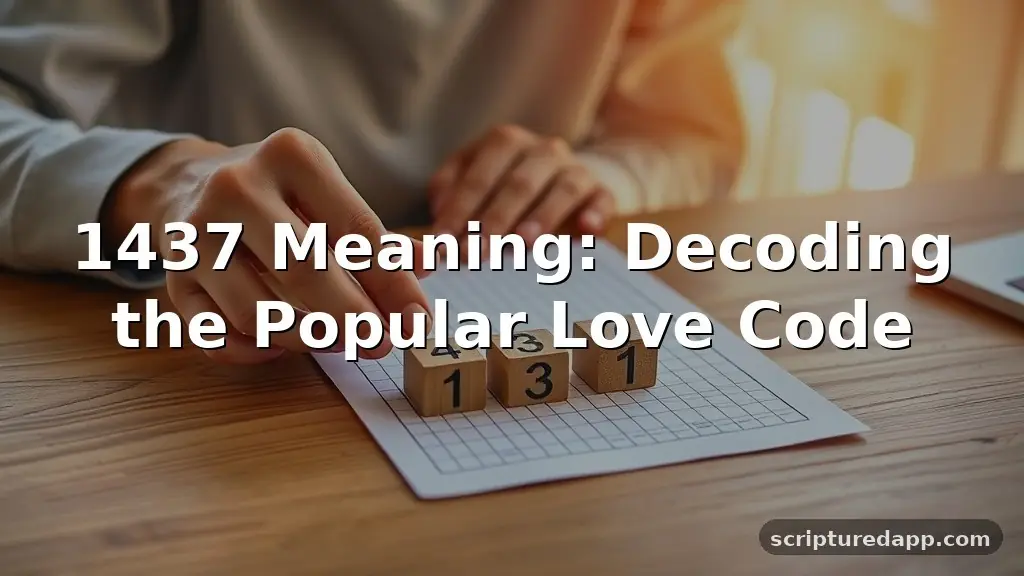

When you see the string of digits 1437 pop up in your notifications or on a friend’s social media page, you might be confused. It looks like a random sequence, but it is actually a shorthand for a very specific sentiment. The 1437 meaning is rooted in the number of letters in each word of a classic phrase: “I love you forever.”
It’s one of those digital-age shorthand codes that rely on character counts to convey deep emotion without typing out the full sentence. While it might seem obscure to some, this numeric sequence has become a staple in modern messaging and online interaction.
The Linguistic Logic Behind 1437
To understand why this specific number was chosen, you have to break it down by its component parts. Each digit represents the number of letters in a corresponding word. The number 1 represents the word “I.”
The number 4 stands for “love,” which has four letters. The number 3 represents “you,” which also has three letters.
Finally, the number 7 signifies “forever,” a seven-letter word. When you put them together, you get 1-4-3-7.
This method of using number letters is not entirely new, but it gained significant traction with the rise of SMS and early instant messaging platforms. Back then, character limits were a real concern. People needed a way to express strong feelings quickly.
By using this code, a person could send a heavy emotional message while keeping their character count extremely low. It’s an efficient, if slightly cryptic, way to say love you forever.
The logic is consistent across the board. It relies on the letters corresponding to their position in the phrase. Because the English language allows for these types of character-count puzzles, it has stuck around long after the era of flip phones and expensive text messaging plans.
Even today, where character limits are rarely an issue, the slang remains popular because it carries a sense of nostalgia and insider knowledge. It’s a shorthand that feels personal, almost like a secret language shared between two people who understand the code.
Origins in Digital Communication
Long before social media dominated our lives, people were finding ways to abbreviate common phrases. The 1437 meaning really took off in the early 2000s. Teens and young adults were the primary drivers of this trend.
At the time, sending a text message often cost money per character or per message. Being concise wasn’t just a stylistic choice; it was a financial necessity for many.
The way people communicated began to shift during this period. We moved from long-form emails to short, punchy bursts of text. In that environment, the word l-o-v-e being represented by the number 4 became common practice.
Eventually, people started stacking these numbers to form longer phrases. It’s a fascinating example of how language evolves when it’s forced into a constrained medium. The meaning didn’t change, but the delivery system did.
Over the years, this has transitioned from a necessity into a cultural artifact. Even though we now have unlimited texting and social media platforms that allow for thousands of characters, the code persists. It’s used now more as a stylistic choice or a “cool” way to sign off on a post.
You’ll see it in comment sections or as a caption on a photo, serving as a subtle nod to the recipient. It shows that the sender is aware of the history behind the number.
1437 Meaning in Social Media Trends
If you spend any time on TikTok or Instagram, you have likely seen this numeric sequence in the comments. It often appears on videos where someone is expressing affection or showing off a significant other.
The content creators use it to keep their captions clean and minimal. It’s a way to signal that the post is about a relationship without being overly verbose.
On platforms like TikTok, trends move incredibly fast. A specific slang term can go from obscurity to widespread use in a matter of days. 1437 has enjoyed a resurgence because it fits the aesthetic of “minimalist” posting.
People don’t always want to write long paragraphs about how much they care for someone. A simple 1437 conveys the meaning perfectly. It allows the visual content to speak for itself while the caption provides a hint of sentiment.
It’s also common to see it used in posts where people are celebrating anniversaries or milestones. Because the meaning is so specific—love you forever—it carries a bit more weight than just a heart emoji.
It feels like a deliberate choice. When you see it, you recognize that the person behind the screen is making a conscious effort to use a specific piece of internet history to express their feelings.
Topical Gaps: Misinterpretations and Variants
There is often confusion surrounding numbers that look similar to 1437. For instance, people sometimes confuse it with 143, which simply means “I love you.” The addition of the “7” is the crucial differentiator.
Without the 7, the forever aspect is lost. It is important to distinguish between these codes because they carry slightly different levels of commitment. 143 is a general expression of love, while 1437 is a deeper, more permanent-sounding declaration.
Another gap in common knowledge is the regional variation of these codes. While 1437 is widely understood in English-speaking corners of the internet, it isn’t universal. In some countries, different numeric codes have developed based on the phonetics of their own languages.
It’s a mistake to assume that every country uses the same number letters to convey these specific meanings. When people travel or interact globally, these linguistic barriers can lead to genuine confusion.
Finally, there is the issue of “Angel Numbers.” Some people interpret 1437 as a spiritual sign rather than a romantic code. In numerology, these sequences are often viewed as messages from the universe.
This can cause friction when someone uses 1437 in a romantic context and someone else interprets it through a spiritual lens. Being aware of these dual meanings helps in navigating online interactions without making awkward assumptions about what someone is actually trying to say.
Comparing Common Numeric Love Codes
The following table breaks down the most popular numeric codes used for expressing affection, allowing you to see exactly how they differ in scope and structure.
| Code | Full Meaning | Character Count Logic |
|---|---|---|
| 143 | I love you | 1 letter, 4 letters, 3 letters |
| 1437 | I love you forever | 1, 4, 3, 7 letters |
| 831 | I love you | 8 letters total, 3 words, 1 meaning |
| 1432 | I love you too | 1, 4, 3, 2 letters |
How It Is Used in Daily Life
You might wonder if people actually use this in real-life, non-digital conversations. Mostly, the answer is no. It is almost exclusively a text-based phenomenon.
You wouldn’t walk up to someone and say “fourteen thirty-seven” to express your undying affection. That would sound bizarre and likely confuse the person you are talking to. The meaning is strictly tied to the visual representation of the numbers.
However, it does show up in creative ways. Some people use it in usernames, passwords, or even as a personalized license plate. When it appears in these contexts, it serves as a private identifier.
It’s a way for people to keep their feelings visible to themselves or their partner without broadcasting the exact words to the entire world. It’s a subtle form of digital intimacy.
When used in messaging, it often signals a level of comfort between the two parties. You don’t send this to a new acquaintance or a casual friend. It’s reserved for people who share that specific cultural context.
If you receive a 1437, you know the person is trying to be sweet while adhering to a specific stylistic trend. It shows they are plugged into the same digital sphere as you, which can create an immediate sense of connection.
The Role of Context in Interpretation
Context is everything when it comes to internet slang. If a friend sends you a 1437 after you help them with a favor, it’s clearly being used in a platonic, appreciative way.
They are saying, “I love you forever” as a way of expressing deep gratitude. In this scenario, the meaning is warm and friendly, not necessarily romantic.
Conversely, if someone you are dating sends it, the meaning takes on a more serious, romantic tone. It acts as a digital promise of commitment. Because the code itself is so simple, it is highly adaptable.
It doesn’t carry the weight of a formal declaration, yet it is more than a simple “thanks.” This flexibility is exactly why it has stayed in use for so many years.
You should also consider the platform. A 1437 in a Snapchat story might just be a stylistic choice for a photo caption. A 1437 in a private DM is much more likely to be a sincere expression of emotion.
Always look at the environment where the code is being used before jumping to conclusions about the sender’s intentions. The medium often dictates the intent as much as the numbers themselves.
Why People Prefer Codes Over Words
Why not just say “I love you forever”? It seems like it would be easier. The reality is that people often feel vulnerable expressing deep emotions.
Using a code like 1437 acts as a buffer. It’s a way to state your feelings while keeping a slight layer of irony or distance. It makes the expression of love feel less like a heavy performance and more like a casual, shared secret.
There is also the element of playfulness. Decoding a message can be fun. When someone sends a code, they are inviting the recipient to participate in the interaction.
It’s a small puzzle that reinforces the bond between two people. You have to “get it” to appreciate the sentiment, which creates a feeling of exclusivity. That meaning is reinforced every time you successfully decode a string of numbers.
Furthermore, it’s a way to bypass filters or avoid unwanted attention. In some online spaces, people might be hesitant to type out full romantic phrases for fear of being teased or having their posts flagged by algorithms.
Numeric codes are less likely to trigger these reactions. It’s a subtle way of communicating that flies under the radar of those who don’t know the slang, keeping the message private even in a public forum.
Evolution of Internet Slang
The history of 1437 is a window into the evolution of our digital language. We have moved from character-limited SMS to the current era of emojis and memes. Throughout all these changes, numeric codes have remained a constant.
They represent a bridge between the old way of typing and the new way of communicating. They are essentially digital hieroglyphics.
As we look toward the future, these codes will likely continue to shift. New ones will emerge, and old ones will fade away. But the core human desire to connect and express deep emotion will remain the same.
Whether we use 1437 or some new, future-proof code, the sentiment remains the same. People will always look for ways to say “I love you” in a manner that feels unique to them and their social circle.
This is why understanding these terms is so helpful. It’s not just about knowing what the numbers mean; it’s about understanding the culture of communication.
When you understand the 1437 meaning, you are gaining insight into how people have been connecting for decades. It’s a small but significant piece of the digital landscape that helps us navigate our relationships in a world that is increasingly mediated by screens and keyboards.
Common Misconceptions About 1437
A frequent mistake people make is assuming that 1437 is a specific code for a certain group or organization. It isn’t. It’s a grassroots, organic development of internet culture.
There is no official body that regulates these codes, and there is no “correct” way to use them. It’s entirely dependent on usage. If people start using it in a different way tomorrow, that will become the new meaning.
Another misconception is that it is strictly for teenagers. While it might have started that way, it has permeated all age groups. You will find adults, parents, and even grandparents using these codes if they are active on social media.
The meaning is accessible to anyone who spends enough time online to encounter it. It’s not an exclusive club; it’s just a piece of common digital literacy.
Finally, don’t assume that a 1437 is always a good thing. Like any form of communication, it can be used sarcastically or even dismissively. If someone is being rude and throws a 1437 at the end of a message, it’s likely meant to be ironic.
Tone is hard to read in text, and numeric codes don’t help with that. Rely on your knowledge of the person and the situation to determine if the meaning is sincere or meant in jest.
Frequently Asked Questions
Is 1437 considered a romantic message?
Yes, 1437 is primarily a romantic code. It stands for “I love you forever.” However, it can also be used between close friends or family members to express deep, platonic appreciation, depending on the context of the conversation and the relationship between the two people.
Why do people use numbers instead of words?
People use numbers as a form of shorthand that originated from early character-limited text messaging. It has since evolved into a stylistic choice that feels more casual, playful, or exclusive, allowing users to express feelings while keeping their messages concise and aesthetically clean on social media.
Does 1437 have different meanings in other countries?
While the numeric code is widely recognized in English-speaking digital spaces, it isn’t universal. In some countries, different numeric sequences are used based on local language phonetics. It is always best to verify the cultural context if you are communicating with someone from a different region.
Is 1437 the same as Angel numbers?
Sometimes they overlap. While 1437 is a common romantic shorthand, some people view it through the lens of numerology as an “Angel number,” which is believed to be a spiritual message. The context of your interaction is key to knowing whether it is a romantic gesture or a spiritual one.
Meta Description: Discover the 1437 meaning. Learn how this popular numeric code for “I love you forever” is used in modern messaging and social media trends today.